


Most camps treat parent engagement like a checklist: send welcome packet, collect forms, maybe a newsletter. Then wonder why families don't come back next summer. After building operational platforms for camps ranging from 50 to 800 campers, one pattern keeps showing up—camps with structured parent engagement lifecycles see significantly better retention than those running ad-hoc communications. The difference isn't dramatic on paper, but it compounds fast.
It's not about more touchpoints. It's about mapping each interaction to specific enrollment metrics, then running the same proven cadence year after year. Not randomly emailing when someone remembers to, but following a documented system that ties parent satisfaction directly to rebooking rates.
Why camps lose families between seasons
Parent attrition follows predictable patterns. A family registers in January, excited about summer. Then radio silence until May's paperwork flood. Camp happens. Generic thank-you email. Nothing until next year's registration opens—if they even remember your camp exists.
Meanwhile, competing camps, sports leagues, and summer programs are actively courting the same families. Your camp becomes a distant memory while other activities stay visible. The family that had a great experience just forgets to re-register because someone else stayed in touch.
This disconnect compounds operationally. Without consistent parent data, you can't predict enrollment. Without enrollment predictions, staffing gets messy. When staffing is off, service quality drops. And when quality drops, fewer families come back. The cycle accelerates quietly.
The real damage happens silently. Parents don't complain—they just don't return. No angry emails, no obvious red flags. Just gradually declining numbers that feel mysterious until you actually map where the touchpoint gaps are.
Building your parent engagement lifecycle map
A functional parent engagement strategy breaks into five distinct phases, each with measurable outcomes tied directly to enrollment KPIs. Not vague "engagement" metrics—actual numbers that predict next season's registration counts.
Simplify camp operations with centralized control.
Campyly empowers you to manage registrations, staff, and activities seamlessly—all from one platform.
- Integrated camper and staff management
- Automated notifications and alerts
- Dynamic scheduling and resource allocation
No credit card required
Phase 1: Inquiry to enrollment (October–January)
This phase determines initial conversion rates—how many inquiries become actual registrations. Most camps track basic conversion percentages but miss the behavioral signals that predict long-term loyalty.
-
Initial inquiry response (within 4 hours)
-
Virtual tour scheduling
-
Sibling discount explanation
-
Payment plan options
-
Early-bird deadline reminders
-
65% inquiry-to-tour conversion
-
40% tour-to-deposit conversion
-
Average 2.3 touchpoints before registration
-
72-hour decision window after tour
Pay attention not just to whether families register, but how quickly they decide. Families who commit within 72 hours of touring tend to show meaningfully higher retention—they're emotionally invested, not just filling a childcare gap.
Phase 2: Pre-arrival preparation (February–May)
The forgotten phase that determines day-one satisfaction. Camps dump paperwork on parents, then act surprised when arrival day feels chaotic. This window is actually an opportunity to build anticipation while reducing parent anxiety before it starts.
-
February
Camp culture video from counselors
-
March
Packing list with specific brand recommendations
-
April
Cabin assignment announcements
-
May
Transportation logistics confirmation
-
Two weeks before
Daily schedule walkthrough
-
85% form completion rate 30 days before camp
-
Less than 3 parent questions per family pre-arrival
-
90% positive sentiment in pre-camp survey
-
Zero day-one confusion about dropoff logistics
Phase 3: Active session management (June–August)
Where most camps think parent engagement peaks—but actually where trust either solidifies or starts to crack. Parents hand over their kids, which is the ultimate trust exercise. How you reinforce that trust during separation shapes everything that follows.
-
Day 1
Arrival confirmation with photo
-
Day 3
Activity highlight reel
-
Weekly
Individual camper update (not generic)
-
Mid-session
Optional video call scheduling
-
Final 48 hours
Pickup logistics reminder
-
One meaningful update per camper per week
-
Under 5% parent-initiated worried contacts
-
95% on-time pickup compliance
The balance matters—enough communication to reassure without overwhelming busy parents or creating unnecessary dependency. Informed, not bombarded.
Phase 4: Post-camp momentum (August–September)
The highest-leverage phase that most camps completely ignore. Families just had a peak emotional connection with your program. Their kids are still talking about counselors and friendships. This 6-week window determines whether that enthusiasm actually converts to a rebooking.
-
24 hours post-pickup
Thank you with specific highlights
-
Day 3
Photo gallery release
-
Week 1
Camper achievement certificates
-
Week 2
Session recap video
-
Week 3
Early registration opens (previous families only)
-
Week 6
Deadline for early-bird pricing
-
70% photo gallery engagement rate
-
45% early registration capture (previous families)
-
4.5+ average satisfaction score
-
30% social media sharing of camp content
Phase 5: Off-season relationship maintenance (October–December)
Where average camps go dark and better camps stay connected. Not selling—just maintaining presence so when January planning starts, you're already top of mind.
-
October
Alumni virtual campfire
-
November
Counselor spotlight series
-
December
Holiday card with summer memories
-
January
"Space is filling" authentic update
-
25% engagement rate on off-season content
-
60% email open rates maintained
-
15% referral generation from existing families
-
80% previous family re-registration by February
A visual workflow helps you see when each phase triggers specific touchpoints.
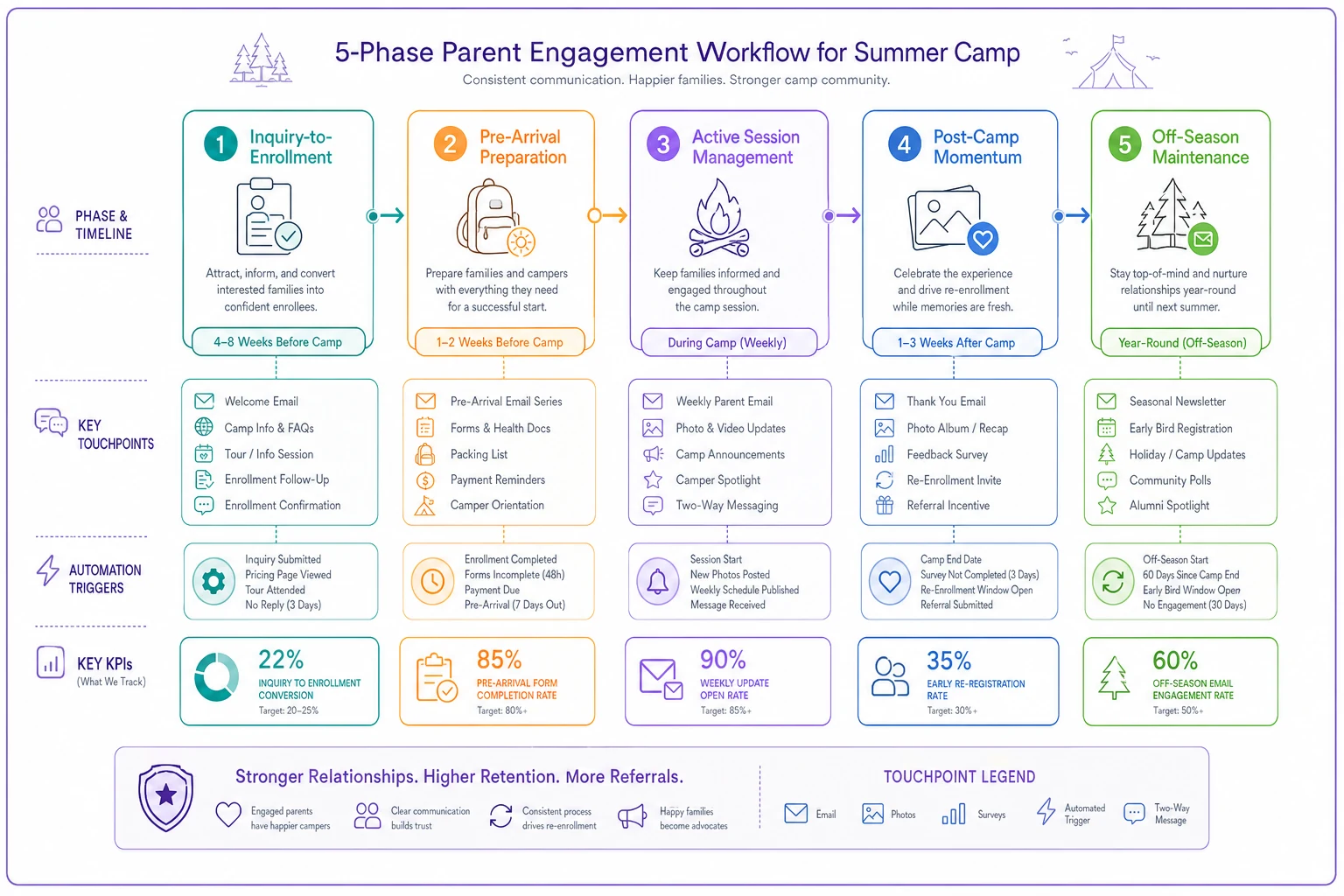
Prioritize post-camp momentum and off-season maintenance for the biggest retention lift.
When implemented consistently, these phases create a predictable pipeline of families who remember and re-register.
Tying touchpoints to retention KPIs
The lifecycle map only works when each touchpoint connects to measurable retention indicators. Here's the KPI framework that actually predicts next year's enrollment:
| Lifecycle Phase | Primary KPI | Warning Threshold | Target Performance |
|---|---|---|---|
| Inquiry to enrollment | Deposit conversion rate | <35% | 45-50% |
| Pre-arrival | Form completion timeline | >14 days before camp | 30+ days before |
| Active session | Parent-initiated concerns | >8% of families | <5% of families |
| Post-camp | Week 3 registration rate | <40% previous families | 50%+ capture |
| Off-season | Email engagement rate | <20% opens | 30%+ consistent |
These aren't arbitrary benchmarks. Camps hitting these targets consistently tend to see 65-75% family retention year-over-year. Miss more than two warning thresholds, and retention often drops below 50%.
The post-camp registration rate correlation is particularly strong. Families who re-register within three weeks of camp ending have roughly an 85% likelihood of actually attending next year. Wait until general registration opens, and that drops to somewhere around 60%.
Templates that actually drive enrollment
Generic templates produce generic results. These frameworks, refined across dozens of camp operations, consistently outperform standard communications:
Early-bird registration sequence (3-email series)
Email 1: The "counselor excitement" message Subject: "Mac and Sarah can't wait to see [CAMPER NAME] again" Body focuses on specific counselors mentioning specific campers, program improvements based on last year's feedback, and genuine urgency about filling sessions.
Email 2: The "sibling logistics" message Subject: "Coordinating [FAMILY NAME] camp schedules" Addresses multi-child scheduling, transportation coordination, and payment plan options. Includes a visual calendar showing session options.
Email 3: The "deadline reality" message Subject: "Thursday midnight: early bird pricing ends" Not fake scarcity—an actual deadline with specific dollar amounts saved, comparison to general registration pricing, and a one-click registration link.
This sequence tends to generate roughly 3x the registration rate of a single deadline reminder.
Mid-session parent update framework
Stop sending "Your camper is doing great!" messages. Parents assume you're hiding something. Instead:
Opening: Specific activity from today "This morning during archery, [CAMPER] helped younger campers with proper form"
Middle: Social observation "Noticed a strong friendship developing with [BUNKMATE NAMES]"
Closing: Upcoming highlight "Tomorrow's overnight camping trip has everyone excited—[CAMPER] volunteered for fire-starting duty"
Photo: Action shot, not a posed group photo
Parents forward these specific updates to grandparents, share them on social, and—most importantly—remember them when registration opens.
Post-camp feedback capture
Instead of a 20-question survey nobody finishes, try this 3-question framework with around 73% completion rates:
-
"What one thing should we never change?"
-
"What would make you hesitate to return?"
-
"Which family should we reach out to about joining?"
Responses surface actionable retention data plus warm referral leads. That second question in particular tends to reveal friction points before families quietly disappear.
Where engagement systems break at scale
Small camps under 100 campers can manage parent relationships personally. The director knows every family, remembers siblings' names, sends direct texts. This starts breaking around 150 campers—too many relationships to track manually, but not enough volume to justify dedicated communication staff.
The danger zone sits between 150 and 300 campers. Parent communication becomes inconsistent. Some families get multiple touchpoints; others get forgotten. Staff make promises about updates they can't actually deliver. Parents compare notes with friends and notice the gaps.
This is where systematic KPI tracking becomes critical. You can't personally manage 200 family relationships, but you can track whether each family received their scheduled touchpoints. When touchpoint completion drops below 80%, retention predictably follows.
Camps above 300 typically dedicate staff to parent engagement or implement automated communication platforms. The challenge shifts from capacity to consistency—making sure the 500th family gets the same quality experience as the 50th.
Technology that supports lifecycle management
Manual tracking stops scaling around 100 families. Spreadsheets can't handle the complexity of multiple children, different session dates, and varying communication preferences. You need systems that automatically trigger touchpoints based on enrollment status and camp timeline.
Modern camp management platforms with AI automation handle this orchestration. They track which families received which communications, flag anything that fell through, and can generate personalized updates based on activity data. The goal isn't to replace human connection—it's to make sure no family gets forgotten when things get busy.
The critical feature is connecting registration data to communication workflows. When a family registers for Session 2, they automatically enter the Session 2 preparation sequence. When a camper completes swimming levels, parents get achievement notifications without anyone having to remember. When early-bird deadlines approach, only eligible families see the reminders.
This matters most for off-season maintenance. No staff member is going to reliably remember to send October alumni invitations while they're deep into planning next summer. Automated systems make those touchpoints happen regardless of bandwidth, and that consistency is what keeps your camp visible when families start making plans.
Also worth noting—coordinating gear, consumables, and logistics across sessions is its own operational lift. A simple inventory system for camp gear and consumables can reduce the friction that often bleeds into parent-facing operations when things go missing or run short.
Measuring what matters: enrollment impact
Parent engagement without enrollment impact is just expensive relationship management. Every touchpoint should ultimately point toward two metrics: retention rate and referral generation.
Track cohort retention consistently. Of families who attended Summer 2024 Session 1, what percentage registered for Summer 2025 Session 1 by February 1st? This number, more than any satisfaction survey, tells you whether the engagement lifecycle is actually working.
Similarly, track referral source for every new registration. When 30% or more of new families come from existing referrals, your system is doing its job. Below 20% suggests parents like your camp but don't advocate for it—which is an engagement gap worth taking seriously.
The compounding effect is real. A camp with 65% retention and strong referral-driven growth needs minimal marketing spend. A camp with 45% retention and weak referrals bleeds money on acquisition just to maintain current enrollment.
Implementation roadmap for next season
Start with the highest-impact phases. Most camps should prioritize post-camp momentum and off-season maintenance first—these drive immediate retention improvements for the coming season.
Month 1: Document current touchpoints Map what you actually do, not what you think you do. Survey parents about which communications they remember receiving. The gaps are usually surprising.
Month 2: Build post-camp sequence Create templates, assign ownership, and test the technical workflow. Better to discover email automation issues in October than August.
Month 3: Design measurement dashboard A simple spreadsheet tracking key metrics—registration timing, touchpoint completion rates, parent response rates—is enough to start. You don't need fancy software initially, just consistent tracking.
Month 4: Launch with a single cohort Pick one session or program for full lifecycle implementation. Better to nail the experience for 50 families than dilute it across 500.
Month 5: Iterate based on data Adjust touchpoint timing, message content, and channel mix based on actual engagement rates. What works in these templates might need tweaking for your specific families.
Month 6: Scale to full operation Roll successful elements across all programs while maintaining quality. This is where automation platforms earn their keep for consistency.
The compound effect on camp operations
Systematic parent engagement doesn't just improve retention—it changes how camp operations run overall. Predictable enrollment enables better staffing models. Consistent communication reduces complaint volumes. Strong referral rates lower acquisition costs.
The financial reality is straightforward. Acquiring a new camp family costs roughly $150–300 in marketing. Retaining an existing family costs under $30 in engagement effort. A 200-camper camp that improves retention from 45% to 65% can add meaningful revenue annually without raising prices or adding capacity.
Engaged parents also become operational assets. They volunteer, give useful feedback, and defend your camp when problems come up. Instead of managing damage, you're building on momentum.
That shift from reactive to proactive parent management changes the director role in a real way. Less time on damage control, more time on program quality. Less anxiety about next year's numbers, more focus on this year's experience.
Parent engagement isn't about sending more emails or building prettier newsletters. It's about building a systematic lifecycle that connects every touchpoint to measurable enrollment outcomes. The camps that hold their ground over the next decade won't necessarily have the best facilities—they'll be the ones that treat parent engagement as a core operational discipline, not an afterthought.
The frameworks here aren't theoretical. They come from actual camp operations that changed their enrollment patterns by running consistent, meaningful parent engagement tied to real retention KPIs. Start with one phase, measure the impact, and build from there. Your future enrollment depends less on hope or tradition and more on the disciplined execution of systems that turn first-time families into multi-year advocates.
Ready to elevate your camp management?
Join 500+ camps using Campyly to save administrative time, enhance camper experiences, and streamline daily operations.