


Running camp inventory is like predicting the weather three months out. You order 400 pounds of marshmallows thinking July will be your peak month, then a heat wave hits and suddenly nobody wants s'mores. Meanwhile, your waterfront director scrambles because half the life jackets went missing after color war and you didn't factor in the replacement cycle.
Most camps operate with spreadsheets that haven't been updated since 2019, a storage room that looks like a tornado hit it, and a purchasing strategy that basically amounts to "order what we ordered last year, plus 10%." Then peak season arrives and you're either drowning in unopened boxes of craft supplies or sending counselors on emergency Walmart runs at 9 PM.
The real problem isn't tracking what you have—it's building a camp inventory system that actually predicts what you'll need, when you'll need it, and keeps everything organized enough that your 19-year-old CIT can find the spare volleyball nets without calling you during dinner.
Where camps actually lose money on inventory
Last summer, I walked through a camp storage facility in upstate New York that had $12,000 worth of expired sunscreen sitting in boxes. Not because they forgot about it, but because their inventory tracking consisted of a clipboard hanging on the door and nobody updated it after the June orientation rush.
The expensive mistakes happen in predictable patterns.
Peak week miscalculations cost the most. When you hit maximum enrollment in week 4, you need roughly 40% more consumables than your baseline week. Most camps order for their average week, then panic-buy at retail prices. A camp running 220 kids during peak versus their normal 160 ends up spending an extra $1,800 on last-minute supply runs just for that one week.
Seasonal items disappear into black holes. Those 30 sleeping bags you bought for overnight trips? By August, you'll find 18 of them, three will have mysterious stains, and nine vanished somewhere between the June camping trip and color war. Without a proper check-out system, gear worth thousands walks away or gets destroyed without anyone noticing until it's too late to file damage claims or order replacements.
Multi-location storage creates duplicate ordering. The arts and crafts shed has 200 bottles of glue. The main storage has another 150. The aftercare room has a secret stash of 75 more. Nobody knows about all three locations, so the program director orders another case "just to be safe." Now you've got $400 of glue expiring while next summer's budget takes the hit.
Building tags that actually match how camps operate
Forget complicated SKU numbers and barcode systems. Your counselors need to find things fast, often in the dark with a flashlight, while managing 12 sugar-hyped eight-year-olds.
Simplify camp operations with centralized control.
Campyly empowers you to manage registrations, staff, and activities seamlessly—all from one platform.
- Integrated camper and staff management
- Automated notifications and alerts
- Dynamic scheduling and resource allocation
No credit card required
A tagging structure that actually works in camp chaos:
-
MAIN-SPORTS-CONSUMABLE-SUMMER
-
WATERFRONT-SAFETY-EQUIPMENT-YEAR
-
ARTS-CRAFT-CONSUMABLE-WEEKLY
Every item gets a primary tag based on where it lives most of the time. Secondary tags track who uses it and when. This means your waterfront director can pull up everything tagged WATERFRONT in seconds, while your purchasing coordinator can filter by CONSUMABLE to build next week's order.
Physical tags matter as much as digital ones. Color-coded bins with laminated labels survive better than fancy electronic systems. Red bins for safety equipment, blue for sports, green for arts and crafts—simple enough that exhausted counselors can maintain it at 11 PM after campfire.
Color-coded bins with laminated labels survive better than fancy electronic systems.
The critical insight: camps don't need to track every individual item. Track containers and quantities. "Blue bin 3: 50 tennis balls" works better than trying to assign ID numbers to each ball. Your staff can do a 30-second visual check instead of a 20-minute detailed count.
Check-out routines that survive teenage counselors
Traditional sign-out sheets fail because they require multiple steps and assume people will remember to sign items back in. They won't. Especially not at 6 AM when they're grabbing equipment for morning soccer.
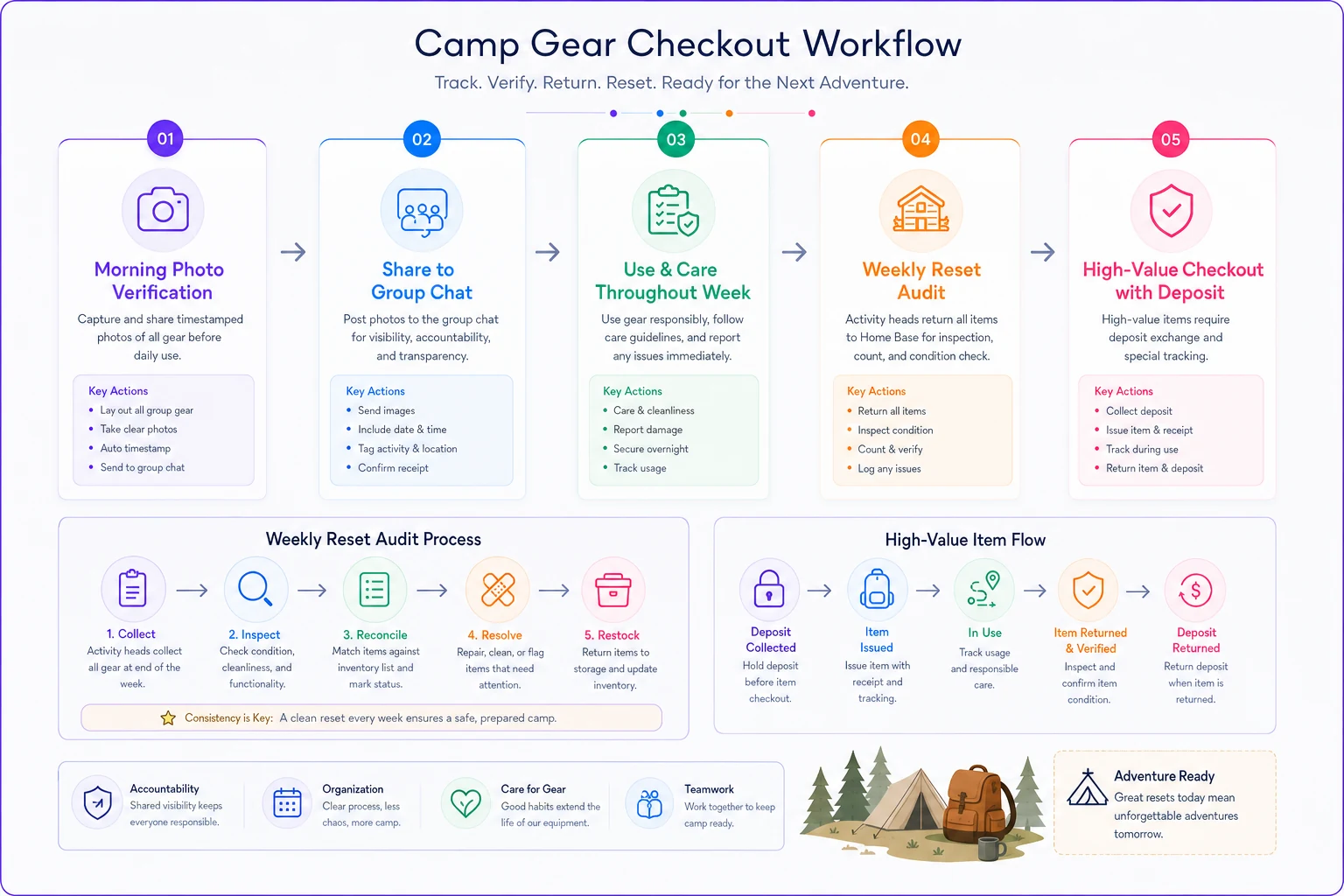
The pattern that reduces loss by about 60% uses a buddy system with photo verification:
Morning equipment pull: One counselor takes a quick phone photo of what they're removing from storage, texts it to the group chat with their activity location. Takes 5 seconds, creates a timestamp, and everyone can see who has what.
Weekly reset audit: Every Sunday during rest hour, activity heads do a 15-minute reset. Everything returns to home base, damaged items get flagged, missing items get noted. This catches problems while they're still small—a missing volleyball on Sunday is findable, a volleyball missing for three weeks is gone forever.
High-value item tracking: Walkie-talkies, specialty sports equipment, and medical supplies need stricter controls. These get individual checkout with a deposit system—counselors leave their phone or car keys when they take expensive gear. Primitive but effective. Nobody forgets to return the $300 archery set when their car keys are sitting in your office.
This diagram shows the checkout workflow in practice.
The checkout system also drives your replacement ordering. When the same items keep disappearing or breaking, you know to either buy cheaper versions, more quantities, or change how they're stored. One camp discovered they were losing $2,000 annually in soccer balls until they realized the storage shed's location meant counselors grabbed new balls rather than retrieving ones that rolled into the woods.
Seasonal replenishment schedules based on actual camp patterns
Most camps order supplies in three big waves: pre-season, mid-season panic, and "oh no we're almost out." This creates cash flow problems and usually means paying premium prices at least once per summer.
A working replenishment schedule maps to your actual camp rhythm:
Pre-season baseline (April/May): Order 40% of your summer needs. This covers weeks 1-3 when enrollment ramps up and you're still figuring out which activities are popular this year. Focus on non-perishables and equipment that needs time to arrive.
Week 2 adjustment order: After two weeks, you know which activities are hitting hard and which are flopping. Place your second order for 35% of seasonal needs, adjusted based on actual consumption. If friendship bracelet making exploded and nobody wants to do pottery, you pivot here.
Rolling weekly orders (Weeks 4-8): Switch to weekly ordering for consumables. Set automatic reorder points—when marshmallows drop below 20 pounds, order 40 more. When sunscreen drops below 30 bottles, order 60. This prevents both stockouts and overordering.
Peak week surge (usually weeks 4-6): Your busiest weeks need 40-60% more consumables. Schedule these orders two weeks in advance. A 200-kid camp hitting 280 kids during peak week needs roughly:
-
120 extra juice boxes per day
-
35 pounds more ice per day
-
50% more toilet paper and paper towels
-
200 additional craft project kits
End-season drawdown (final 2 weeks): Stop ordering consumables except emergency items. Use up inventory rather than storing it for nine months.
The money-saving trick: negotiate blanket orders with suppliers in March, then release inventory as needed. You lock in better pricing, guarantee availability, and avoid storage problems.
Peak week forecasting that prevents scrambles
Peak weeks break inventory systems because the increase isn't linear. When camp population jumps 40%, consumption of some items doubles while others barely change.
Items that spike disproportionately during peak weeks:
-
Ice
2.5x normal consumption
-
Toilet paper
1.8x normal
-
First aid supplies
2x normal (more kids = more scraped knees)
-
Snack foods
2.2x normal
-
Sports equipment damage
3x normal rate
Items that barely change:
-
Craft supplies (same number of craft periods)
-
Sunscreen (applied at same checkpoints)
-
Cleaning supplies (same facilities being cleaned)
Build your peak week forecast using this formula:
Base consumption × occupancy multiplier × activity intensity factor
Example: Normal week uses 100 rolls of toilet paper with 150 kids. Peak week has 220 kids (1.47x occupancy) but also runs longer days with evening programs (1.2x activity intensity). Forecast: 100 × 1.47 × 1.2 = 176 rolls.
The trick is tracking your multipliers from previous years. Most camps find their patterns repeat within 10-15% annually. A spreadsheet tracking daily consumption during peak weeks becomes your forecasting gold mine for next season.
Storage architecture that prevents the end-of-summer disaster zone
By August, most camp storage areas look like a Category 5 hurricane hit them. The solution isn't more shelving—it's designing flow patterns that match how staff actually access supplies.
Zone by frequency, not by category. Daily-use items live in the "grab zone" right by the door—sunscreen, basic first aid, sports balls, water bottles. Weekly-use items go in the middle zone. Seasonal or specialty items go in the back. This prevents people from destroying your organization while digging for frequently-needed supplies.
Create overflow protocols. When peak week orders arrive, they can't fit in normal storage. Designate overflow zones with clear rules: overflow consumables go in the nurse's station closet, overflow equipment goes in the covered pavilion. Without designated overflow, supplies end up scattered across camp and nobody can find anything.
Implement the "one touch" rule. When supplies arrive, they go directly to their final storage location. No "temporary" piles that become permanent. This requires receiving supplies during quiet hours (rest period or evening) when staff can properly organize them.
| A camp running 200 kids needs roughly: |
|---|
| 400 square feet of primary storage |
| 150 square feet of overflow space |
| 100 square feet of refrigerated/frozen storage |
| 50 square feet of locked storage for valuables/medications |
The architectural insight: vertical storage fails in camps. Counselors won't use step ladders at midnight, so anything above six feet becomes dead space. Better to use horizontal zones with clear ground-level access.
Making it sustainable when your staff turns over annually
The harsh reality of camp operations is that 70% of your staff is new each year. Your elaborate inventory system means nothing if only the director understands it.
Visual management beats documentation. Photos of properly organized storage zones posted on walls work better than written procedures. "Match this picture" is an instruction anyone can follow.
Assign ownership by week, not season. Instead of one person managing inventory all summer (who burns out by week 4), rotate responsibility weekly. Week 1: head counselor owns it. Week 2: program director. This spreads knowledge and prevents single points of failure.
Build checking routines into existing meetings. Don't create special inventory meetings—nobody will attend. Instead, add a 2-minute inventory check to existing gatherings. "While we're discussing tomorrow's activities, who needs supplies?" becomes a natural checkpoint.
Create consequences that matter to teenagers. Lost equipment means that activity gets last choice next week. Organized storage areas get first pick of new supplies. Building accountability into the social dynamics of camp works better than formal write-ups.
When spreadsheets hit their limit
Simple camps can survive with Google Sheets and discipline. But around 150 kids or multiple program areas, spreadsheets start breaking. You can't see real-time inventory from multiple locations, forecasting becomes guesswork, and nobody updates the sheets consistently.
This is where a proper camp inventory system—especially one with AI-powered forecasting—changes the game. Modern platforms can track inventory across multiple storage areas, automatically generate reorder suggestions based on your historical patterns, and send alerts before you run out of critical supplies.
The operational difference is dramatic. Instead of spending three hours weekly on inventory counts and ordering, you spend 30 minutes confirming automated suggestions. Instead of discovering you're out of bug spray during evening activities, you get a notification three days before supplies run low. The system learns your camp's specific patterns—that Thursday night cookouts use 3x more ketchup, that rainy weeks spike craft supply usage by 60%, that the third week of July always sees increased first aid supply usage.
More importantly, AI-assisted systems can spot patterns humans miss. Maybe your camp consistently over-orders paper towels but under-orders hand soap. Maybe certain combinations of activities on the schedule predictably spike equipment damage. These insights save thousands annually and prevent those painful emergency supply runs.
Making inventory management invisible
The best camp inventory system is one nobody thinks about because it just works. Counselors find what they need, activities run smoothly, and you're not getting calls about missing equipment during dinner.
Start with the basics: implement the tagging system and check-out photos this week. Track consumption during your next peak week. Build your zones based on access patterns, not alphabetical order. These foundations matter more than any software or fancy tracking system.
Camps that nail inventory management share a few traits. They accept that some loss is inevitable and build it into budgets—typically 8-10% annually for consumables and 15% for equipment. They prioritize consistency over perfection, maintaining simple systems rather than attempting complex ones. They recognize that inventory is really about program quality—kids can't play capture the flag without flags, can't make s'mores without marshmallows, can't swim safely without proper equipment quantities.
Most importantly, they understand that camp inventory isn't about counting things. It's about ensuring every kid gets the full camp experience without staff scrambling behind the scenes. When your inventory system runs smoothly, counselors focus on campers instead of supply hunts. That's when the magic happens—and ironically, when equipment stops disappearing because everyone's engaged in programming instead of frustrated by missing supplies.
The Friday afternoon test tells you if your system works: can a tired counselor find what they need for an impromptu activity without calling anyone? If yes, your camp inventory system is doing its job. If no, it's time to rebuild from the ground up, starting with the simple frameworks that match how camps actually operate, not how inventory textbooks say they should.
Ready to elevate your camp management?
Join 500+ camps using Campyly to save administrative time, enhance camper experiences, and streamline daily operations.