


Three summers ago, a 9-year-old broke his wrist falling off the climbing wall at a camp in upstate New York. Standard injury, happens every season. But the communication that followed turned a routine incident into a camp-ending disaster.
The counselor texted a photo to the kid's mom. Just the injury, no context. Mom panicked, called 911 thinking it was life-threatening, posted on Facebook that the camp was unsafe. Within two hours, seventeen parents had pulled their kids. The camp lost $42,000 in remaining session fees and never recovered their reputation.
The wrist? Hairline fracture. Kid was laughing and asking for ice cream at the hospital.
This happens because camps treat emergency communication like they treat lunch announcements - figure it out when you need it. But parent communication during emergencies follows completely different rules. The wrong message, wrong timing, or wrong spokesperson destroys trust instantly. And unlike other operational mistakes, you can't fix panic once it spreads.
The messaging hierarchy that stops panic before it starts
Most camps think emergency severity determines message priority. They're backwards. Parent anxiety determines everything.
Here's what actually works:
Tier 1: Individual medical (non-life-threatening)
-
Broken bones, cuts needing stitches, allergic reactions under control
-
Message within 15 minutes of stabilization
-
Direct call from health director to parent
-
Follow-up text with facts only
Tier 2: Individual behavioral/discipline
-
Fights, property damage, repeated rule violations
-
Message within 2 hours
-
Call from program director
-
Email follow-up with incident report
Tier 3: Group exposure (no symptoms)
-
Lice discovery, minor stomach bug in cabin, poison ivy exposure
-
Message by end of day
-
Email from camp director to affected group
-
General update in next regular communication
Tier 4: Facility/weather disruption
-
Power outage, storm damage, schedule changes
-
Message within 1 hour of confirming duration
-
Text blast from operations director
-
Email with adjusted schedule
Tier 5: Serious incident (life-threatening or legal)
-
Major injury, missing camper, abuse allegation
-
Immediate notification after emergency services
-
Direct call from camp director
-
Legal-approved written follow-up
Notice what's missing? The actual medical severity. A broken finger (Tier 1) gets faster communication than a stomach bug affecting twelve kids (Tier 3) because individual injuries trigger more immediate parent anxiety.
Pre-written templates that sound human when stress hits
Writing messages during an emergency guarantees mistakes. Your brain can't process language properly when cortisol spikes. That's why paramedics use scripts - not because they can't think, but because scripts work when thinking fails.
Simplify camp operations with centralized control.
Campyly empowers you to manage registrations, staff, and activities seamlessly—all from one platform.
- Integrated camper and staff management
- Automated notifications and alerts
- Dynamic scheduling and resource allocation
No credit card required
Tier 1 Medical Template (call script):
"Hi [Parent Name], this is [Your Name] from Camp [Name]. First, [Child] is safe and comfortable. They had an accident during [activity] and injured their [body part]. We've provided first aid and they're being seen by [medical professional/facility]. They're in good spirits and asked me to tell you [something child said]. We'll head to [location] for [X-rays/treatment]. Can I answer any questions? I'll text you updates every 30 minutes."
Never start with "There's been an accident." Never use "emergency" or "incident." Never say "don't worry." These trigger primal fear responses before parents can process facts.
Tier 3 Group Exposure Template (email):
"Dear [Cabin Name] Parents, This afternoon we identified [issue] in [location]. As a precaution, we've [action taken]. Your camper shows no symptoms and activities continue normally. What we've done:"
-
[Specific action 1]
-
[Specific action 2]
-
Monitoring by our health team
If symptoms develop, we'll contact you directly. Otherwise, we'll update you in Friday's regular email. Questions? Reply directly or call [number]. [Name] [Title]"
Tier 5 Serious Incident Template (call script):
"[Parent Name], this is [Director Name] from Camp [Name]. [Child] has been in a serious accident and is receiving emergency medical care. They're at [Hospital Name] with [injuries]. I'm heading there now with [Staff Member]. The doctors say [prognosis if known]. I know this is terrifying - I'm here to support you. What do you need from me right now?"
For Tier 5, throw away diplomatic language. Parents need truth and presence, not polish.
Spokesperson assignment that prevents mixed messages
The worst camp emergency communication disasters happen when multiple staff members talk to parents. Each adds details, interprets differently, creates contradictions. Parents compare notes, trust collapses.
Fixed spokesperson assignments:
| Incident Type | Primary Spokesperson | Backup | Never Speaks |
|---|---|---|---|
| Medical injury | Health director | Camp nurse | Counselor who witnessed |
| Behavioral issue | Program director | Unit head | Other camper's counselor |
| Facility problem | Operations director | Camp director | Maintenance staff |
| Group health | Camp nurse | Health director | Activity instructors |
| Legal/serious | Camp director | Board president | Anyone else |
The witness counselor always wants to call parents. They feel responsible, want to explain. This destroys message control. They provide written statements to the spokesperson, nothing else.
During one memorable incident, a counselor called a parent about a minor cut while the health director was examining the child. Counselor said "lots of blood," health director said "small laceration." Parent heard "massive blood loss," drove three hours at dangerous speeds to pick up a kid with two stitches.
The 4-point verification before any parent contact
Camps skip verification under pressure. This creates the nightmare scenario: calling the wrong parent, revealing medical information to a non-custodial parent, or contacting someone with a restraining order.
Run this checklist even if you "know" the family:
-
Legal custody status - Check registration for custody notes, court orders, contact restrictions
-
Preferred contact parent - Some families designate one parent for emergencies regardless of custody
-
Contact hierarchy - Primary, secondary, emergency contacts in order
-
Special instructions - "Mom travels Tuesdays," "Dad doesn't have phone at work," "Grandmother handles medical decisions"
Build this into your database with red-flag alerts. One camp had a counselor call a dad about his daughter's anxiety attack. Dad had lost custody for abuse. Mom had specifically noted "no contact." The legal fallout lasted two years.
Escalation triggers by severity - when to break your own rules
Your communication runbook needs circuit breakers - specific situations that override normal protocol. These aren't suggestions. They're mandatory escalations.
Immediate director notification (drop everything):
-
Any injury requiring ambulance transport
-
Any allegation involving staff misconduct
-
Any camper who cannot be located for 10+ minutes
-
Any parent threatening legal action or media contact
-
Any incident involving blood exposure between campers
Immediate legal counsel contact (before parent notification):
-
Sexual misconduct allegations
-
Serious injury during unauthorized activity
-
Medication errors causing hospitalization
-
Any death (even unrelated medical conditions)
-
Pattern incidents suggesting negligence
Immediate board president notification:
-
Any incident requiring police involvement
-
Media arriving on property
-
Government inspector arriving unexpectedly
-
Multiple parents removing campers (3+)
-
Staff member arrested on property
One July, a counselor found two campers with alcohol. Instead of escalating, they handled it themselves, calling parents directly. Parents compared notes, realized the counselor hadn't involved directors, assumed cover-up. Eight families pulled kids, local news picked it up, camp closed the following year.
The cascade pattern when things go sideways
Sometimes the first message fails. Parent doesn't answer. Text doesn't deliver. Email bounces. Now you're racing against social media, where other parents start posting "anyone heard from camp?"
Here's your cascade:
-
Minute 0-15 Primary phone call to preferred contact
-
Minute 15-30 Text to primary, call to secondary contact
-
Minute 30-45 Email to all listed contacts, text to secondary
-
Minute 45-60 Call emergency contact
-
After 60 Document all attempts, proceed with treatment, prepare written summary for eventual contact
Never leave voicemails about injuries. "Please call me back immediately" triggers more panic than silence. Text basic facts instead: "[Child] is safe, minor injury at camp, receiving treatment, please call [number] when available."
Building your camp emergency parent communication runbook
Start with the framework, but every camp needs customization. A wilderness camp in Montana has different communication challenges than a day camp in suburban New Jersey.
Your common incidents (based on past seasons):
-
Most frequent injury type
-
Most frequent behavioral issue
-
Most common parent complaint
-
Your facility's weak points
Your communication limits:
-
Cell service dead zones
-
Internet reliability
-
Backup communication methods
-
Parent language needs
Your staff reality:
-
Who actually stays calm under pressure
-
Who writes clearly versus confusingly
-
Who parents trust already
-
Who should never speak publicly
Here's a visual workflow to map scenarios and assignments.
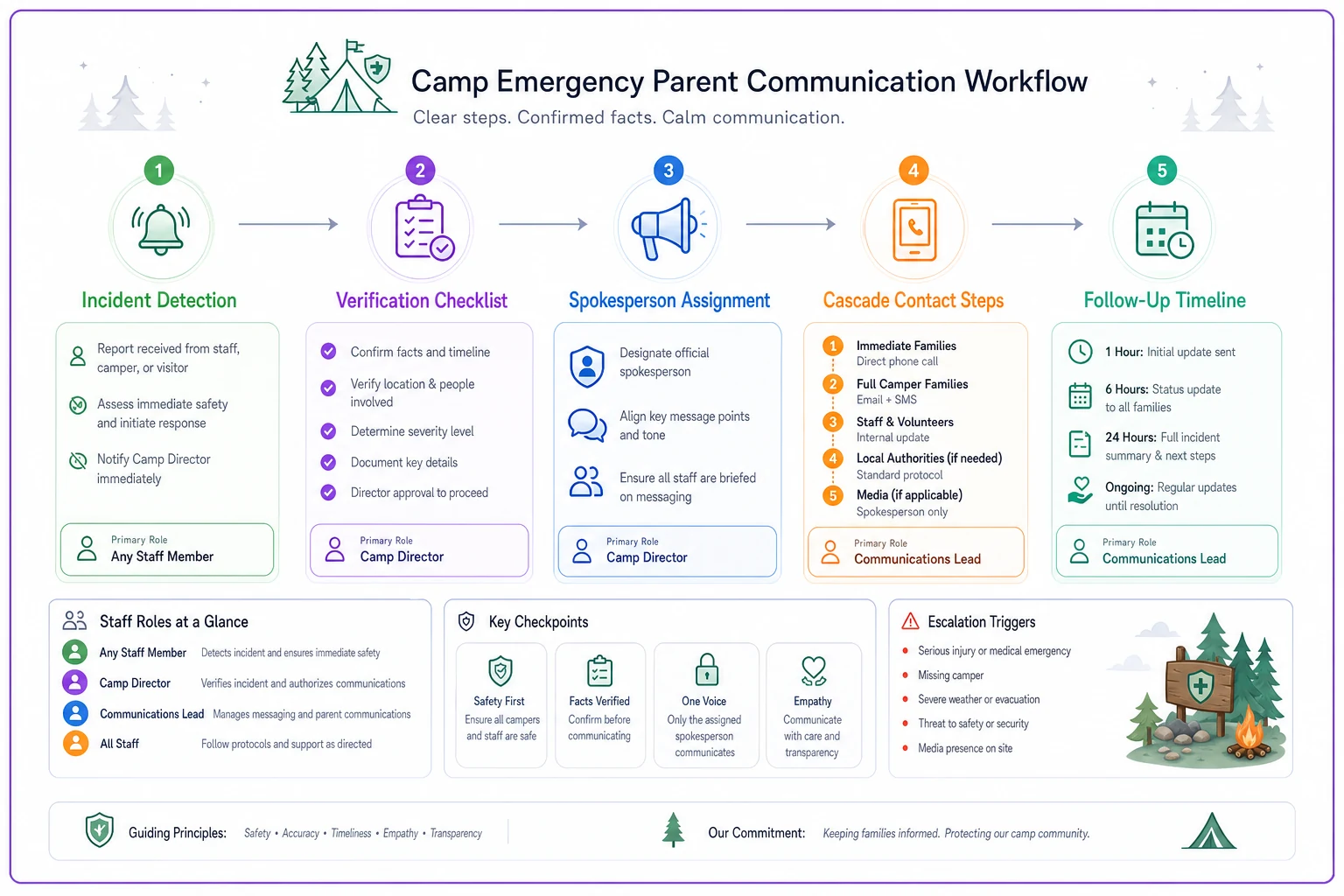
Then build your templates, but make them yours. Generic templates sound generic. Parents detect copy-paste immediately.
When automation actually helps (and when it destroys trust)
Camp emergency communication feels like the last place for technology. Parents want human connection during crisis. But humans make terrible mistakes under pressure.
Operational software can handle the mechanical parts - verification, cascade timing, message logging - while humans handle the emotional parts. Think of it as guardrails, not autopilot.
What works:
-
Automated parent contact verification pulling from registration data
-
Timer alerts for cascade steps
-
Template storage with field fills
-
Communication logs for legal protection
-
Automated staff notifications up the chain
What fails:
-
Fully automated parent notifications
-
AI-written emergency messages
-
Chatbot responses to parent concerns
-
Automated severity assessment
-
Delayed sending "to seem less reactive"
Camps try to fully automate tier 3 and 4 messages. Parents immediately detect the robotic tone, assume the camp doesn't care, trust evaporates. One camp sent automated lice exposure notices that parents screenshot and mocked on Facebook for being "coldly corporate."
The recovery protocol nobody teaches
Every camp focuses on initial emergency communication, nobody plans for recovery. But the three days after an incident determine whether parents keep or pull their kids.
Day 1 follow-up: Personal call from spokesperson checking on child/family
Day 2 follow-up: Email with specific measures taken to prevent recurrence
Day 3 follow-up: Program director call about child's reintegration
Week 1: Director's letter to all families about lessons learned
Session end: In-person conversation at pickup
A Pennsylvania camp had a camper break her ankle on a hike. Perfect initial communication. Then nothing for four days. Parents assumed negligence, started calling other parents, doubt spread. By pickup day, twelve families didn't re-register for the next summer.
Testing your runbook before you need it
Running emergency drills for fire and medical makes sense. Nobody drills communication. Then real emergency hits and your health director freezes on a parent call.
Quarterly communication drills:
-
Scenario injection
Give a manager a scenario card, 2 minutes to prepare, then make the call to another staff member playing parent
-
Template review
Read all templates aloud - they often sound different spoken
-
Database audit
Check 10% of camper files for correct contact info and custody notes
-
Cascade timing
Run a mock cascade with staff phones
-
Parent feedback
After minor incidents, ask parents what worked and what didn't
Keep a printed copy of the runbook at the health center so it's accessible when electronics fail.
The drill always reveals gaps. Phone numbers changed. Templates that sound condescending. Staff who shouldn't be spokespersons. Better to discover these over coffee than during crisis.
Bottom line: preparation prevents panic
Your camp emergency parent communication runbook isn't about legal protection or operations efficiency. It's about maintaining trust when parents are most vulnerable.
Camps that survive emergency seasons aren't the ones with no incidents - those don't exist. They're the ones where parents say "they handled it perfectly." That only happens with a tested runbook, clear assignments, and practice before pressure.
Most camps won't build this until after their first communication disaster. By then, the reputation damage is done, the families are gone, and the lawyers are involved. The three hours it takes to build your runbook now saves your camp's next decade.
Because in emergency communication, you don't get second chances. Parents remember how you made them feel in those first minutes forever. Make those minutes count.
Because in emergency communication, you don't get second chances. Parents remember how you made them feel in those first minutes forever. Make those minutes count.
Ready to elevate your camp management?
Join 500+ camps using Campyly to save administrative time, enhance camper experiences, and streamline daily operations.