


Most camps don't have a pricing problem. They have a portfolio problem that looks like a pricing problem.
You set prices in January, publish the schedule in February, and then spend the rest of the season reacting — discounting a slow week here, adding a last-minute half-day option there, quietly comping siblings because a parent complained. By August you can't actually tell which sessions made money, which ones filled because they were good, and which ones filled because you accidentally underpriced them. The whole thing runs on gut feel and last year's spreadsheet.
The camps that consistently hit their numbers treat the season as one connected system: how sessions are designed feeds pricing, pricing feeds enrollment behavior, enrollment behavior feeds bundling, and all of it gets checked on a calendar instead of whenever someone panics. That's what this playbook is about — not a magic price point, but a repeatable way to run camp program portfolio pricing so decisions are based on evidence, not instinct.
Why portfolio pricing breaks down (and it's not what most directors think)
The instinct is to blame the price itself. "We're too expensive." "The market can't bear it." Sometimes true. But in practice, the breakdown usually starts one step earlier — at the session design level.
A director builds a schedule around what's easy to staff rather than what parents actually buy. So you end up with eight nearly identical general-activity weeks priced within $15 of each other, plus a couple of specialty sessions — robotics, horseback, sailing — that cost significantly more to run but are priced only slightly higher because raising them felt risky. Now every week competes with every other week for the same families, the specialty weeks bleed margin, and there's no logical reason for a parent to pick Week 4 over Week 6.
When your sessions aren't meaningfully different from each other, price becomes the only lever parents have to compare them — and you've trained families to shop on discounts. A portfolio should give parents reasons to choose that aren't price: theme, intensity, outcome, age fit, convenience. Once those reasons exist, price stops being the whole conversation.
The second failure point is that most camps never separate volume weeks from margin weeks. Volume weeks are your bread-and-butter general sessions that fill reliably and cover fixed costs. Margin weeks are specialty or premium offerings that carry higher per-camper profit. Price and promote them the same way, and you optimize for neither. You'll discount margin weeks to fill them and leave money on the table during volume weeks that would've filled anyway.
The four systems that have to move together
Think of the portfolio as four gears. When one turns without the others, you get friction — half-empty premium sessions, waitlists on the wrong weeks, refunds eating into July gains.
Simplify camp operations with centralized control.
Campyly empowers you to manage registrations, staff, and activities seamlessly—all from one platform.
- Integrated camper and staff management
- Automated notifications and alerts
- Dynamic scheduling and resource allocation
No credit card required
-
1. Session design sets what you're actually selling and what it costs to deliver. A 5-day specialty session with a 6:1 ratio and outside instructors is a fundamentally different product than a 3-day general session at 10:1. They should not share the same pricing logic.
-
2. Pricing translates cost-and-value differences into numbers parents see — base price, early-bird structure, sibling policy, and the spread between tiers.
-
3. Enrollment triggers are the rules that fire based on how fast a session is filling: when to open a waitlist, when to release held spots, when to nudge a slow week, when to stop discounting.
-
4. Bundling is how you package multiple weeks or add-ons to raise average booking value and lock families in earlier.
A typical example of these gears grinding: a camp runs a "buy 3 weeks, get 10% off" bundle and an early-bird discount and a sibling discount, and a family stacks all three. That family books four weeks at an effective 22% off — during peak weeks that would have sold out at full price. The bundle was designed to fill slow weeks but wasn't fenced to slow weeks, so it just handed a discount to the camp's most committed customers. That's not a pricing problem. It's a rules-coordination problem.
Start with a forecast curve, not a price
Before you touch a single price, you need to understand the shape of your demand across the booking window. Most directors have this information buried in registration exports and never plot it.
Pull two or three years of enrollment data and, for each session, chart cumulative bookings against weeks-before-start. You're looking for the curve's shape:
-
Front-loaded curves (fills fast early, flattens)
your specialty and marquee weeks. These are your pricing power. Do not discount these to accelerate what's already accelerating.
-
Back-loaded curves (slow, then a late rush)
often shoulder-season weeks or lower-demand age bands. These are where triggers and targeted bundles earn their keep.
-
Flat/stalled curves (never really move)
a session-design problem, not a pricing one. No discount fixes a session parents don't want.
A rough forecast curve for a mid-size camp might look something like this:
| Weeks before start | Front-loaded specialty week | General volume week | Shoulder / slow week |
|---|---|---|---|
| 16+ weeks | 35% full | 15% full | 8% full |
| 12 weeks | 62% full | 30% full | 15% full |
| 8 weeks | 85% full | 55% full | 28% full |
| 4 weeks | 96% full | 78% full | 45% full |
| 1 week | 100% (waitlist) | 90% full | 60% full |
The value here isn't the exact percentages — yours will differ. Once you can see the curve, you know which weeks need intervention and when. The specialty week hitting 85% at eight weeks out is a signal to test a price increase next year, not to relax. The slow week sitting at 28% at eight weeks is your trigger point for action. Reacting before you have the curve is guessing.
If you're already tracking operational metrics in a structured way — and if you're not, the prioritized KPI framework for camp operational health is a good place to start — the fill-rate-by-week curve should live right next to your other season dashboards.
Running pricing experiments without gambling the season
The word "experiment" makes some directors nervous because it sounds like you're risking real revenue. Done right, it's the opposite — it's how you stop risking revenue on untested assumptions.
The rule: test one variable, on a bounded portion of the portfolio, with a clear metric and a pre-committed decision. Never test your whole season at once, and never test during your riskiest cash-flow window.
Sample experiment 1 — Specialty week price ceiling. You suspect your robotics week is underpriced because it fills to 85% four weeks early. Next season, raise it $40 (roughly 8%) and hold everything else constant. Metric: does it still hit at least 90% fill by two weeks out? If yes, you found free margin. If it stalls below 75%, you've learned the ceiling and you revert. Downside is capped at one session.
Sample experiment 2 — Early-bird cutoff timing. You currently offer early-bird through March 1. Test moving it to February 1 for half your general weeks. Metric: total bookings by March 1 across both groups. If the earlier cutoff pulls demand forward without reducing total volume, you've improved cash flow and cut late-season uncertainty.
Sample experiment 3 — Slow-week bundle vs. straight discount. Take two comparable shoulder weeks. Week A gets a 10% straight discount. Week B gets bundled — "add this week to any booking for $99 off." Metric: fill rate and average total booking value per family. Straight discounts usually win on raw fill; bundles usually win on total revenue because they pull in an extra week. Worth knowing which matters more for that slot.
The discipline that makes this work is writing down the decision rule before you see results. "If fill by week 6 is under 70%, we revert to old price." Otherwise you'll rationalize whatever happened. That's the most common mistake — running a test and then reinterpreting the outcome to match what you already wanted to do.
When pricing experiments are a bad idea
Skip experimentation on weeks that are load-bearing for cash flow if you're already running tight. Don't experiment across a season where you've also changed your session lineup, staffing model, or location — too many variables, no clean read. And don't run more than two or three real tests per season; you need a stable baseline to measure against.
Enrollment triggers: turning the forecast curve into action
A forecast curve is diagnostic. Triggers are what make it operational. Instead of checking enrollment "whenever," you define thresholds that force a specific decision at a specific fill level and time.
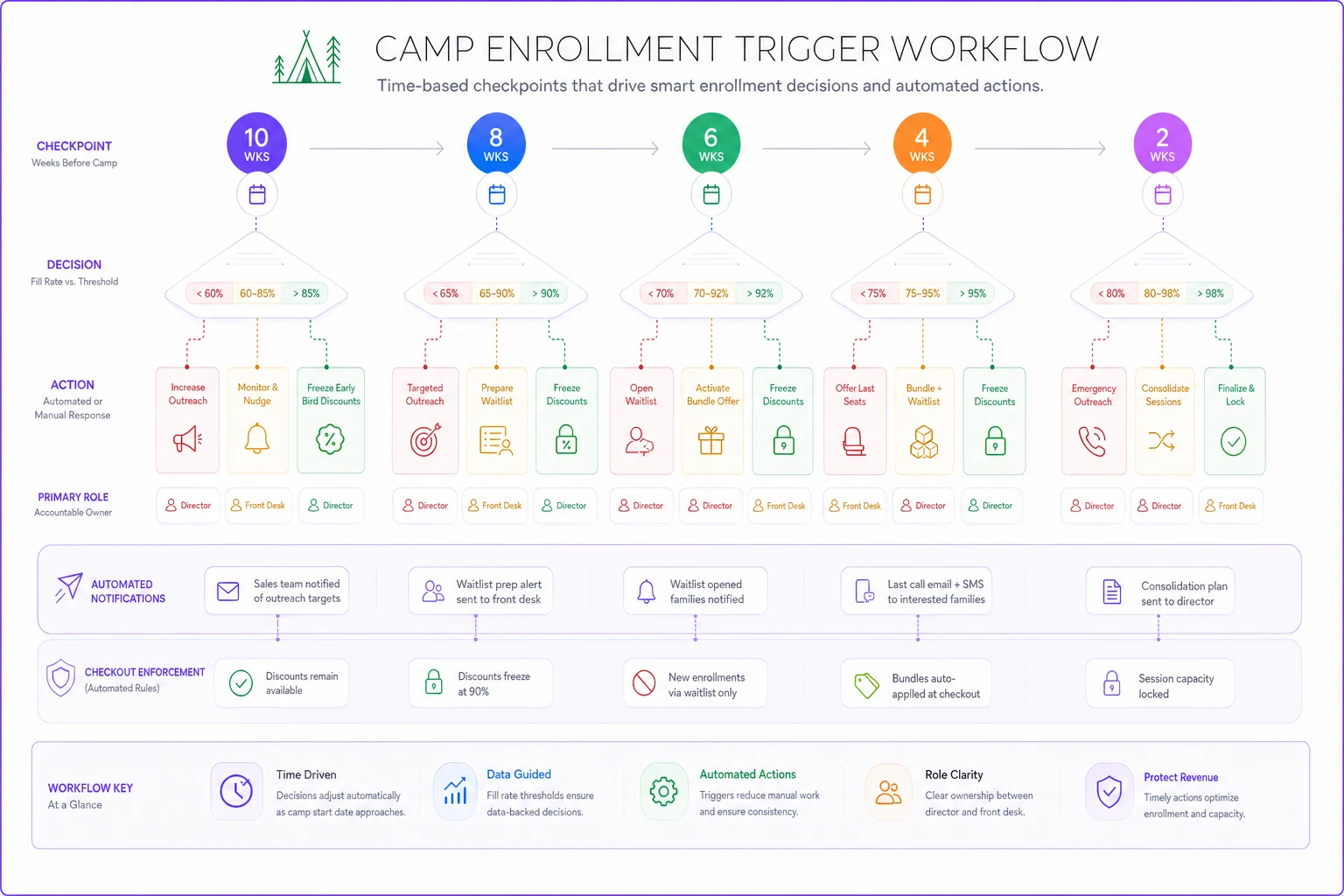
Here's how a typical trigger decision flow works in practice: a session hits a checkpoint on the calendar, the director compares current fill to the threshold, and the pre-written rule determines the action — no deliberation required. The specialty week at 80% with ten weeks out gets discounts frozen. The slow week at 28% with eight weeks out activates the bundle offer. Each decision fires based on data, not mood.
Here's a decision table a director can actually run:
| Session type | Checkpoint | Fill status | Trigger action |
|---|---|---|---|
| Specialty / marquee | 10 wks out | ≥ 80% full | Freeze discounts; flag for price test next year |
| Specialty / marquee | 6 wks out | ≥ 95% full | Open waitlist; convert to premium last-seat pricing |
| General volume | 8 wks out | < 50% full | Send targeted reminder to prior-year families |
| General volume | 4 wks out | < 65% full | Open to bundle offers from adjacent full weeks |
| Shoulder / slow | 8 wks out | < 30% full | Activate slow-week bundle or add-on discount |
| Shoulder / slow | 3 wks out | < 45% full | Release held staff/spots; consider consolidation |
| Any | 2 wks out | ≥ 100% | Waitlist-only; hold pricing firm |
Two things make this table work in practice. First, the waitlist can't be an afterthought — a well-run waitlist is a pricing tool, because it tells you exactly which weeks have unmet demand you can charge more for next year. Setting up publishable waitlist rules that fill cancelled seats fairly and fast turns those "sold out" moments into both revenue recovery and pricing intelligence.
Visualizing the trigger decision flow can help teams follow the rules consistently.
Second, the trigger for consolidating a chronically slow week is a real decision, not a failure. If a week sits at 45% three weeks out and you can fold those families into an adjacent week, you often improve the camper experience and your margin. Letting sunk-cost pride keep a half-empty week running is the mistake.
Bundling rules that raise value instead of leaking margin
Bundling is where most portfolios lose money quietly. The offers feel generous, parents love them, so nobody questions them — until you total the season and realize your effective discount rate was double what you intended.
-
Fence discounts to the weeks that need them. Multi-week bundles should preferentially fill shoulder weeks — "book any peak week plus a shoulder week and save." Never let a bundle discount stack across two peak weeks that would sell out anyway.
-
Cap discount stacking. Pick a maximum effective discount (say 15%) and make sure early-bird + sibling + bundle can't combine past it. This one rule protects more margin than most price increases.
-
Bundle add-ons, not just weeks. Extended-day, lunch programs, transport, and specialty add-ons bundle well and carry high margin. "Add extended care to any 3+ week booking for a flat $199" raises average booking value without touching your base session price.
-
Use bundles to drive multi-week commitment early. A family booked for three weeks in February is far less likely to cancel than three separate single-week bookings made in June. Bundling is a retention tool as much as a revenue one.
A sample bundling ruleset for a mid-size camp:
-
Loyalty multi-week Book 3+ weeks by March 1 → 8% off, but only one of those weeks may be a designated peak week.
-
Shoulder pull-through Any peak-week booking can add a designated shoulder week at $89 off.
-
Add-on stack Extended care flat-rate bundle available on 2+ week bookings.
-
Sibling 10% off the lower-priced enrollment, non-stackable with multi-week beyond the 15% total cap.
-
Hard cap No combination of offers exceeds 15% off the total booking.
The pattern to watch for: if your most-committed families — three weeks, siblings, booked in February — are getting your deepest discounts, your bundle logic is backwards. Those families would pay full price. Reserve real discounting for the demand you actually need to create.
Cap discount stacking at checkout to prevent accidental over-discounting by staff.
Bundling should be designed to pull marginal demand, not reward your most loyal customers with the deepest cuts.
The seasonal decision calendar
Everything above falls apart without a calendar. Pricing decisions turn into panic decisions because nobody scheduled the checkpoint, so the decision only happens once a week is already in trouble. Calendarizing turns reactive scrambling into routine review.
A repeatable annual cadence:
-
September–October (Post-season autopsy) Plot last season's fill curves. Rank every session by fill rate and margin. Identify your true volume weeks vs. margin weeks. Flag anything that filled too fast (underpriced) or never moved (design problem).
-
November (Portfolio design) Redesign the lineup based on the autopsy. Kill or merge chronically weak sessions. Differentiate lookalike weeks. Decide which one or two pricing experiments you'll run.
-
December–January (Price setting) Set base prices, tier spreads, early-bird structure, and bundling rules with the discount cap locked in. Write your trigger table for the year.
-
February–March (Early-bird checkpoint) First real read on the forecast curve. Compare to prior-year pace. Are front-loaded weeks tracking ahead? Adjust promotion targeting, not prices yet.
-
April–May (Mid-cycle checkpoint) Fire the enrollment triggers. Activate slow-week bundles. This is where the decision table earns its keep.
-
June–August (Live season) Run waitlist and consolidation triggers only. Prices are locked — this window is for execution and data capture, not experimentation.
-
August (Reconciliation) Capture cancellations, refunds, and comps against each session so the September autopsy has clean numbers.
That August reconciliation matters more than it sounds. Refunds and prorated credits can quietly erase the margin you thought you earned, and if they're not attributed back to the right session, your autopsy is lying to you. Having clean operational rules for cancellations, prorates, and automated credits means the numbers you plan next year's portfolio on are actually real.
A short real scenario
A mid-size day camp — around 620 campers across a summer, roughly 14 weekly sessions — kept "hitting their revenue number" but with thinning margins each year. The autopsy revealed the real story: four specialty weeks were filling to 90%+ a full month early (badly underpriced), while three general weeks limped along at 50–60% and got rescued every June with panic discounts stacked on top of early-bird and sibling deals.
They didn't overhaul pricing. They did three things. Raised specialty weeks about 8–10% (they still filled). Capped total discount stacking at 15%, which eliminated the accidental 22% giveaways on peak-week families. And introduced a shoulder-week pull-through bundle so slow weeks filled through commitment rather than fire-sale discounts.
Net effect: total enrollment held roughly flat, but effective yield per camper rose enough to add somewhere around $30k–$40k to the bottom line — mostly recovered from margin they were already leaving on the table. Nothing exotic. They just stopped letting the four gears turn against each other.
Where this tends to fall apart at scale
At one location with 10–14 sessions, a spreadsheet and a disciplined calendar are genuinely enough. The trouble starts when you're running multiple locations, longer booking windows, or dozens of session variants — because now the forecast curves, trigger thresholds, and stacking caps have to be enforced across more products than fit in one person's head.
That's where the manual version breaks down. You can't eyeball fifty fill curves weekly, and discount-stacking rules that live in a director's memory get violated the moment a front-desk staffer wants to make a parent happy. Camps in that position lean on their registration and operations platform to enforce the rules automatically — caps that can't be exceeded at checkout, alerts that fire when a session crosses a threshold, fill curves that update without anyone rebuilding a spreadsheet. The system doesn't replace the judgment; it makes the judgment executable across more products than any one person can track.
But that's a scaling question, not a starting point. The playbook itself — forecast curves, fenced bundles, trigger tables, a decision calendar — works on paper first. Get the system right at small scale, and the tooling just lets you run the same discipline bigger. Get it wrong, and no software saves a portfolio full of lookalike sessions and stacked discounts.
The takeaway
Pricing is downstream of design, enrollment behavior is downstream of pricing, and bundling either amplifies or undermines the whole thing. When directors treat these as separate decisions made at separate moments, the portfolio quietly works against itself — discounting committed families, underpricing marquee weeks, and rescuing slow sessions with margin they can't spare.
Run it as one calendarized system. Plot the curves, differentiate the sessions, fence the discounts, write the triggers, and check them on a schedule you set in advance rather than one your slowest week forces on you. That's the difference between a season you can explain afterward and one you can actually steer while it's happening.
Ready to elevate your camp management?
Join 500+ camps using Campyly to save administrative time, enhance camper experiences, and streamline daily operations.