



Three weeks before summer 2024 started, Mountain View Adventure Camp had 47 cancellation requests pile up. Their policy said "30 days notice required" but didn't specify what happens at 29 days, 15 days, or when a kid breaks their arm two days before camp starts.
The director spent 19 hours that week on phone calls negotiating individual cases. Some parents got full refunds. Others got nothing. A few threatened legal action. By opening day, they'd refunded $31,000 more than their policy actually required—simply because they hadn't built clear operational rules around any of it. This plays out at camps everywhere when cancellation policies exist on paper but lack the framework to actually implement them. You need explicit windows, prorate calculations, transfer options, medical exception protocols, and automation rules that take the guesswork out of every scenario.
The hidden cost of unclear cancellation rules
Most camps write a basic cancellation policy, post it on their website, and call it done. But when real cancellations start coming in, that two-paragraph policy creates chaos that costs both money and reputation.
Think about what actually happens during cancellation season. Parents email at 11pm asking for refunds. Staff make different judgment calls on similar situations. Someone processes a full refund when policy says 50%. Another person forgets to subtract the deposit. Meanwhile, your accounting system shows different numbers than your registration platform, and nobody can figure out which families still owe partial payments versus which ones need credits applied.
Every unclear rule multiplies into dozens of individual decisions. A camp with 400 families might handle 60–80 cancellations per season. Without explicit operational rules, each one becomes a negotiation. That's easily 40 hours of administrative time just managing the confusion—not counting the actual processing.
The financial impact goes beyond lost deposits. When parents feel policies are applied inconsistently, they share that frustration in Facebook groups and school pickup lines. One family's bad cancellation experience can cost you several future enrollments.
Building cancellation windows that actually work
"30 days notice" isn't enough. Real operational cancellation policies break down into specific timeframes with clear consequences at each stage.
Simplify camp operations with centralized control.
Campyly empowers you to manage registrations, staff, and activities seamlessly—all from one platform.
- Integrated camper and staff management
- Automated notifications and alerts
- Dynamic scheduling and resource allocation
No credit card required
Start with your actual cost structure. A camp spending $180 per camper per week has different breakpoints than one spending $340. Map out when your major expenses lock in—staff contracts, food orders, activity supplies, transportation bookings. These natural commitment points should drive your cancellation windows.
Here's what an operational cancellation schedule looks like: 60+ days before session: Full refund minus $75 processing fee 30–59 days before: 50% refund of tuition (deposit non-refundable) 14–29 days before: 25% refund of tuition (deposit non-refundable) 7–13 days before: Credit for future session only Less than 7 days: No refund or credit unless medical emergency
Each window has explicit percentages and clear deposit handling. No room for interpretation. No negotiations needed.
The processing fee on early cancellations isn't punitive—it covers the real administrative cost of refunds. Between payment processing fees, staff time, and system updates, each cancellation costs somewhere in the range of $50–100 to process properly.
Prorate formulas that eliminate arguments
Partial week cancellations create the most confusion. A camper leaves Wednesday of a two-week session—what exactly do they get back? Without a clear formula, every case becomes a debate.
Your prorate formula needs to account for fixed versus variable costs. Roughly 40% of your per-camper cost is fixed (facilities, core staff, insurance) while 60% varies with attendance (food, supplies, activity staff). This split drives your calculation.
-
Daily rate
$500 ÷ 5 = $100
-
Variable portion
$100 × 0.6 = $60
-
Camper leaves after day 3
$60 × 2 = $120 refund
Standard daily prorate: (Variable cost per day) × (Days not attended) = Refund amount
Most camps miss the minimum threshold problem. Processing a $30 refund often costs more than the refund itself. Set a minimum refund amount—usually around $50—below which credits get issued instead of cash refunds.
Set a minimum refund amount (usually around $50) so processing doesn't cost more than the refund.
Some camps try to prorate everything: early pickup, late arrival, skipped activities. That creates administrative nightmares. Draw clear lines about what gets prorated (full days missed) versus what doesn't (partial days, individual activities).
Transfer rules that preserve revenue
Transfers are your best tool for keeping revenue when families need to change plans. But without clear rules, they become backdoor full refunds.
Operational transfer rules need three components: eligibility windows, transfer fees, and session availability limits.
-
Free transfer 30+ days before original session
-
$50 transfer fee 14–29 days before
-
$100 transfer fee 7–13 days before
-
No transfers less than 7 days (medical exceptions only)
The transfer fee discourages casual schedule changes while covering the real cost of moving registrations, updating rosters, and adjusting capacity planning.
Session availability matters too. You can't transfer unlimited kids into your most popular week. Set transfer caps at around 10% above original enrollment to maintain program quality. When sessions fill, transfers go on a waitlist with no guarantee of placement.
Specify transfer expiration as well. Credits from 2024 cancellations shouldn't float indefinitely. Most camps set a one-year expiration, though some allow two years for medical situations. After expiration, credits convert to tax-deductible donations—worth checking with your accountant on proper handling.
Medical exceptions without opening floodgates
Medical cancellations require special handling, but "my kid is sick" can't become a universal refund loophole. You need clear documentation requirements and consistent processing.
Required documentation depends on timing:
-
More than 14 days before camp
Doctor's note stating inability to attend
-
Less than 14 days
Detailed medical documentation (diagnosis, treatment plan, recovery timeline)
-
During camp session
Hospital or urgent care discharge papers or physician's order
The documentation requirement isn't about being heartless—it's about being fair to families who followed standard cancellation procedures. Without it, every cancellation becomes "medical" the day before camp starts.
Even with proper documentation, medical exceptions don't automatically mean full refunds. Reasonable policies might offer:
-
Full refund minus deposit for cancellations 7+ days before
-
75% refund for cancellations 3–6 days before
-
50% refund or full credit for cancellations 0–2 days before
-
Prorated refund for mid-session medical withdrawals
COVID added complexity that most older policies weren't built for. Many camps now differentiate between COVID exposure (usually full refund or credit) versus other illnesses (standard medical policy). Whatever you decide, make it explicit in your operations manual.
Parent-facing language that prevents confusion
The language you use in cancellation communications determines whether parents accept your decision or fight it.
Terrible cancellation language: "Cancellations must be received 30 days in advance for refund consideration."
Language that actually works: "To cancel your camp registration, email cancellations@campname.org with your camper's name and session dates. Refunds are processed according to the schedule below based on the date we receive your email."
Notice the specifics: where to send the request, what information to include, and exactly how timing gets determined. No ambiguity about "consideration" or what constitutes proper notice.
Your confirmation language matters too. When processing a cancellation, the response should include:
-
Cancellation date received
-
Applicable refund percentage
-
Exact refund amount
-
Processing timeline (usually 7–10 business days)
-
Where the refund will appear (original payment method, check, or credit)
Build templates for common scenarios. Staff shouldn't be writing custom cancellation responses—that's how inconsistencies creep in.
FAQ matrix for the 12 questions you'll get repeatedly
Parents ask the same cancellation questions every season. Build a comprehensive FAQ matrix that covers every scenario instead of answering individually.
| Scenario | Policy | Refund Amount | Documentation Needed |
|---|---|---|---|
| Cancel 45 days before | Standard cancellation | 100% minus $75 fee | Email request |
| Cancel 20 days before | Standard cancellation | 50% tuition | Email request |
| Cancel 5 days before | Late cancellation | Credit only | Email request |
| Child breaks bone 10 days before | Medical exception | 75% refund | Doctor's note |
| COVID exposure 3 days before | COVID policy | Full credit | Test result or exposure notice |
| Family emergency 2 weeks before | Standard cancellation | 25% refund | Email request |
| Session canceled by camp | Camp cancellation | 100% refund | None |
| Withdraw after day 2 of 5-day session | Mid-session withdrawal | $180 credit | Written withdrawal |
| Switch from Week 3 to Week 7 | Transfer | No fee if 30+ days | Transfer form |
| Payment plan incomplete | Non-payment | No refund | N/A |
This matrix becomes your staff's reference for handling requests. Post a simplified version on your website so parents can find answers themselves.
Timing automated credits and refunds
Manual refund processing kills productivity and creates errors. The real operational challenge isn't writing refund checks—it's tracking who gets what, when, and keeping your various systems synchronized.
Most camps run registrations in one system, payments in another, and accounting in a third. When a cancellation comes in, someone updates the registration system, someone else processes the payment refund, and hopefully someone remembers to tell accounting. This disconnected process practically guarantees mistakes.
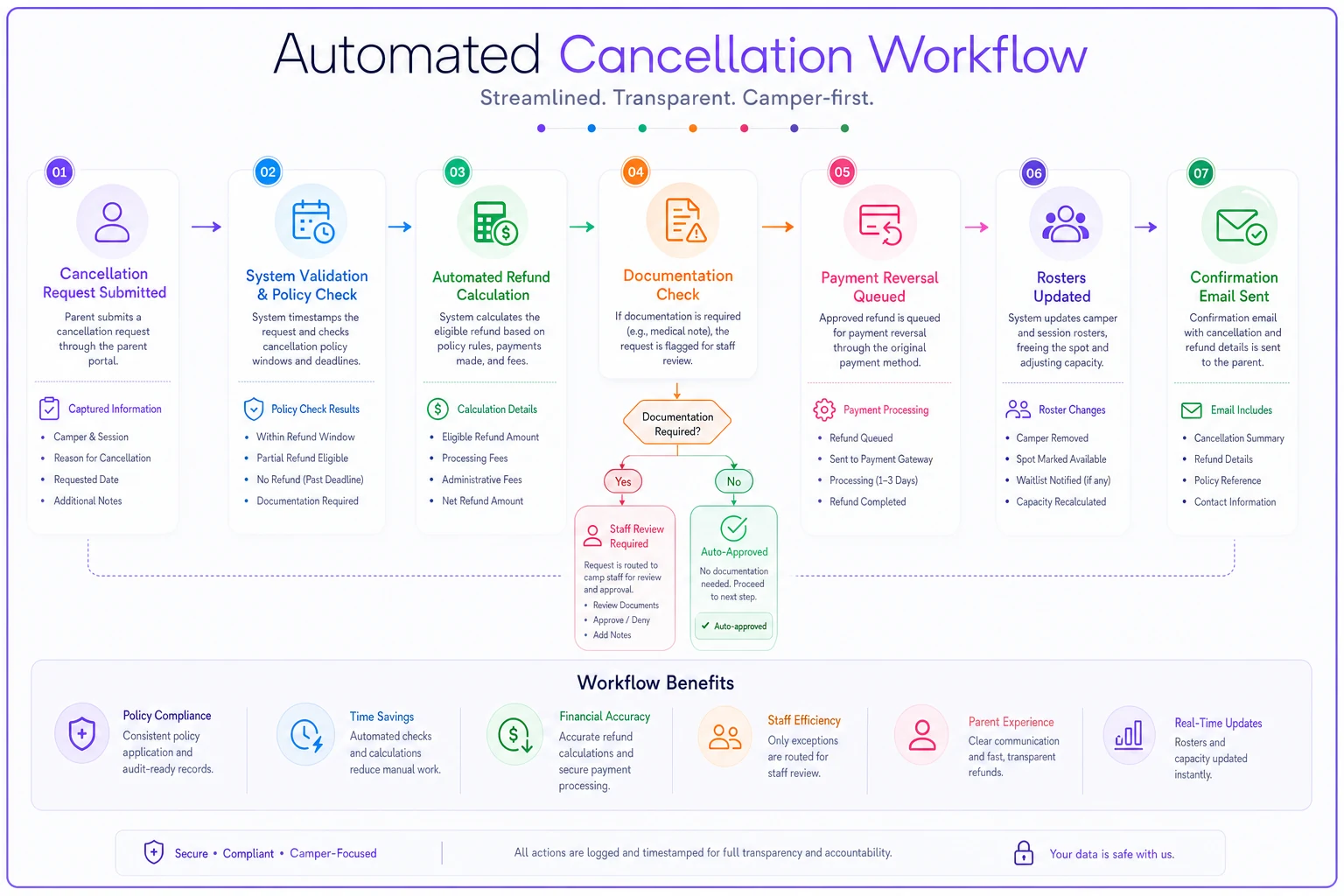
Here's how a well-automated cancellation workflow runs from start to finish:
-
Parent submits cancellation request with required information
-
System timestamps the request and checks it against your policy windows
-
Refund amount is calculated automatically based on the applicable window
-
If documentation is required, request is flagged for staff review before proceeding
-
Once approved, payment reversal is queued and all rosters are updated
-
Confirmation email with refund details is sent to the parent automatically
What used to take 20 minutes of cross-referencing now takes seconds. But the timing of automated refunds also matters for cash flow. Many camps process refunds in weekly batches rather than immediately—this gives you time to verify documentation, attempt saves (offering transfers or future credits), and manage cash position. Automation should queue refunds for review, not blindly process them.
Here's a simple visual of that workflow.
Build in override capabilities for edge cases. Sometimes you'll want to offer a better refund than policy requires for a longtime family facing hardship, or hold firmer with a chronic last-minute canceller. Automation should handle the bulk of cases while leaving room for human judgment on the rest.
Protecting cash flow while maintaining trust
Your cancellation policy directly impacts whether you can make payroll in June. Too generous, and you're scrambling to cover costs. Too strict, and families choose other camps next year.
The balance comes from understanding your actual cost commitment timeline. If you're locking in seasonal staff contracts by April 1st, your policy should get stricter after that date. If your food vendor requires final numbers two weeks out, that's when your refund percentage should drop significantly.
Being transparent about this builds trust. "After May 15th, we've committed to staffing and supplies for your camper. Refunds after this date reflect costs we cannot recover." Parents understand business realities when you explain them plainly.
Some camps have started offering cancellation insurance for $50–75 that provides full refunds up to 7 days before camp. Around 20% of families tend to buy it, generating extra revenue while giving nervous parents peace of mind. The key is pricing it high enough that you still come out ahead even with increased refunds.
Track your cancellation patterns season to season. If you're seeing 15–20% cancellation rates, your prices might be too high or your value proposition unclear. Below 5% might mean you're leaving money on the table with overly generous policies.
Sample templates for different cancellation scenarios
Your staff needs exact language for different situations. Here are templates that handle the most common scenarios while keeping things consistent.
Standard cancellation (meets policy timeline): "We've received your cancellation request for [camper name] for [session dates]. Based on our [X-day] cancellation policy, you're eligible for a [X%] refund of tuition. Your refund amount is $[amount] and will be processed to your original payment method within 7–10 business days. Your deposit of $[amount] is non-refundable per our registration terms."
Late cancellation (misses deadline): "Thank you for notifying us about [camper name]'s cancellation. Unfortunately, your request was received [X days] before the session start date, which is past our [X-day] refund deadline. While we cannot offer a refund, we can provide a credit of $[amount] toward any 2025 session. This credit expires December 31, 2025."
Medical exception approved: "We're sorry to hear about [camper name]'s medical situation. Based on the documentation provided, we're approving a medical exception refund of $[amount], which represents [X%] of your tuition payment. This refund will process within 10 business days. We hope [camper name] recovers quickly and can join us in the future."
Transfer request: "We've processed your transfer request moving [camper name] from [original dates] to [new dates]. A transfer fee of $[amount] has been applied. Your balance for the new session is $[amount]. Please note this was your one allowed transfer—future changes will require standard cancellation and re-registration."
These templates ensure every family gets consistent information regardless of which staff member handles their request.
When strict policies actually help families
It seems counterintuitive, but strict, clear cancellation policies often create better parent relationships than flexible, case-by-case approaches.
When every cancellation becomes a negotiation, parents feel pressure to present the most sympathetic story possible. They stress about whether their reason is "good enough" and worry that other families might get better treatment. The ambiguity creates anxiety on both sides.
Clear rules remove that burden. Parents know exactly what they'll get back based on when they cancel. No special pleading. No worrying about favoritism. The policy is the policy.
This clarity also helps families make better decisions upfront. When parents know cancellations after June 1st forfeit 75% of tuition, they think harder before committing—which leads to fewer last-minute bailouts and more stable enrollment.
Strictness with compassionate execution is the sweet spot. Yes, the policy says no refunds after 7 days. But when you immediately offer a transfer credit and help them find a session that works better, families feel heard even when they don't get cash back.
Tracking refund patterns to spot operational problems
Your cancellation data tells stories about operational issues if you know how to read it.
Consistent cancellations 2–3 weeks before certain sessions might point to scheduling conflicts with school events you haven't caught. Multiple medical cancellations from the same week could suggest an activity parents perceive as too risky. Transfers clustering into specific weeks reveal which sessions families actually want versus the ones you assumed they did.
Track these metrics as part of your operational health monitoring to spot problems before they become crises. A spike in cancellations isn't just lost revenue—it's feedback about something that needs fixing.
Watch for fraud patterns too. Some families register for multiple sessions to hold spots, then cancel all but one at the last minute. Others repeatedly register and cancel to game payment plans. Once you identify these patterns, you can add protective policies like limiting registrations per family or requiring full payment from chronic cancellers.
Making cancellation processing sustainable with the right systems
Manual processing breaks down at scale. When you're handling 400+ registrations, even a 10% cancellation rate means 40+ refunds to process, track, and reconcile.
Modern camp management platforms with AI automation handle the entire cancellation workflow—a parent submits a request, the system checks the date against your policy windows, calculates the refund, processes the payment reversal, updates all rosters, and sends confirmation without anyone touching it manually. The real value comes from edge case handling. AI-powered systems can flag when a cancellation needs human review: documentation that seems off, a family with a history of payment issues, or a request that falls just outside policy windows. Instead of auto-processing everything or manually reviewing everything, your team focuses attention where it actually adds value.
Your broader operational playbook should include cancellation handling as a core module, with clear escalation paths and defined decision rights. Not every staff member should have authority to override policy, but the ones who do need clear guidelines about when exceptions actually make sense.
The difference between revenue protection and parent satisfaction
Most camps think cancellation policy is about choosing between keeping money or keeping families happy. It's not. It's about creating predictable, fair processes that everyone understands going in.
Parents don't actually expect full refunds for last-minute cancellations. What frustrates them is inconsistency, unclear communication, and feeling like other families got better treatment. A strict but transparent policy creates more satisfaction than a flexible but opaque one.
Your cancellation policy is really an operational system that balances four competing needs: cash flow protection, administrative efficiency, parent satisfaction, and enrollment stability. Getting it right means thinking through every scenario, building clear rules, and automating the repetitive parts while preserving human judgment for exceptional cases.
The camps that handle cancellations well don't have more generous policies or stricter terms than everyone else. They have better operational systems that remove ambiguity, process requests consistently, and communicate clearly throughout. When you build these operational rules properly—with explicit windows, clear formulas, documented exceptions, and appropriate automation—cancellations stop being daily fires and become routine transactions. Your staff spends less time negotiating and more time running great programs. Parents trust your fairness even when they don't like the outcome. And your revenue becomes predictable enough to actually run a sustainable camp operation.
The camps that handle cancellations well don't have more generous policies or stricter terms than everyone else. They have better operational systems that remove ambiguity, process requests consistently, and communicate clearly throughout. When you build these operational rules properly—with explicit windows, clear formulas, documented exceptions, and appropriate automation—cancellations stop being daily fires and become routine transactions. Your staff spends less time negotiating and more time running great programs. Parents trust your fairness even when they don't like the outcome. And your revenue becomes predictable enough to actually run a sustainable camp operation.
Ready to elevate your camp management?
Join 500+ camps using Campyly to save administrative time, enhance camper experiences, and streamline daily operations.