


June 15th rolls around and your camp operations turn into controlled chaos. Registration data sits in three different spreadsheets, your scheduling coordinator just texted that they mixed up the swim rotation (again), and someone forgot to order lunches for the field trip tomorrow. Meanwhile, parents are calling about pickup times that nobody communicated properly.
This isn't a staffing problem or a communication problem. It's an operations architecture problem.
Camps treat each operational area like its own island. Registration runs their process. Activities runs theirs. Kitchen does their thing. When these disconnected pieces collide during Week 3 of summer, everything breaks.
The camps that run smoothly? They build modular operational systems where every process connects, every handoff has an owner, and every failure point has a backup plan. Not because they have better staff or bigger budgets, but because they architect their operations differently.
The hidden complexity of camp operations nobody talks about
Most camp directors think they have four or five major processes to manage. Registration, staffing, activities, food, transportation. Simple enough.
Then summer starts.
A camper with severe allergies registers late. The information needs to flow from registration to the nurse, kitchen staff, activity leaders, and bus drivers. But registration uses paper forms, the nurse keeps records in a binder, the kitchen has their own allergy list on the wall, and activity leaders find out when something goes wrong.
Staff scheduling gets messy fast. You've got counselors, specialists, support staff, and volunteers. Some work mornings only, others can't work Fridays, and your swim instructor just got certified for archery too. Now multiply that complexity by eight weeks of programming, rainy day contingencies, and last-minute parent requests for schedule changes.
Most camps follow this predictable spiral:
Week 1-2: The honeymoon phase. Everyone's fresh, systems seem to work, minor issues get patched with enthusiasm and extra effort.
Week 3-4: The cracks show. Staff are tired, parents are comfortable enough to make demands, and that "we'll figure it out as we go" approach to rainy day activities becomes a problem when it rains three days straight.
Week 5-6: Full breakdown mode. Your operations coordinator is working 14-hour days trying to hold everything together. Communication breaks down between departments. Parents complain about inconsistent information. Staff morale drops.
Week 7-8: Survival mode. Just trying to make it to the end without major incidents.
The camps that avoid this spiral don't have superhuman staff. They have modular operations that can flex without breaking.
Building your camp operations playbook: The modular approach
Instead of treating camp operations as one massive interconnected web, break it into modular components that can operate independently but connect seamlessly. Think of it like building blocks - each piece works on its own, but they stack together to create something bigger.
Simplify camp operations with centralized control.
Campyly empowers you to manage registrations, staff, and activities seamlessly—all from one platform.
- Integrated camper and staff management
- Automated notifications and alerts
- Dynamic scheduling and resource allocation
No credit card required
Core Module 1: Registration Architecture
Registration isn't just collecting forms. It's the data backbone of your entire operation. Every piece of information collected needs a destination and an owner.
Your registration workflow should include these steps:
-
Parent submits registration (online or paper)
-
Data entry and verification (who checks for completeness?)
-
Medical/allergy flagging (automatic alerts to nurse, kitchen, activities)
-
Payment processing and confirmation
-
Roster distribution to relevant departments
The RACI matrix for registration might look like:
| Task | Responsible | Accountable | Consulted | Informed |
|---|---|---|---|---|
| Initial data entry | Admin Assistant | Camp Director | - | Department Heads |
| Medical review | Camp Nurse | Health Director | Parents (if needed) | Activity Leaders |
| Allergy/dietary flags | Admin Assistant | Camp Nurse | Kitchen Manager | All Staff |
| Roster finalization | Registrar | Camp Director | Department Heads | All Staff |
| Late registration processing | Registrar | Camp Director | Affected departments | Direct supervisors |
Each task has one person responsible for doing it and one person accountable for ensuring it gets done. No confusion, no assumptions.
Core Module 2: Staff Scheduling Framework
Staff scheduling in camps is particularly brutal because you're juggling certifications, ratios, preferences, and coverage across multiple activity areas simultaneously.
Build your scheduling module around constraint layers:
Primary constraints (non-negotiable):
-
State-mandated ratios
-
Certification requirements
-
Break/lunch coverage
-
Opening/closing responsibilities
Secondary constraints (important but flexible):
-
Staff preferences
-
Skill optimization
-
Professional development rotation
-
Energy management (not burning out your best people)
Your escalation tree for scheduling conflicts should follow this order:
-
Direct supervisor attempts resolution
-
Operations coordinator reviews for system-wide impact
-
Assistant director makes final call
-
Camp director involved only for policy exceptions
One camp in Massachusetts had their scheduling coordinator spending 12 hours every Sunday night rebuilding the next week's schedule from scratch. They switched to a constraint-based template system where 80% of the schedule rolled forward automatically, and only the 20% that needed adjustment got touched. Scheduling time dropped to 3 hours.
Core Module 3: Activity & Program Flow
Activities seem straightforward until you're managing 200 kids rotating through 8 activity areas with different capacity limits, equipment needs, and weather dependencies.
The modular approach breaks activities into:
-
Standard rotations (your default daily flow)
-
Flex activities (backup options for weather/staffing)
-
Special events (field trips, performances, tournaments)
-
Transition protocols (how kids move between activities)
Each activity area requires specific systems. Setup checklists, safety verification processes, attendance protocols, equipment inventory tracking, cleanup responsibilities, and incident reporting flows.
Core Module 4: Communication Streams
Communication fails because camps try to use one system for everything. Parents, staff, vendors, and emergency contacts all need different information at different times through different channels.
Map your communication streams:
Parent communications:
-
Daily updates (what happened today)
-
Schedule changes (pickup time adjustments)
-
Incident notifications (your child scraped their knee)
-
Emergency broadcasts (weather closures)
Staff communications:
-
Shift reminders
-
Policy updates
-
Schedule changes
-
Emergency protocols
Define which channel carries which type of message. Parents might get texts for emergencies, emails for daily updates, and app notifications for schedule changes. Staff might use radios for immediate needs, a bulletin board for schedule posts, and group messages for policy updates.
The shift-by-shift operational template that actually works
Most camps create beautiful program plans in April that fall apart by the second week of summer. The disconnect? Those plans don't translate to what individual staff members do minute by minute.
A functional shift template breaks down like this:
Morning Shift (7:00 AM - 12:00 PM)
7:00-7:30: Setup Phase
-
Facility unlock and safety check
-
Activity area preparation
-
Equipment inventory
-
Communication check (radios, phones)
-
Review daily modifications
7:30-8:00: Arrival Prep
-
Staff briefing on daily changes
-
Medical alerts review
-
Weather contingency confirmation
-
Parent communication items
8:00-9:00: Camper Arrival
-
Check-in protocol
-
Late arrival processing
-
Parent questions/concerns
-
Medication collection
-
Transition to first activity
9:00-11:30: Morning Activities
-
Activity blocks per master schedule
-
Transition supervision
-
Incident documentation
-
Hydration breaks
-
Bathroom coverage
11:30-12:00: Lunch Prep
-
Activity cleanup
-
Headcount verification
-
Allergy/dietary review
-
Transition to lunch areas
Each time block has specific, actionable items. Not "manage arrival" but the exact steps that need to happen.
Afternoon and Evening Shifts follow similar structure with role-specific modifications. A counselor's template differs from a specialist's, which differs from support staff. But they all connect at the handoff points.
When operations break: Your escalation trees
Every camp needs clear escalation paths before problems happen. Not just for emergencies (though those matter), but for the daily operational hiccups that can spiral into disasters.
Registration Issues Escalation:
-
Level 1
Front desk handles standard questions/changes
-
Level 2
Registrar handles payment issues, special requests
-
Level 3
Assistant Director handles policy exceptions
-
Level 4
Camp Director handles formal complaints, legal issues
Staffing Shortage Escalation:
-
Level 1
Shift supervisor reassigns within team
-
Level 2
Operations coordinator pulls from flex pool
-
Level 3
Assistant director approves overtime/ratio modifications
-
Level 4
Camp director authorizes emergency staffing measures
Activity Disruption Escalation:
-
Level 1
Activity leader implements backup plan
-
Level 2
Area supervisor coordinates resource sharing
-
Level 3
Program director activates weather/emergency protocols
-
Level 4
Camp director makes closure/cancellation decisions
Each level has defined authority limits and required notifications. No confusion about who can make which calls.
The RACI matrix that prevents finger-pointing
RACI (Responsible, Accountable, Consulted, Informed) matrices sound corporate, but they're invaluable for camp operations where everyone wears multiple hats.
Practical example for handling a lost camper situation:
| Action | Responsible | Accountable | Consulted | Informed |
|---|---|---|---|---|
| Initiate headcount | Discovering staff | Activity leader | - | All staff |
| Facility search | All available staff | Operations coordinator | - | Parents (after 10 min) |
| Parent notification | Camp director | Camp director | Assistant director | Board president |
| External search | Camp director | Camp director | Law enforcement | All stakeholders |
| Incident documentation | Witnessing staff | Assistant director | Legal counsel | Insurance carrier |
| Process review | Assistant director | Camp director | All department heads | All staff |
When something goes wrong, everyone knows exactly what their role is. No duplicate efforts, no dropped balls.
Connecting modules: Where handoffs happen
The magic isn't in the individual modules - it's in how they connect. Every handoff point between departments needs these components:
-
Clear trigger (what initiates the handoff)
-
Information requirements (what data must be passed)
-
Confirmation protocol (how you verify receipt)
-
Failure backup (what happens if handoff fails)
Example: Camper with new allergy registered after season starts
Trigger: Late registration form with allergy information
Information required: Camper name, session dates, specific allergy, severity, medication
Confirmation: Kitchen posts on allergy board → nurse verifies → activity leaders initial acknowledgment
Failure backup: Daily medical briefing includes all new allergies until all departments confirm
These connection points are where camps typically fail. Information gets stuck in one department while another operates blind.
Technology as infrastructure, not solution
Operational software becomes genuinely valuable here - not as a magic fix, but as infrastructure that makes these modular systems work smoothly.
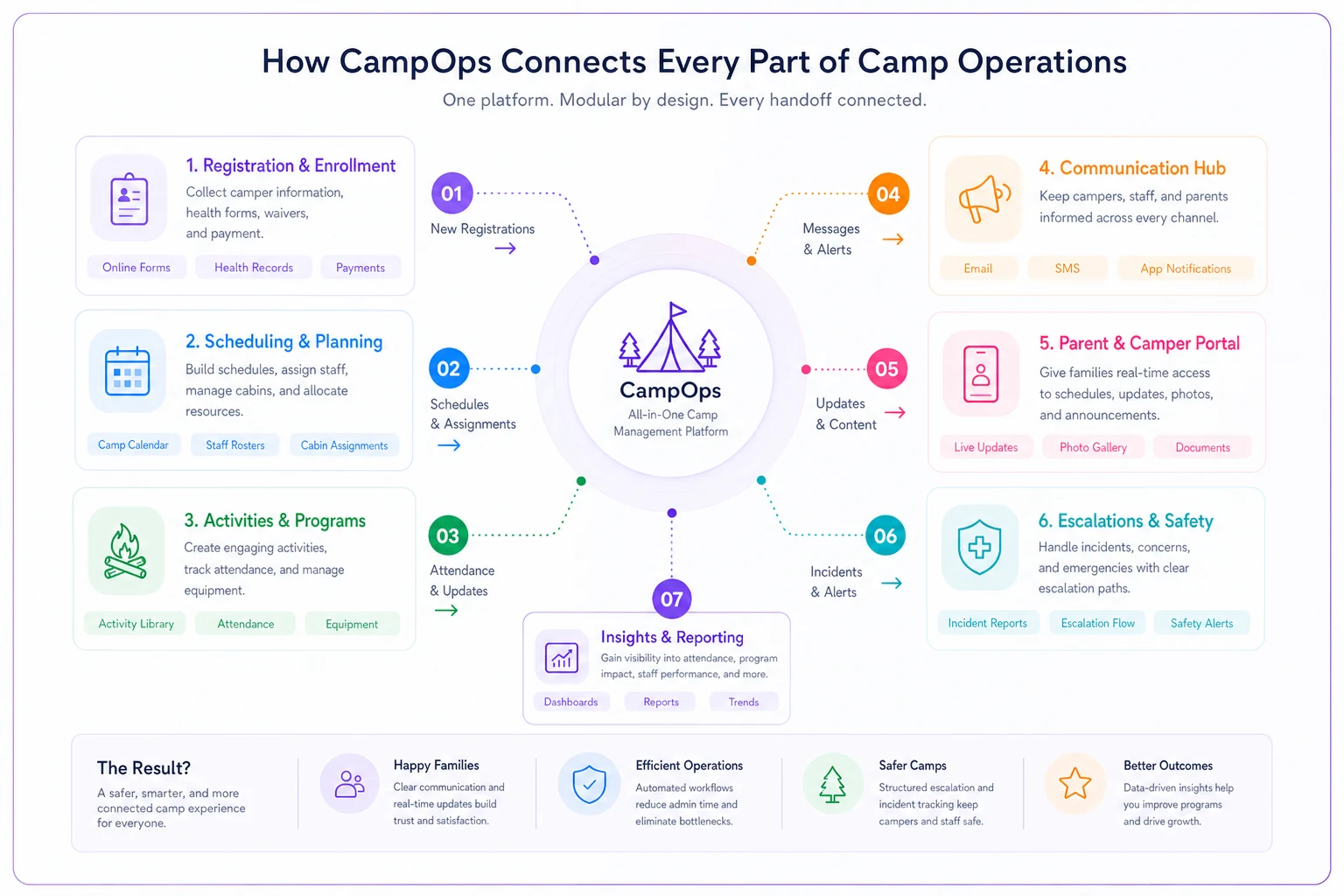
The camps running cleanest operations use platforms that centralize registration data so every department sees updates immediately, automate staff scheduling within defined constraints, track activity attendance and ratios in real-time, route communications to the right people through the right channels, and document everything for compliance and improvement.
Here's a simple visual of how modular systems and a central platform interact.
AI-powered scheduling can juggle your certification requirements, ratio rules, and staff preferences simultaneously. Automated communication systems can ensure parents get updates while staff focus on kids. Digital check-in can flag medical alerts to every relevant person instantly.
But the technology only works if your operational architecture is solid. You can't automate chaos.
The real test: Week 5 operations
Any camp can run smoothly in Week 1. The test of your operations playbook comes in Week 5 when staff are exhausted, parents are demanding, equipment is breaking, weather isn't cooperating, and that one difficult camper is pushing everyone's buttons.
Camps with modular operations maintain quality because processes run independent of individual energy levels. Clear ownership prevents things from falling through cracks. Escalation paths handle issues before they compound. Documentation helps identify patterns to fix.
One camp outside Denver told me their Week 5 used to be "hell week" every summer. After implementing modular operations with clear RACI ownership, Week 5 became just another week. Same tired staff, same challenges, but the structure carried them through.
Making it stick: Implementation without overwhelming staff
The biggest mistake camps make is trying to revolutionize everything in May. Your staff are already overwhelmed with training, and suddenly you're throwing new processes at them.
Start with one module. Usually registration, since it affects everything downstream. Get that running smoothly, then add the next module. By the time summer starts, staff have internalized the core processes.
Training approach that works:
-
Introduce the concept in spring training
-
Practice with scenarios, not lectures
-
Run mock days with the new processes
-
Document pain points and adjust
-
Launch with graduated complexity
Start with registration and run a mock day focused only on registration handoffs.
Week 1 might use simplified versions of each process. By Week 3, you're running full modules. This gives staff time to adapt while camps are still finding their rhythm.
Measuring what matters: Is your playbook working?
Track the right metrics:
Operational Health Indicators:
-
Time spent on daily scheduling adjustments (should decrease)
-
Parent complaints about communication (should drop significantly)
-
Staff overtime hours (should reduce)
-
Incident report processing time (should be faster)
-
End-of-day reconciliation time (should shrink)
Quality Indicators:
-
Camper retention rate week-over-week
-
Staff satisfaction scores mid-summer
-
Parent likelihood to recommend
-
Compliance audit results
-
Near-miss incidents reported (more is actually better - means people are documenting)
A camp in Oregon tracked these metrics across two summers. Year 1 (before modular operations): 3.5 hours daily on administrative firefighting. Year 2 (with modular operations): 45 minutes. That's nearly 3 hours per day freed up for actual camp programming and relationship building.
The bottom line on camp operations
Running a camp without a modular operations playbook is like trying to conduct an orchestra where every musician has different sheet music. Sure, they're all talented, and they're all trying hard, but the result is chaos.
The camps that thrive - not just survive - through eight weeks of summer intensity are the ones that build operational systems before they need them. They define ownership before confusion arises. They create escalation paths before emergencies hit. They connect their modules before handoffs fail.
This isn't about making camp feel corporate or removing the fun, spontaneous spirit that makes summer camp special. It's about creating invisible infrastructure that lets your staff focus on what matters: creating incredible experiences for kids.
The most successful camps realize that operational excellence isn't the opposite of camp magic - it's what makes that magic possible, reliably, every single day of summer.
Your campers won't notice your RACI matrices or modular processes. They'll just know that everything works, their counselors aren't stressed, and their summer is unfolding exactly as it should.
The most successful camps realize that operational excellence isn't the opposite of camp magic - it's what makes that magic possible, reliably, every single day of summer.
Your campers won't notice your RACI matrices or modular processes. They'll just know that everything works, their counselors aren't stressed, and their summer is unfolding exactly as it should.
Ready to elevate your camp management?
Join 500+ camps using Campyly to save administrative time, enhance camper experiences, and streamline daily operations.