



Most camps treat the waitlist like a shoebox of names. Someone cancels their week, the coordinator scrolls back through emails, picks whoever "feels" next, sends a text, and waits. By the time that family responds, another cancellation has come in, the coordinator is now juggling two open seats and three "let me check with my husband" replies, and the week starts with two empty spots that were technically full six times over.
That gap — between a seat opening and a seat actually being paid for and confirmed — is where camps quietly lose money and where parents quietly lose trust. A messy waitlist doesn't just cost revenue. It creates the exact kind of "why did the Hendersons get in and we didn't, we registered first" phone call that eats a director's afternoon.
This is a fixable problem, and it's fixable in a way you can publish. A good camp waitlist policy isn't a secret internal ranking. It's a set of rules clear enough that you'd be comfortable posting them on your registration page. If you can't publish it, it's probably not fair — and if it's not fair, you'll spend the season defending it.
Why "first come, first served" quietly breaks
On paper, first-come-first-served feels like the fairest rule. It's a line. You wait your turn. Nobody can accuse you of favoritism.
In practice, pure FCFS ignores everything that actually makes a camp week work. It doesn't account for siblings needing the same week. It ignores families who've come back five summers in a row. It says nothing about whether your open seat is in the 8-year-old girls' cabin or the teen leadership track — and those aren't interchangeable.
A typical example: a spot opens in Session 3 for a 9-year-old. Your strict FCFS list puts a 14-year-old at the top. That teen can't take a 9-year-old's cabin seat, so now you're skipping down the list anyway — which means you were never really running FCFS. You were running FCFS plus a bunch of undocumented judgment calls. And undocumented judgment calls are exactly what parents smell when they get upset.
The other quiet failure: FCFS doesn't move fast. When the top name doesn't answer within a day, coordinators freeze. Do we wait? Do we skip? How long? Without a written timing rule, the seat just sits there while everyone hesitates.
The three prioritization rules worth publishing
Camps that run clean waitlists almost all come down to three factors layered on top of registration date. You don't need more than these, and adding more usually just makes the policy harder to defend.
Simplify camp operations with centralized control.
Campyly empowers you to manage registrations, staff, and activities seamlessly—all from one platform.
- Integrated camper and staff management
- Automated notifications and alerts
- Dynamic scheduling and resource allocation
No credit card required
1. Sibling linkage. If a family already has one child confirmed in a session and their second child is on the waitlist for the same session, that second child gets a priority bump. This isn't favoritism — it's operational reality. Splitting siblings across weeks creates transportation problems, refund requests, and a decent chance the family walks entirely. Keeping a family whole protects revenue you already have.
2. Returning campers. Families who came back last summer (or the last two or three) earn a modest priority weight. Retention is cheaper than acquisition, returning families refer other families, and rewarding loyalty is something you can say out loud without wincing. The key word is modest. If returning-camper priority is so strong that a first-timer never gets in, you've built a closed club and your growth stalls.
3. Session balance. This is the one most camps forget and the one that fills seats fastest. A waitlisted camper only counts as a real candidate for a specific open seat if they actually fit it — right age band, right gender cabin where applicable, right program track, any capacity limits like swim-level groupings. Matching the person to the actual hole in the schedule is what turns a name on a list into a paid registration.
The trick is deciding the order these apply. Eligibility first (can this camper even take this seat?), then priority weighting (siblings and returning status), then registration date as the tiebreaker. Eligibility is a gate. Priority is a sort. Date breaks ties. That order is easy to explain and hard to argue with.
A sample scoring approach directors can actually publish
You don't need a data science team. A simple point system does the job and, more importantly, can be shown to parents.
Here's a workable weighting you can adapt:
| Factor | Points | Notes |
|---|---|---|
| Eligible for the open seat | Required | If not eligible, camper is skipped entirely for this seat |
| Sibling already confirmed in session | +40 | Only applies to the same session |
| Returning camper (last summer) | +20 | +10 more for each prior summer, capped at +40 total |
| On waitlist per day waiting | +1/day | Rewards patience, caps FCFS runaway |
| Registration date | Tiebreaker | Earlier date wins if points tie |
When a seat opens, you filter to eligible campers, score them, sort descending, and the top name gets the offer. Ties fall to the earlier registration date. Because every input is a fact and not a feeling, you can hand a parent the exact math behind why someone else got the seat.
A quick worked example. A Session 3 girls' cabin seat opens for the 9–10 age band. Three waitlisted campers are eligible:
-
Camper A first-timer, waiting 12 days, no sibling → 12 points
-
Camper B returning two summers, waiting 4 days, no sibling → 20 + 10 + 4 = 34 points
-
Camper C first-timer, sibling already confirmed in Session 3, waiting 2 days → 40 + 2 = 42 points
Camper C wins. Not because someone liked them more, but because keeping a sibling pair together protects a family that's already half-committed. You can publish that logic without hesitation.
Notification timing is where most seats actually die
This is the part nobody writes down and everybody gets wrong. The scoring gets you the right person. The timing determines whether the seat fills before the next cancellation muddies everything.
The core rule: every offer needs an expiration. An offer with no deadline is a seat held hostage by one indecisive family. The sweet spot for peak-season offers is a tight window — often 24 hours during registration crunch, sometimes 48 hours in the slower shoulder months. Long enough to be reasonable, short enough to keep the line moving.
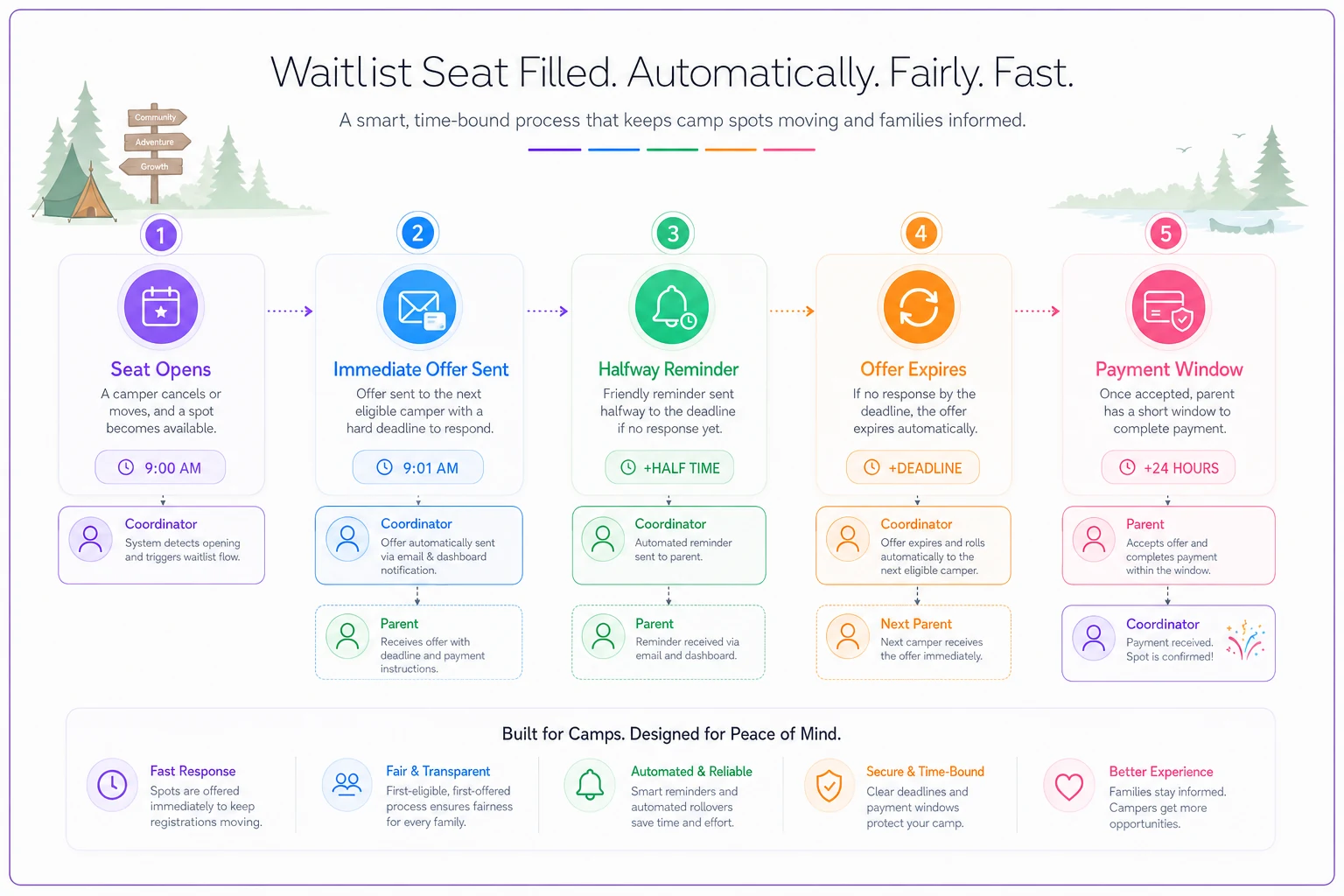
A workflow that actually fills seats:
-
Seat opens (cancellation, no-show forfeit, or added capacity). The clock starts.
-
Offer sent immediately to the top-scored eligible camper with a hard accept-by time stated in the message ("please confirm by 6:00 PM tomorrow, Thursday").
-
Reminder fires at the halfway point if there's no response.
-
Offer auto-expires at the deadline. No response = declined. The seat rolls to the next-scored camper automatically.
-
Payment window attaches to acceptance — accepting isn't the same as holding. Many camps give a short payment window (a few hours to a day) or the seat rolls again.
Here's a simple workflow visualization.
The reason this matters: a single cancellation in July should be filled within a day or two, not left dangling for a week. Every day a seat sits open in peak season is a day you're refunding money on one end and turning away demand on the other.
Notification templates worth stealing
Offer message:
> Hi [Parent], great news — a spot just opened for [Camper] in [Session 3, July 14–18]. To claim it, please confirm and complete payment by [Thursday 6:00 PM]. After that, the spot rolls to the next family on the list. Confirm here: [link]
Halfway reminder:
> Hi [Parent], quick reminder — the [Session 3] spot for [Camper] is still open but expires [tonight at 6:00 PM]. If the timing no longer works, no problem — just let us know so we can offer it to the next family.
Auto-decline / roll notice (internal + optional parent):
> The [Session 3] offer to [Camper] expired without confirmation and has rolled to the next eligible camper. [Parent] has been moved back to active waitlist status for future openings.
The transparency policy you can post publicly
This is what ends the angry phone calls before they start. Publish a short version of your rules right on the registration or FAQ page. Something like:
-
How the list works When a seat opens, we offer it to the best-matched, highest-priority camper for that specific spot — not simply the next name on a list, because seats are age- and program-specific.
-
What earns priority Siblings of an already-enrolled camper in the same session, returning families, and time spent waiting all add priority. Registration date breaks any ties.
-
How offers work Offers are sent by email/text with a firm deadline (usually 24–48 hours). If we don't hear back by then, the spot moves to the next family automatically.
-
How to stay eligible Keep your contact info current and respond quickly. Watch your spam folder during peak weeks.
-
How to ask questions You can request your current waitlist status any time.
Five bullets. The magic isn't in the detail — it's in the fact that it exists and matches what you actually do. A parent who reads "not simply the next name on a list, because seats are age- and program-specific" before they're upset is a parent who won't be blindsided later.
Where this gets hard to run by hand
The rules above are simple. Running them manually during a July cancellation wave is not.
A coordinator would have to catch the cancellation the moment it lands, re-score every eligible camper, send the offer with the right deadline, remember to fire the reminder at the halfway mark, watch the clock, decline at expiration, and roll to the next person — all while doing forty other things. That's a lot of steps to get right when someone's also dealing with a lost water bottle situation at the front gate.
Automate offer reminders and rolling so expired offers don't require someone to watch the clock.
This is exactly the kind of repetitive, time-sensitive coordination that falls apart when things get busy. Operational software with some automation built in handles it well. The scoring logic runs the instant a seat opens, offers and reminders go out on schedule without anyone remembering to hit a button, and expired offers roll to the next camper automatically. The director sets the rules once; the system handles the timing. The point isn't fancy technology — it's that the seat gets filled in hours instead of sitting open for days because someone was at the archery range when the cancellation email came in.
Real scenario: a mid-size day camp fixing its waitlist
A day camp running around 600 campers across summer sessions had a recurring July problem. Cancellations averaged a handful per week during peak, and their manual process meant open seats sat for roughly 3–5 days before getting refilled — if they got refilled at all before the week started. Two or three seats per peak week simply went empty because the coordinator ran out of time to chase the list.
They rebuilt around three changes: a published point-based policy, a firm 24-hour offer window during peak, and automated offer-and-roll timing. Within a couple of sessions, average fill time dropped from that 3–5 day drift to under a day, and the number of seats that started a week empty went from two or three down to nearly zero.
The revenue recovery was real but modest — filling an extra couple of seats per peak week across a full summer adds up to a few thousand dollars. The bigger win was quieter: the "why did they get in and we didn't" emails mostly stopped, because the answer was now printed on the website.
When a formal waitlist policy is worth it — and when it isn't
When it makes sense: Any camp that regularly runs sessions to capacity, has real cancellation volume, and serves families who care about siblings staying together or coming back year over year. If you're turning people away and leaving seats empty in the same summer, you need this yesterday.
When it's overkill: A small camp with plenty of open capacity and rare cancellations doesn't need a scoring engine. If you can fill any open seat with a two-minute phone call and nobody's ever complained about fairness, a simple ordered list is fine. Don't build a policy for a problem you don't have.
Who should be careful: Camps with highly specialized tracks — small-cohort leadership programs, specific skill certifications — where "eligibility" is complicated. In those cases, the session-balance gate does most of the work and the priority weights matter less. Make sure your eligibility rules are airtight before worrying about points.
A waitlist stops causing problems the moment it becomes a set of rules instead of a series of judgment calls. Write the rules so you'd be comfortable publishing them, put a clock on every offer, and let the seat roll automatically when no one answers. Do that, and a cancelled seat becomes a filled seat in a day — and the family who got it never has to wonder why.
Ready to elevate your camp management?
Join 500+ camps using Campyly to save administrative time, enhance camper experiences, and streamline daily operations.