


Most camps don't have an enrollment problem. They have a timing problem. Marketing fires at the wrong moment, offers open when nobody's ready to buy, the waitlist sits idle while staffing decisions get made on gut feel, and by the time families are actually shopping, the director is buried in week-one logistics and can't respond to inquiries within a day.
The result is a season that feels busy but underperforms. You hit maybe 80% of capacity, you discount too late to matter, and you never quite figure out why some weeks sell out in March while others limp into June half-empty.
This playbook treats seasonal enrollment growth as one connected system — a calendar that links what you promote, when you open and close offers, how leads move through a funnel, and the operational handoffs that keep marketing and operations from working against each other. Not a list of marketing hacks. A machine where each part triggers the next.
Why enrollment breaks down as a disconnected sequence of events
The core failure is that most camps run marketing and operations on two separate clocks. Marketing is thinking about open houses and email blasts. Operations is thinking about hiring, housing, and food orders. These clocks almost never sync.
Here's what that actually looks like. A camp pushes an early-bird campaign in January and fills 60% of a session fast. Great. But nobody told operations that this specific session is tracking ahead, so when demand signals say add a second cabin group, the hiring decision gets made six weeks too late and they can't staff it. The camp caps enrollment artificially — not because demand ran out, but because the handoff never happened.
Run it the other direction and it's equally bad. Operations commits to a staffing plan in February based on last year's numbers. Marketing underperforms on a mid-summer session. Now you're carrying payroll for counselors without campers to fill the ratio, and the margin on that session evaporates.
The camps that grow consistently aren't better marketers. They've just connected the triggers. An enrollment threshold doesn't just fill a spreadsheet cell — it does something: opens the next pricing tier, triggers a staffing decision, closes an offer, or releases waitlist seats.
The rest of this is how to build that.
The lead-generation calendar: channel priorities by month
Camp buying behavior is intensely seasonal, and spreading effort evenly across the year is a mistake. You want to concentrate the right channel at the right moment.
Simplify camp operations with centralized control.
Campyly empowers you to manage registrations, staff, and activities seamlessly—all from one platform.
- Integrated camper and staff management
- Automated notifications and alerts
- Dynamic scheduling and resource allocation
No credit card required
A realistic calendar for a summer camp looks roughly like this:
| Window | Primary channel focus | Enrollment goal | What operations should be doing |
|---|---|---|---|
| Sept–Oct | Re-enrollment to last year's families (email, direct outreach) | Lock 30–40% of capacity from returners | Finalize next-season dates, pricing bands |
| Nov–Dec | Referral + early-bird to warm list | Push returners to ~50% | Draft staffing model, flag high-demand sessions |
| Jan–Feb | Paid social + search for cold audiences | Fill to ~70% | Open hiring for sessions tracking ahead |
| Mar–Apr | Open houses, local partnerships, retargeting | 70% → 90% | Lock core staffing, confirm vendor orders |
| May | Urgency campaigns, waitlist conversion | Close remaining seats | Final staffing adjustments, cap decisions |
| Jun–Aug | Referral capture mid-session, next-year teaser | Collect reviews, pre-commit returners | Operate; log demand signals for next year |
The insight buried in that table: your cheapest enrollments come first (returners cost almost nothing to convert) and your most expensive come last (cold paid acquisition in spring). If you're relying on paid ads to fill gaps in April, you're paying the highest price for the campers you planned worst for.
This also connects directly to how you structure programs and tiers. If you haven't nailed down your session mix and price bands before the re-enrollment window opens, the whole calendar slips. The seasonal program portfolio and pricing playbook for directors covers how to set those bands so the calendar actually has something to sell.
Conversion funnel: what each stage actually requires
A camp enrollment funnel isn't complicated, but most camps leak at predictable points.
Stage 1 — Awareness to inquiry. A parent finds you and submits interest, requests info, or visits an open house. Leak point: slow or no response. If a parent inquires on Tuesday and hears back the following Monday, you've probably lost them. The SLA here should be a first response within a few hours during peak season — same-day minimum.
Stage 2 — Inquiry to application started. The family engages but hasn't committed a deposit. Leak point: friction in the registration process, or no follow-up after initial contact. Families drop here when the form is long, the medical requirements feel overwhelming, or nobody checks back in after the first email.
Stage 3 — Application started to deposit paid. This is the real conversion. Leak point: no urgency, no reason to pay now versus later. Families who start an application and don't finish within about a week usually need a nudge — a deadline, a pricing change, or a "seats remaining" signal.
Stage 4 — Deposit to full enrollment + retention. Payment plan completion, forms submitted, and ideally a commitment to return next year. This is where retention actually starts, and it's cheaper to keep these families than to find new ones. The full lifecycle of turning a first-timer into a repeat camper is its own system — the parent engagement lifecycle breaks down the KPIs and templates for that stage.
A reasonable set of benchmarks:
-
Inquiry → application started
40–55%
-
Application started → deposit
50–65%
-
Deposit → fully enrolled
85–95%
-
Returner re-enrollment rate
55–70% for a healthy program
Track first-response time and automate same-day acknowledgments during peak season to protect your inquiry→application conversion.
If your inquiry-to-application rate is sitting around 25%, the problem is almost never camp quality — it's response speed and follow-up. That's a fixable operations issue, not a marketing spend issue.
Sample nurture sequences that actually move people
Nurture sequences fail when they read like generic newsletters. They work when each message maps to where the family is in the funnel and what's blocking them.
Here's a realistic deposit-chase sequence for a family who started an application but didn't pay:
-
Day 0 (same day) Friendly confirmation — "You started your registration for [Session]! Here's what happens next." Low pressure, includes a direct link back to finish.
-
Day 2 Address the common hesitation — a short note answering the top three parent questions (what to pack, homesickness support, a parent testimonial).
-
Day 4 Soft urgency — "This session is about 80% full." Only send this if it's true. Fake scarcity gets noticed and kills trust.
-
Day 7 Deadline nudge tied to a real pricing or availability change — "Early rate ends Friday" or "3 spots left in this age group."
-
Day 10 Human touch — a direct email or call from a coordinator, not an automated blast. "Wanted to check if you had questions before this session fills."
For re-enrollment of past families, the sequence is shorter and warmer:
-
Early fall "We'd love to have [Camper] back. Here's your returning-family rate and priority window."
-
Two weeks later "Priority enrollment closes [date] — reserve your spot before we open to new families."
-
One week before deadline Final reminder with a referral ask built in — "Know a family who'd love camp? Refer them and you both save."
The pattern that separates camps that convert from camps that don't: sequences have to be triggered by behavior, not sent on a fixed blast schedule. A family that already paid shouldn't get deposit-chase emails. A returner shouldn't get the cold welcome series. When these wires cross, families notice — and it reads as careless.
Managing this by hand across hundreds of families is where it breaks. This is the honest case for using a management platform with automation built in — not because automation is trendy, but because a human coordinator can't reliably send the right message to the right family at the right trigger point when you're running 400+ registrations. Behavior-triggered sequences (started application but didn't pay, paid deposit but didn't submit forms, enrolled last year but not this year) are exactly the kind of repetitive, state-dependent work that software should carry so your staff can focus on actual conversations.
The handoff rules: where marketing hands off to operations
This is the part almost every camp skips, and it's really the whole point of the playbook. Enrollment data has to trigger operational decisions on a defined schedule. Otherwise you're always reacting late.
Here's a decision table that makes those handoffs explicit:
| Trigger | Threshold | Operations action | Owner |
|---|---|---|---|
| Session fills early | Hits 70% before target date | Evaluate opening additional capacity / hire | Director |
| Session lagging | Below 40% at 8 weeks out | Open pricing nudge or promo; pause cold spend if unfixable | Marketing + Director |
| Session sold out | 100% | Close offer, open waitlist, stop ad spend | Coordinator |
| Deposit velocity high | Deposits exceeding plan by 15%+ | Trigger early staffing commitment | Director |
| Cancellation spike | More than expected drops | Release waitlist seats, re-open marketing | Coordinator |
| Forms incomplete | <70% submitted 3 weeks out | Launch forms-completion nurture | Coordinator |
The staffing trigger is where you save or lose the most money. If a session crosses 70% enrollment eight or more weeks before it starts, that's your signal to make a hiring decision while you still can. Wait until it's full and you're scrambling for counselors in May when every other camp is doing the same.
The pricing nudge trigger matters just as much going the other direction. A lagging session shouldn't get a panic discount in the final week. It should get a structured nudge the moment it crosses the lagging threshold — an early-bird extension, a sibling discount, a limited promo — so there's actually time for it to work.
And the "stop ad spend" handoff matters more than people think. Camps routinely keep running ads for sessions that are already full because nobody told marketing to turn them off. That's pure wasted budget, and it's a handoff failure, not a judgment failure.
Every one of these handoffs ties back to cash. When enrollment pace is connected to staffing and spend decisions, cashflow becomes predictable instead of a season-end surprise. The seasonal camp finance framework covers how to model that so deposit velocity actually informs your reserve and payroll planning.
A sample automation sequence from inquiry to enrolled
Walking through one full workflow shows how the pieces chain together naturally.
A parent submits an inquiry form on a Saturday afternoon. An automated acknowledgment goes out immediately with a link to register and a realistic "we'll follow up personally within one business day" promise. The inquiry drops into a queue tagged by session and age group.
Visual workflow:
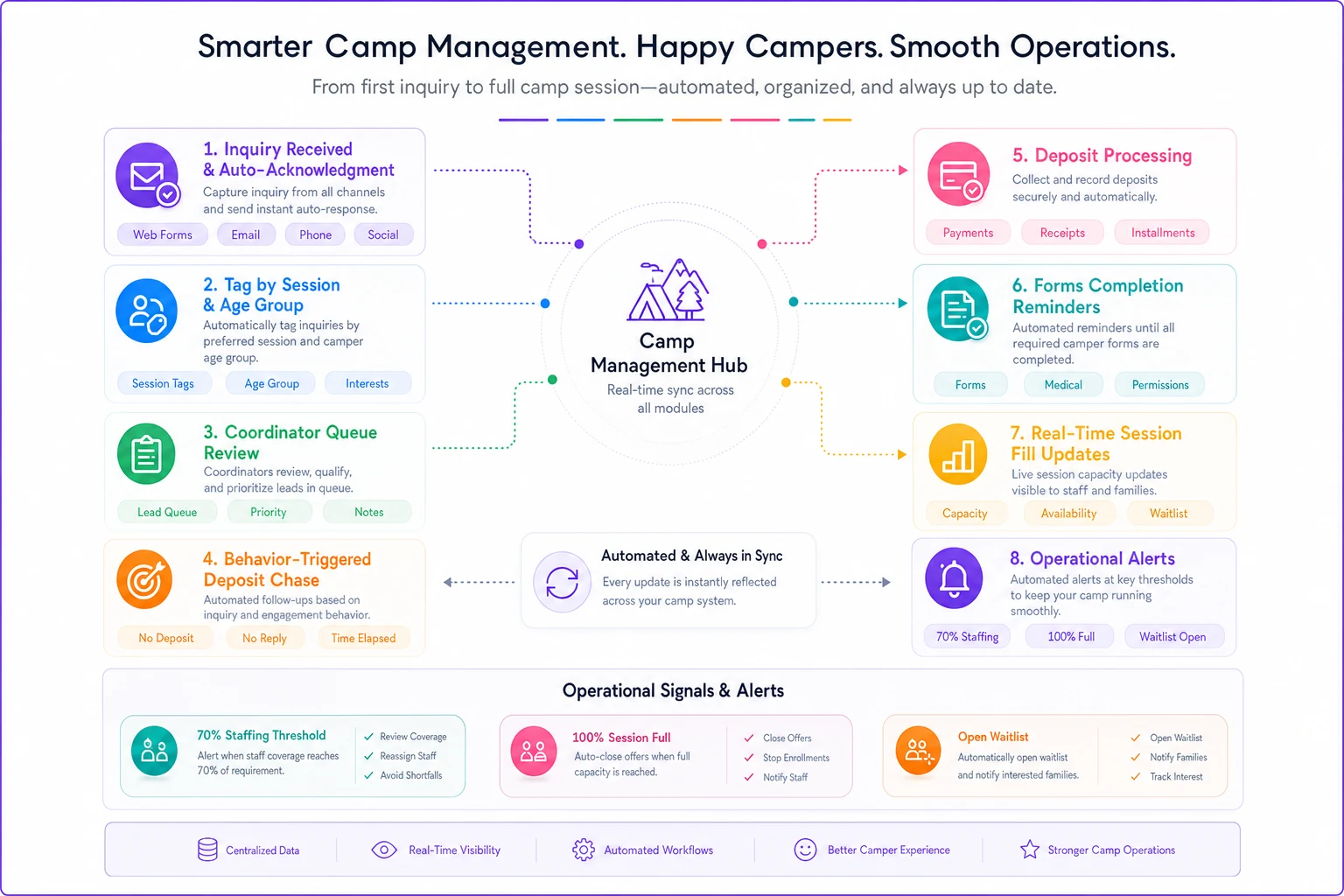
[INQUIRY RECEIVED] ↓ [Auto-acknowledgment sent + registration link] ↓ [Inquiry tagged by session and age group] ↓ [Coordinator reviews sorted queue Monday AM] ↓ [Personal reply sent — hot vs. lagging session flagged] ↓ [Application started but no deposit within 48hrs?] Yes → [Behavior-triggered deposit sequence fires] No → [Family exits to forms-completion track] ↓ [Deposit received → forms-completion reminders begin] ↓ [Session fill rate updates in real time] ↓ [70% fill → director staffing alert] [100% fill → offer closes, waitlist opens, ads pause]
If the family starts an application but doesn't pay within 48 hours, the behavior-triggered deposit sequence kicks in automatically. The coordinator doesn't have to track who's at which step.
When the deposit lands, the family exits the chase sequence and enters the forms-completion track. Medical forms, waivers, packing lists — each with its own reminder cadence tied to the start date. Meanwhile, every deposit updates the session's fill rate in real time. When a session crosses 70%, the director gets an alert tied to the staffing decision table. When it hits 100%, the offer closes, the waitlist opens, and ad spend for that session pauses.
The entire chain runs without anyone manually watching a spreadsheet. Staff spend their time on conversations that actually need a human — the hesitant parent, the special accommodation, the referral relationship. That's the right division of labor.
When this full system makes sense — and when it doesn't
When it makes sense: You're running at least a few hundred registrations across multiple sessions, you have distinct session dates that fill at different rates, and you've got at least one person whose job touches both marketing and enrollment ops. At that scale, the handoff failures cost real money and the calendar pays for itself.
When it's overkill: A single-session camp with 60 spots that sells out from a waitlist every year doesn't need a six-channel calendar and a decision table. You need to not break what works. Adding automation and triggers to a program that reliably sells out just creates maintenance work.
Who should NOT start here: If your program and pricing structure isn't settled, don't build the enrollment machine on top of it. The calendar assumes you know what you're selling and at what price. Fix the portfolio first, then layer the calendar. Building sophisticated nurture sequences for sessions you might restructure next month is wasted effort.
A realistic scenario
Take a mid-size overnight camp running six sessions, roughly 320 total slots. Historically they filled to around 82% and did most of their "marketing" as a flurry of emails in April and May, with a panic discount in the final two weeks on whatever hadn't sold.
The problems were structural, not effort-based. Inquiries sat for three to five days during peak season. Two sessions consistently sold out by March while two others always lagged — but staffing was planned uniformly, so the lagging sessions carried counselors they didn't need and the hot sessions couldn't expand.
After restructuring around a calendar with explicit triggers — re-enrollment starting in September, same-day response SLA, automated deposit-chase sequences, and the 70%-early-fill trigger connected to a staffing decision — they were able to staff and open a second cabin group on a hot session that had previously been capped.
Over the following season, fill rate moved from the low 80s to around 93%. The last-minute discounting mostly disappeared because lagging sessions got nudged early instead of dumped late, which protected margin more than the fill-rate gain did. Nobody worked dramatically harder. The timing just stopped fighting them.
Bringing it together
Seasonal enrollment growth isn't about finding a better marketing channel or writing cleverer emails. It's about connecting the clocks — making sure the moment a session fills, something happens operationally, and the moment a session lags, a structured response fires before it's too late to matter.
The camps that struggle treat enrollment as a spring sprint. The camps that grow treat it as a year-round system where the calendar, the funnel, the nurture sequences, and the operations handoffs are all wired to the same triggers. Build that machine once, and each season you're refining a system instead of improvising a scramble.
Start with the handoff decision table — that's the piece almost nobody has. Once marketing and operations are responding to the same signals, everything else has something solid to hang on.
Ready to elevate your camp management?
Join 500+ camps using Campyly to save administrative time, enhance camper experiences, and streamline daily operations.