



Most camps don't fail because of a single bad decision. They fail because five reasonable decisions—made in isolation, at different times, by different people—stack up into a cash crunch nobody saw coming. A slow spring enrollment quarter. Payroll that hits before the last tuition installment clears. A well pump that dies in week three. A refund wave after a heat advisory. None of these are catastrophic alone. Together, in the wrong order, they can drain an operating account by mid-July and leave a director floating payroll on a personal credit card.
The core problem with seasonal camp finance isn't that the numbers are hard. It's that camps run on lumpy, front-loaded revenue and back-loaded expenses, and most directors manage them as separate spreadsheets that never talk to each other. Enrollment lives in the registration system. Payroll lives with the bookkeeper. Reserves live in a savings account nobody looks at until something breaks. What's missing is the connective tissue—a model that ties enrollment forecasts to a week-by-week cash picture, then uses that picture to set payroll rules, reserve targets, and equipment replacement timing.
This piece walks through how those pieces actually connect, where they break as a camp grows, and how to build a financial system you can stress-test before the season instead of discovering the gaps during it.
Why camp cash breaks even when the season is "profitable"
A camp can be profitable on paper for the year and still run out of money in July. That trips up a lot of directors.
Profit is an annual concept. Cash is a weekly one. Your P&L might show a healthy margin across twelve months, but your bank balance lives and dies on the exact timing of deposits, installment payments, refunds, vendor invoices, and payroll runs. The danger zone is almost always the same window: the six-to-eight weeks spanning late spring deposits through the first two or three sessions, when you're spending heavily on staff, food, and setup while a chunk of tuition is still sitting in installment plans or hasn't cleared.
A typical pattern looks like this. Deposits come in strong through March. Everyone feels good. Then April and May go quiet on the revenue side because families are on payment plans, but you've started hiring, ordering, and prepping the site. By the time the first payroll of pre-camp training hits in June, you're spending real money against a balance that hasn't been topped up yet. If enrollment came in 8% under forecast, that gap doesn't show up as a number on a report—it shows up as a bank balance that's lower than you expected right when you need it most.
The camps that handle this well don't have more money. They have better visibility into the sequence. They know, week by week, roughly what's coming in and going out, and they've built rules that keep the low point in that sequence above zero with room to spare.
The weekly cashflow waterfall (the piece most camps skip)
An annual budget tells you whether the year works. A weekly cashflow waterfall tells you whether next Tuesday works. This is the single most useful financial tool a director can build, and everything else sits on top of it.
Simplify camp operations with centralized control.
Campyly empowers you to manage registrations, staff, and activities seamlessly—all from one platform.
- Integrated camper and staff management
- Automated notifications and alerts
- Dynamic scheduling and resource allocation
No credit card required
A waterfall is just a running week-by-week ledger of your beginning cash, everything expected in, everything expected out, and your ending cash—which becomes next week's beginning balance. The value isn't precision to the dollar. It's spotting the low point of the season before you're standing in it.
-
Start with beginning cash for the week (last week's ending balance).
-
Add expected inflows
new deposits, scheduled installment payments, day-of walk-in revenue, canteen/store, any grants or partner payments.
-
Subtract fixed outflows
rent or mortgage, insurance, loan payments, software, utilities.
-
Subtract variable outflows
food orders, supplies, transportation, program materials.
-
Subtract payroll for any run landing that week (this is the big lumpy one).
-
Subtract expected refunds/credits based on your historical cancellation rate.
-
Land on ending cash, which carries forward.
When you lay 20-26 weeks of this out in a row, the season's shape becomes obvious. You'll usually see one or two weeks where ending cash dips to its lowest point—almost always a week with a payroll run and no matching tuition inflow. That low point is the number your entire reserve strategy should be built around.
One insight that surprises people the first time they build this: the low point is rarely during peak season. It's usually in the ramp-up, three to five weeks before campers arrive, when payroll and setup costs are live but revenue collection has paused between deposit season and balance-due dates. Move your balance-due dates two weeks earlier and that low point can lift dramatically without you earning a single extra dollar.
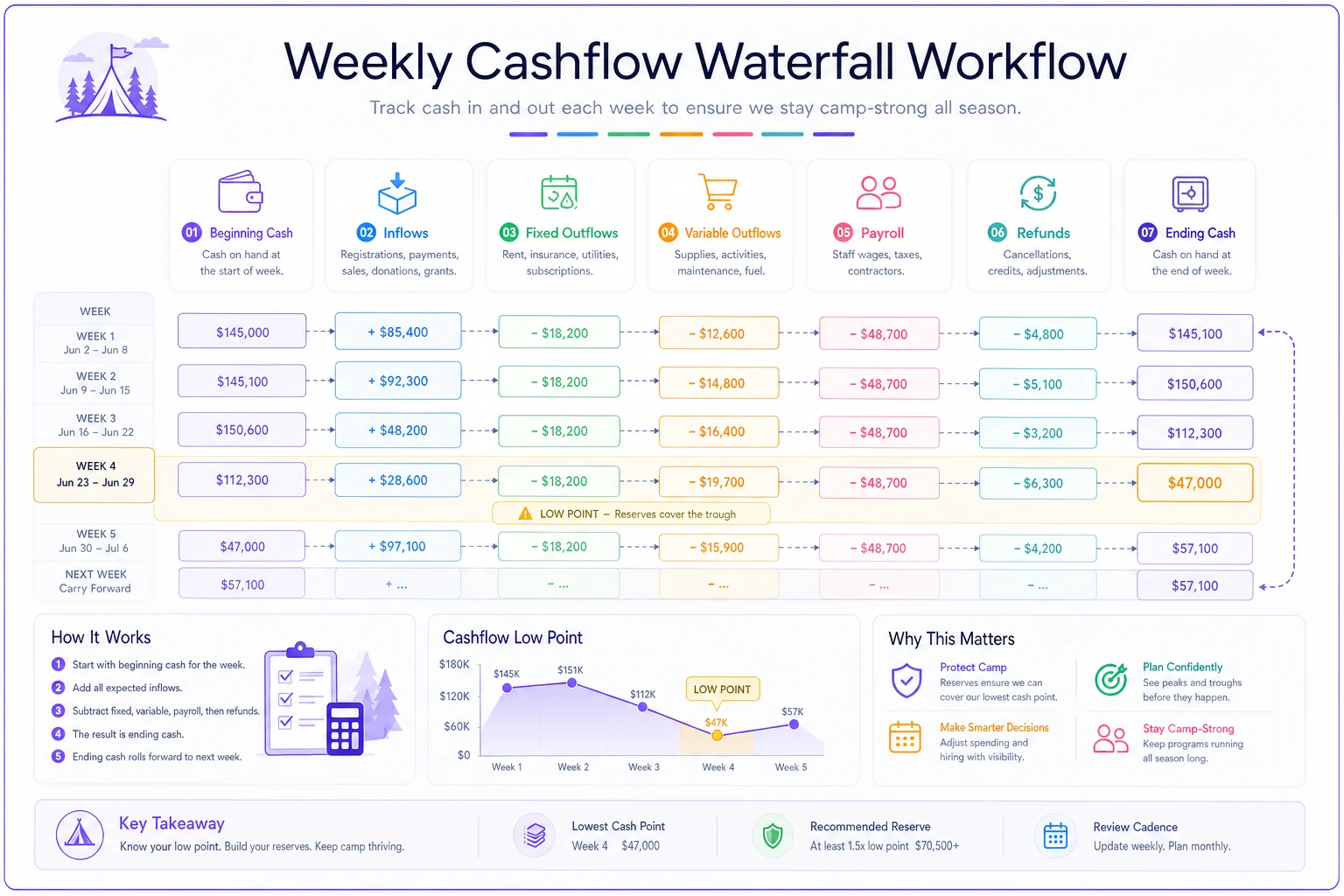
This diagram highlights the weekly flow and the season's low point so you can see where reserves need to sit.
Payroll timing rules that keep you out of the danger zone
Payroll is the biggest single outflow most camps have, and it's the one with the least flexibility—people expect to be paid on time, full stop. So the rules you set around when payroll lands relative to your inflows matter more than almost any cost you can cut.
-
Align balance-due dates ahead of your first big payroll. If pre-camp staff training payroll hits June 12, your tuition balance-due date should be June 1 or earlier, not June 15. That ordering alone prevents the most common ramp-up cash gap.
-
Know your payroll cadence's cash rhythm. Weekly payroll smooths your outflows but gives you less slack in any single week. Biweekly concentrates outflows into bigger, lumpier hits that are easier to mistime against inflows. Neither is wrong—but you need to model which one fits your inflow pattern.
-
Front-load a payroll buffer before the season, not during it. The week before your first payroll run should end with enough cash to cover two full payroll cycles, not one. That gives you a cushion if an inflow slips.
Here's a simple comparison of how cadence choices interact with cash risk:
| Payroll cadence | Cash flow effect | Best fit for | Main risk |
|---|---|---|---|
| Weekly | Smooth, predictable outflows | Camps with steady weekly walk-in/day revenue | Less slack in any single tight week |
| Biweekly | Lumpier, larger single hits | Camps with clear installment inflow dates | Mistiming a run against a slow inflow week |
| Semi-monthly (1st/15th) | Predictable dates, uneven cycles | Camps aligning payroll to balance-due dates | Uneven day counts complicate hourly staff |
The week before your first payroll should end with enough cash to cover two full payroll cycles to avoid timing risk.
The mistake that comes up most often isn't choosing the "wrong" cadence—it's choosing one and never checking it against the actual timing of when money comes in. A biweekly run that consistently lands the week before installment payments clear will squeeze you every single cycle. Directors often blame "a tight year" when the real problem is a scheduling mismatch they could fix in an afternoon.
Reserve formulas: how much to hold, and why
"Keep three months of expenses in reserve" is advice for businesses with even monthly costs. Camps are not that. A flat months-of-expenses rule either leaves you cash-starved during the ramp-up or has you hoarding money you could be using off-season.
A better approach ties your reserve target to two things your waterfall already tells you: your deepest cash trough and your refund exposure.
Think of reserves in three layers:
Layer 1 — Trough coverage. This is the amount needed to keep your lowest cashflow week comfortably above zero. If your waterfall shows the season bottoming out at negative $18k in a worst-case enrollment scenario, your trough reserve needs to cover that plus a buffer—call it $25k. This is non-negotiable operating reserve.
Layer 2 — Refund and cancellation exposure. Based on your historical cancellation rate, hold enough to cover a realistic refund wave. If you typically refund 4-6% of collected tuition and you've collected around $400k by mid-June, that's a $16k-$24k exposure. You don't need all of it liquid all the time, but you need to model it—especially heading into weather-sensitive weeks. Getting your refund and credit rules tight in the first place shrinks this exposure, which is one reason clean operational rules for cancellations, prorates and automated credits pay for themselves in reduced reserve pressure.
Layer 3 — Off-season float. The money that carries you from the end of one season's spending through the start of next year's deposit collection. This is the reserve most under-funded camps skip, and it's why so many directors spend every February scrambling.
| Annual camp revenue | Suggested minimum operating reserve | Refund exposure to model | Off-season float target |
|---|---|---|---|
| Under $250k | 1.5x deepest trough | 4-6% of collected tuition | 2 months fixed costs |
| $250k-$750k | 1.75x deepest trough | 5-7% of collected tuition | 2-3 months fixed costs |
| $750k-$2M | 2x deepest trough | 6-8% of collected tuition | 3 months fixed costs |
| Over $2M | 2x trough + board-set contingency | Modeled by session type | 3-4 months fixed costs |
These are starting points, not gospel. The point is that your reserve number should fall out of your waterfall, not get pulled from a generic rule of thumb.
Capex and equipment replacement math
Reserves cover the surprises you can't predict. Capital replacement covers the ones you absolutely can—and camps are notoriously bad at funding them.
A camp is full of assets with knowable lifespans: mattresses, kitchen equipment, buses, pumps, HVAC units, canoes, playground structures, roofing. Every one of them will need replacement. The failure isn't that they break—it's that they break unbudgeted, forcing you to pull from operating cash in the exact week you can least afford it.
The fix is boring and it works: build a replacement schedule and fund it monthly.
-
Replacement cost (what it'll cost to replace today, adjusted up a bit for inflation).
-
Useful life (realistic years of service, not the manufacturer's optimistic number).
-
Current age (how far into that life you already are).
Annual sinking-fund contribution = replacement cost ÷ useful life. Do this for every asset and sum it. That total, divided by twelve, is what you should be quietly setting aside every month into a capex fund.
A quick real example: a mid-sized camp with roughly $95k of replaceable assets—bus at $65k over 12 years, kitchen line at $18k over 10 years, plus assorted smaller equipment—lands somewhere around $8k-$10k a year in sinking-fund contributions, or just under $800 a month. That's an amount most camps can absorb without much pain. Absorbing a $65k bus replacement in a single July is the kind of hit that ends seasons.
Camps that skip capex funding don't save money. They convert predictable small monthly costs into unpredictable large emergency costs, and pay a premium—rush shipping, emergency contractors, short-term financing—on top. It's the most expensive way to buy the same equipment.
Where this whole system breaks as you grow
A single-site day camp with 120 kids can run this on a competent spreadsheet and a director who checks the bank balance weekly. The model above works fine at that scale.
What breaks as you grow is coordination and freshness. When you're running multiple sessions, multiple sites, or a mix of day and overnight programs, the inputs to your waterfall stop being static. Enrollment shifts daily. Refunds trickle in unevenly. Payroll changes as you flex staffing to actual attendance. A forecast built in February is stale by May, and a stale waterfall gives you false confidence—the most dangerous kind.
-
Enrollment forecasts drift from reality. Your February projection said 340 campers; you're tracking to 305, but nobody's updated the cash model, so the reserve you thought was fat is actually thin.
-
Payroll grows faster than the model. You add positions mid-season to cover demand, and those additions never make it back into the waterfall until the run clears and surprises you.
-
Multi-session accounting gets muddy. Money from session three's deposits masks a shortfall in session one, and you don't notice until the whole thing unwinds in August.
This is where keeping enrollment, payments, and financial visibility in one connected system stops being a nice-to-have. When your registration and payment data feeds a live financial picture instead of a spreadsheet someone updates monthly, your waterfall stays current without constant manual intervention. Camp management platforms that combine enrollment, installment tracking, and reporting reduce the reconciliation work that makes stale models inevitable—so when enrollment slips 10%, you see the cash impact in days, not when payroll bounces.
The tools matter less than the principle: your financial model should be fed by real operational data, not rebuilt by hand every few weeks.
A real scenario: the ramp-up trough that almost sank a season
A regional day camp doing roughly $600k in annual revenue ran three summer sessions plus a spring break program. Profitable every year on the P&L. But two years running, the director had to move personal money into the operating account in mid-June to cover training payroll—and both times paid it back within a month, so it never felt like a real problem. It was.
When they finally built a weekly waterfall, the cause was obvious. Balance-due dates were set for June 20. First training payroll landed June 10. That ten-day gap, multiplied across roughly $180k of outstanding balances, created a predictable trough that bottomed out around negative $22k every single year. They'd been treating a structural timing flaw as a cash-flow "surprise."
The fixes were unglamorous. They moved balance-due dates to May 28. They built a two-cycle payroll buffer into the pre-season close. And they started a modest capex sinking fund after a walk-in freezer failure blindsided them the prior August. The next season, the deepest trough came in around positive $9k instead of negative $22k—a roughly $30k swing—without adding a single new camper or cutting any real cost. All of it came from reordering timing and funding the predictable stuff on purpose.
The lesson wasn't "hold more cash." It was "understand the sequence, then fix the timing."
Building your own stress-test model
The whole point of this framework is to break your season on paper before it breaks in the bank account. That means running your waterfall under scenarios, not just your base case.
-
Base case enrollment lands on forecast, cancellation rate is normal.
-
Soft enrollment enrollment comes in 10-12% under forecast, cancellations run a bit high.
-
Shock case enrollment soft and an unbudgeted capex hit (dead bus, failed HVAC) lands in peak season.
For each, watch two things: the deepest cash trough and the off-season ending balance. If your shock case goes negative, you've found a gap you can close now—by adjusting payment timing, sizing reserves up, or securing a line of credit before you need it, which is always cheaper than after.
A short checklist to know your model is actually usable:
-
Weekly waterfall covering the full season plus off-season float
-
Balance-due dates set ahead of your first major payroll run
-
Payroll cadence checked against your actual inflow timing
-
Reserve target derived from your deepest trough, not a generic rule
-
Refund exposure modeled from your real historical cancellation rate
-
Capex sinking fund calculated per-asset and funded monthly
-
Three stress scenarios run, with the shock case staying above zero
-
A plan to refresh the model from real enrollment data monthly, not annually
When this level of rigor makes sense—and when it doesn't
If you're running a small, single-session program with predictable enrollment and one payroll run, a full multi-scenario waterfall is probably overkill. A simple month-by-month projection and a sensible reserve will do.
Where this becomes essential: multiple sessions, multiple revenue streams, overnight programs with heavy fixed costs, or any camp that's carried a line of credit or floated payroll personally in the last two years. If you've felt that mid-June squeeze even once, that's your signal the timing problem is structural and worth modeling properly.
Camps that treat finance as one connected system—forecast feeding cashflow, cashflow setting reserves, reserves and capex protecting the season—stop having "surprise" cash crises. They still have hard years. Bad weather, soft enrollment, and broken equipment don't disappear. But those events become line items in a scenario they already planned for, not emergencies that require a personal credit card at 11pm.
Tying it back to the rest of your operation
Finance doesn't sit in a corner by itself. Your enrollment forecast is only as good as your pricing and program mix, which is why getting your seasonal program portfolio and pricing right directly shapes the top of your cashflow waterfall. And the health of your cash position is one of the most important signals to track over a season—something worth building into a broader operational health KPI framework alongside enrollment, staffing, and retention metrics.
Build the waterfall first. Let your reserve and payroll rules fall out of it. Fund your capex on purpose. Then stress-test the whole thing against a bad year before the bad year arrives. That sequence—not more cash, not tighter budgets—is what separates the camps that sweat every June from the ones that already know exactly where their low point is and have money sitting on top of it.
Build the waterfall first. Let your reserve and payroll rules fall out of it. Fund your capex on purpose. Then stress-test the whole thing against a bad year before the bad year arrives. That sequence—not more cash, not tighter budgets—is what separates the camps that sweat every June from the ones that already know exactly where their low point is and have money sitting on top of it.
Ready to elevate your camp management?
Join 500+ camps using Campyly to save administrative time, enhance camper experiences, and streamline daily operations.