


Running one camp is a coordination problem. Running three, five, or twelve sites is a governance problem wearing a coordination costume. Most directors don't realize the difference until the second or third site is live and something small — a consent form variation, a float counselor who "belongs" to no one, a partner organization that onboards on their own timeline — quietly causes an incident that crosses site lines and nobody's quite sure who owns the cleanup.
The uncomfortable truth about multi-site camp operations is that the thing that made your single site excellent — tight informal control, you knowing everything, decisions made in the dining hall — is exactly what breaks when you scale. The informal glue stops holding at the second location. What replaces it isn't more meetings. It's a clear map of who decides what, what data everyone agrees to share in the same shape, and what happens when a partner or a float staffer moves between sites.
This is the blueprint for that map. Not generic org-chart theory — the actual decision rights, data contracts, pooled-staffing rules, partner SLAs, and audit playbooks that keep a multi-site program from becoming a federation of tiny kingdoms that distrust each other.
The real failure mode: everyone thinks they're in charge of something, and nobody's in charge of the seams
Single-site problems are usually vertical — something breaks inside one function (aquatics, kitchen, transport) and you fix it within that function. Multi-site problems are horizontal. They live in the seams between sites and between central and local.
A typical example looks like this. Site A updates its allergy intake form to capture a new field. Site B doesn't, because nobody told them to — or they were told mid-season and deferred it. Now your central reporting pulls incomplete data, your cross-site float nurse arrives at Site B expecting the field she saw at Site A, and a kid with a newly-flagged allergy gets served at the wrong table. No single person broke a rule. The seam broke. There was no governance saying "allergy intake fields are a central standard, not a local choice."
That's the pattern underneath almost every multi-site breakdown: a decision that should have been central got made locally, or a decision that should have stayed local got frozen by central until the site stopped caring and worked around it.
Before you can fix anything, you have to stop treating "who decides" as obvious. It isn't.
Central vs local authority: draw the line before the season, not during an incident
The single most useful governance artifact for multi-site camp operations is a plain decision-rights table. Not a philosophy statement — a table that answers "for this specific thing, who decides, who's consulted, and who just gets informed."
Simplify camp operations with centralized control.
Campyly empowers you to manage registrations, staff, and activities seamlessly—all from one platform.
- Integrated camper and staff management
- Automated notifications and alerts
- Dynamic scheduling and resource allocation
No credit card required
Here's a working version. Adapt the rows to your program, but keep the discipline of forcing every meaningful decision into exactly one "decides" column.
| Decision area | Central decides | Local decides | Shared / consult |
|---|---|---|---|
| Safeguarding standards & reporting thresholds | ✅ | Local informs central within SLA | |
| Health/allergy intake fields & data shape | ✅ | Local can add fields, never remove | |
| Emergency parent communication templates | ✅ | Local fills site-specific details | Local triggers, central is notified |
| Daily activity schedule & rotations | ✅ | Central sees read-only | |
| Hiring within approved budget & role bands | ✅ | Central sets bands & screening pipeline | |
| Float/pooled staff assignment | ✅ | Local requests | Joint priority rules |
| Vendor selection (transport, food) | ✅ (approved list) | Local picks from list | Local can nominate new vendors |
| Pricing, discounts, scholarships | ✅ | Local escalates exceptions | |
| Facility maintenance (routine) | ✅ | Central funds capital items | |
| Incident classification & escalation | ✅ (the scale) | Local applies it | Central reviews all Level 2+ |
Here's a quick visual workflow for decision rights across central and local.
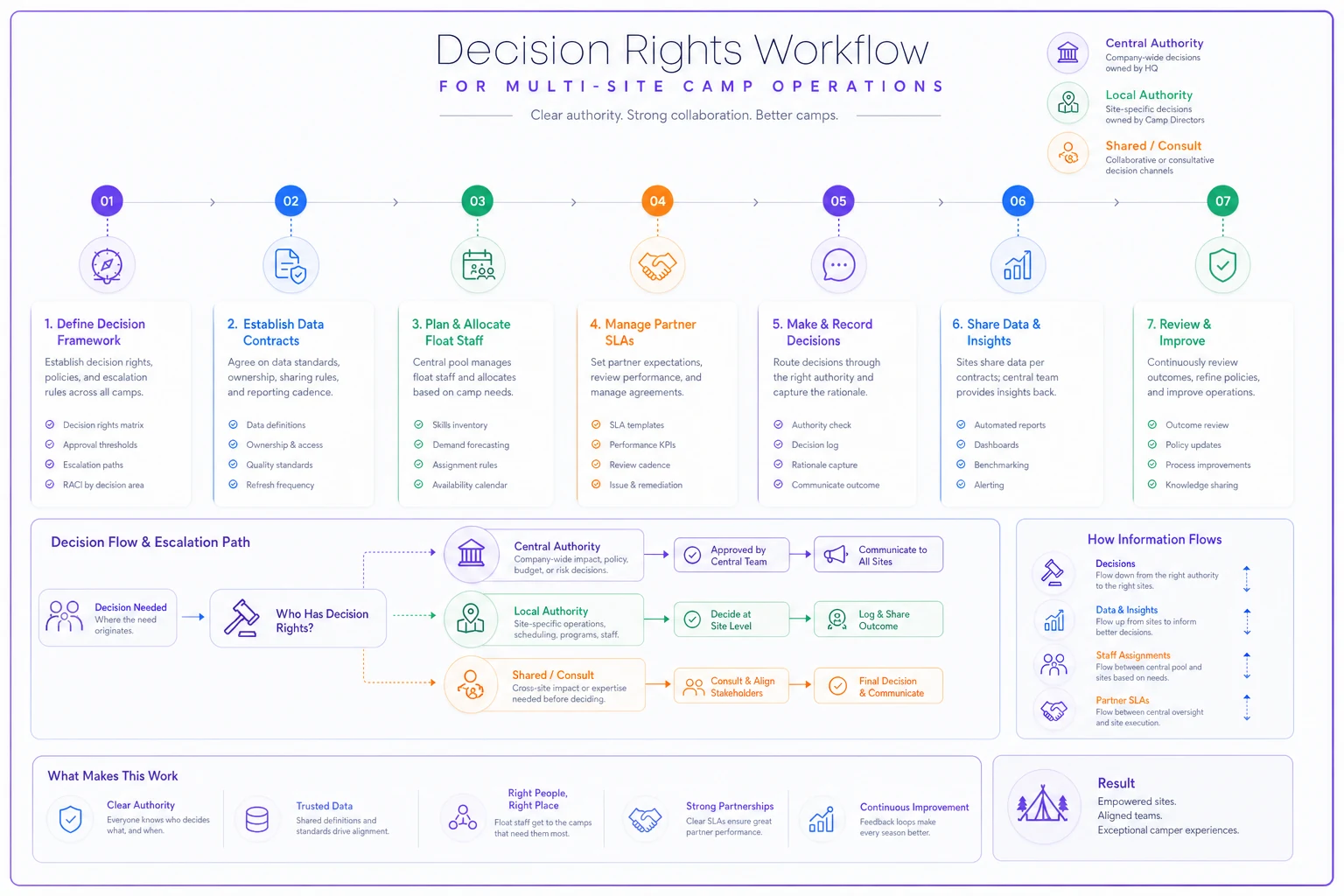
The principle buried in that table: central owns anything where inconsistency creates legal, safety, or data risk. Local owns anything where speed and context beat uniformity. Schedules should be local — the camp down the valley knows its own weather and terrain. Safeguarding thresholds should never be local, because "what counts as reportable" cannot vary by zip code.
The mistake directors make here is splitting authority by department instead of by decision type. "The nurse owns health" sounds clean until you realize some health decisions (what data we collect, how we report an outbreak) must be identical across all sites, while others (which cot a kid naps on) obviously shouldn't be. Split by decision, not by job title.
When tight central control actually makes sense — and when it's a mistake
Centralize hard when the cost of inconsistency is catastrophic or legal: consent language, background screening standards, incident classification, data retention. Nobody should be able to opt a site out of those.
Centralize loosely — set the standard, let sites execute — for things like parent communication, where central owns the template and the triggers but local owns the send button and the site-specific details.
Push authority local for anything where the site director's on-the-ground judgment genuinely beats a decision made from HQ: daily scheduling, routine facility calls, which local counselor covers which cabin. If you centralize these, you create a bottleneck where every site waits on HQ for decisions HQ has no business making, and site directors quietly stop respecting the central office.
The warning sign you've over-centralized: site directors start asking forgiveness instead of permission, and you only find out about their workarounds during audits.
Shared data contracts: the unglamorous thing that makes everything else possible
You cannot run consistent multi-site reporting, pooled staffing, or cross-site audits if each site stores the same information in a slightly different shape. A "data contract" just means: an agreement that certain data fields exist, are named the same way, mean the same thing, and are mandatory at every site. It's the API between your sites, even if a human is the one typing it in.
Most multi-site camps don't have this, and it shows up as reconciliation hell. Central tries to produce a season report and spends two weeks figuring out that "no-show," "DNA," and "didn't arrive" are the same thing recorded three different ways. If you've already worked through the deeper plumbing of this, the architecture side is covered in your registration system is lying: a camp data architecture, integrations and migration playbook — governance sits on top of that architecture, but it fails without it.
Here's what a minimal camper data contract looks like in practice. Keep it human-readable so site coordinators actually understand what they're agreeing to:
camperrecord contract v2.1 — binding across ALL sites camperrecord: camperid: required, globallyunique, format: "SITE-YYYY-#####" legalname: required dob: required, format: YYYY-MM-DD homesite: required, enum: [NORTH, LAKE, RIDGE, VALLEY] sessionid: required allergyflags: required, array, controlledvocab: allergylistv3 consentstatus: required, enum: [GRANTED, PARTIAL, PENDING, DENIED] consentscope: requiredif consentstatus != DENIED medicalnotes: optional, accessrole: [nurse, director] attendancestate: required, enum: [EXPECTED, PRESENT, ABSENT, WITHDRAWN] # Sites MAY add local fields with prefix "local_" # Sites MAY NOT rename, drop, or redefine any field above
Two rules make a data contract survive contact with reality. First, sites can extend (add local fields) but never override the shared core. Second, the controlled vocabularies — the allergy list, the attendance states — live centrally and get versioned. When allergylist_v3 becomes v4, every site updates on the same date, not whenever they get around to it.
Version and publish controlled-vocab change dates centrally, and require a site acknowledgement before the version becomes active.
For staff, you need a parallel contract so pooled staffing works at all:
staffrecord contract v1.4 staffrecord: staffid: required, globallyunique primarysite: required clearedsites: required, array # where this person can legally work screeningstatus: required, enum: [CLEARED, EXPIRING, EXPIRED, PENDING] screeningexpiry: required, format: YYYY-MM-DD certifications: required, array, controlledvocab: certlistv2 rolebands: required, array # e.g. [counselor, lifeguardassist] floateligible: required, boolean
That cleared_sites field is the one that quietly prevents a disaster. A float counselor cleared to work at Site A is not automatically cleared at Site B if screening or local requirements differ. If your data doesn't encode that, somebody will "borrow" staff across sites and accidentally place an uncleared adult with campers.
Pooled staffing and float rules: who owns a person who belongs to two sites?
Pooled staffing is the biggest operational advantage of running multiple sites — and the biggest source of resentment if you don't write the rules down. The whole point is that when Site Lake is short two counselors during peak week and Site Ridge is overstaffed, you move people. But the second you share people, you create a dozen ambiguities: Whose budget pays? Whose schedule wins? Who's responsible if a float staffer underperforms at the borrowing site?
-
Clearance gates everything. No float assignment happens unless
clearedsitesincludes the destination andscreeningstatusis CLEARED. This is a hard stop, not a judgment call. -
Home site has first claim, but only up to baseline. A site can't hoard floats "just in case." Once a site is at its staffing baseline, surplus float capacity returns to the central pool.
-
Need is ranked by safety ratio, not by who asks loudest. A site that drops below its aquatics or cabin supervision ratio outranks a site that merely wants more hands for a program. Write the ratios down so this isn't political.
-
The borrowing site owns day-to-day direction; the home site owns the employment relationship. Performance issues get documented by the borrowing site and routed to the home site director. Nobody fires a borrowed person on the spot.
-
Cost follows the work. The borrowing site's budget absorbs the float's hours for that period. Otherwise home sites over-request and borrowing sites over-rely.
-
Float fatigue is tracked centrally. A counselor who's been moved across three sites in two weeks is a burnout risk and a safety risk. Someone at the central level has to see that pattern, because no individual site director will.
The failure here is almost always rule #6 and rule #3. Without central visibility, float staff get ping-ponged. Without ranked need, the loudest site director wins instead of the site closest to a ratio breach. Both turn a smart efficiency into a morale sink.
| Field | Owner | Rule |
|---|---|---|
| float_request | Local director | Must state ratio gap or program need, with current headcount |
| request_priority | Central | Auto-ranked: ratio breach > ratio risk > program want |
| clearance_check | System/central | Hard block if destination not in cleared_sites |
| assignment_period | Central | Max consecutive cross-site days before mandatory home rotation |
| cost_center | Central | Charged to borrowing site for the period |
A realistic staffing-contract governance snippet, so float decisions are auditable:
Partner onboarding SLAs: the part everyone underestimates
Multi-site programs almost always run with partners — a local nonprofit hosting one site, a school district providing a facility, a specialty vendor running the ropes course across locations. Partners are where governance gets tested, because a partner is outside your authority structure but inside your risk perimeter. If their staff aren't screened to your standard, that's your incident in the eyes of a parent, not theirs.
The tool for this is a partner onboarding SLA: a written agreement about what the partner must deliver, by when, before they can operate. Not a vague MOU — dated, checkable commitments.
A partner onboarding checklist that holds up:
-
Signed data processing agreement — partner commits to the shared data contract and retention rules before any camper data moves
-
Staff roster with screening evidence — delivered no later than 21 days before first operating day
-
Certification proof for any specialized roles (aquatics, climbing, medical) mapped to your
cert_listvocabulary -
Insurance certificate naming your organization, verified not self-reported
-
Incident reporting agreement — partner commits to your classification scale and your escalation SLA
-
Named accountable contact at the partner, with a backup, reachable during operating hours
-
Walkthrough / joint inspection of any partner-controlled facility, signed off by a central rep
-
Offboarding terms — what happens to data and access when the partnership ends or a partner leaves mid-season
The SLA part is the timing. Each item gets a deadline relative to the first operating day, and a consequence for missing it. The consequence that works: no screening evidence 14 days out = partner does not operate, no exceptions, decided centrally. The moment you grant one exception "because they're reliable," every partner learns the deadline is soft.
Programs that get burned by partners almost always treated onboarding as a relationship ("we've worked with them for years") instead of a repeatable gate. Trust is fine. Trust without a dated evidence trail is how a lapsed certification slips through in year four of a partnership nobody re-checked.
Cross-site audit playbooks: proving the governance is real
Governance that only exists on paper decays. Sites drift. The way you catch drift before it becomes an incident is a cross-site audit — a periodic, standardized check that each site is actually doing what the governance says, run by someone who doesn't work at that site.
Cross-site audits matter more than single-site ones because a problem at one site is often a leading indicator for the others. If Site Ridge is six weeks behind on screening renewals, the same process gap probably exists at Valley — they just haven't hit an expiry yet. The audit's job is to turn one site's visible failure into every site's early warning.
A practical cross-site audit cadence:
-
Pre-season baseline audit (all sites, same week). Verify every site is on the current data contract version, screening is current, consent coverage is complete, partner SLAs are closed out. This is the big one.
-
Mid-season spot audits (rotating, unannounced). One site, randomly selected, checked against a short list: attendance reconciliation accuracy, incident log completeness, allergy data matching the contract, float clearance compliance. Unannounced is the point — scheduled audits measure theater, not reality.
-
Cross-site data reconciliation (monthly in-season). Pull the shared fields from every site into one view and look for contract violations: missing required fields, vocab mismatches, attendance states that don't resolve. This is where data contracts pay off — reconciliation becomes a query, not a two-week forensics project.
-
Post-incident lateral check. Any Level 2+ incident at one site triggers a same-check at all other sites within 72 hours. If a cabin supervision gap caused it at Lake, you confirm the gap doesn't exist at Ridge and Valley before the week is out.
This ties directly into how you measure whether the whole program is healthy, not just compliant — the signals worth watching across sites are covered in a prioritized KPI framework to measure camp operational health across a season. Audits check compliance; KPIs check health. You need both, and they should share the same underlying data contract so the numbers reconcile.
One audit artifact worth standardizing: a simple drift log. Every finding gets logged as site | finding | severity | owner | due_date | status. Over two seasons that log becomes the most honest document about your program — it shows which sites repeatedly drift on the same thing, which usually means the governance rule itself is unrealistic and needs changing, not the site.
A real scenario: three sites, one float pool, and a fixable mess
A regional day-camp organization expanded from one flagship site to three over two summers — roughly 180 campers per site at peak, a shared pool of about 25 float-eligible staff, and two partner organizations hosting facilities.
The first multi-site summer, the seams showed everywhere. Each site had evolved its own intake form, so central couldn't produce a clean allergy report and spent close to two weeks before parent-week reconciling records by hand. Float staff were assigned by phone calls between site directors, which meant whoever called first got the help. Twice, a float counselor was sent to a site where their screening hadn't been verified for that location — caught only because a nurse happened to ask. One partner delivered its staff roster four days before opening, with two certifications expired.
What changed the second summer wasn't more software or more staff. They wrote a decision-rights table, forced all three sites onto a single camper data contract with a central allergy vocabulary, moved float assignment to a central priority rule ranked by ratio breach, and put a 21-day hard deadline on partner rosters.
The results weren't dramatic in a press-release way, but they were the right kind of boring. Pre-season reconciliation dropped from roughly two weeks to a couple of days because the data already matched. Zero float assignments went out without a clearance check, because the rule made it a hard block instead of a judgment call. The partner that had been chronically late delivered on time once "no roster, no operating" was an actual central decision rather than a threat nobody enforced. And when a supervision near-miss happened at one site mid-season, the 72-hour lateral check caught a thinner-than-it-should-be ratio at a second site before it became its own incident.
Nothing here required heroics. It required deciding who owns what, writing down what data everyone agrees to share, and enforcing a few deadlines without exceptions.
Who should NOT build this out — at least not yet
If you run a single site, most of this is overkill. Decision-rights tables and data contracts solve coordination problems you don't have yet. Build the clean data habits — consistent fields, controlled vocabularies — because those pay off the day you add a second site, but skip the heavy governance scaffolding.
If you're running two sites that are functionally one operation — same staff, same director walking between them daily — you're on the edge. You need the data contract and clearance rules, but a full central/local authority split might create bureaucracy where informal trust still works fine.
The governance blueprint earns its keep at three or more sites, or at two genuinely independent sites with separate directors and partners in the mix. That's where the seams multiply faster than your ability to watch them personally, and where "I'll just handle it" stops scaling.
Pulling it together
Multi-site camp operations don't fail because individual sites are bad at their jobs. They fail because the connective tissue — who decides, what data means, how people move between sites, what partners must deliver, how you verify any of it — was never written down, so it defaulted to whoever was loudest or fastest in the moment.
The fix isn't centralization and it isn't autonomy. It's a deliberate split: central authority over the things where inconsistency is dangerous, local authority over the things where context wins, shared data contracts so everyone's speaking the same language, pooled-staffing rules that respect both clearance and fairness, partner SLAs with real deadlines, and audits that treat one site's problem as every site's warning. Get those seams right and the sites stop feeling like separate camps that happen to share a logo — and start operating like one program.
And because governance is useless if the whole thing collapses the first time a site loses power or a partner pulls out, pair this blueprint with a genuine resilience plan — the scenario playbooks and recovery SLAs in keep the season running after disruption: a camp continuity framework with scenario playbooks and recovery SLAs are the natural companion. Governance tells you who's in charge on a normal day. Continuity planning tells you who's in charge on the worst one.
Ready to elevate your camp management?
Join 500+ camps using Campyly to save administrative time, enhance camper experiences, and streamline daily operations.