

The problem with most camp continuity plans isn't that they don't exist. It's that they exist as one flat document that treats every disruption the same way. A power flicker gets the same three-page response as a flooded dining hall. So when something actually happens, the plan is useless — nobody's reading fourteen pages while 120 kids are standing in a parking lot.
The camps that recover cleanly aren't the ones with the thickest binders. They're the ones who decided in advance what "small," "medium," and "we're relocating" actually mean, and who does what at each level. That's the whole game: matching your response to the size of the problem, fast, without a committee meeting.
This is the part of a camp continuity plan that almost nobody builds properly. Everyone plans for the extreme (fire, evacuation) and the trivial (rain plan). The gap is the messy middle — a water main break that closes half your program space for two days, a norovirus that takes out a third of your staff, a road washout that strands your buses. Those are the disruptions that actually happen, and they're the ones people improvise through.
Let's build the tiering that makes improvisation unnecessary.
Why one-size continuity plans fall apart
A camp writes an emergency plan because a licensing body or insurer requires one. It gets written once, gets a signature, and lives in a drawer. It's built around worst-case scenarios because those are the scary ones. Then real life delivers a partial disruption — not a catastrophe, not nothing — and the plan has no gear for it.
-
Overreaction. A minor issue triggers a full parent notification blast, which spooks families, jams your phone lines, and makes a two-hour delay look like a crisis. Now you're managing perception on top of the actual problem.
-
Underreaction. A serious issue gets waved off because the person on-site didn't want to bother anyone, or wasn't sure it crossed a line. The delay in escalating is almost always worse than the disruption itself.
-
Unclear authority. Nobody knows who can cancel a session, authorize a spend, or call the relocation. So everything waits for the director, and if the director is unreachable, the whole thing stalls.
This usually happens when the plan describes what to do but never defines thresholds — the specific conditions that move you from one response level to the next. Without thresholds, every decision becomes a judgment call made under stress by whoever happens to be standing there.
The tiering model: four levels, defined by impact not cause
Stop organizing your plan by type of disruption (weather, facility, health, staffing). Organize it by severity of operational impact. The cause matters for response tactics, but the tier — and who takes over — should be driven by how much of your operation is compromised and for how long.
Simplify camp operations with centralized control.
Campyly empowers you to manage registrations, staff, and activities seamlessly—all from one platform.
- Integrated camper and staff management
- Automated notifications and alerts
- Dynamic scheduling and resource allocation
No credit card required
Here's the structure that holds up across camp sizes:
| Tier | What it means operationally | Typical duration | Who owns the response | Recovery SLA target |
|---|---|---|---|---|
| T1 – Minor | One activity or space affected, program continues | Under 2 hours | Activity lead / senior counselor | Resolve or reroute within 60–90 min |
| T2 – Moderate | Multiple activities or a full age group disrupted; some staff or space lost | 2 hours to end of day | On-site coordinator | Stable alternate schedule within 2–3 hrs |
| T3 – Major | Half or more of programming halted; safety concern; likely spills into next day | 1–2 days | Camp director | Decision to run/modify/close by set cutoff each morning |
| T4 – Facility loss / evacuation | Site unusable; campers cannot remain or return | 2+ days / rest of session | Director + owner/board + insurer | Communicate plan within 4 hrs; relocation or refund path within 24 hrs |
The reason to tier by impact instead of cause: a lightning storm, a transformer fire, and a scheduled grid outage can all produce the same operational reality — no power for three hours during peak programming. You don't need three separate plans. You need one T2/T3 power-loss response, plus notes on cause-specific safety steps.
The tier line most camps get wrong is the T2/T3 boundary. That's the one that determines whether the director drops everything and comes in, or whether the on-site team handles it. Define it crisply. "More than one age group affected for more than two hours, OR any safety-related closure" is a workable trigger. Vague triggers get argued about at exactly the wrong moment.
Building your decision matrix
The tier table tells you what level you're at. A decision matrix tells you what to do at each level and what has to be true before you escalate. This is where the continuity plan earns its keep, because it removes the "should I call someone?" hesitation.
-
The trigger conditions — specific, observable criteria that put you at this tier. Not "significant disruption." Something like "kitchen unusable AND lunch cannot be served on time."
-
The decision owner — one named role, with a named backup. Not a committee. If the primary is unreachable within a set window (say, 15 minutes for T3), authority automatically passes to the backup.
-
Authorized actions — what that owner can do without further approval. Spend limits matter here. A coordinator who can authorize a $400 emergency van rental without hunting down a director saves you two hours.
-
The recovery SLA — the time target for reaching a stable state, not necessarily full resolution. "Stable" means kids are safe, supervised, and on a functioning schedule, even if it's not the normal one.
-
The escalation trigger — the condition that bumps you to the next tier. Every tier needs an exit ramp upward.
Write spend limits clearly in dollars so coordinators can act without delay.
A note on recovery SLAs, because people set these unrealistically. The SLA is not "fix the problem." For a flooded activity room, the SLA isn't "dry out the room." It's "have every affected group on an alternate activity within 90 minutes." You measure yourself on how fast you reach operational stability, because that's what families and staff actually experience. The repair happens on its own clock.
Scenario playbooks: turning the matrix into muscle memory
The matrix is the logic. Playbooks are the specific runbooks for the disruptions you're actually likely to hit. You don't need forty of them. Six to ten covering the realistic range, each mapped to its most common tier, is plenty.
-
Power / HVAC loss (T2–T3) — heat is the real risk; a full-day power loss in July can push you toward closure fast
-
Water / plumbing failure (T2–T3) — no potable water or no functioning bathrooms is often an automatic T3 regardless of duration
-
Facility damage — partial (T2–T3) — one building down, program continues elsewhere
-
Facility loss — full (T4) — fire, flood, structural, gas leak requiring evacuation
-
Illness outbreak (T2–T4) — scales with how many campers and staff are affected
-
Staffing collapse (T2–T3) — ties directly to your absence contingencies
-
Access / transport failure (T2–T3) — road closure, bus breakdown, buses can't reach the site
-
Utility-adjacent (well, septic, kitchen gas) (T2–T4) — rural camps especially
Each playbook should be one page, tops. Trigger conditions at the top. The tier it maps to. The sequence of actions in order. The comms that fire and when. If a playbook needs a second page, it's trying to do too much.
For the illness and staffing scenarios specifically, don't rebuild logic you already have. Your outbreak response should hook into your health screening and exclusion routines, and your staffing-collapse playbook should lean directly on your contingency plan for last-minute staff absences during peak weeks rather than duplicating it. The continuity framework's job is to say when those existing plans get activated and who pulls the trigger — not to reinvent the tactics.
Here's a simple flow showing how a detected issue moves through the matrix into a playbook and communications.
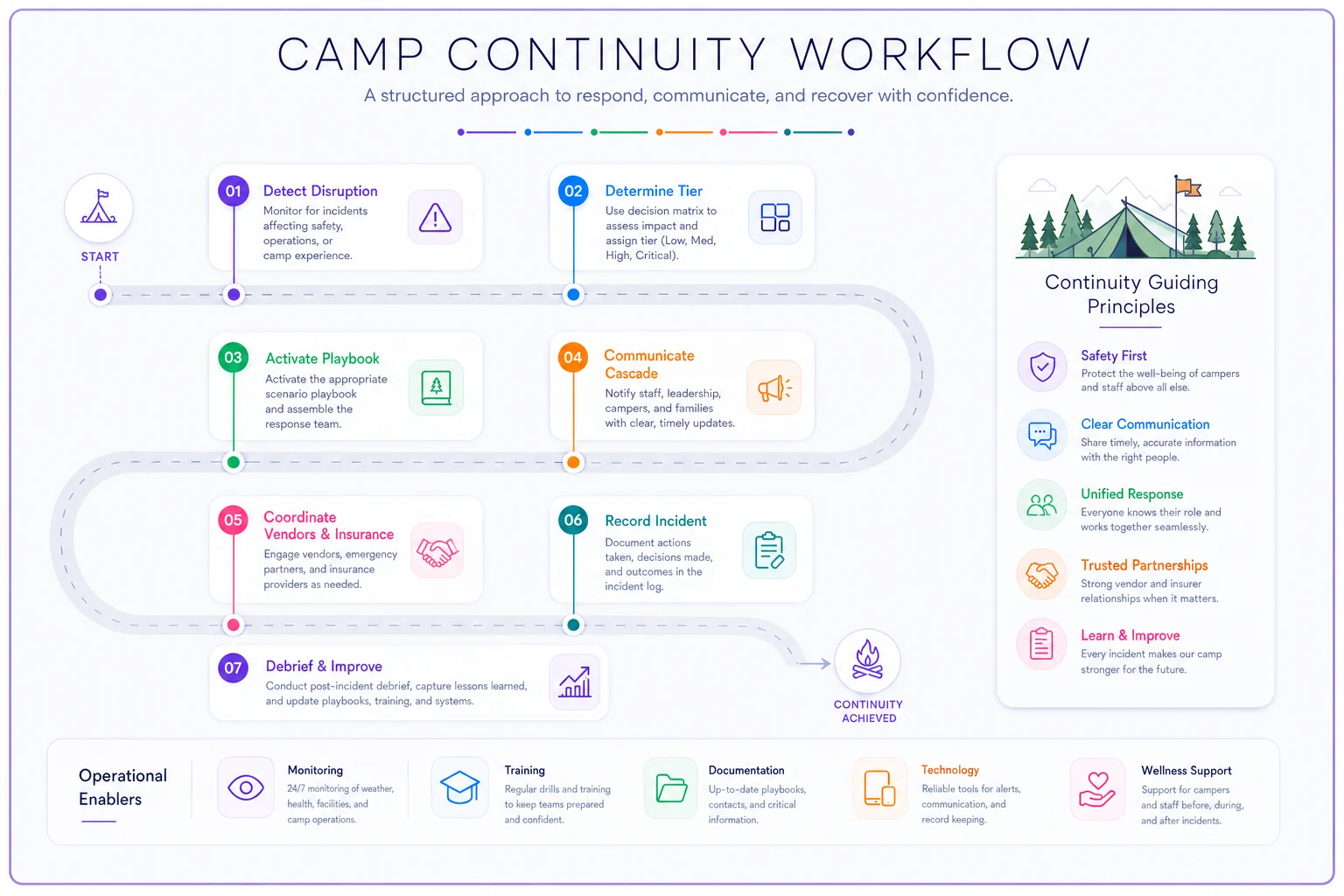
If you don't already have vetted language for on-site emergency situations, build your T3/T4 templates on top of a proper parent communication runbook for on-site emergencies so the tone and structure are already tested rather than written in a panic.
Communication tied to thresholds, not instinct
The most common continuity failure isn't operational — it's communication timing. Camps either notify parents too early (before they know anything, creating panic and a flood of calls) or too late (parents hear from another parent's kid first, and now you've lost trust).
-
T1 — No parent communication. Log it internally. Families never need to know a kayak session moved indoors.
-
T2 — Internal staff notification only, unless pickup timing changes. If dismissal will be delayed more than roughly 20 minutes, a brief heads-up to affected families goes out.
-
T3 — Proactive parent communication is mandatory. Send a factual, calm update before the rumor cycle starts — what happened, that kids are safe, what you're doing, when the next update comes.
-
T4 — Full communication cascade
parents, staff, board/owner, insurer, licensing, and often local authorities. Multiple channels. Named point of contact for family questions so the director isn't fielding 90 phone calls.
The detail that matters most in the T3/T4 templates: always state when the next update will come. "We'll send another update by 2:00 PM whether or not there's news." That one line cuts inbound call volume dramatically, because families stop calling when they know a check-in is already scheduled.
Pre-write all of these. A calm, clear message written on a normal Tuesday is worth ten messages written while your dining hall is under two inches of water.
Insurance and vendor coordination — the part everyone forgets until T4
The continuity plan covers what happens to campers but says nothing about the money and documentation side. Then a T4 hits, and three weeks later you're fighting an insurance claim because nobody photographed the damage before cleanup, or because you can't prove which days you were closed.
-
- [ ] Photograph and timestamp all damage before any cleanup or repair begins
-
- [ ] Log the exact time the disruption started and when normal operations were suspended
-
- [ ] Note every affected session, headcount, and program area (drives refund/credit and claim math)
-
- [ ] Contact your insurer within their required window — know this number before you need it
-
- [ ] Track all emergency spend with receipts (rentals, relocation, extra staff hours, alternate transport)
-
- [ ] Record staff hours worked during response — often reimbursable, often forgotten
-
- [ ] Keep a running incident timeline; you'll need it for both the insurer and, potentially, licensing
-
- [ ] Document all parent communications sent, with timestamps
Many policies have business-interruption or extra-expense coverage that only pays if you can document the interruption and the costs. The camps that get reimbursed are the ones who treated documentation as part of the response, not an afterthought. Assign it to a specific role in your T3/T4 playbook — call them the "incident recorder" — so it doesn't fall through the cracks while everyone's focused on the kids.
Same logic applies to vendors. Know before the season which vendors you'd call for emergency generators, portable restrooms, van rentals, and alternate facility space. Having those numbers in the playbook — with account info and after-hours contacts — turns a two-hour scramble into a ten-minute phone call.
Practice: the plan is worthless if it's never run
A continuity plan that's never been exercised is a hypothesis, not a plan. You find the broken parts during the drill, which is exactly where you want to find them.
You don't need a full evacuation drill every week. Run tabletop exercises — 20 to 30 minutes, staff sitting in a room, someone reads out a scenario, and the team talks through who does what. You'll surface gaps fast: the backup decision-maker who didn't know they were the backup, the emergency contact list that's a year out of date, the assumption that "someone" grabs the medication binder during an evacuation.
-
Pre-season, all-staff Walk one T4 scenario end to end (evacuation). Everyone physically knows their role.
-
Week 1, leadership Tabletop one T3 scenario. Test the decision matrix and comms triggers.
-
Mid-season, quick drills Two or three 15-minute tabletops on T2 scenarios during staff meetings.
-
After any real incident Short debrief. What worked, what didn't, what changes. Update the playbook the same week while it's fresh.
The mistake is treating drills as a box to check. The value isn't the drill — it's the debrief. Every real disruption should feed back into the plan. If you activated a playbook and found step three didn't make sense, fix step three now, not next season when you've forgotten the detail.
Where this gets harder as you scale
A single-site day camp with 80 kids can run most of this out of the director's head and a printed binder. The tiering still helps, but the coordination load is manageable.
Multi-site operations, or camps that scale past a couple hundred campers, hit a different wall. The moment you have more than one location, more than a handful of decision-makers, and buses moving kids between sites, your continuity plan becomes a coordination problem, not just a decision problem. A T3 at one site needs the other sites to know — maybe they absorb displaced campers, maybe they release staff to help, maybe the transport plan changes for everyone.
This is where the flat-binder approach genuinely collapses. You can't verbally coordinate a five-site response while managing an active incident. What holds up at scale is having your plans, contact trees, tier definitions, and communication templates in a shared operational system — where activating a tier pushes the right alerts to the right people automatically, where the incident log lives in one place instead of six people's notebooks, and where you can see across sites in real time. The point isn't fancy software for its own sake; it's that manual coordination has a hard ceiling, and disruptions are exactly when you're least able to coordinate manually.
Even smaller camps benefit from getting this out of the director's head and into a shared place, because the whole premise of tiered response is that the director isn't always the one making the call. If the decision matrix and playbooks only live in one person's memory, you don't actually have a continuity plan — you have a continuity person, and single points of failure are the entire thing you're trying to eliminate.
A real scenario
A mid-sized overnight camp — roughly 210 campers, four program areas — had a well pump fail on a Sunday afternoon. No potable water, no working bathrooms. Under their old flat plan, the first two hours went to people asking each other what to do and whether to call parents.
After they rebuilt around tiering, the same failure plays out differently. No water is an automatic T3 in their matrix. The on-site coordinator declares the tier, the director is notified with a defined 15-minute response window, portable restroom vendor and water delivery numbers are already in the playbook, and the pre-written T3 parent message goes out within the hour — factual, calm, next-update time stated.
The actual outcome the season they'd tiered it: from problem identified to stable operations (temporary restrooms staged, bottled water distributed, affected activities rerouted) was a little under three hours instead of most of an afternoon of confusion. Inbound parent calls dropped noticeably because the proactive message got ahead of the rumor mill. And because the incident recorder documented everything, emergency vendor costs — somewhere in the low four figures — went into a clean insurance claim instead of getting eaten as a loss.
Nothing about the disruption changed. The response changed, because the decisions were made in advance.
The takeaway
A continuity plan isn't a document you write for a licensing inspector. It's a set of pre-made decisions that let a stressed, understaffed team respond correctly at 3 PM on a Sunday without needing to reach the one person who knows what to do.
Tier by impact. Define the thresholds that move you between tiers. Assign clear owners and backups with real authority and spend limits. Pre-write the communications. Handle the insurance and vendor side from the start. And run the thing at least a few times before the season opens, because the gaps only reveal themselves when you practice.
Do that, and disruptions stop being emergencies. They become situations you already have a page for.
Do that, and disruptions stop being emergencies. They become situations you already have a page for.
Ready to elevate your camp management?
Join 500+ camps using Campyly to save administrative time, enhance camper experiences, and streamline daily operations.