


Peak summer weeks hit different when you're already running at capacity. Parents book months ahead, waitlists are full, and suddenly Tuesday morning brings three simultaneous sick calls. Your lead counselor's car broke down. The waterfront instructor has food poisoning. The junior counselor who covers breaks just texted they're stuck at the airport.
Most camps scramble through these situations with frantic group texts and whoever answers their phone first. But scrambling doesn't work when you're managing 200+ kids across multiple activity areas during your busiest weeks.
Why staff absences hit harder during peak capacity
The math gets ugly fast during peak weeks. Running at 85% capacity means some slack exists—someone can cover two groups temporarily, activities can merge, schedules flex. Peak weeks run differently. Every counselor already manages their maximum ratio. Every activity area operates at full enrollment. Your float staff are already deployed covering scheduled breaks and transitions.
A single absence during peak week creates compound problems. The archery instructor calls out sick, so you pull the crafts counselor who knows archery basics. Now crafts needs coverage, so you grab the junior counselor from free play supervision. Three areas operating below standard instead of one.
Camps typically see 15-20% higher absence rates during peak summer weeks. Not because staff get sicker—they're just stretched thinner. That minor cold they'd push through in June becomes a sick day in July when they're already exhausted.
Personal emergencies that could wait become urgent when staff haven't had a real break in weeks. Traditional coverage approaches assume distributed capacity. "Just have everyone cover a little extra" works when you have extra to give. Peak weeks eliminate that buffer entirely.
Building your escalation framework
Start with coverage zones, not individual assignments. Map your camp into operational clusters where staff can realistically cross-cover with minimal disruption.
Simplify camp operations with centralized control.
Campyly empowers you to manage registrations, staff, and activities seamlessly—all from one platform.
- Integrated camper and staff management
- Automated notifications and alerts
- Dynamic scheduling and resource allocation
No credit card required
Zone 1: Waterfront
-
Primary
3 certified lifeguards
-
Secondary
2 counselors with basic water safety
-
Critical threshold
Never below 2 certified guards
-
Consolidation point
Combine swim lessons into free swim if below threshold
Zone 2: Sports Fields
-
Primary
2 sports specialists
-
Secondary
4 general counselors with sports experience
-
Critical threshold
1 specialist minimum
-
Consolidation point
Merge competitive games with general rec
Zone 3: Creative Arts
-
Primary
2 arts instructors
-
Secondary
3 counselors with craft experience
-
Critical threshold
1 instructor per 30 kids
-
Consolidation point
Convert to supervised free creative time
Your escalation tree needs clear decision points. When does pulling a float counselor make sense versus consolidating activities? When do you shift from maintaining full programming to protective scheduling?
-
Level 1 Response (1-2 absences) - Float staff deploy immediately. No program changes. Parents notice nothing.
-
Level 2 Response (3-4 absences) - Begin selective consolidation. Combine similar activities. Modify but maintain core schedule.
-
Level 3 Response (5+ absences) - Activate emergency scheduling. Notify parents of modified programming. Focus on safety and basic supervision over specialized activities.
Here's a visual workflow for activating escalation levels during staff absences.
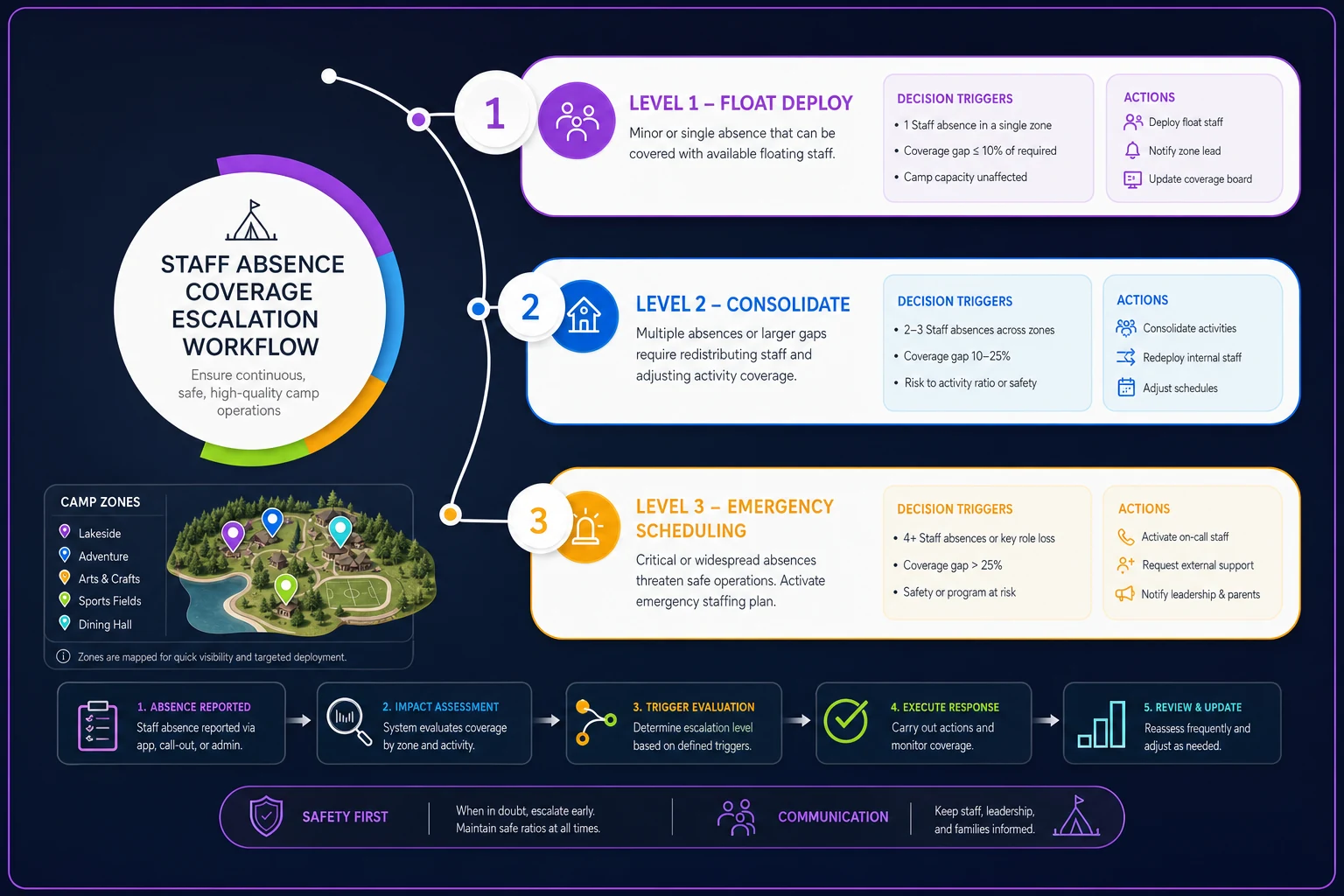
Each level needs specific triggers, not judgment calls. "When we're short-staffed" means nothing at 6 AM when making coverage decisions.
Cross-training matrices that actually work
Most cross-training fails because it treats all skills equally. Your tennis instructor might know basketball basics, but can they manage the behavioral dynamics of switching from individual to team sport supervision?
Build competency levels, not just skill lists:
Level A: Full Competency Can lead activity independently, handle emergencies, manage behavior, teach progressions
Level B: Supervised Competency Can run activity with remote supervision, handle basics, maintain safety, follow established lesson plans
Level C: Emergency Coverage Can provide safe supervision, run simple activities, maintain ratios, buy time until proper coverage arrives
Your matrix might look like:
| Staff Member | Swimming | Archery | Crafts | Soccer | Drama |
|---|---|---|---|---|---|
| Sarah M. | A | C | B | A | C |
| Mike T. | B | A | C | B | C |
| Jessica L. | C | B | A | C | B |
| David K. | A | C | C | B | B |
The matrix doesn't drive decisions by itself. Add operational constraints:
-
Sarah can't cover swimming and soccer simultaneously (opposite ends of camp)
-
Mike's archery certification expires week 6
-
Jessica handles sensitive campers better than large groups
-
David speaks Spanish (critical for certain camper groups)
Update these constraints weekly. The counselor who handled pottery perfectly in week 2 might be burned out by week 7.
Some camps discover that their best cross-trainers aren't necessarily their most experienced staff. Sometimes that second-year counselor who's naturally adaptable handles transitions better than the specialist who's been running the same activity for five summers.
Float rotation schedules for sustained coverage
Random float assignments burn people out. The same reliable counselors end up covering every crisis while others never get called. Build structured rotation that spreads the load predictably.
Week 1-2: Building Capacity
-
Morning float
Senior staff only
-
Afternoon float
Split between senior/junior
-
Priority
Training juniors through shadowing
Week 3-5: Peak Preparation
-
Morning float
Junior staff primary
-
Afternoon float
Senior staff primary
-
Priority
Building junior confidence before peak
Week 6-8: Peak Weeks
-
All hands rotation
-
4-hour float shifts maximum
-
Mandatory recovery blocks after coverage
Structure float schedules around energy patterns. That energetic counselor who brings amazing morning energy might crash by 2 PM. The steady afternoon performer might need three coffees to function before 10 AM.
Build in float recovery time. Four hours of bouncing between coverage areas is more exhausting than eight hours in your assigned role. Counselors need transition time to switch mental modes between activities.
Schedule mandatory recovery blocks after 4-hour float shifts to prevent burnout.
Some camps try to incentivize float coverage with extra pay. This backfires during peak weeks—you get the counselors who need money, not necessarily those best suited for flexible coverage. Build float duties into base expectations with recovery perks: first choice on days off, premium break locations, exemption from cleanup duties.
Parent communication scripts that preserve confidence
Parents judge camp stability through communication tone. One panicked email about staff shortages triggers ten withdrawal requests. But silence during visible chaos erodes trust faster.
Proactive Messaging (before issues visible): "Good morning Camp Families, This week brings our highest enrollment of the summer—247 campers ready for adventure! With full capacity comes slight schedule adjustments to ensure every camper gets maximum attention and fun. Tuesday/Thursday: Combined junior and senior swim lessons (more games, same skill building!) Wednesday: Merged arts and crafts with nature exploration (outdoor creativity day) Friday: All-camp field activities replace separated sports rotations Your campers won't notice these as 'changes'—they'll experience them as special peak week programming. Same counselor ratios, enhanced group activities, and more opportunities for siblings and friends across age groups to connect."
Reactive Messaging (addressing visible changes): "Camp Families, Quick update from this morning's unexpected adjustments: Three staff members encountered transportation delays due to the Route 95 closure. We've seamlessly deployed our float team and merged morning activities into super-groups with special all-camp games. Regular programming resumes at 11 AM. Lunch and afternoon schedules remain unchanged. Camp thrives on flexibility—today your campers learned adaptation and community support firsthand. They're having a blast with the unexpected morning adventure!"
Never use words like "shortage," "absence," or "emergency" in parent communications. Frame everything through program enhancement or special opportunities.
The messaging works because you're giving parents information before they start wondering why their kid's swimming lesson turned into a treasure hunt. Control the narrative before rumors start.
Consolidation versus cancellation decision framework
The urge to maintain all programming at reduced quality hurts more than strategic consolidation done well. Parents prefer one excellent combined activity over two mediocre separated ones.
Consolidation triggers:
-
Specialist coverage drops below 50%
-
Safety ratios at minimum legal limits
-
Staff energy visibly depleted
-
Weather creates additional complications
-
Multiple zones simultaneously affected
Cancellation triggers:
-
Cannot maintain legal ratios
-
No qualified supervisor for high-risk activities (swimming, climbing)
-
Staff illness outbreak (3+ with similar symptoms)
-
Emergency services advise closure
-
Insurance requirements cannot be met
Map consolidation options before you need them:
Natural Merges:
-
Junior + Senior swimming → Mixed age aquatics
-
Soccer + Basketball → Field sports rotation
-
Arts + Crafts → Creative workshop
-
Music + Drama → Performance arts
Problematic Merges:
-
Swimming + Any land activity (location logistics)
-
Quiet activities + High energy sports (incompatible energy)
-
Large group + Special needs support (attention dilution)
Build your week with consolidation points pre-identified. Tuesday and Thursday already have compatible schedules? Those become your automatic merge days if needed. Monday has complex logistics? Protect it with maximum float coverage.
Technology and documentation systems
Paper systems collapse during actual emergencies. The binder with everyone's certifications sits in the locked office. The emergency contact list hasn't been updated since May. The cross-training matrix exists only in the assistant director's head.
Build hybrid documentation:
-
Core documents printed daily (ratios, certifications, emergency contacts)
-
Digital systems for real-time updates
-
Automated sync when connectivity returns
-
SMS fallback for critical communications
Track absence patterns across seasons. That counselor who called out three Wednesdays in a row might have a standing appointment they forgot to mention. The waterfront team consistently has higher Monday absences? Maybe Sunday night gatherings need addressing.
Modern operational platforms can predict coverage needs based on historical patterns. When three counselors requested the same July weekend off last year and you barely survived, the system flags it during spring scheduling.
When absence rates spike every time certain counselors work together, you notice before peak week arrives. Sometimes personality conflicts create stress that leads to sick days.
Real-world implementation timeline
January-February: Framework Design Build your zones, establish competency levels, create initial matrices
March-April: Staff Integration Include coverage expectations in contracts, discuss float duties during hiring, set cultural expectations
May: Initial Training Cross-training sessions, practice coverage drills, refine zones based on actual staff
June: System Testing Intentional coverage exercises, identify weak points, adjust matrices
July: Peak Implementation Full system activation, daily adjustment meetings, continuous documentation
August: Recovery and Analysis Debrief with staff, analyze patterns, document lessons
September: Next Year Planning Revise frameworks, update job descriptions, modify training plans
Camps that handle peak week absences smoothly started preparing in winter, not when the first counselor called in sick. The planning feels like overkill until that Tuesday morning when everything falls apart. Then it becomes essential.
Beyond basic coverage
Your camp staff absence contingency plan tests organizational resilience. Can your operation flex without breaking? Do your systems support rapid adaptation? Does your culture embrace coverage as community support rather than burden?
Strong contingency planning becomes invisible when executed well. Parents see engaged counselors running creative programming. Staff feel supported rather than stressed. Campers experience adventure, not disruption.
The best framework is one you rarely fully activate. But when that Tuesday morning brings multiple absences during your busiest week, you'll shift smoothly from panic to process. Your escalation tree guides decisions. Cross-trained staff deploy confidently. Parents receive reassuring updates before concerns arise.
Peak weeks will always bring surprises. The question isn't whether absences will happen, but whether your operation can absorb them without anyone noticing the scramble behind the scenes.
Ready to elevate your camp management?
Join 500+ camps using Campyly to save administrative time, enhance camper experiences, and streamline daily operations.