


Most camps don't have a people operations problem. They have a handoff problem.
Recruiting hands off to onboarding with half the context missing. Onboarding hands off to supervisors who never saw the hiring notes. Performance "reviews" happen in a parking lot conversation during week six. By the time August hits and you're deciding who to invite back, the only data you have is a gut feeling and a Google Doc someone half-filled-out in July.
That disconnection is the actual cost center. Not turnover alone — the fact that nothing connects, so you rebuild the same institutional knowledge every single season from scratch.
A real seasonal people operations system for camp isn't a stack of forms. It's a governance layer: defined owners, defined metrics, defined decision gates, and reusable artifacts that let you budget training like a line item and report people outcomes to your board the same way you report enrollment or cash position. This article walks through how the whole thing fits together — and where it tends to crack when you scale from one site to three.
Why camp people-ops breaks differently than year-round orgs
Year-round employers get to amortize their people investments over 12 months or more. You don't. You compress recruiting, onboarding, development, evaluation, and the rehire decision into roughly 14–16 weeks, then everyone leaves.
That compression changes everything about governance. In a normal company, a bad hire reveals itself over a quarter and you course-correct. At camp, a bad hire reveals itself in week two, and you've already lost a third of your usable runway. There's no slack.
The second structural difference: your talent pipeline is your alumni pipeline. The counselor you develop this year is your unit leader in two years and your assistant director in five — if you capture the data to make that case. Most camps don't. They treat each season as a closed loop instead of one segment of a multi-year ladder.
So the system has to do two jobs at once. It has to run hot inside a single season, and it has to accumulate across seasons. Those are different design requirements, and conflating them is where most directors go wrong.
The recruiting-to-onboarding bridge
When a candidate comes through, your funnel should capture more than "hired / not hired." It should flag the why — strong on youth development, weak on waterfront confidence, needs conflict-handling reps. That flag is the single most valuable input to a targeted onboarding plan, and it's the one almost everyone throws away.
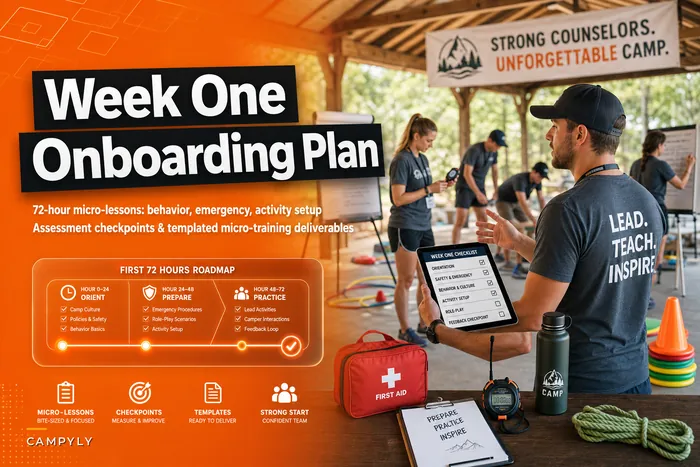
If you've built a serious onboarding sequence — and if you haven't, the first-72-hours counselor onboarding plan is the place to start — the recruiting flags should feed directly into which micro-modules each hire gets prioritized. A waterfront-nervous hire and a conflict-shy hire should not get the identical day-two schedule.
The five linked stages (and the handoffs that actually fail)
Think of the whole thing as one pipeline with five stages. The value isn't in any single stage — it's in what carries forward between them.
Simplify camp operations with centralized control.
Campyly empowers you to manage registrations, staff, and activities seamlessly—all from one platform.
- Integrated camper and staff management
- Automated notifications and alerts
- Dynamic scheduling and resource allocation
No credit card required
| Stage | Primary KPI | Common failure at the handoff |
|---|---|---|
| Recruiting | Qualified-applicant-to-offer ratio; time-to-fill | Hiring notes never reach the direct supervisor |
| Onboarding | % certified-ready by day 3; early attrition (first 2 weeks) | No link between role gaps identified in hiring and training focus |
| Performance | % staff with a mid-season checkpoint logged | Reviews happen verbally, nothing written, nothing comparable |
| Micro-learning (L&D) | Module completion %; competency lift | Training calendar isn't tied to review gaps, so it's generic |
| Promotion / Rehire | Rehire-intent rate; promotion-fill-from-within % | Decision made on memory, not on a documented record |
Look at that failure column. Every single break is a data discontinuity. The hiring team knows something onboarding needs. Onboarding spots a gap that L&D should address. The supervisor sees a performance issue that the rehire decision should weigh. None of it travels.
A governance system's main job is to make the record travel. Everything else is secondary.
KPI definitions that actually mean something on a board slide
Directors get into trouble when they report activity instead of outcomes. "We trained all staff" is activity. "87% of staff hit certified-ready by day 3, up from 71% last season" is an outcome. Boards fund outcomes.
Here's a working KPI set, with definitions tight enough that two different people measuring them get the same number:
-
Time-to-fill (per role class) Calendar days from req-open to signed offer. Measure separately for leadership vs. general counselor — they behave completely differently.
-
Certified-ready by day 3 % of new hires who've completed all mandatory certifications and sign-offs before campers arrive. This is your single best leading indicator of a smooth week one.
-
Early attrition % of hires who leave (or are let go) within the first 14 days. High early attrition almost always traces back to a recruiting-screening mismatch, not a training failure.
-
Mid-season checkpoint coverage % of staff with a documented review logged by the midpoint. If this is under 90%, your performance data for rehire decisions is fiction.
-
Competency lift Change in a staffer's rubric score between onboarding baseline and mid-season. This is what justifies your L&D budget.
-
Rehire-intent rate % of departing staff you'd actively invite back. Track it, because it's your leading indicator for next season's recruiting cost.
-
Promotion-fill-from-within % of leadership roles filled by returning staff vs. external hires. Rising = your ladder works. Falling = your pipeline is leaking.
The two metrics directors most often skip — rehire-intent and promotion-fill-from-within — are also the ones that predict next year's budget most accurately. External leadership hires cost significantly more in both recruiting spend and ramp time than promoting someone who already knows your culture.
Who owns what: a RACI you can actually run
The fastest way to kill a people system is to make it "everybody's job," which means nobody's. Each stage needs one accountable owner, and that owner shouldn't change mid-season.
| Activity | Director | Asst. Director / Coordinator | Unit Leader / Supervisor | HR / Admin |
|---|---|---|---|---|
| Recruiting funnel & screening | A | R | C | R |
| Onboarding delivery | A | R | R | C |
| Mid-season reviews | C | A | R | I |
| L&D calendar & modules | A | R | C | I |
| Promotion decisions | A | R | C | I |
| Rehire decisions | A | C | R | I |
| KPI reporting to board | R/A | C | I | C |
(A = Accountable, R = Responsible, C = Consulted, I = Informed)
The non-obvious part: unit leaders are Responsible for mid-season reviews but only Consulted on promotion decisions. That separation is deliberate. The person doing day-to-day evaluation shouldn't be the sole voice on advancement — it concentrates too much bias in one relationship. Keep the data collector and the decision-maker structurally distinct.
The L&D calendar as a budget instrument, not a nice-to-have
Most directors treat training as a sunk cost — a thing you do because you have to — instead of an investment with a measurable return. That's where real budget leverage gets left on the table.
A budgeted training line should answer one question: what does this module change, and is that change worth more than the module costs?
A worked example. Say you're spending roughly $90–$110 per staffer on a structured conflict-de-escalation micro-course — materials, trainer time, the hours themselves at wage. Forty general staff puts you around $4,000 for the season.
What does it buy? In camps that run this well, documented camper-behavior incidents requiring director intervention tend to drop noticeably — often by a third or more — because frontline staff handle conflicts earlier. If each director-level incident eats 45–90 minutes of your time plus a parent call, and you're preventing even 15–20 of them across a season, you've bought back a real chunk of your own capacity plus reduced the parent-complaint load that quietly erodes re-enrollment.
That's the framing boards respond to: not "we trained staff on conflict," but "we spent roughly $4k and reduced director-involved incidents by about a third while protecting retention."
The trick is tying each module to a KPI it should move. If a module doesn't map to a metric, it's either entertainment or compliance — and you should budget those differently and honestly.
Building the calendar backward from review gaps
The strongest L&D calendars aren't planned in the spring. They're planned from last season's review data. If mid-season rubrics consistently flagged weak behavior-management in week-one staff, that's your pre-season priority module. The calendar becomes a direct response to measured gaps, not a recycled agenda.
This is also where your volunteer development overlaps — many camps run parallel tracks, and the volunteer program playbook covers how to sequence volunteer training without duplicating the paid-staff calendar or burning your trainers out running everything twice.
Promotion decision gates: how to make advancement defensible
"She's great, let's make her a unit leader" is how camps end up with strong counselors in leadership roles they're not ready for — and then lose them when it goes badly.
Gates fix this. A promotion gate is a small set of pass/fail-ish conditions that have to be met before a promotion conversation even happens. They don't guarantee a promotion; they qualify someone to be considered.
-
Tenure gate At least one full completed season (or a documented equivalent).
-
Performance gate Mid-season rubric score above a defined threshold, not a single supervisor's say-so.
-
Competency gate Completion of the leadership-track micro-modules, with demonstrated — not just attended — results.
-
Peer/behavioral gate No unresolved safeguarding or conduct flags. This one is non-negotiable and should be a hard stop.
-
Capacity gate An actual open role, budgeted, with headcount that fits your staffing model.
That last gate trips up more camps than you'd expect. People get promoted into roles that don't exist in the budget, and then the whole FTE math breaks. If you haven't pinned your headcount logic down, the reproducible camp staffing model is where promotion decisions should reconcile against real capacity rather than wishful thinking.
The governance benefit of gates is that the decision stops being personal. When someone isn't promoted, you're not saying "we don't like you." You're saying "gate three isn't met yet, here's the specific module to close it." That's a retention conversation instead of a resignation trigger.
The alumni-rehire loop: your cheapest recruiting channel
Every season you let strong people walk without a documented rehire record, you're paying full price to replace them next year. The rehire loop closes that leak.
At the end of each season, every departing staffer gets a simple, consistent record:
-
Final rubric score and competency lift over the season
-
Rehire-intent rating from their supervisor (Yes / Conditional / No)
-
One documented development note — what they'd need to grow into next season
-
Role they'd be a fit for next year
That record does two things. It gives next year's recruiting a warm, pre-qualified pool — people who already know your culture, which cuts both time-to-fill and early attrition. And it gives you an honest number on promotion-fill-from-within, so you can actually see whether your ladder is working or just aspirational.
Camps that formalize rehire-intent capture tend to see their returning-staff percentage climb within two or three seasons, almost entirely because they stopped losing the record. The people were always willing to come back. Nobody had written down to ask them.
Reusable templates: the artifacts that make this repeatable
Governance lives or dies on whether the next person can run it without you in the room. That means templates. The minimum durable set:
-
Recruiting funnel tracker — stages, source, screening flags, and the "why" note that bridges to onboarding.
-
Review rubric — a fixed set of competencies scored on a consistent scale, same instrument at baseline and mid-season so you can measure lift.
-
L&D calendar — modules mapped to the KPI each one targets, with cost and owner per module.
-
Promotion gate checklist — the pass/fail conditions, documented per candidate.
-
Rehire record — the four-item end-of-season capture above.
-
People-ops board slide — the five or six KPIs that roll up to governance reporting, in the same format every season.
Standardizing the instruments isn't bureaucracy. It's comparability. A rubric only tells you about competency lift if it's the same rubric across time and across staff. The moment each supervisor invents their own, your data stops aggregating and you're back to gut feel.
When this full system makes sense — and when it doesn't
When it's worth building: You're running more than roughly 25–30 seasonal staff, you're returning year over year, and you have a board or owner you report to. At that scale, the handoff losses are real money and the governance artifacts pay for themselves in a season or two.
When it's overkill: A tiny day camp with eight staff, most of whom are family or long-returning locals, doesn't need promotion gates and RACI charts. Run a lightweight version — a rubric and a rehire note — and skip the rest. Forcing full governance onto a micro-operation just creates paperwork nobody maintains.
Who should NOT do this yet: If your core safeguarding and screening pipeline isn't solid first, don't build the development ladder on top of a shaky foundation. Lock down the non-negotiables, then layer the growth system.
A real scenario: what changes when the links hold
Consider a mid-size overnight camp — around 45 seasonal staff, two sessions, a board that wanted real people metrics instead of "everyone worked hard this year."
Before: recruiting was a spring scramble, reviews were verbal and inconsistent, and rehire decisions happened over text message in September. Returning-staff rate hovered around 40%, early attrition ran high enough that they were backfilling into week two most seasons, and training was the same generic pre-camp day it had always been.
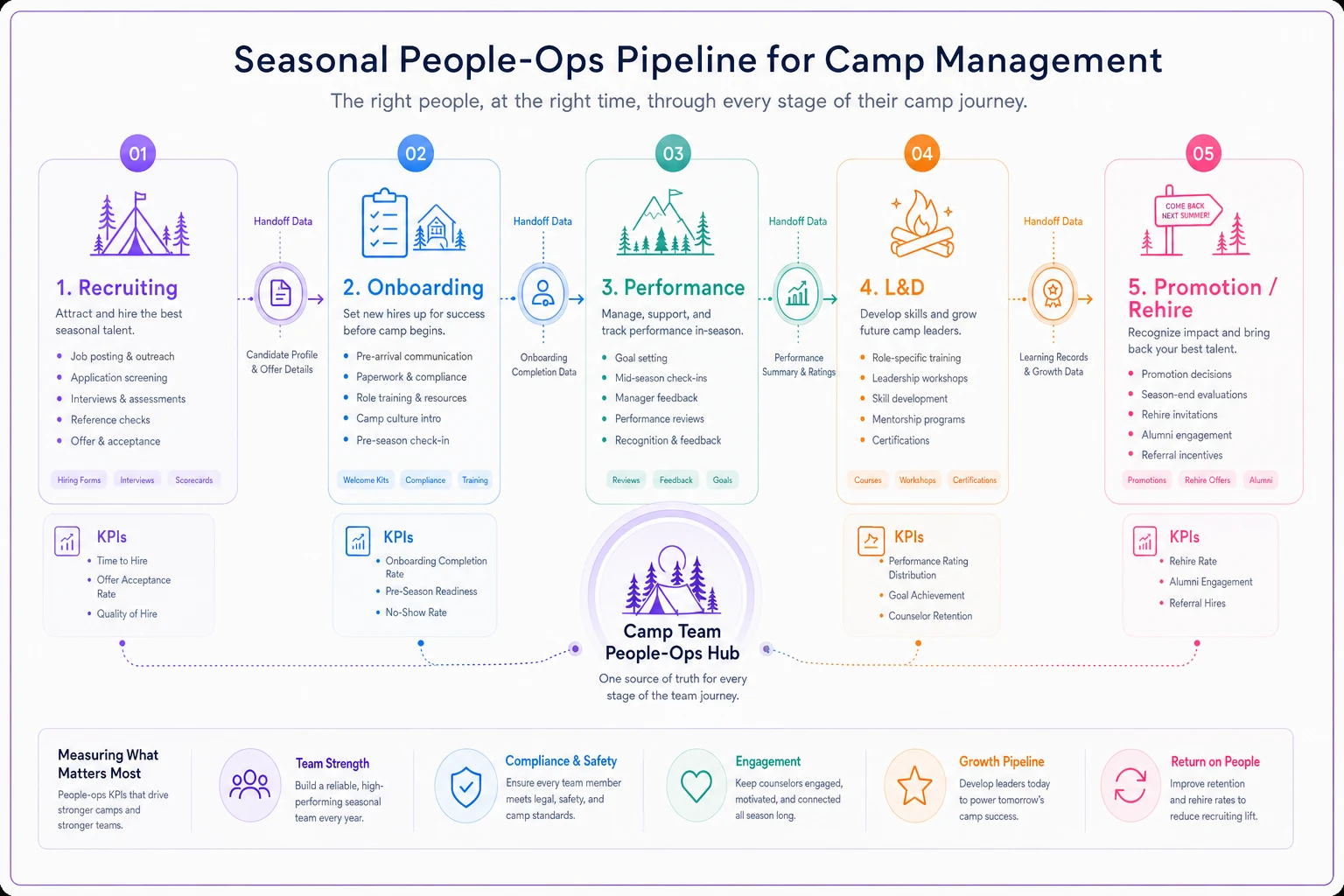
The diagram above shows the five-stage pipeline and the handoff data points used in this scenario.
They didn't overhaul everything at once. They started with three artifacts: a consistent rubric, mid-season checkpoints with real coverage, and an end-of-season rehire record. The L&D calendar got rebuilt the following spring off those rubric gaps.
Within two seasons, the returning-staff rate climbed into the mid-50s, early attrition dropped off noticeably because recruiting flags were finally reaching onboarding, and — the part the board actually cared about — the director could present a people slide showing competency lift and promotion-fill-from-within as hard numbers. The spring recruiting scramble shrank because roughly half the leadership roles were filling from within.
None of that required new technology or a bigger budget. It required the record to travel from one stage to the next, and someone accountable at each gate.
Where the system usually earns its keep
The honest payoff of a connected people-ops system isn't any single metric. It's that you stop rebuilding from zero every April. Institutional knowledge compounds instead of evaporating. The counselor you developed shows up in your promotion pipeline with a documented track record. The training dollar you spent shows up as measurable competency lift on a board slide. The person who left on good terms shows up in next year's warm pool instead of a cold ad.
Camps run on people, and seasonal camps run on remembering people — across a nine-month gap when everyone's scattered. The governance layer is how you remember accurately enough to budget, report, and improve.
Build the links, name the owners, standardize the artifacts. The season will still run hot. But it'll run hot on top of something that lasts longer than the season.
Ready to elevate your camp management?
Join 500+ camps using Campyly to save administrative time, enhance camper experiences, and streamline daily operations.