

The gap between "counselor signed the contract" and "counselor can run a cabin alone" is where most camps quietly lose their first week. You've hired well, run background checks, maybe even paid for a full orientation weekend — and yet on Day 1 a counselor freezes when a kid melts down, nobody knows where the EpiPens live, or the arts-and-crafts station opens 20 minutes late because nobody set it up.
The problem isn't that counselors are unprepared people. It's that onboarding usually happens in one giant Saturday brain-dump, and human brains don't retain a firehose. What sticks is sequenced, time-boxed, and tested — which is exactly what a real counselor onboarding camp plan needs to be. So here's a 72-hour version built around micro-lessons and checkpoints, designed so that by the time campers arrive, you actually know who's ready and who needs a shadow day.
Why the "one big orientation day" model keeps failing
Most camps front-load everything into a single 8-hour orientation. Somewhere around hour four, a counselor has heard the allergy protocol, the fire drill route, the behavior escalation ladder, the waterfront rules, and the lost-camper procedure — all in a fog. Ask them on Monday where the incident forms are and half of them guess.
-
No spacing. Everything is delivered once, with no repetition. Adults forget roughly half of new information within a day if it isn't reinforced.
-
No testing. Sitting through a session isn't the same as being able to do the thing. Without a checkpoint, "I attended" gets treated as "I'm competent."
-
No sequencing logic. Behavior management gets taught next to inventory sign-out sheets, as if they carry the same weight. They don't.
-
Passive delivery. A director talking at 40 people for 45 minutes is the least effective way to teach a behavioral skill.
A typical example looks like this: a mid-size day camp with around 22 seasonal counselors runs one Saturday orientation, feels good about it, then spends the entire first week fielding radio calls that all boil down to "what do I do when…" — questions that were technically "covered" on Saturday.
The core idea: three days, small modules, real checkpoints
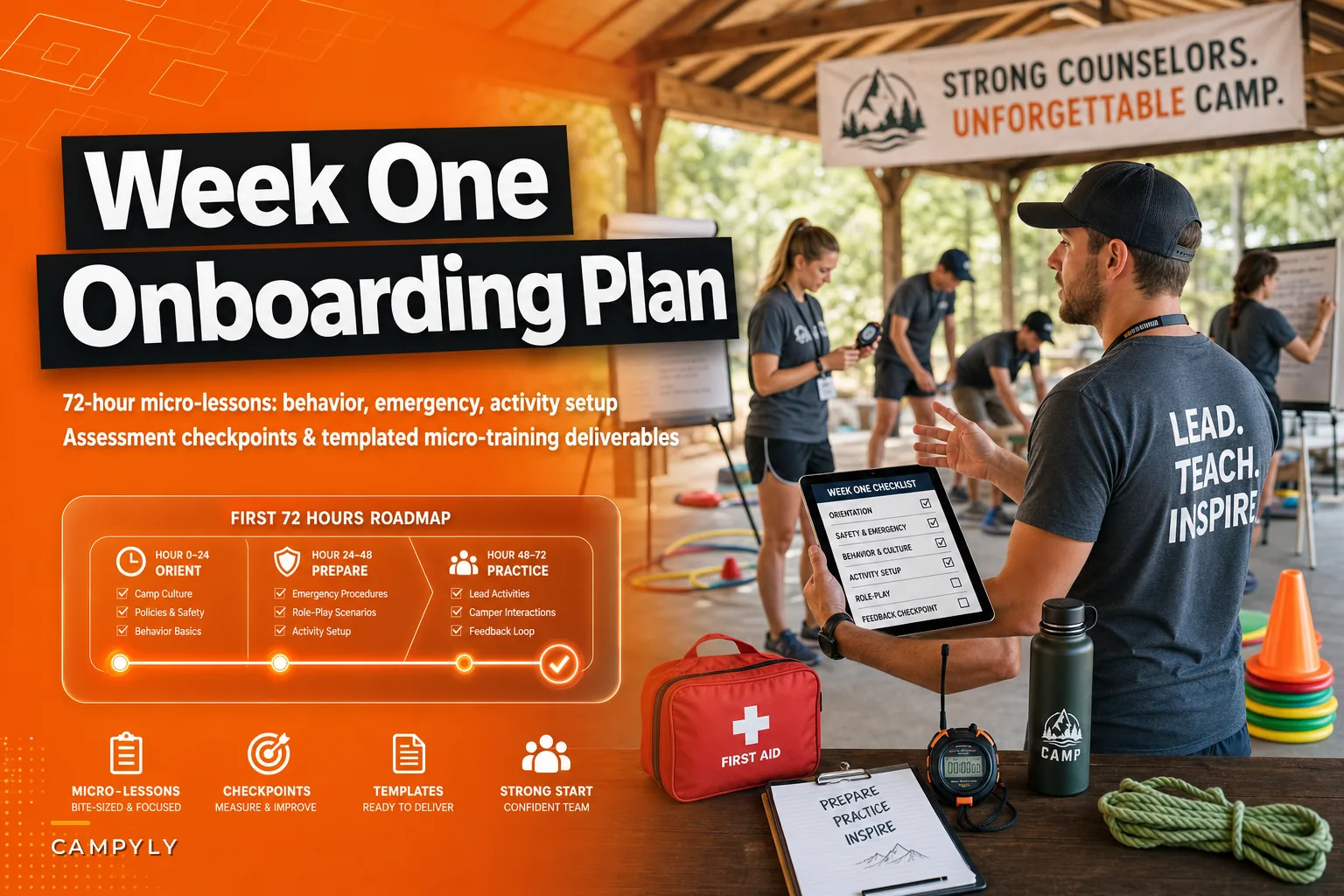
Instead of one dump, you break onboarding into three focused days with a handful of short modules each. Every module is 20–40 minutes, ends with a quick assessment, and produces something you can see — a signed checklist, a role-play pass, a completed setup. The point isn't to add more hours. Most of these plans total 9–11 hours of contact time, which is often less than the bloated single-day version because you cut the filler.
Simplify camp operations with centralized control.
Campyly empowers you to manage registrations, staff, and activities seamlessly—all from one platform.
- Integrated camper and staff management
- Automated notifications and alerts
- Dynamic scheduling and resource allocation
No credit card required
Three priorities get the most airtime, in this order:
-
Behavior management (the thing that eats a counselor's day)
-
Emergency response (the thing that has to be automatic)
-
Activity setup and flow (the thing that makes the day actually run)
Everything else — dress code, sign-out sheets, meal roster — becomes a reference sheet, not a lecture.
The 72-hour sequence at a glance
Here's the shape of it. Times assume staff are on-site or joining remotely in scheduled blocks, not doing it whenever.
| Window | Focus | Micro-lessons | Checkpoint |
|---|---|---|---|
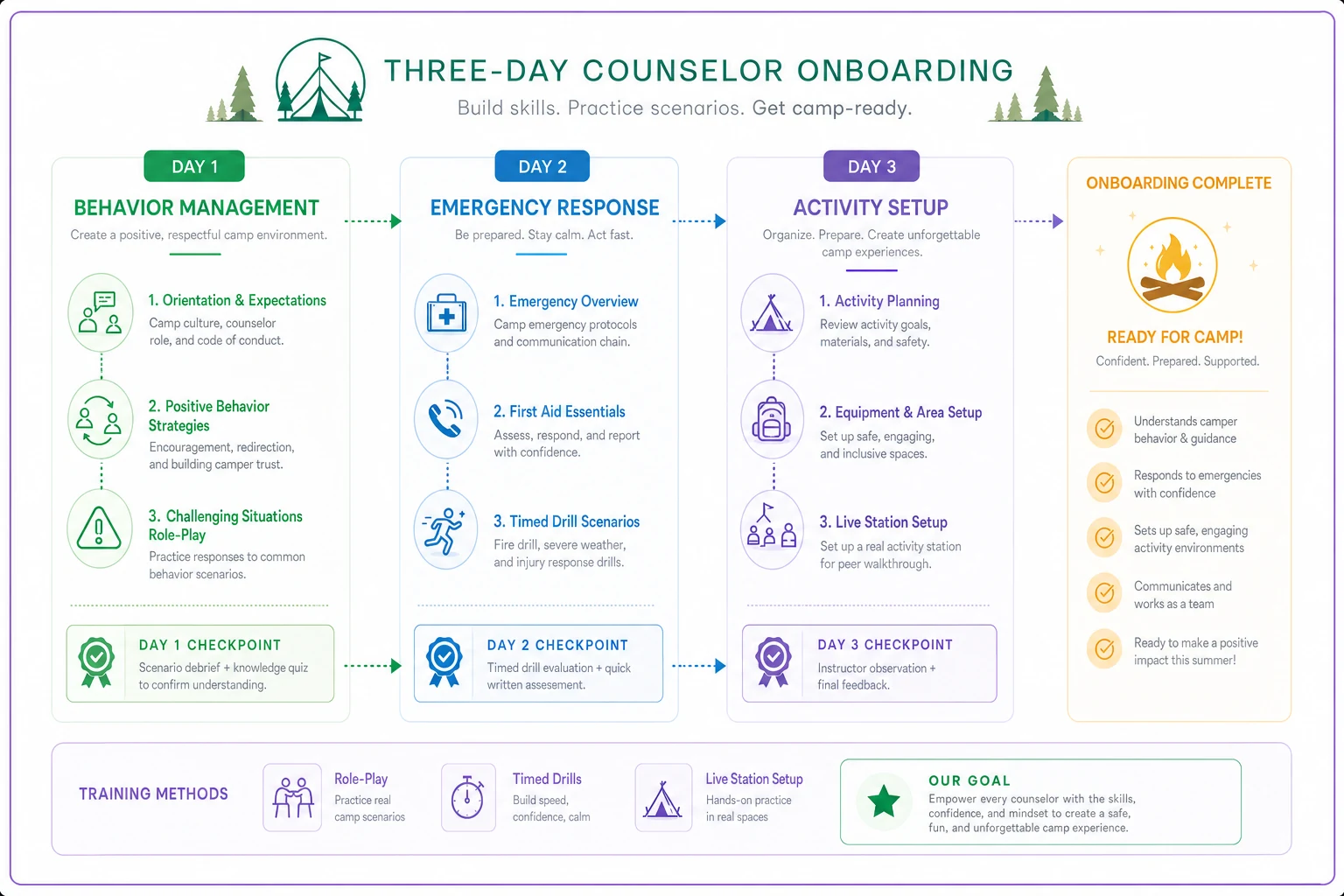
| Hours 0–24 (Day 1) | Behavior foundations | Escalation ladder, positive redirection, homesickness, difficult conversations with parents | Role-play pass + written scenario quiz |
| Hours 24–48 (Day 2) | Emergency response | Medical/allergy protocol, missing camper, weather/evacuation, incident documentation | Timed drill + protocol recall check |
| Hours 48–72 (Day 3) | Activity setup & flow | Station setup, transitions, group management ratios, supply handling | Live station setup + observed transition |
The magic isn't the grid — it's that each row ends in a pass/fail signal. You're not hoping people absorbed it. You're checking.
This visual summarizes the three-day workflow and checkpoints.
The magic isn't the grid — it's that each row ends in a pass/fail signal. You're not hoping people absorbed it. You're checking.
Day 1: Behavior management (Hours 0–24)
This is the day counselors will thank you for later, because behavior is what fills most of their real workload. Skills, not slides.
Micro-lesson 1 — The escalation ladder (30 min). Walk through the exact steps from "gentle redirect" to "involve senior staff." Keep it to one page. The mistake most camps make is teaching philosophy here ("we believe in positive discipline") instead of the actual sequence of moves a counselor makes when a 9-year-old refuses to leave the pool.
Micro-lesson 2 — Redirection and de-escalation (30 min). Practice, not theory. Counselors pair up and run three short scenarios: the kid who won't participate, the two campers fighting over equipment, the child having a full meltdown. One plays counselor, one plays camper, a lead observes.
Micro-lesson 3 — Homesickness and emotional first aid (20 min). This is the quiet one that causes the most parent phone calls. Give them scripts. Literal sentences to say.
Micro-lesson 4 — Parent-facing moments (20 min). What a counselor says at pickup when a kid had a rough day. Two minutes of a bad answer here can cost you a returning family.
Checkpoint: Each counselor runs one live role-play in front of a lead and passes a 10-question scenario quiz ("A camper throws sand at another child. Your first move is…"). Anyone who freezes gets flagged for a shadow day — not punished, just paired with an experienced counselor for Week 1.
The insight most directors miss: the role-play is the training, not the test. People learn the escalation ladder by doing it wrong once in a safe room rather than wrong for real in front of 12 kids.
Day 2: Emergency response (Hours 24–48)
Behavior can be improvised. Emergencies cannot. Day 2 is about building automatic responses, which means repetition and timed drills — not a slideshow.
Micro-lesson 1 — Medical and allergy protocol (40 min). Where the meds are, who's authorized, the exact allergy response sequence, and — critically — how a counselor knows which camper has which allergy in the moment. If your only answer is "check the binder," you have a gap. This ties directly into your incident and health tracking systems, and it's the kind of thing that should be dead-simple to look up on a phone in the field, not buried in a filing cabinet in the office.
Micro-lesson 2 — Missing camper drill (30 min). Run it live. Actually make someone "go missing" and time the response. The first time a camp does this, response times are usually messy and slow. That's the point of doing it before campers arrive.
Pro-tip: Run the missing-camper drill twice back-to-back so the second run reflects tightened roles and improved timing.
Micro-lesson 3 — Weather and evacuation (30 min). Routes, muster points, headcount procedure. Walk it physically if you can. People don't remember evacuation routes from a map; they remember them from walking the path once.
Micro-lesson 4 — Incident documentation (20 min). What gets written down, when, and by whom. A counselor who handles the incident but can't document it leaves you exposed later.
Checkpoint: A timed missing-camper drill plus a short recall check on the allergy sequence. For a small day camp, a full accounted-for headcount within about 6–8 minutes is a reasonable Day 2 target — and you'll watch it tighten with a second run.
Camps that drill emergency response before the season tend to handle real incidents with far less panic, and their staff absence contingency plans hold up better too, because trained staff can step into unfamiliar roles under pressure. If you don't have a backfill plan for the day someone calls out sick during peak week, a step-by-step contingency plan for last-minute staff absences pairs naturally with this onboarding sequence.
Day 3: Activity setup and daily flow (Hours 48–72)
By now they can manage behavior and respond to emergencies. Day 3 is about making a normal day run smoothly — which is mostly about transitions and setup, the two things that silently wreck a schedule.
Micro-lesson 1 — Station setup (30 min). Each counselor physically sets up one real activity station from scratch using the actual supply list. You immediately find out which stations take longer than the schedule allows.
Micro-lesson 2 — Transitions (30 min). Moving 15 kids from the field to lunch without losing 10 minutes and two campers is a skill. Teach the count-off, the line-up cue, the buddy check.
Micro-lesson 3 — Ratios and group management (20 min). What the ratio actually means in practice when one counselor needs a bathroom break.
Micro-lesson 4 — Supply handling and reset (20 min). How stations get reset for the next group so the day doesn't degrade by hour three.
Checkpoint: Observed live station setup and one observed group transition. If it takes a counselor 18 minutes to set up a station the schedule allots 10 for, you've found a scheduling problem before it blew up your first day.
Building the micro-training deliverables (so you can reuse them)
The reason this survives past one season is that each module has a template. You build it once, then tweak. For every micro-lesson, create:
-
A one-page cheat sheet (the counselor keeps this)
-
A facilitator script (so any lead can run the module, not just you)
-
A checkpoint rubric (what "pass" looks like, in plain terms)
-
A remote version (a short recorded walkthrough + a live check-in for staff who can't attend in person)
That last one matters more every year. Seasonal staff scatter — college students, out-of-town hires — and forcing everyone into one physical Saturday no longer works. A remote track that still ends in a real checkpoint (a video role-play submission, a live 15-minute drill over call) keeps standards intact without demanding everyone be in the same room.
Keeping all of this in one place — the modules, who's completed what, who passed which checkpoint, who got flagged for a shadow day — is where a shared operations system earns its keep. When onboarding status lives in one dashboard instead of a director's memory and three spreadsheets, you walk into Day 1 knowing exactly which counselors are cleared and which need a buddy. This fits inside a broader modular camp operations playbook rather than living as a standalone binder nobody opens after week one.
A real scenario: what changes when you sequence it
A day camp running roughly 180 campers across the week hired around 24 seasonal counselors. Their old model was one Saturday orientation. Their first week every summer was rough — lots of radio traffic, a couple of behavior incidents that escalated further than they should have, and stations consistently opening late on Monday.
They switched to the 72-hour sequence: three shorter days, checkpoints at each. The first practical change was that four counselors failed the Day 1 behavior role-play — which sounds bad, but meant those four got paired with experienced staff for Week 1 instead of being handed a cabin cold. The missing-camper drill on Day 2 started at a messy 11 minutes and dropped to under 7 by the second run.
The outcome that mattered: their first Monday went from constant radio calls all morning to a noticeably quieter open, and the two escalated-behavior incidents that used to happen in Week 1 didn't repeat. Nothing magical — they just stopped confusing "attended orientation" with "can do the job."
When this makes sense — and when it doesn't
This works well when:
-
You have 10+ seasonal counselors and can't personally shadow each one
-
Your first week has historically been the messiest part of the season
-
You have at least a few experienced leads who can run modules and observe checkpoints
This is overkill when:
-
You run a small operation with 4–5 counselors you already know well and can train hands-on
-
Your season is a single short session where the setup cost outweighs the benefit
Who should NOT just copy this blindly: camps with heavy specialized programming — aquatics-intensive, adventure/high-ropes, clinical needs. You'll need deeper certification tracks layered on top. The 72-hour sequence handles the general counselor baseline, not specialist competencies.
The one habit that makes it stick
The whole model lives or dies on the checkpoints. Plenty of camps will adopt the three-day structure and then skip the assessments because they feel awkward "testing" volunteers and college kids. Don't. The checkpoint is the only thing that tells you the difference between a counselor who heard the escalation ladder and one who can run it when a kid is screaming in front of a parent.
Sequence the learning, keep the modules small, and make every one end in a visible pass or a flag. Do that, and Week One stops being the part of the season you dread — it becomes the part you've already rehearsed.
Do that, and Week One stops being the part of the season you dread — it becomes the part you've already rehearsed.
Ready to elevate your camp management?
Join 500+ camps using Campyly to save administrative time, enhance camper experiences, and streamline daily operations.