



Most camp directors don't struggle to find volunteers. They struggle with what happens after the volunteer says yes. The parent who signed up to help with arts & crafts shows up on day two, hasn't been background checked, doesn't know where the first aid kit is, and now a senior counselor is babysitting the babysitter instead of running their group.
That's the real problem with a camp volunteer program: it quietly consumes supervision capacity. Every under-trained, loosely-scheduled volunteer pulls a trained staffer off their actual job. By mid-week you've got more bodies on site and somehow less coverage.
This playbook is about fixing that specific failure. Not recruitment fluff, not "why volunteers matter." The actual operational machinery: a 60-minute onboarding path that gets someone useful by lunch, a supervision matrix that defines who watches whom, integration rules so volunteers don't blow holes in your coverage ratios, and scheduling templates that treat volunteers like the variable-reliability resource they are.
Start with the uncomfortable truth: volunteers are a liability surface, not free labor
The mental model that wrecks volunteer programs is treating them as unpaid staff. They're not. They show up inconsistently, you can't discipline them the way you can an employee, and in most states they still count — or fail to count — toward your ratios in ways that matter legally.
What we've seen across a lot of seasonal programs is a predictable pattern: the camps that run volunteers well don't give them independent responsibility. Volunteers augment a supervised station. They never become the supervision. The moment a volunteer is the only adult watching kids, you've created an exposure that your insurance may not cover and your state licensing almost certainly doesn't like.
So before anything else, draw a hard line in writing:
-
Volunteers never have unsupervised contact with a single camper
-
Volunteers never count toward your minimum staff-to-camper ratio
-
Volunteers never handle medications, discipline escalation, or incident documentation
-
Volunteers never drive campers
Everything downstream — training, scheduling, the supervision matrix — flows from those four rules. Get them wrong and no amount of good scheduling saves you.
The 60-minute onboarding path
The reason most volunteer onboarding fails is that it's either nonexistent ("just follow Sarah around") or it's the same two-hour counselor orientation crammed onto someone who's here for one afternoon. Both waste everyone's time.
Simplify camp operations with centralized control.
Campyly empowers you to manage registrations, staff, and activities seamlessly—all from one platform.
- Integrated camper and staff management
- Automated notifications and alerts
- Dynamic scheduling and resource allocation
No credit card required
-
Minutes 0–10
Safety floor.
Emergency signals, evacuation routes, the location of first aid and the nearest trained first-aider, and the single most important rule — "if something feels wrong, you find your supervisor immediately, you don't handle it." This is non-negotiable and identical for every volunteer regardless of role. -
Minutes 10–20
Boundaries and conduct.
Two-adult rule, bathroom protocols, physical contact guidelines, phone/photo policy. This is your liability spine. Have them sign the acknowledgment at the end of this block, not at the car when they're distracted. -
Minutes 20–45
The actual role.
This is where it splits by station. The archery volunteer learns the range rules. The kitchen helper learns the allergen board. The crafts volunteer learns cleanup and the supply cabinet. Specific, hands-on, tied to the one job they'll do. -
Minutes 45–55
Shadow walkthrough.
Walk the physical space. Where they stand, where the kids enter, where their supervisor will be, what "done" looks like at the end of their shift. -
Minutes 55–60
Who's got you.
They meet their named supervisor for the day. Not "the staff" — a specific person with a name and a radio channel.
That last five minutes is the most important part, and most directors skip it or treat it as an afterthought. A volunteer who knows exactly which human to find for every question stops interrupting everyone else. A volunteer with a vague "ask any counselor" instruction becomes a floating distraction for the rest of the day.
You can build the role-specific middle block (minutes 20–45) once per station and reuse it every season. Record a short walkthrough video for each one. That turns onboarding into something a junior staffer can run instead of pulling your most experienced people off-line.
Record a short walkthrough video for each station so onboarding can be run by a junior staffer instead of pulling experienced people off-line.
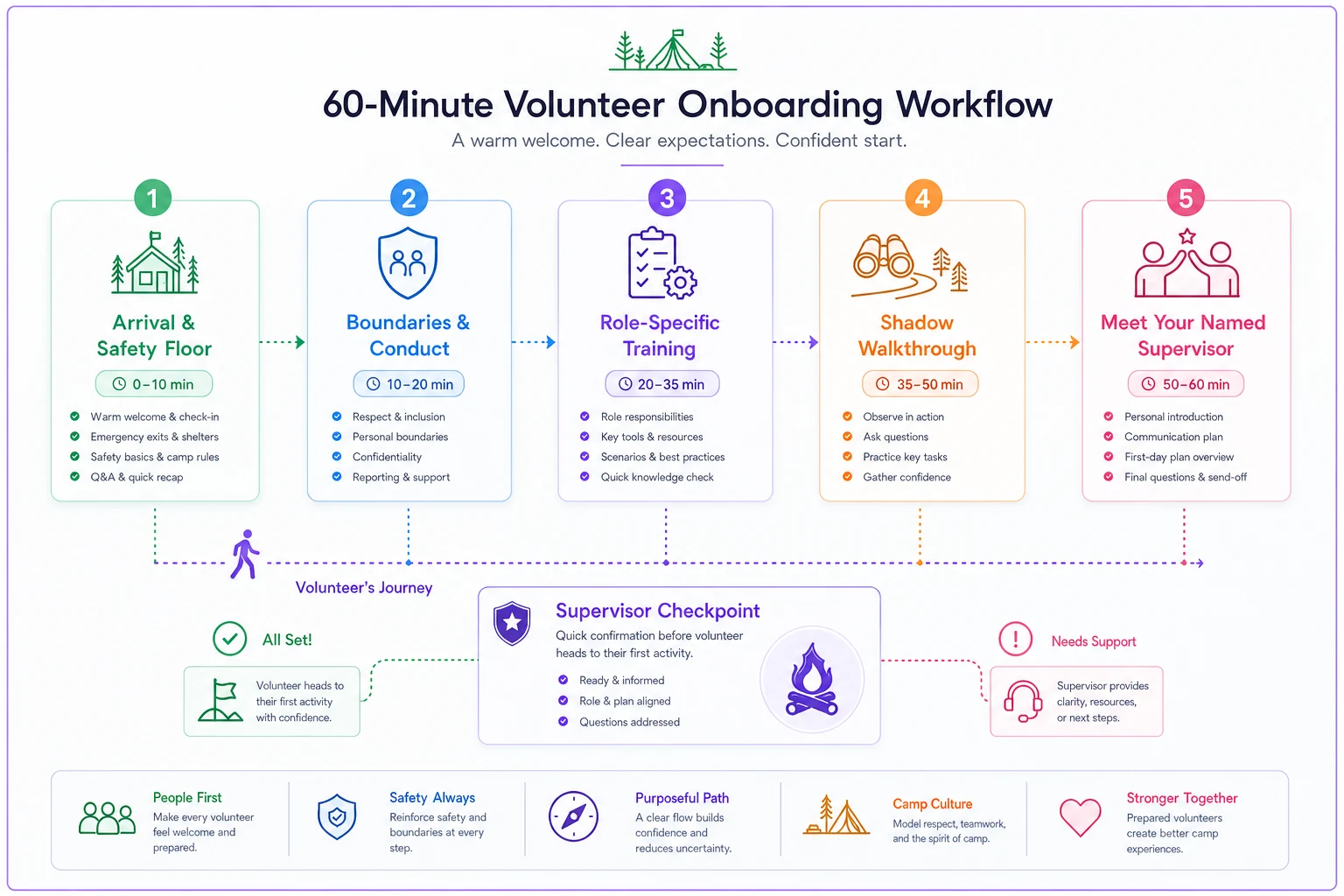
This visual shows the onboarding workflow from arrival through meeting a named supervisor.
The supervision matrix
This is the piece almost nobody documents, and it's the piece that keeps you out of trouble. A supervision matrix answers one question for every volunteer on site at any given moment: who is responsible for this person right now?
Here's a working version you can adapt:
| Volunteer role | Max volunteers per supervisor | Supervising staff type | Can be left with campers? | Notes |
|---|---|---|---|---|
| Activity helper (crafts, sports) | 2 | Lead counselor at that station | Never alone | Must stay in sightline of lead |
| Kitchen/meal service | 3 | Food service lead | N/A — no camper supervision | Allergen board briefing required |
| Special event / one-day | 4 | Event coordinator | Never alone | Wristband color-coded by day |
| Overnight support (day shift only) | 2 | Cabin lead | Never | No overnight volunteers near cabins |
| Teen junior volunteer (14–17) | 2 | Assigned senior counselor | Never — they're minors too | Counts as a camper for ratio purposes |
That last row trips up a lot of programs. A 15-year-old "volunteer" is a minor in your care. They don't reduce your supervision load — they add to it. Treat teen volunteers as campers-with-chores, not as staff. If you're navigating the teen labor side of this more broadly, the staffing math gets complicated fast, and it's worth treating volunteers and paid teens as two completely separate planning problems.
The matrix also does something subtle but important: it caps how many volunteers you can accept per shift. If you only have four station leads working a given afternoon, your matrix tells you that's a ceiling of roughly eight activity volunteers — not twelve, not "however many signed up." That cap is a feature. It stops you from over-accepting volunteers and diluting your actual supervision.
Integration rules: don't let volunteers eat your coverage
Here's the operational trap. You've got a swim block with the right number of lifeguards and counselors. Three parent volunteers show up to "help at the pool." Now your deck is crowded, the volunteers are standing in guard sightlines, and a counselor is explaining pool rules to adults instead of watching kids.
More adults did not equal more safety. It equaled more noise.
-
Assign volunteers to the lowest-risk stations first. Crafts, free play, meal setup, special events. Keep them away from aquatics, high ropes, archery, and anything requiring certification unless they hold that certification and are credentialed by you.
-
Give every volunteer a defined physical zone. "You work this table" beats "float around and help." Floating volunteers drift into supervision gaps and make ratios harder to read at a glance.
-
Volunteers are additive, never substitutive. If a counselor calls out sick, you do not backfill with a volunteer. You pull from your trained bench. Volunteers never plug a hole in your staffing plan. If last-minute absences are a recurring headache, your contingency plan for staff absences should name trained substitutes, not volunteers.
-
Color-code visibility. Volunteer lanyards or shirts in a distinct color let any staffer instantly see "that's a volunteer, they shouldn't be alone with kids." It also lets campers and parents identify who's who.
The integration rule that saves the most grief: one supervisor owns the volunteer check-in/check-out. Volunteers don't just wander on and off site. They sign in with a named coordinator, get assigned to a zone, and sign out through the same person. If you don't know a volunteer left early, you might think you have coverage you don't.
Role checklists: day camp vs. overnight
Day camp volunteer checklist (per shift):
-
- [ ] Signed conduct acknowledgment on file
-
- [ ] Background check cleared (for recurring volunteers)
-
- [ ] Completed 60-minute onboarding for assigned station
-
- [ ] Wearing volunteer identifier
-
- [ ] Assigned to a named supervisor and a defined zone
-
- [ ] Knows emergency signals and first aid location
-
- [ ] Checked in at the volunteer coordinator station
-
- [ ] Checked out at end of shift
Overnight camp volunteer checklist (adds/changes):
-
- [ ] Volunteer hours restricted to daytime programming only
-
- [ ] No access to cabin areas during rest or overnight hours
-
- [ ] No overnight presence on site (volunteers go home / off-site before lights-out)
-
- [ ] Explicitly excluded from bedtime routines, shower supervision, and cabin transitions
-
- [ ] Separate credentialing for any volunteer handling waterfront or specialized activities
-
- [ ] Day-visitor protocol followed if volunteer is a parent of a camper
The overnight restriction isn't about distrust — it's about keeping your highest-risk time windows staffed only by trained, screened, insured people who are accountable to you around the clock. A volunteer who's wonderful at crafts has no business near a cabin at 10 p.m., and putting them there is exactly the kind of decision that ends up in an incident report.
A real scenario
A mid-sized day camp — around 180 campers across a summer, running a fairly typical parent-volunteer program for special event days and activity support — kept running into the same Monday-morning problem. Volunteers showed up enthusiastic and unprepared. Senior counselors spent the first hour of every event day re-explaining basics, and on two occasions the camp realized afterward that a volunteer had been left briefly alone with a small group during a transition.
The fix wasn't more volunteers or fewer. It was structure. They built five role-specific micro-training videos (crafts, sports, kitchen, event support, check-in desk), each around 15 minutes, paired with a shared 20-minute safety-and-conduct block. They wrote a one-page supervision matrix and capped volunteer intake per shift based on how many station leads were actually working that day.
The change over the back half of the season was mostly qualitative — fewer interruptions, counselors staying on task — but a couple of things stood out. Volunteer onboarding time dropped from a loose "most of the morning" to a tight hour, which freed up roughly 3–4 senior-staff hours on each big event day. The no-coverage incidents went to zero, because the matrix made it structurally impossible to accept more volunteers than they could supervise.
Nothing dramatic. But a volunteer program that works is one you stop noticing, because it's no longer generating fires.
When a volunteer program makes sense — and when it doesn't
It makes sense when: you have special event days, enrichment activities, or support roles (meals, setup, check-in) that benefit from extra hands at low-risk stations, and you have enough trained staff to supervise them properly. Parent volunteers can also deepen family engagement, which feeds directly into retention — the same loyalty dynamics covered in the parent engagement lifecycle apply here.
It's a bad idea when: you're using volunteers to patch a staffing shortfall. If your ratios only work because volunteers are present, you're understaffed and exposed. Volunteers evaporate — someone's kid gets sick, the weather turns, they just don't show. A coverage plan that depends on unpaid, un-obligated people isn't a plan.
Who should probably not run a volunteer program: very small overnight programs with thin senior staff. If you don't have the supervisory bench to assign a named owner to every volunteer, the program will cost you more supervision than it provides help. In that case, spend the energy on your paid staffing model instead.
Scheduling templates that respect volunteer unreliability
The scheduling mistake is treating a volunteer shift like a staff shift — one name, one slot, done. Volunteers no-show at a far higher rate than paid staff, so your schedule has to assume attrition.
-
Over-recruit by 30–40% for any volunteer-dependent event. If you need six, confirm nine. The ones who don't show are expected, not a crisis.
-
Build a confirmed/standby structure. Confirmed volunteers get the shift; standby volunteers get a "we'll text you the night before" note. This gives you a buffer without over-crowding stations.
-
Cap by supervisor availability, not by sign-ups. Your schedule's real constraint is how many station leads are working, pulled straight from your supervision matrix.
-
Send a confirmation the day before with the zone, the supervisor's name, and the check-in location. A volunteer who knows exactly where to go and who to find shows up more reliably and ramps faster.
The simplest scheduling template is a weekly grid: rows for each station that accepts volunteers, columns for shift blocks, and each cell showing supervisor name / max volunteers / confirmed count. At a glance you can see where you're over capacity, where you have open standby slots, and which stations have no supervisor and therefore can't take volunteers at all.
If you're already managing complex rotations and staff schedules in an operational platform, folding volunteer slots into the same scheduling view — with the matrix cap built in as a hard limit — stops the over-acceptance problem before it starts. The system won't let you schedule more volunteers than a station lead can supervise. That kind of guardrail turns a policy you have to remember into a rule that enforces itself.
A camp volunteer program isn't a recruiting problem. By the time someone's standing on your site, the hard part isn't getting them there — it's making sure they're trained enough to be safe, supervised enough to be legal, and scheduled honestly enough that you never mistake their presence for coverage you can count on.
Build the 60-minute path. Write the supervision matrix. Cap intake by how many trained supervisors you actually have on the clock. Keep volunteers off your overnight and high-risk windows entirely. Do those four things and your volunteers start adding real capacity instead of quietly draining your best staff — which is, after all, the entire point of having them.
Ready to elevate your camp management?
Join 500+ camps using Campyly to save administrative time, enhance camper experiences, and streamline daily operations.