

Most camps don't fail their safeguarding obligations because someone didn't care. They fail because the pieces live in different heads, different binders, and different email threads — and nobody can prove, after the fact, who was supposed to do what and when. A counselor knows something's off. A coordinator makes a judgment call. A director gets a text at 9pm. The insurer finds out three weeks later. The board finds out when the lawyer calls.
That's not a people problem. It's a governance problem. And it's the single most under-built system at most camps, because it only becomes visible when something has already gone wrong.
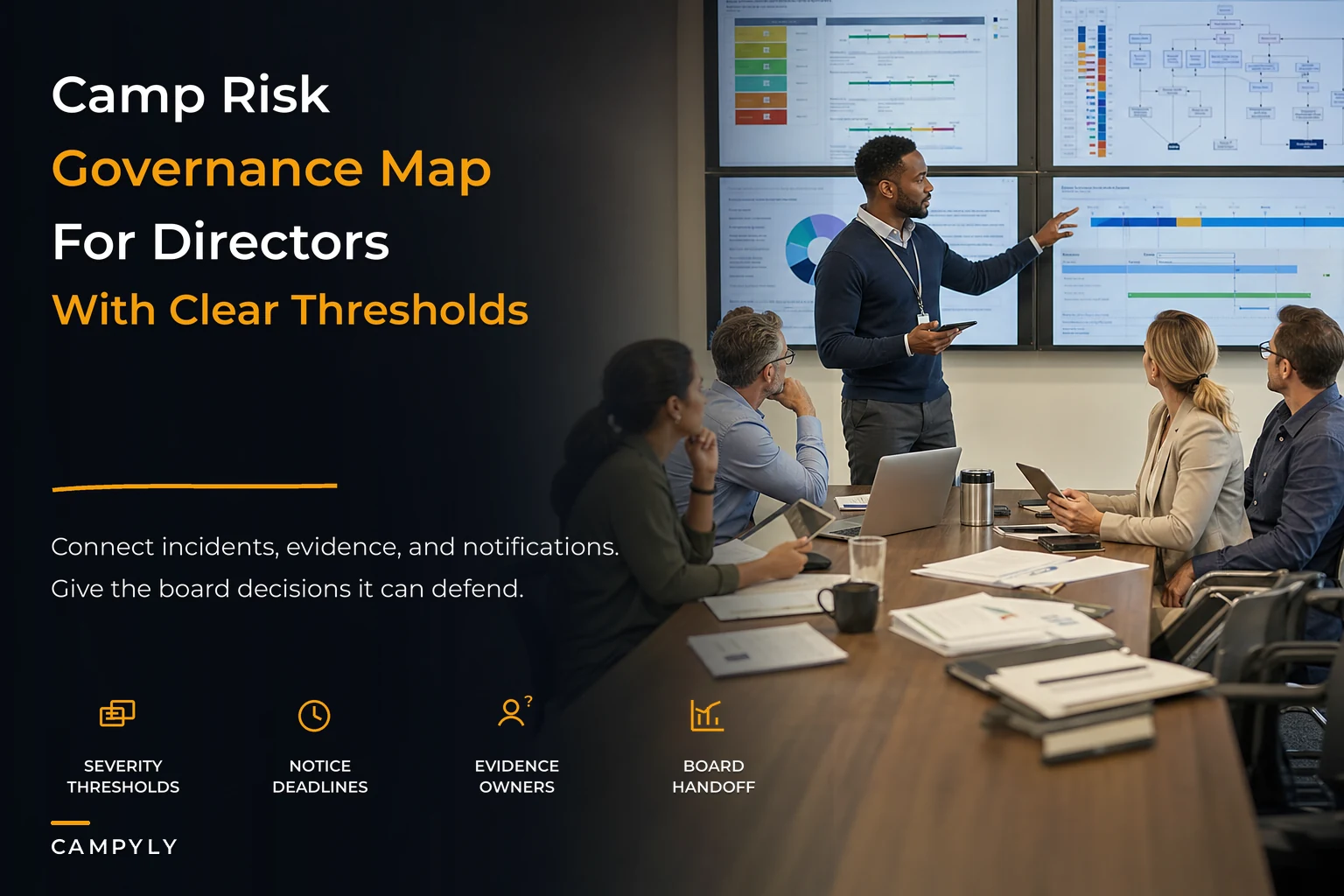
A real camp risk governance framework isn't a policy document that lives in a shared drive. It's a working map that connects four things camps usually treat separately: safeguarding decisions, incident escalation, external notification obligations (insurer and regulator), and the compliance thresholds that tell you when a small thing has legally or contractually become a big thing. When those four are wired together and produce an audit trail, your board can govern. When they aren't, your board is just hoping.
Why these four systems drift apart in the first place
Here's the pattern almost every growing camp hits. In year one or two, the director is the framework. They know every kid, every staff member, every parent. Escalation happens because someone walks into the director's office. Notification happens because the director remembers the insurance policy has a 48-hour clause. It works because everything routes through one brain.
Then the camp grows. Two sessions become five. One site becomes three. Headcount doubles. And that single-brain system silently breaks — but nobody notices because it doesn't break loudly. It breaks in the gaps:
-
A safeguarding concern gets handled quietly at the unit level and never reaches the person who understands the reporting threshold.
-
An incident gets logged, but nobody classifies its severity, so nobody knows it triggered the insurer's notice window.
-
A regulator has a mandatory reporting requirement that the coordinator on duty has genuinely never read.
-
The board hears a sanitized summary at the next quarterly meeting — 40 days after the deadline that already passed.
The failure almost never happens at the moment of the incident. It happens in the handoff. The frontline person acts correctly. The system just doesn't carry that action upward fast enough or with enough structure to trigger the obligations attached to it. This is why bolting on "better incident reporting" alone doesn't fix governance. You can have a beautiful incident log and still miss every notification deadline, because logging and deciding are two different functions. Governance is the layer that turns a logged event into a classified event with owners, thresholds, and deadlines attached.
The core idea: severity drives everything downstream
The mistake most frameworks make is organizing around event type — "here's what to do for a medical incident, here's what to do for a behavioral incident." That feels intuitive but collapses fast, because a bruise and a broken arm are the same "type" with wildly different obligations.
Simplify camp operations with centralized control.
Campyly empowers you to manage registrations, staff, and activities seamlessly—all from one platform.
- Integrated camper and staff management
- Automated notifications and alerts
- Dynamic scheduling and resource allocation
No credit card required
Organize around severity instead. Severity is what actually determines who gets told, how fast, what evidence you need, and whether an external party has to be notified. Event type becomes a secondary tag, not the primary driver. A workable severity model has four tiers, and every tier maps to a fixed set of downstream actions:
| Severity | Example triggers | Who must be notified (internal) | External notification | Response clock | Board visibility |
|---|---|---|---|---|---|
| S1 – Minor | Scraped knee, minor conflict resolved on-site | Unit lead logs; coordinator reviews daily | None | End of day | Aggregated in monthly report |
| S2 – Significant | Injury needing off-site care, repeated behavioral issue, minor property/data issue | Coordinator + Director same day | Possible insurer notice depending on policy | Within 24 hrs | Named in monthly report |
| S3 – Serious | Hospitalization, safeguarding disclosure, staff misconduct allegation, data breach | Director + designated safeguarding lead immediately | Insurer within policy window; regulator if mandated | Within hours | Chair notified directly; item at next board meeting |
| S4 – Critical | Death, serious abuse allegation, mass illness, major regulatory breach | Full escalation to board chair + legal | Regulator (often immediate/statutory), insurer immediately | Immediate | Emergency board notification |
The value of this table isn't the specific examples — you'll rewrite those for your jurisdiction and insurer. The value is that the moment a frontline person assigns a severity, the entire downstream chain is already decided. No one has to remember the insurance clause at 9pm. The severity carries the obligation with it.
One important nuance: severity can escalate but rarely de-escalates cleanly. A scrape that gets infected and lands a camper in the hospital was logged as S1 and is now S3. Your framework has to allow re-classification and — critically — has to recalculate the notification clock from the moment severity changed, not from the original event. This is exactly where camps get caught: they think the deadline passed, so they stop, when in fact the clock reset.
Compliance thresholds: the part everyone gets wrong
A "threshold" is the specific condition that flips an internal matter into an externally-reportable one. Most camps have dangerous blind spots here, because thresholds are usually buried across three different documents that nobody reads together:
-
Your insurance policy (notice clauses, coverage conditions, often "prompt" or a fixed hour window)
-
Your regulator's requirements (mandatory reporting for safeguarding, licensing conditions, health authority rules)
-
Your own internal policy (which should be the strictest of the three, not the loosest)
The trap: these thresholds don't align. Your insurer might want notice of any injury requiring professional medical treatment. Your regulator might only require reporting of hospitalizations. Your safeguarding law might mandate reporting on suspicion, not proof. If your framework uses one threshold as a proxy for all three, you will comply with one and breach another. The fix is to write thresholds as a checklist that runs against every S2-and-above event, independently:
-
Does this meet the insurer's notice condition? → Y/N → deadline
-
Does this meet a mandatory regulatory reporting condition? → Y/N → deadline
-
Does this meet our internal escalation trigger? → Y/N → owner
-
Does this involve personal data exposure that triggers privacy obligations? → Y/N → separate clock
That last one catches people constantly. A lost binder of camper medical forms isn't a "safety incident" in most people's mental model, but it's a data breach with its own notification timeline. If your governance map treats safeguarding and data as separate universes, you'll miss it. The way data obligations interlock with incident handling is worth mapping in detail alongside your broader camp data governance, retention and consent rules, because the two systems share evidence and deadlines more than most directors realize.
Required evidence: what "auditable" actually means
Boards love the word "auditable" and rarely define it. In practice, auditable means: for any given event, six months later, you can reconstruct what happened, what was decided, who decided it, when, and what was sent to whom — without relying on anyone's memory.
Evidence requirements have to be defined per outcome, not collected randomly. Each severity tier should specify what must exist in the record before the event can be marked closed. For an S2 (Significant) event, the closed record should contain:
-
Timestamped initial log with the frontline reporter named
-
Coordinator's severity classification and rationale
-
Any parent communication sent (with timestamp)
-
Insurer notice, if the threshold was met — or a documented note explaining why it wasn't
-
Corrective action taken
For an S3 (Serious) event, add:
-
Safeguarding lead's involvement documented
-
Regulator report reference number, if filed
-
Legal consult note, if obtained
-
Board chair notification timestamp
-
A short factual chronology (not a narrative essay — a timeline)
"We handled it" is not evidence. An audit doesn't ask whether you were competent. It asks whether you can prove it. A camp that responded perfectly but kept no record is, from a governance and insurance standpoint, indistinguishable from a camp that did nothing. This is the same principle behind building a genuinely auditable incident-management system — the response and the record are two separate deliverables, and the record is the one your board and insurer actually see.
Two dashboard views, because boards and operations need different things
A governance dashboard fails when it tries to serve both audiences with one screen. Directors on the ground need live operational detail. The board needs pattern, risk posture, and exceptions — not a firehose.
The operations view (director + coordinators, checked daily/weekly):
-
Open incidents by severity, with response clocks counting down
-
Any event past or approaching a notification deadline (flagged red)
-
Events awaiting classification (the dangerous limbo state)
-
Evidence-incomplete closed events (things marked done but missing required records)
-
Staff safeguarding training status and expiries
The board view (chair + directors, per meeting and on exception):
-
Count and trend of S3/S4 events across the season vs. prior years
-
Notification compliance rate — were deadlines met, yes/no
-
Any breached obligation, surfaced explicitly, never buried
-
Open high-severity items and their owners
-
Themes
are behavioral incidents clustering in one unit? Are injuries clustering in one activity?
The single most useful thing a board view can show is not the number of incidents — it's the notification compliance rate. A camp with 30 incidents and 100% on-time notification is governed well. A camp with 4 incidents and one missed regulator deadline is not. Boards consistently anchor on the wrong number, and a good dashboard corrects that instinct by putting compliance front and center.
The other thing worth surfacing is clustering. Individual incidents look like bad luck. Ten incidents plotted out suddenly show that one waterfront shift, one bunk, or one activity is generating a disproportionate share. That's the governance signal that turns reactive incident handling into actual risk reduction — and it's only visible when incidents flow into one structured system instead of scattered logs.
A real scenario: where the gap actually shows up
Consider a mid-sized overnight camp — roughly 320 campers across the summer, three sessions, around 55 seasonal staff. Not huge. Big enough that no single person sees everything. Mid-July, a camper takes a hard fall during an activity. Unit staff respond well, the camper is taken to urgent care, treated, and back the same evening. Logged as an injury. Everyone moves on. The coordinator handling it was new, competent, and had genuinely never read the insurance notice clause — which required notification within 72 hours of any injury requiring professional medical treatment.
Nothing goes wrong immediately. That's the deceptive part. Six weeks later the family raises a concern, and now the insurer is being notified around 45 days late. Coverage isn't automatically void, but the camp spends real money and weeks of back-and-forth defending a claim that a simple 72-hour notice would have kept clean. The board learns all of this at once, in a panicked email — which is the worst possible way for a board to learn anything. Now run the same event through a wired framework. The injury gets logged and classified S2. That severity classification automatically surfaces the insurer threshold checklist. The coordinator sees a countdown: "Insurer notice due in 72 hrs." The notice goes out day one. The board view shows one S2 event, notification met, closed with complete evidence. Same incident, same competent staff — but the governance layer carried the obligation the coordinator didn't have memorized. The difference between those two outcomes wasn't skill or care. It was whether the system attached the obligation to the event automatically, or left it to someone remembering a clause in a policy PDF.
Where software fits — and where it doesn't
You can run a governance framework on paper and spreadsheets. Plenty of camps do, and for a very small single-site operation it's workable. The framework matters more than the tooling.
But the wiring — severity triggering thresholds, thresholds starting clocks, clocks driving alerts, everything landing in an audit trail and two dashboard views — is exactly the kind of coordination that manual systems drop once you're past one site or a few dozen staff. This is where AI-assisted operational platforms earn their place: not by making the safeguarding decision (a human always classifies severity, and judgment stays human), but by making sure the classification instantly pulls the right notification rules, starts the correct deadline for each obligation, flags evidence gaps before an event is closed, and rolls everything into the board and operations views without anyone hand-building a report.
The realistic value is boring and huge: no missed deadline because someone was on a bus without signal, no closed event missing its required evidence, no board meeting where the risk picture gets assembled from memory the night before. Automation here isn't about intelligence — it's about the system never forgetting an obligation that a tired human on day 40 of the season understandably might.
When this framework makes sense — and when it's overkill
Build the full framework when: you run multiple sessions or sites, have more than roughly 30–40 seasonal staff, carry meaningful insurance with specific notice conditions, or operate under regulatory or licensing oversight with mandatory reporting. At that scale the single-brain system has already quietly failed — you just haven't hit the incident that reveals it.
Keep it lighter when: you're a small single-site day program where the director genuinely sees every event same-day. You still need severity tiers and written thresholds — those are non-negotiable at any size — but you don't need dual dashboards and automated clocks yet.
Who should not skip the thresholds piece: nobody, regardless of size. Even the smallest camp needs to know, in writing, what flips an internal matter into an insurer or regulator notification. That's the part that creates financial and legal exposure, and it costs nothing but an afternoon to write down.
Putting it in place: a sane build order
Don't try to stand up the whole framework at once. Sequence it:
-
Write your severity tiers. Four levels, with real examples from your camp's history. Get frontline staff to sanity-check them.
-
Map your three threshold sources. Pull the actual insurer notice clause, the actual regulatory reporting rules, and draft internal triggers stricter than both. Write the deadlines next to each.
-
Define required evidence per severity. What must exist before an event closes. Keep it to a short checklist per tier.
-
Assign owners and clocks. Every threshold gets a named role responsible and a fixed response window.
-
Build the two dashboard views. Operations first (it's used daily), board view second.
-
Run a tabletop test. Take two or three real past incidents and push them through the framework on paper. You'll find the gaps immediately — usually in re-classification and in the data-breach threshold.
Below is a simple workflow diagram to visualize the recommended sequence from writing tiers to running tabletop tests.
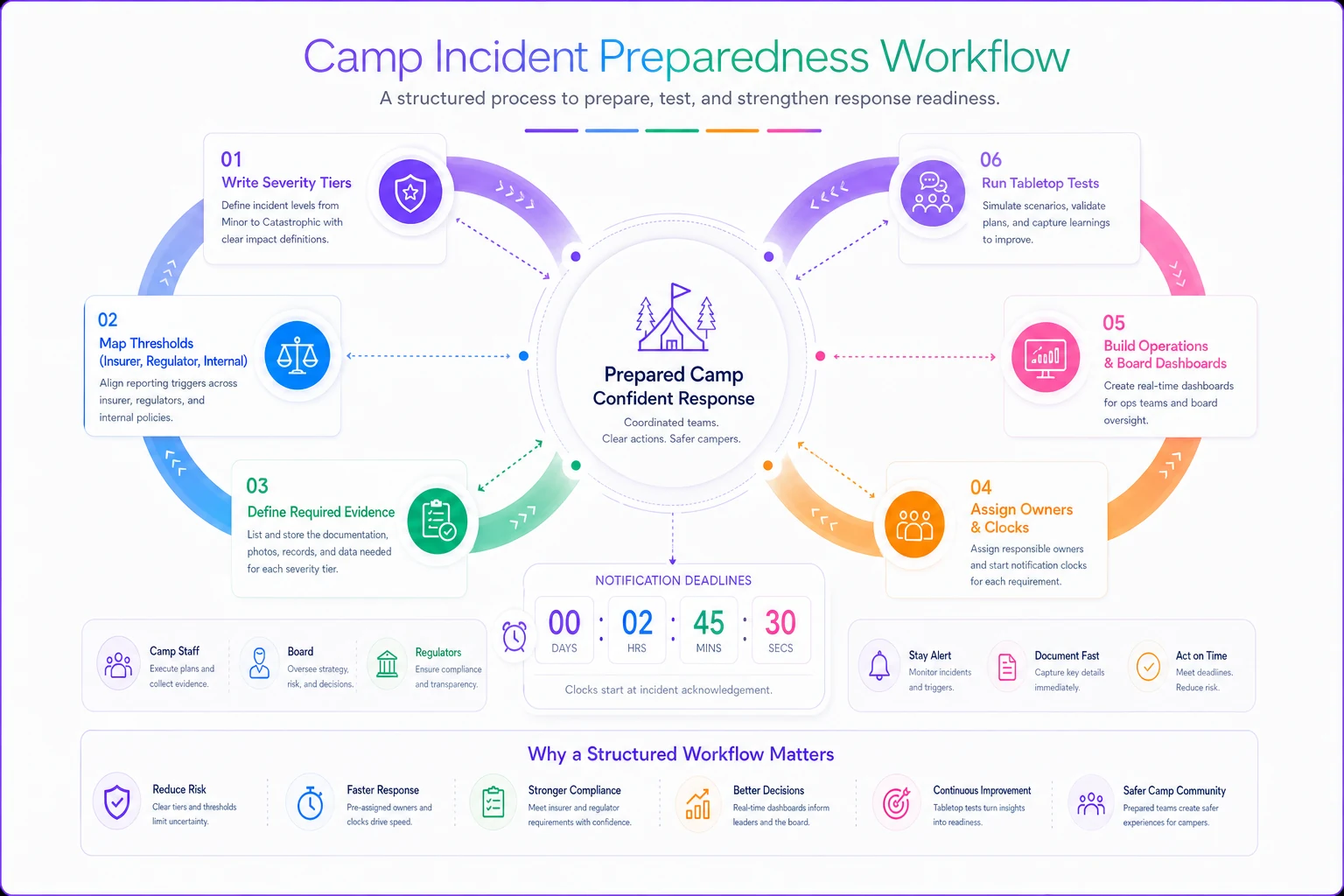
Run tabletop tests with two or three real past incidents to surface re-classification and threshold gaps quickly.
Fold this into your broader continuity planning as well. A governance framework and a camp continuity framework with scenario playbooks and recovery SLAs share the same DNA — both are about knowing, in advance, who decides and who gets told when the pressure is highest and clear thinking is hardest.
The point of all of this
Governance isn't there to slow your camp down or to give the board cover after something bad happens. Its real job is to make sure that when a frontline staff member does the right thing at 2pm in the middle of a chaotic session, that action reliably triggers every obligation attached to it — without depending on anyone remembering a policy clause, without depending on a handoff that might not happen, and without the board finding out weeks too late.
Get severity, thresholds, evidence, and dashboards wired into one map, and your board can actually govern instead of react. That's the whole difference between a camp that handles incidents and a camp that can prove it handled them — which, when the call comes, are not the same thing at all.
Governance isn't there to slow your camp down or to give the board cover after something bad happens. Its real job is to make sure that when a frontline staff member does the right thing at 2pm in the middle of a chaotic session, that action reliably triggers every obligation attached to it — without depending on anyone remembering a policy clause, without depending on a handoff that might not happen, and without the board finding out weeks too late.
Get severity, thresholds, evidence, and dashboards wired into one map, and your board can actually govern instead of react. That's the whole difference between a camp that handles incidents and a camp that can prove it handled them — which, when the call comes, are not the same thing at all.
Ready to elevate your camp management?
Join 500+ camps using Campyly to save administrative time, enhance camper experiences, and streamline daily operations.