


Running summer camp means managing everything from homesick eight-year-olds to broken equipment to medical emergencies. Most camps handle incidents fine in the moment—counselors know what to do when a kid twists an ankle or has an allergic reaction. But three months later when a parent's lawyer calls? That's when camps discover their incident management is more scattered Post-it notes than actual system.
The gap between handling incidents and documenting them properly kills camps during audits and lawsuits. You dealt with the bee sting perfectly, gave the right medication, called the parents. But where's the paperwork? Who signed off? What time did it happen? Where's the follow-up documentation? These aren't compliance checkboxes—they're the difference between a quick insurance claim and a two-year legal nightmare.
Why camp incident management breaks down
Camp incident management fails because it treats documentation like an afterthought instead of part of the response itself. Counselors handle the immediate problem—bleeding stops, tears dry, parents get called—then everyone moves on to the next activity. The paperwork gets done later, maybe, if someone remembers, assuming they can find the right form.
This approach works fine when you're dealing with five incidents per summer. Scale up to running three sessions with 200 campers each, and you're looking at potentially dozens of incidents weekly. Minor scrapes, behavioral issues, equipment damage, medical events, near-misses that need documenting for next year. Without a real system, information lives in random places: incident reports in the nurse's office, text messages between counselors, handwritten notes in activity logs, emails to parents that nobody saved, photos on personal phones, verbal reports during staff meetings that never got written down.
Audit season arrives or worse—a parent claims their child got injured and you failed to provide proper care. Now you're scrambling through filing cabinets, searching email accounts, trying to piece together what happened six weeks ago. Your insurance company wants documentation you can't find. The health department needs reports you never filed. That minor incident suddenly becomes major because you can't prove how you handled it.
Camps treat each incident as an isolated event rather than part of a larger risk management system. Every scraped knee teaches you something about that particular trail. Every behavioral incident reveals patterns about certain activity combinations. Every equipment failure points to maintenance gaps. Without proper documentation and analysis, these lessons disappear into the summer haze.
Building your incident intake and verification framework
A working camp incident management system starts before anything happens. You need clear definitions of what counts as an incident, who reports it, and how information flows from the moment something occurs to final documentation.
Simplify camp operations with centralized control.
Campyly empowers you to manage registrations, staff, and activities seamlessly—all from one platform.
- Integrated camper and staff management
- Automated notifications and alerts
- Dynamic scheduling and resource allocation
No credit card required
Start with incident categories that match your actual operations. Medical incidents cover everything from band-aid scrapes to emergency transports. Include allergic reactions, medication errors, existing condition flare-ups, and mental health crises. Each needs different documentation requirements but the same initial intake process.
Behavioral incidents include bullying, fighting, inappropriate contact, property damage, repeated rule violations. These often require multiple perspectives and ongoing documentation as situations develop over days or weeks.
Facility and equipment issues matter too—broken playground equipment, damaged boats, unsafe conditions discovered during activities. Even if nobody got hurt, near-misses need documenting to prevent actual injuries.
Program incidents cover lost campers (even briefly), unauthorized area access, activity modifications due to weather, transportation problems. These might not involve injury but affect liability and parent communication.
Your intake process needs to capture information while it's fresh. Counselors dealing with crying campers and worried peers can't write novels. Give them a simple initial reporting method—even a voice memo or photo with basic facts: time and location, people involved (campers, staff, witnesses), basic description of what happened, immediate actions taken, who was notified.
This initial report triggers your verification process. Within two hours, someone with training needs to gather the full story. Not tomorrow during rest hour, not at the end of the week when memories fade. Two hours. This person—usually your program director or head nurse—expands the basic report with detailed timeline of events, environmental factors (weather, time of day, activity context), contributing factors (fatigue, previous incidents, equipment condition), complete list of witnesses, photos of location/injuries/equipment, and signed statements from involved staff.
The verification step catches details that matter later. Maybe the counselor forgot to mention the activity ran late because another group's transportation broke down, meaning kids were tired and hungry when the incident occurred. Maybe there was a similar near-miss yesterday that nobody connected. These details disappear fast but matter enormously during investigations.
The intake-to-verification workflow looks like this.
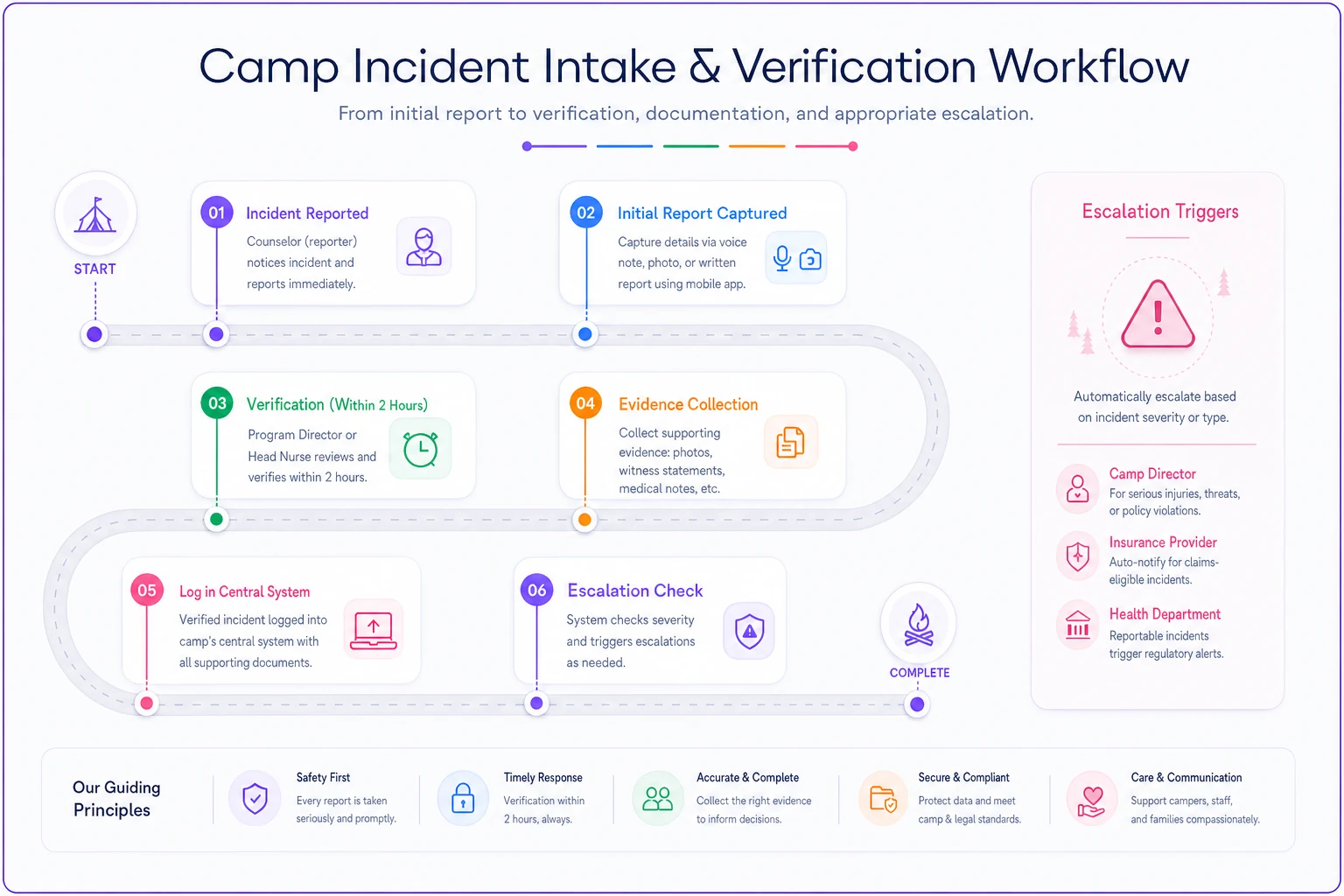
This diagram summarizes the steps from initial report to verification and escalation.
Creating your incident logging and chain-of-command structure
Once verified, incidents need proper logging that creates an auditable trail. This isn't just typing up the handwritten notes—it's establishing official record-keeping that stands up to scrutiny.
Your logging system needs mandatory fields that prevent incomplete documentation. Incident basics include unique incident ID number, date/time reported vs date/time occurred, primary category and subcategories, and severity rating (your scale, consistently applied).
People involved means all campers (full names, cabin/unit, age, parent contacts), all staff (names, positions, certifications), witnesses (with contact info if non-staff), and responders (who provided care, made decisions, handled communications).
Build escalation triggers into your system.
Incident details require objective description (what happened, not why), location specifics (not just "waterfront" but "swimming area, shallow end, near ladder"), contributing factors, and timeline of response.
Actions taken covers medical care provided, parent notifications (time, method, who spoke to whom), program modifications, and follow-up requirements. Documentation attached includes initial report, verification notes, photos, witness statements, medical forms, and parent communications.
Logging means nothing without clear chain-of-command for different incident types. Your night counselor shouldn't decide whether a behavioral incident requires parent notification. Your nurse shouldn't determine if equipment damage needs reporting to insurance.
Build escalation triggers into your system. Immediate director notification goes to any injury requiring outside medical care, any allegation of abuse or inappropriate contact, any incident involving law enforcement, missing camper (even if quickly found), serious behavioral incidents (violence, self-harm threats). Same-day director review covers prescription medication errors, repeated behavioral issues, equipment failures affecting program, parent complaints about incident handling, any incident requiring parent pickup. Next-day review team handles minor medical treatments, successful behavior interventions, near-misses with safety implications, patterns emerging across multiple incidents.
Each level has different documentation requirements and decision authority. The counselor documents what they saw and did. The unit leader verifies facts and ensures proper care. The director determines external notifications and policy implications. The board gets summary reports showing patterns and systemic issues.
Investigation protocols that protect your camp
Not every incident needs investigation, but when they do, you need protocols that uncover facts without creating additional liability. The difference between "looking into what happened" and conducting a proper investigation determines whether you're protecting or exposing your camp.
Investigation triggers should be crystal clear: any injury requiring hospital treatment, any incident where accounts conflict significantly, patterns of similar incidents, parent threats of legal action, unusual or suspicious circumstances, staff misconduct allegations.
Start investigations within 24 hours while memories remain clear and evidence exists. Waiting until Monday or after the session ends means losing critical information.
Your investigation process needs structure to ensure consistency and completeness. Assign a trained investigator (not the person who handled the incident) who follows established protocols.
Secure evidence immediately. Lock down any equipment involved. Save all documentation. Prevent photo deletion. Mark locations. The kayak paddle that broke shouldn't get fixed until you've documented the break pattern. The trail where someone tripped needs photographing before rain washes away conditions.
Interview systematically. Start with uninvolved witnesses who have less emotional investment. Move to involved staff, then campers. Interview separately to avoid contamination. Use open-ended questions. Document exact words, not summaries. Note emotional states and inconsistencies without judgment.
Review comprehensively. Check previous incidents at same location. Review staff training records. Examine equipment maintenance logs. Look at scheduling and supervision patterns. Sometimes the smoking gun isn't in the incident itself but in the context around it.
Document everything. Every interview needs written notes signed by the investigator. Every piece of evidence needs chain-of-custody documentation. Every decision needs rationale recorded. This isn't bureaucracy—it's protection. Two years later when someone questions why you didn't suspend the counselor or close the activity, you need contemporaneous documentation of your reasoning.
Report findings formally. Investigation reports follow standard format:
-
Executive summary
-
Methodology
-
Timeline of events
-
Contributing factors
-
Root cause analysis
-
Recommendations
-
Supporting documentation
The investigation goal isn't assigning blame but understanding what happened and preventing recurrence. Maybe the climbing wall incident reveals that your belay training doesn't account for left-handed counselors. Maybe the repeated behavioral issues in arts and crafts trace back to ventilation problems making everyone irritable. Real investigations find real problems.
Building audit-ready reporting and documentation systems
Auditors don't care about your good intentions or verbal assurances. They want documentation proving you follow your own policies and meet regulatory requirements. Most camps fail audits not because they handle incidents poorly but because they can't prove they handled them properly.
Different authorities require different reporting. State licensing usually wants summaries of significant incidents, injury statistics, and evidence of corrective actions. They're checking that you're identifying and addressing patterns. The health department focuses on communicable diseases, food-related illness, water safety incidents, and medication administration. They want detailed logs showing proper protocols followed.
Your insurance company needs immediate notification of potential claims plus comprehensive documentation of all incidents that could become claims later. They're looking for risk management and proper response. Accreditation bodies want evidence of continuous improvement. Not just incident reports but analysis, trend identification, policy updates, and staff training modifications based on lessons learned.
Your reporting system needs to generate these different outputs from the same core data. Manual copying between different forms wastes time and introduces errors. Build templates for each reporting requirement that pull from your central incident database.
Monthly summary reports should show incident counts by category, severity distributions, location heat maps, time-of-day patterns, staff/camper ratios during incidents, response time metrics, and parent communication completion rates.
These summaries reveal patterns invisible in individual reports. Maybe all your behavior incidents happen during transition times when supervision drops. Maybe your Wednesday afternoon injury spike correlates with accumulated fatigue. Maybe one counselor appears in multiple incident reports as a witness but never as responder, suggesting training gaps.
Annual analysis goes deeper with year-over-year comparisons, effectiveness of policy changes, training impact on incident rates, equipment lifecycle patterns, and seasonal progression trends.
Sample forms and templates that actually work
Initial Incident Report (for immediate use)
| Field | Details |
|---|---|
| Reporter Information | Name, Position, Contact |
| Time Details | Date, Time of incident, Time reported |
| Location | Specific location description |
| People Involved | Injured person (name, age, cabin), Staff present, Witnesses |
| Basic Description | Facts only, no interpretation |
| Immediate Actions | Care provided, notifications made |
| Signatures | Reporter signature and completion time |
Detailed Investigation Form (for follow-up)
This expands the initial report with incident ID and investigation timeline, classification and severity rating, detailed chronological timeline, contributing factor checklist, attached documentation inventory, root cause analysis, corrective actions and recommendations, investigator and director signatures.
The forms need to be practical for real camp conditions. Counselors can't fill out dissertation-length reports while managing groups. But they can handle quick checklists that capture essential information.
Build your forms based on actual patterns you see, not theoretical worst-case scenarios.
Data retention policies and compliance requirements
Keeping everything forever isn't the answer. Neither is throwing away documents after summer ends. Your retention policy needs to balance legal requirements, practical storage, and privacy concerns.
Minimum retention periods vary by state and incident type. Medical records usually need keeping for seven years after camper reaches age of majority. That scraped knee from an 8-year-old needs documentation until they're 25. Incident reports involving injury typically require 7-10 years retention, longer if litigation is pending.
Employment-related incidents follow your state's employment law requirements, usually 3-7 years after staff member leaves. General program incidents need three years minimum, though keeping 5-7 protects you better. Investigation reports should be kept as long as underlying incident documentation.
Retention means proper storage with controlled access. Incident reports contain private medical information, minor children's names, and potentially embarrassing behavioral details. You can't just file them in the unlocked cabinet in the main office.
Physical documents need locked, fireproof storage with limited access lists, sign-out logs for removal, scanning for backup, and secure destruction when retention periods end.
Digital files need password protection, regular backups, access logging, encryption for sensitive data, and clear folder structure for retrieval.
Your retention policy should specify what gets kept and for how long, where documents are stored, who has access, how documents are destroyed, and what triggers extended retention for litigation holds.
Don't forget about informal documentation. That WhatsApp group where counselors discuss camper behavior? Those photos on the staff photographer's personal phone? The handwritten notes the nurse keeps in her pocket? These create liability if not properly managed. Either incorporate them into official documentation or establish clear policies about destruction.
When manual systems fail: Moving to operational software
Paper forms and Excel sheets work until they don't. Usually that breaking point hits around 150-200 campers per session, when the volume of minor incidents makes manual tracking impossible. You're not just managing the big stuff—every bandaid, every timeout, every "I don't feel good" needs documenting to establish patterns and protect against claims.
The gaps in manual systems compound over time. Counselors skip fields on paper forms. Handwriting becomes illegible. Forms get misfiled or lost. The three different people who touched an incident report have three different versions of events. By August, your June incidents are already fuzzy memories with incomplete documentation.
Modern operational software addresses these problems directly. The technology doesn't replace human judgment but ensures nothing falls through cracks. When counselors use mobile devices to voice-record initial reports, automated transcription catches details that handwritten forms miss. AI-powered alerts remind staff about follow-up requirements before memories fade.
Immediate reporting becomes simpler with voice recordings that get transcribed and categorized automatically, alerting appropriate staff without delays. No more hunting for forms or waiting until shift changes to document incidents.
Verification gets support through systems that prompt for required information based on incident type. Forgot to document parent notification time? The platform flags incomplete records before they become compliance gaps.
Pattern recognition through automated analysis identifies trends across incidents that manual review misses. Three different counselors report camper fatigue in outdoor activities? The system connects dots and suggests program modifications.
Compliance automation generates reports automatically for different authorities. Real-time dashboards track incident metrics. Retention policies enforce themselves without manual calendar tracking.
Connected operations integrate incident data with staff schedules, camper medical records, and activity planning. When heat exhaustion gets reported, the system already knows today's temperature reached dangerous levels and can suggest immediate program adjustments.
For smaller camps, even basic operational software beats paper systems. Cloud storage prevents document loss. Required fields ensure complete information. Automatic timestamps create accurate timelines. These fundamental improvements matter more than fancy features when audit season arrives.
Making incident management part of camp culture
The best incident management system fails if staff see it as bureaucracy rather than protection. Every counselor who skips documentation, every unit leader who delays verification, every director who doesn't review reports creates gaps that become chasms during crisis.
Building documentation culture starts with explaining why it matters. For counselors: "This protects you when parents question your actions. These reports prove you followed protocols and provided appropriate care." For activity leaders: "This helps you improve programs. These patterns show where activities need modification before someone gets seriously hurt." For administrators: "This demonstrates professional operation. These records prove we meet standards and continuously improve safety."
Training needs to be specific and practical. Don't just explain the forms—walk through actual scenarios. What happens when two campers fight during capture the flag? How do you document a camper's anxiety attack during swim time? Who gets notified when expensive equipment breaks? Practice the actual workflow, not just the theory.
Regular review of incident trends with staff shows them their documentation creates value beyond compliance. When you can show that Tuesday morning swim lessons have three times the injury rate of afternoon sessions, that's actionable information that protects campers and reduces their workload. When behavioral incident patterns reveal that certain activity combinations create problems, that helps them plan better programs.
Recognition matters too. Thank counselors who submit thorough, timely reports. Highlight how good documentation prevented problems or improved operations. Make it clear that detailed incident management is a professional skill, not administrative busy work.
The goal isn't perfect paperwork—it's creating habits that protect everyone when things go wrong.
Because they will go wrong. The question is whether you'll have the documentation to prove you handled them right.
Ready to elevate your camp management?
Join 500+ camps using Campyly to save administrative time, enhance camper experiences, and streamline daily operations.