

Most camps don't fail because directors lack information. They fail because the information is scattered across six people's heads, four group chats, a clipboard at the health center, and a transportation coordinator who stepped away for lunch. By the time a director pieces together "wait, is Bus 3 late AND are we short a lifeguard at the waterfront?" the window to make a clean decision has already closed.
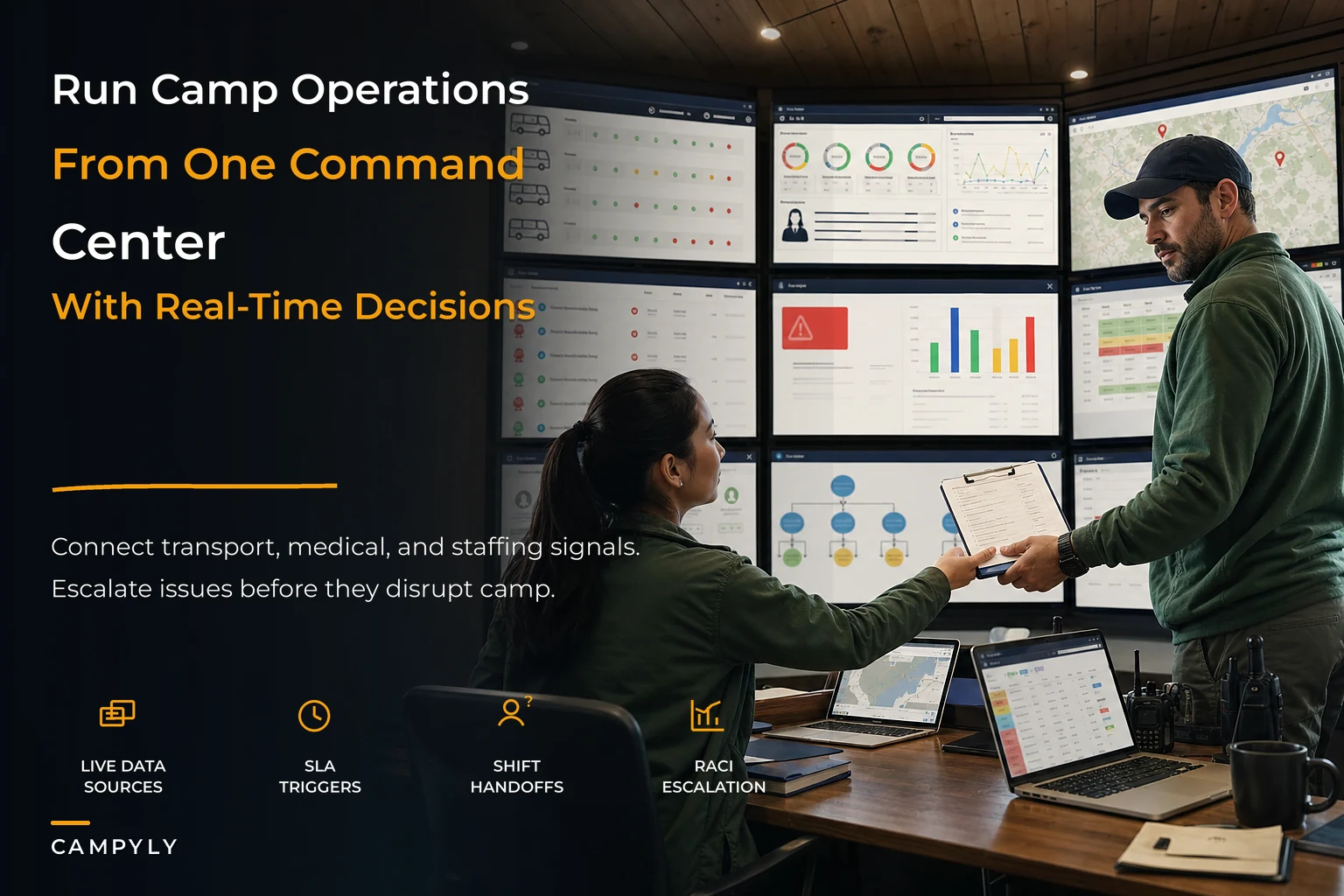
A command center isn't a fancy screen on the wall. It's a discipline: deciding ahead of time which signals matter, where they come from, who owns the response, and what "normal" looks like so you can spot "not normal" in seconds instead of minutes. This article walks through how that system actually fits together — the data sources, the SLA definitions by function, the handoff checklists, the escalation RACI, and the tabletop drills that make the whole thing hold up under pressure.
Why camps lose the plot at 2:47pm on a Wednesday
Nothing at camp happens in isolation. A late bus isn't just a transport problem — it's a staffing problem (the counselor assigned to that group is now double-covering), a parent-communication problem (pickup parents are texting), and sometimes a medical problem (the kid who needs a 3pm med is on that bus).
What breaks is the coordination layer, not any individual function. Each department usually runs fine on its own. Transport has their routes. The health center has their logs. Staffing has their coverage sheet. The trouble is that none of those three see each other in real time, so the director becomes the human integration point — physically walking or calling between them to piece together a picture.
That works at a 120-camper day program with one director who knows everyone by name. It completely falls apart at 400+ campers across multiple sites, or at an overnight camp where the director is asleep when the 11pm cabin issue starts. A common example: a coordinator notices a camper missing from evening rollcall, assumes they're with the nurse, the nurse assumes they're at an activity, and 40 minutes evaporate before anyone realizes no one actually knows where the kid is. Nobody made an obvious mistake — the system just had no shared source of truth.
The three data sources that actually matter
You don't need to surface everything. A command center showing 90 metrics is as useless as one showing none — directors tune out noise fast. The goal is to map a small number of decision-relevant signals to the places they already live.
Simplify camp operations with centralized control.
Campyly empowers you to manage registrations, staff, and activities seamlessly—all from one platform.
- Integrated camper and staff management
- Automated notifications and alerts
- Dynamic scheduling and resource allocation
No credit card required
| Function | Source of truth | Signals worth surfacing | Update cadence |
|---|---|---|---|
| Transport | Route sheets / GPS / driver check-ins | Bus status (on-time / delayed / arrived), headcount loaded vs. expected, driver confirmed | Per stop + live during runs |
| Medical | Health center log | Open med administrations due, active incidents, exclusions/isolation count, staff on duty | Real-time during med windows |
| Staffing | Coverage board | Ratio status per zone, open shifts, call-outs today, floaters available | Per shift + on any call-out |
The pattern that matters: each row has a single source of truth. The moment two systems both claim to know the current bus headcount, you're back to reconciling by phone. One source per signal, no exceptions.
None of these are vanity metrics. Nobody at 2:47pm needs to see the season's enrollment trend — that belongs in your board-ready reporting, not your live operations view. The command center answers one question: what needs a decision in the next 30 minutes?
Defining SLAs by function so "normal" is actually written down
The mistake almost everyone makes: they build a dashboard full of status lights but never define what each color means. So a bus marked "delayed" could be four minutes behind or forty, and nobody knows whether to care.
An SLA in this context isn't a contractual thing — it's your internal definition of the threshold between "fine" and "respond now." You set these once, before the season, when you're calm.
Transport SLAs (example thresholds):
-
Bus check-in missing more than 10 minutes past scheduled departure → escalate
-
Arrival delay beyond 15 minutes → notify pickup parents proactively
-
Headcount mismatch of any size → hard stop, reconcile before moving
Medical SLAs:
-
Scheduled med not administered within 20 minutes of its window → flag
-
Any incident requiring more than first-aid → director notified immediately, no waiting
-
Isolation/exclusion count change → logged and surfaced same-hour
Staffing SLAs:
-
Any zone below required ratio → red, floater dispatched within 10 minutes
-
Two or more call-outs in the same session → director alerted (this is often the early sign of a bigger problem, like illness spreading)
-
Open shift unfilled 24 hours out → escalate to contingency plan
The real value here is that these thresholds convert judgment calls into automatic ones. A coordinator doesn't have to decide whether a 12-minute bus delay is "a big deal" — the SLA already decided. That consistency is what lets you delegate the dashboard to someone who isn't you.
Shift-handoff checklists: where most information dies
The single most dangerous moment in camp operations is the handoff. Morning staff to afternoon staff. Day team to overnight team. Health center shift change. This is where open items disappear, because the outgoing person knows about the kid who was feeling off, but never wrote it down.
A good handoff checklist is short and forces the specific items that tend to vanish. Here's a working overnight-handoff example:
-
Open medical items — any camper being watched, pending med, or follow-up needed tonight
-
Headcount reconciliation — confirmed count per cabin/zone, signed by both outgoing and incoming
-
Staffing gaps for next shift — any coverage holes, floater assignments, who's on call
-
Transport for tomorrow — early departures, special pickups, any route changes
-
Parent communications pending — anything promised to a parent that hasn't been closed out
-
Facilities/safety flags — broken lock, flickering light near the waterfront, anything physical
-
"One thing I'm worried about" — the open-ended line that catches gut feelings the checklist misses
That last item does more work than people expect. The structured fields catch known issues; the "worried about" line catches the stuff that doesn't fit a box but turns out to matter.
Have both outgoing and incoming staff sign the handoff to confirm ownership transferred — it's closure, not blame.
The handoff should be signed by both parties. Not for blame — for closure. When both people sign, the open items have officially transferred ownership. Without that, everyone assumes someone else has it.
RACI for escalations: deciding who moves before the crisis
When something goes wrong, the worst outcome isn't the incident itself — it's three people simultaneously assuming someone else is handling it, or five people jumping on one problem while a second one goes unwatched. A simple RACI (Responsible, Accountable, Consulted, Informed) mapped to your most common escalation types fixes this before it happens.
You don't need a RACI for everything. Map it for the handful of scenarios that actually recur:
| Escalation type | Responsible | Accountable | Consulted | Informed |
|---|---|---|---|---|
| Missing camper | Zone lead | Director | Health center, transport | All staff on duty |
| Medical emergency | On-duty nurse | Director | EMS / parent | Front office |
| Bus incident/breakdown | Transport coordinator | Director | Backup driver, affected group counselors | Pickup parents |
| Below-ratio coverage gap | Staffing coordinator | Assistant director | Floaters | Zone leads |
The distinction people blur most often: Responsible is the person doing the work; Accountable is the one person who owns whether it got resolved. There's exactly one Accountable per row. The moment you have two, you effectively have zero.
This connects directly to your broader continuity planning — the escalation RACI is the acute-incident layer of the same thinking that governs how you recover from larger disruptions. One is "the next 15 minutes," the other is "the next three days," but they should share the same chain of command.
Tabletop exercises: proving the system works before you need it
A command center that's never been stress-tested is a theory. Tabletop exercises — running through a scenario out loud, with the actual people who'd respond — are where you find the gaps that look fine on paper.
A worked example. Run this one at a staff meeting before opening week: It's 3:10pm. Bus 2 is 20 minutes late checking in from an offsite trip. At the same time, the health center flags that a camper due a 3pm medication is on Bus 2. A parent calls the front office asking why pickup is delayed. Walk the room through it:
-
Who's Accountable? (Director, per the transport RACI)
-
What SLA already triggered? (Bus check-in missed by 10+ min; med missed its window)
-
What does the dashboard show right now, and is it accurate?
-
Who talks to the parent, and what do they say?
-
At what point does this become a medical escalation rather than a transport delay?
The first time a camp runs this, they almost always find the same thing: the handoff between "transport problem" and "medical problem" has no owner. Everyone assumed the nurse and the transport coordinator were talking. They weren't.
Run three or four of these a season. Rotate the scenarios — a staff call-out cluster, a weather evacuation, a missing-camper drill. Each one surfaces a different weak seam. The point isn't to score people; it's to find the coordination gaps while the stakes are a conference room, not a real child.
When a command center is overkill — and when it's non-negotiable
This level of structure isn't free. It takes setup time, requires discipline to maintain, and if you over-build it you'll end up with a dashboard nobody actually looks at.
When it genuinely makes sense:
-
Multi-site programs where the director can't physically see every zone
-
Overnight camps with true 24-hour operations and real shift changes
-
Any program over roughly 250–300 campers where no one person holds the whole picture
-
Camps with significant transport operations — multiple daily routes, regular offsite trips
When it's probably overkill:
-
A single-site day camp under around 100 campers where the director knows every situation by walking the grounds
-
Short-season programs where the setup cost exceeds the operational benefit
Who should not start here: if your underlying data is a mess — if transport headcounts live in three incompatible formats and the health log is paper-only — don't build a command center on top of that. You'll just surface bad data faster. Get your single-source-of-truth per function working first, then layer the live view on top.
A real scenario: the 380-camper overnight that stopped guessing
An overnight camp running around 380 campers across four cabin zones kept hitting the same wall every afternoon: the director spent most of the day as a human switchboard, walking between the office, health center, and waterfront to piece together status. Evening rollcall reconciliation regularly ran 30–40 minutes because counts from different zones came in on different formats at different times.
They didn't buy anything elaborate. They defined their three sources of truth, wrote SLA thresholds for each function, and built one shared status view that every coordinator updated in real time. The handoff checklist got signed at every shift change.
The change wasn't dramatic in a flashy way — it was dramatic in a quiet way. Rollcall reconciliation dropped to under 10 minutes most nights because counts came in against one expected number, in one format. The director stopped being the integration point, which freed up probably two to three hours a day. The number of "wait, who's handling this?" moments dropped noticeably, because the RACI had already answered the question before anything escalated.
The biggest win was barely measurable: staff reported feeling less like they were constantly bracing for the next scramble. When the system tells you what's normal, the abnormal stops ambushing you.
Pulling it together
A camp operations command center works because it moves the hard thinking earlier — out of the crisis and into pre-season planning. You decide what matters, where it lives, what the thresholds are, and who owns the response before you need any of it. Then during the season, the system does the integrating that the director used to do by walking and calling.
The components reinforce each other. Clean data sources make the dashboard trustworthy. SLAs turn judgment into automatic triggers. Handoff checklists keep open items from dying between shifts. The RACI makes sure someone moves. And tabletop drills prove the whole thing holds before a real kid is involved. If you want the measurement layer that feeds all of this, a solid operational KPI framework gives you the leading indicators worth surfacing.
Here's a simple workflow that ties these components together.
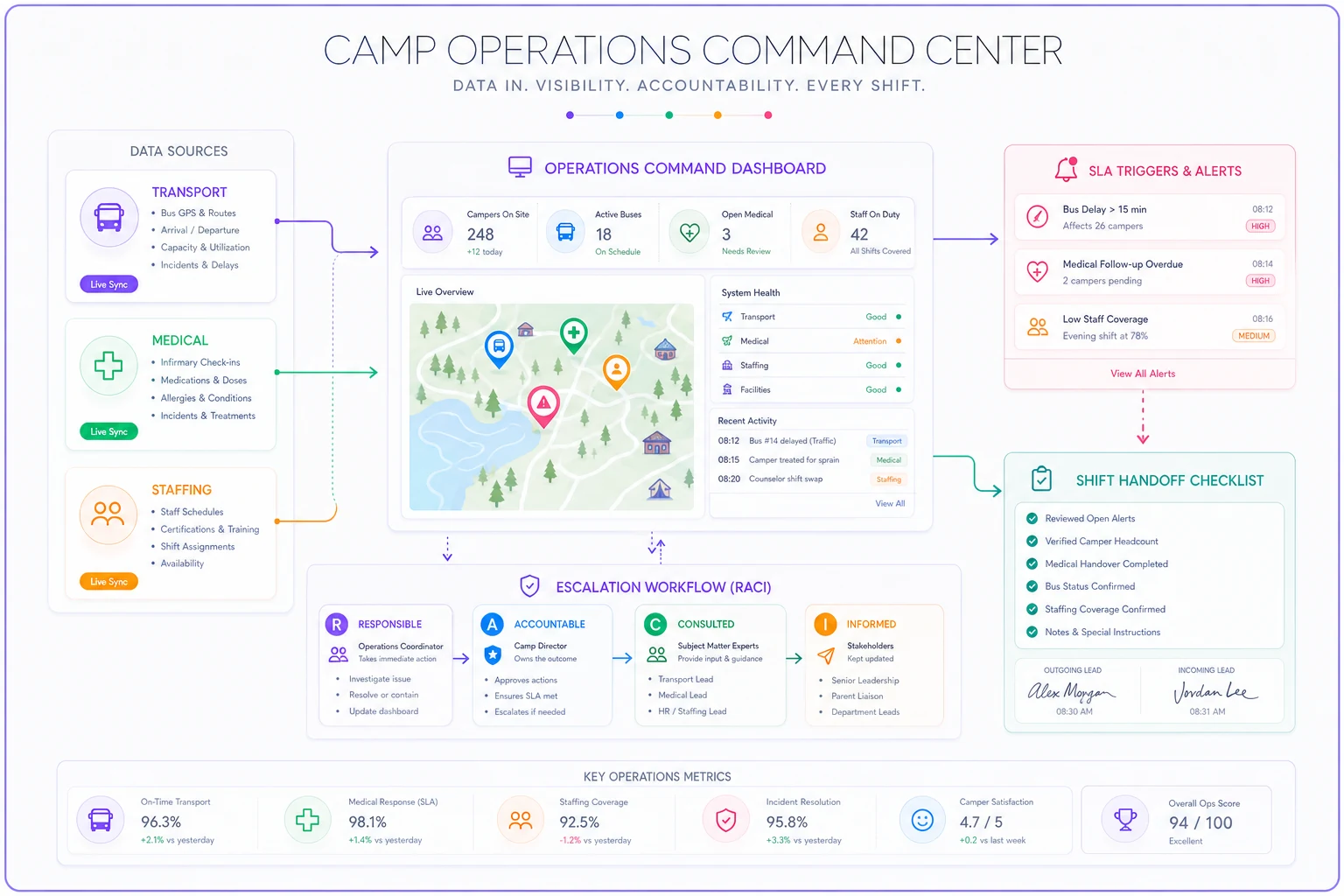
Start small. Pick your three sources of truth, write five SLA thresholds you'd stake your afternoon on, and run one tabletop before opening week. The camps that run calm in July aren't the ones with more staff — they're the ones who built the shared picture in May.
Start small. Pick your three sources of truth, write five SLA thresholds you'd stake your afternoon on, and run one tabletop before opening week. The camps that run calm in July aren't the ones with more staff — they're the ones who built the shared picture in May.
Ready to elevate your camp management?
Join 500+ camps using Campyly to save administrative time, enhance camper experiences, and streamline daily operations.