

Most camp board meetings run on vibes. The director talks for 40 minutes, someone asks about the pool incident from July, the treasurer flips to a spreadsheet nobody read beforehand, and three decisions that needed approval get pushed to "next time." By the time the minutes are written, half the room has forgotten what was actually decided.
That isn't a board problem. It's a reporting problem. Boards make bad decisions when the packet in front of them doesn't tie numbers to choices. And directors burn hours assembling packets that still don't answer the one question a board exists to answer: are we safe, solvent, and on track?
This piece walks through how to build a camp-specific board packet that works as a system — a downloadable monthly/seasonal document where every metric links to a decision checkpoint, every threshold triggers a conversation, and the agenda tells the board what they're approving before they walk in. Not a dashboard dump. A decision instrument.
## Why camp board packets break down
The core issue is that camp operations and board governance run on completely different clocks. Operations is daily — attendance, incidents, cash hitting the account. Governance is monthly or quarterly, sometimes just three or four times across a whole year. So the director is swimming in real-time detail while the board sees snapshots that are already stale by the time they're printed.
What happens across a lot of seasonal programs is that directors try to bridge that gap by including everything. The packet balloons to 30 pages. Enrollment charts, staff ratios, a narrative about the kitchen renovation, a food-cost breakdown, the full incident log. The board, which has maybe 90 minutes and a volunteer treasurer who does this on top of a day job, skims the first three pages and asks questions about whatever caught their eye.
The result is predictable. The board over-indexes on whatever's emotionally loud — a parent complaint, a near-miss at the waterfront — and under-indexes on the slow-moving stuff that actually sinks camps. Deposit pacing that's quietly tracking 15% behind last year. Reserve levels that won't cover the off-season. Nobody flags those until it's too late.
A good packet does the opposite. It's short, prioritized, and ruthless about connecting each number to a decision the board is responsible for.
## The four decision domains every camp board actually governs
Before you pick metrics, you need to know what a camp board is for. Strip away the committee structures and it comes down to four domains where the board — not the director — holds the decision.
Simplify camp operations with centralized control.
Campyly empowers you to manage registrations, staff, and activities seamlessly—all from one platform.
- Integrated camper and staff management
- Automated notifications and alerts
- Dynamic scheduling and resource allocation
No credit card required
-
Safety and risk. Is the camp operating within acceptable risk? Are incidents trending in a way that demands a policy change or capital spend?
-
Enrollment and mission delivery. Are we filling the camp? Are we serving the kids we exist to serve?
-
Cashflow and reserves. Can we make payroll in March? Do we have the runway to survive a bad enrollment year?
-
Incidents and compliance exposure. Are we accumulating liability — safety lapses, consent gaps, staffing violations — that a lawyer or a state inspector would flag?
Every KPI in your packet should map to one of these four. If a metric doesn't help the board decide something inside one of these domains, it belongs in your operational dashboard, not the board packet. This is the single biggest filter, and it's where most directors go wrong — they report what's easy to pull instead of what the board can act on.
If you've already built an operational metrics system, you'll have way more numbers than belong in a board packet. The work here is subtraction. (If you haven't built that layer yet, start with a prioritized KPI framework for operational health — the board packet pulls from it but is a much thinner slice.)
## The prioritized KPI list, with thresholds that trigger conversations
A number without a threshold is just trivia. The whole point of a board KPI is that it has a green / watch / act boundary, and crossing into "act" forces an agenda item. Here's a starting set. Adjust the thresholds to your camp's size and model — these are illustrative, not gospel.
Here's a starting set. Adjust the thresholds to your camp's size and model — these are illustrative, not gospel.
| KPI | Domain | Green | Watch | Act (triggers agenda item) |
|---|---|---|---|---|
| Deposit pacing vs. prior year | Enrollment | Within 5% | 5–15% behind | >15% behind |
| Session fill rate | Enrollment | >90% | 75–90% | <75% |
| Reportable incidents (rolling) | Safety | At or below prior year | Slightly above | Any serious injury, or clear upward trend |
| Staff-to-camper ratio compliance | Safety | 100% of sessions | One lapse flagged | Repeated or uncovered lapses |
| Days cash on hand | Cashflow | >120 days | 60–120 days | <60 days |
| Reserve vs. target | Cashflow | At/above target | 70–99% of target | <70% of target |
| Background screening completion | Compliance | 100% before start | <100% at T-minus-2 weeks | Any staff onsite uncleared |
| Refund/cancellation rate | Cashflow | At plan | 1.5x plan | >2x plan |
| Open incident actions (unclosed) | Incidents | 0 past due | 1–2 past due | 3+ past due or any >30 days |
The design principle: the board should be able to read the status column and know what they're walking into. If three rows are in "Act," they know this is a heavy meeting before they open page two.
Don't soften thresholds after a bad month; the threshold is a contract with your board.
One pattern worth calling out — directors tend to soften thresholds after a bad month so the packet looks calmer. Don't. The threshold is a contract with your board. Moving it quietly is how a camp drifts into a reserve crisis that "nobody saw coming."
## Narrative prompts tied to decision checkpoints
Numbers tell the board that something changed. The narrative tells them why, and more importantly, what you're asking them to decide. This is where most packets fail — they report the metric and then go silent, leaving the board to invent the conversation.
Instead, attach a short, structured narrative prompt to each checkpoint. Not an essay. Three or four sentences built on a fixed skeleton:
-
What the number is and how it changed.
-
Why, in one line (the operational cause).
-
What's already been done operationally.
-
What the board is being asked to decide, if anything.
> Deposit pacing is tracking about 18% behind last year as of the June packet, which crosses our "act" threshold. The gap is concentrated in the two overnight sessions in weeks 5–6; day camp is actually ahead. We've already moved marketing spend toward those two weeks and opened a sibling discount. Board decision requested: approve a one-time $6k marketing push from the discretionary line, or hold and reassess at the July meeting.
Notice what that does. It gives context, shows the director isn't asleep at the wheel, and hands the board a clean, bounded choice. No one has to improvise. The treasurer knows exactly what dollar figure is on the table.
Build one of these narrative prompts for each of the four domains, and make the "board decision requested" line mandatory — even when the answer is "none, informational only." That single discipline eliminates the most common board-meeting failure mode: a long discussion that ends without anyone knowing if a decision was made.
## How the packet connects to the agenda and the approvals
A packet and an agenda should be the same document viewed two ways. The packet holds the detail; the agenda is the decision sequence. When they're built separately, you get the classic disconnect — a board spends 30 minutes on item two and runs out of time before the enrollment vote that actually mattered.
Here's a sample agenda structure that links each metric block to an explicit approval:
-
Consent agenda (5 min) — minutes, routine approvals, informational KPIs in "green." Approved as a block, no discussion unless pulled.
-
Safety & incidents checkpoint (15 min) — review any "watch/act" safety rows, open incident actions. Approval point: any policy change or capital request tied to an incident trend.
-
Enrollment & mission checkpoint (15 min) — fill rates, pacing, scholarship delivery. Approval point: marketing spend, discount programs, session cancellations.
-
Cashflow & reserves checkpoint (20 min) — days cash, reserve status, refund rate. Approval point: reserve draws, budget reforecast, large expenditures.
-
Director's decisions log review (5 min) — what the director decided under delegated authority since last meeting.
-
Forward checkpoints (5 min) — what decisions are coming next meeting, so the board can prepare.
The sequencing matters more than people think. Putting the consent agenda first clears the easy stuff fast and protects time for the three checkpoints that carry real decisions. Putting cashflow after enrollment is deliberate too — you can't intelligently approve a reserve draw until you've seen where enrollment is heading.
Governance and risk reporting lean on each other here. The safety checkpoint in your packet is basically the operational feed into your broader camp risk governance framework — the packet is where risk stops being a binder on a shelf and becomes a monthly decision.
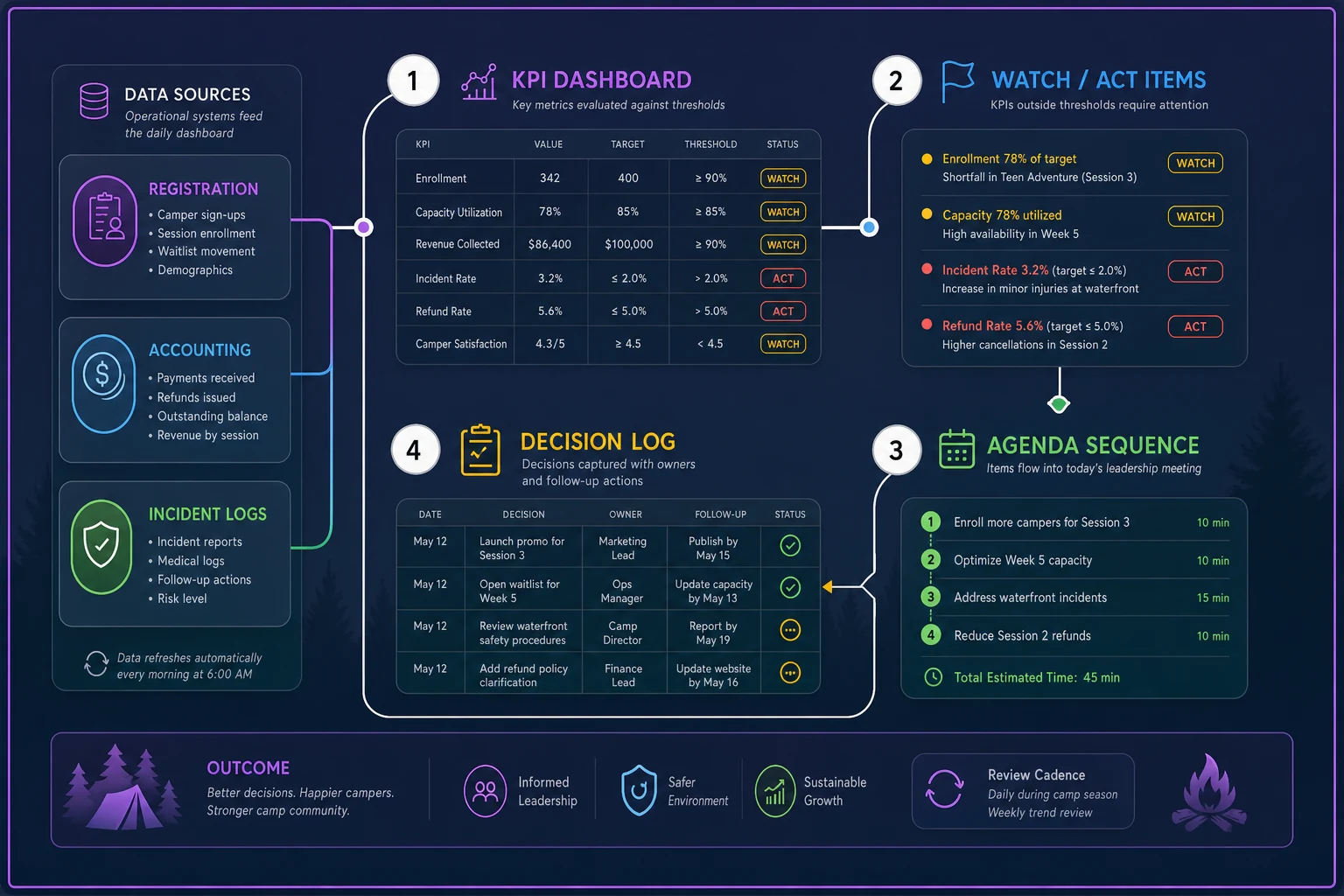
The image above shows the flow from operational data to agenda-ready decisions and the decision log that records outcomes.
## The decision log: the piece almost everyone skips
Most camps have minutes. Almost none have a clean decision log, and that's the gap that bites hardest when something goes wrong.
Minutes are a narrative of a meeting. A decision log is a running index of every decision the board made, who made it, under what authority, and what the follow-up was. When a parent's attorney sends a letter, or a state licensor asks how you handled last summer's incident, minutes make you dig through twelve documents. A decision log answers it in one row.
A workable decision log has these columns:
-
Date / meeting
-
Decision (one sentence)
-
Domain (safety / enrollment / cashflow / incident)
-
Authority (full board vote / delegated to director / committee)
-
Rationale snapshot (the one-line "why")
-
Follow-up owner and due date
-
Status (open / closed)
The habit that makes this work: at the end of each meeting, the person taking notes reads the new decision-log rows aloud before anyone leaves. Two minutes, and it catches the "wait, did we actually approve that?" ambiguity while people are still in the room.
The same discipline applies to decisions the director makes between meetings under delegated authority. Those go in the log too. This is how a board keeps real oversight without micromanaging — they see every delegated call in a single review block instead of being surprised by one six months later.
## A real scenario: the camp that was "fine" until February
Consider a mid-size overnight camp — roughly 320 campers across the summer, a seven-person volunteer board, a solo full-time director. For years the board meetings were enrollment-chart-and-vibes. Reserves looked okay because nobody tracked days-cash; they tracked the bank balance in August, which is always flush right after tuition lands.
Then enrollment came in soft one year — maybe 11% below plan — and nobody flagged it at the board level until registrations were basically closed. The packet showed a raw enrollment count with no prior-year pacing comparison and no threshold. The board found out in the August packet that they were short. By February, with off-season costs running and no summer revenue, days-cash dropped under 40. They made payroll by deferring a facilities project and leaning on a board member's bridge loan. Survivable, but ugly, and entirely avoidable.
What changed the following year wasn't dramatic. They rebuilt the packet around pacing-vs-prior-year with a 15% act threshold, added days-cash and reserve-vs-target rows, and required a "board decision requested" line on every checkpoint. The soft spot showed up in the April packet instead of August. The board approved a modest, targeted marketing push and a small reserve policy change with four months of runway to react.
Same director, same camp, roughly the same raw numbers. The difference was a packet that surfaced the problem while there was still time to decide something about it. That's the entire value of board-ready reporting — it's not about looking professional, it's about buying decision time.
## Building the monthly vs. seasonal versions
One packet template doesn't fit the whole year. A camp's decision load is wildly uneven — nothing happens in November, everything happens in May. So run two cadences off the same KPI spine.
The monthly packet (roughly off-season) is thin: pacing, cash, reserves, screening progress, any open incident actions. Often half a page of status plus one narrative prompt. The board meeting might be 30 minutes. The point is early warning, not depth.
The seasonal packet (pre-season, peak, post-season) is the heavy version: full KPI table, all four narrative checkpoints, forward decisions, and a post-season retrospective that feeds next year's thresholds. The post-season packet is the most underused of all — it's where you compare every threshold against what actually happened and recalibrate. Camps that skip the retrospective keep setting the same thresholds that failed them.
Worth copying: tie the cashflow checkpoint in your seasonal packets directly into your off-season finance planning rather than treating them as separate exercises. The reserve conversation the board has in September should be the same framework that drives your seasonal finance planning for predictable cashflow and reserves — one feeds the other.
## When this level of rigor makes sense — and when it's overkill
This system isn't free. It takes real effort to build thresholds, maintain a decision log, and write narrative prompts every cycle. So be honest about fit.
This makes sense when:
-
You have an actual governing board with fiduciary responsibility, not just an advisory group.
-
Your camp is large enough that a bad enrollment or cash miss is existential.
-
You've had at least one "how did nobody see this coming" moment.
-
Board turnover is high and you need continuity that doesn't live in one person's head.
This is overkill when:
-
You're a tiny program where the director is effectively the board and decisions happen in real time anyway.
-
Your board meets once a year and genuinely just rubber-stamps.
-
You don't yet have the underlying operational data to populate even a handful of thresholds — fix that layer first, because a board packet built on guesses is worse than no packet.
Who should NOT start here: camps that don't have clean enrollment and cash data in the first place. A board packet is a presentation layer. If the numbers underneath are unreliable, you'll just be presenting wrong information more professionally. Get the operational tracking solid, then build the governance view on top.
## Where tooling quietly helps
The honest friction in all of this is assembly. Pulling pacing from the registration system, cash from accounting, incidents from wherever they live, then formatting it into a packet — that's the part directors dread, and it's why packets get skipped in busy months.
Operational platforms that already hold your registration, incident, and staffing data can take most of that assembly off your plate — generating the KPI table against your defined thresholds, flagging which rows crossed into "act," and keeping the decision log as a living record instead of something you reconstruct from memory. The value isn't fancy automation for its own sake; it's that the packet gets built consistently every cycle, including the busy ones, so the board never loses visibility right when operations get hardest.
The goal is simple: spend your time on the decisions, not on the spreadsheet gymnastics that precede them.
## Pulling it together
A board packet is not a report card. It's a decision instrument. The camps that govern well aren't the ones with the prettiest charts — they're the ones where every number on the page is wired to a threshold, every threshold is wired to a conversation, and every conversation ends with a logged decision and an owner.
Start smaller than you think. Pick the four domains, set one or two honest thresholds in each, write the mandatory "board decision requested" line, and keep a real decision log. Run it for two cycles before you add anything. You'll know it's working the first time a problem shows up in April instead of August — with enough runway left for the board to actually do something about it.
Ready to elevate your camp management?
Join 500+ camps using Campyly to save administrative time, enhance camper experiences, and streamline daily operations.