



Most camp directors don't have a people-ops problem. They have five separate people-ops problems that only look separate because they live in different spreadsheets, different inboxes, and different brains.
The recruiter is tracking applicants. The business manager is classifying roles for payroll. Someone on the leadership team owns onboarding. And rehire decisions? Those usually happen in July, informally, when a director mentally files a counselor under "ask back" or "hard no" — and then forgets which bucket they landed in by the time applications open in January.
Individually, each piece runs okay. The chaos shows up at the seams — where the funnel hands off to classification, where classification feeds payroll, where payroll cadence collides with session math, where onboarding depends on data nobody collected during hiring. That's the real story of seasonal people operations at a camp. It's not that any one piece is broken. It's that nothing connects, so every connection becomes manual, and every manual step is a place where things slip.
This is a systems article. We're going to walk the full chain — applicant to rehire — look at where it breaks as you scale from 30 seasonal staff to 120, and talk about what a director-level system actually looks like when it's designed as one thing instead of five.
Why these five systems drift apart
The pattern underneath almost every seasonal people-ops mess: each stage was built by a different person solving a different fire, at a different time of year.
Recruiting got built because someone was drowning in applications. Classification got built because payroll had a tax question. Onboarding got built after a bad first week. Nobody sat down and designed the whole lifecycle — it accreted. And accreted systems share one fatal trait: they don't agree on what a "staff member" is.
In the applicant tracker, a person is a candidate with a status. In payroll, that same person is a tax classification and a pay rate. In onboarding, they're a checklist. Three different records of the same human, kept in sync only by somebody retyping information from one place into another.
A typical example: a counselor gets hired in March. Recruiting has their name, phone, and the role they applied for. Payroll needs their SSN, W-4, exempt/non-exempt status, and a pay rate tied to a role band nobody ever formally defined. Onboarding needs their certifications, cabin assignment, and emergency contact. Three systems, three partial records — and a director who finds out in June that the lifeguard they hired was never classified correctly for overtime, because recruiting marked them "lifeguard" and payroll inherited that label without checking whether aquatics staff are hourly or salaried.
The drift isn't a discipline problem. It's a design problem. When systems don't share a spine, humans become the spine, and humans forget.
The recruiting funnel is where classification errors are born
Everyone treats the funnel as a marketing problem — how many applicants, what sources, what conversion rate. That matters, but it buries the operational point: the funnel is where you first assign a role, and that role assignment quietly determines payroll treatment for the entire season.
Simplify camp operations with centralized control.
Campyly empowers you to manage registrations, staff, and activities seamlessly—all from one platform.
- Integrated camper and staff management
- Automated notifications and alerts
- Dynamic scheduling and resource allocation
No credit card required
If your funnel captures "position applied for" as a free-text field, or worse, as a vague category like "general staff," you've already planted a classification landmine. Because three months later, someone has to turn "general staff" into an actual pay band and an actual exempt/non-exempt determination — and they'll do it fast, under pressure, probably wrong.
The fix starts at intake. Every role in your funnel should map to a defined role class before an offer goes out. Not after. The moment you extend an offer, the role should already carry:
-
Pay band (with a min/max, not a single number)
-
Exempt or non-exempt status
-
Hourly vs. stipend vs. salaried cadence
-
Whether the role is eligible for overtime during peak weeks
-
Supervisory status (this one flips exemption for some positions)
When this lives in the funnel, classification stops being a separate task. The role is the classification. By the time this person hits payroll, there's nothing to decide — it was decided at offer.
Camps that misclassify staff almost never do it on purpose. They do it because the role label and the pay rules were defined in two different places, by two different people, months apart. Collapse that gap and most of the misclassification risk disappears.
This is also where your hiring quality controls belong. A funnel that moves people toward offers should be the same funnel that enforces your seasonal background-screening pipeline — screening isn't a separate step bolted on at the end, it's a gate inside the funnel that a candidate can't pass without clearing.
A role-classification checklist that actually prevents payroll pain
Classification is the part everyone underestimates because it feels like paperwork. It's not paperwork. It's the thing that decides whether you owe overtime, whether a labor audit goes smoothly, and whether your payroll numbers are predictable.
-
Does this role direct other staff? Supervisory duties change exemption analysis. A head counselor is often a different class than a line counselor even if the day-to-day looks similar.
-
Is compensation a true salary or a stipend? Camps love calling things "stipends." Legally, a stipend for someone working 60-hour weeks may not shield you from overtime obligations. Don't assume the label protects you.
-
What's the cadence? Weekly, biweekly, per-session, lump sum at season end? Each has different cash-flow and compliance implications.
-
Is this role hourly with predictable overtime? Aquatics, kitchen, and overnight supervision roles often blow past 40 hours in peak weeks. If they're non-exempt, you need to be tracking and paying overtime — and your budget needs to reflect that in advance.
-
Does the role exist in multiple tiers? Junior counselor, senior counselor, specialist — if your bands aren't written down, each hiring manager invents them, and your pay scale becomes inconsistent by August.
-
Is housing or meals part of compensation? For residential camps this can affect classification and reporting. Decide the treatment once, apply it everywhere.
Keep role bands and exemption rules in a single shared reference so hiring managers can pick the correct class at offer time without guesswork.
The mistake that comes up most often: directors classify the easy roles correctly — office staff, obvious salaried leadership — and wing it on the messy middle. The specialists, the floaters, the "we created this role in June because we needed someone" positions. That messy middle is exactly where audits find problems.
Pay cadence is a math problem tied to your session calendar
Your pay cadence has to agree with your session calendar, or you end up with partial pay periods, confused staff, and a cash-flow pattern that doesn't match your enrollment revenue. A biweekly cadence sounds clean until you realize your sessions run in odd-week increments and staff keep getting paid for "half a session" in ways that feel arbitrary to them.
The core idea: map pay periods to session boundaries, not just to the calendar. When a pay period closes mid-session, you create reconciliation work and staff confusion. When it closes on a session boundary, everything lines up — hours, stipends, session completion bonuses, everything settles cleanly.
A few cadence templates tied to session math:
| Staff type | Session structure | Recommended cadence | Why it works |
|---|---|---|---|
| Hourly line staff | 1-week sessions, back-to-back | Weekly, closing on session end | Overtime settles per session; no mid-period confusion |
| Hourly specialists | Mixed 1–2 week sessions | Biweekly aligned to two-session blocks | Reduces payroll runs while staying on session edges |
| Salaried leadership | Full-season contract | Biweekly, flat | Predictable; no session dependency |
| Stipend counselors | 3–7 day sessions | Per-session, paid at session completion | Ties pay to deliverable; simplifies partial-season exits |
| Returning CITs / junior | Multi-session | Lump sum at defined milestones | Low admin; matches their intermittent schedule |
The session-math point gets more important the more session lengths you run. A camp running a single uniform session length can get away with almost any cadence. A camp running 3-day, 5-day, and 7-day sessions in the same summer cannot — the odd lengths create fractional pay periods that pile up into reconciliation nightmares.
Build pay cadence against the actual session grid for the season. If someone exits after session three of five, a per-session cadence means there's nothing to prorate — they were paid per session, so the math is already done. Good cadence design eliminates proration work before it exists.
Onboarding milestones that depend on data you already collected
Onboarding fails when it starts from zero — when the first day of staff week is the first time anyone collects certifications, emergency contacts, or role-specific training needs. All of that should already be in the system, captured during the funnel and classification stages.
Think of onboarding not as a fresh data-collection event but as a milestone track that unlocks based on information you already have. A lifeguard's onboarding track should already know they need an in-water skills verification, because the role class said so at offer time. A kitchen hire's track should already include food-handler verification. The track configures itself from the role.
-
Pre-arrival (completed before staff week) Tax forms, direct deposit, signed agreements, certification uploads, emergency contacts. If any of this is incomplete, the person doesn't start — and the system flags it weeks ahead, not the morning of.
-
Arrival verification (day 1–2) Confirm certifications are current and physically verified, confirm housing and assignment, confirm they understand their classification and pay cadence. Staff confusion about pay almost always traces back to this step being skipped.
-
Role competency (day 2–5) Position-specific training and sign-offs. This is where your micro-training and skills checks live.
-
Operational integration (first session) Supervisor check-in, early-performance note, and a yes/no flag on "would rehire" that gets captured while it's fresh instead of reconstructed in August.
That fourth phase quietly feeds your rehire pipeline — the part almost everyone builds last and needs most. The tighter your first-72-hours counselor onboarding plan is, the cleaner the signal you capture for next year's hiring decisions.
The rehire pipeline is a retention decision tree you're probably running in your head
Most camps make rehire decisions with better information than they ever actually use. During the season, supervisors form clear, accurate opinions about who's excellent, who's fine, and who shouldn't come back. Then that information evaporates, because nobody captured it in a structured way at the moment it was obvious.
By the time applications open the following winter, directors are reconstructing from memory. "Was she the one who was great with the younger kids, or was that someone else?" The decision gets made on vibes and whoever happens to apply first.
-
Rehire recommendation (strong yes / yes / conditional / no)
-
Role fit (was this the right position for them?)
-
Readiness for a step up (CIT → counselor, counselor → specialist/lead)
-
Any documented performance concerns
-
Their own stated interest in returning
That gives you a real retention decision tree for the next cycle. A "strong yes" with step-up readiness skips most of the funnel — they get a direct offer in a higher role class. A "conditional" gets a conversation before an offer. A "no" is flagged so they can't quietly reapply and slip through as a fresh applicant.
The operational value here is that rehires bypass the expensive parts of the funnel. A returning counselor with a clean prior season needs far less screening, far less onboarding, and a faster classification path because their role class is already known. The more of your staff you can pull from a structured rehire pipeline, the cheaper and calmer your recruiting season gets.
A realistic picture: a camp running around 90 seasonal staff with no rehire tracking might re-recruit nearly the whole roster every year — full funnel, full screening, full onboarding for everyone. The same camp with a working rehire pipeline might fill 40–50% of roles from returners moving through a fast lane. The recruiting load roughly halves, and quality tends to go up because returners are known quantities. That's not a stretch — it's just what happens when you stop throwing away information you already had.
What breaks as you scale
Manual people-ops degrades with headcount, and it degrades faster than linearly.
At 30 staff, one organized person can hold the whole lifecycle in their head and a few spreadsheets. The handoffs are manual but survivable. At 70 staff, handoffs start dropping things — a certification that didn't get verified, a classification that didn't get updated when someone changed roles mid-season. At 120+ staff across multiple session lengths and multiple role classes, manual coordination simply stops working. Not because people get worse at their jobs, but because the number of handoffs grows with every stage multiplied by every person.
A concrete example of how it fails: a specialist gets promoted to a lead role mid-season. In a manual system, that change has to propagate by hand to the pay rate, the exemption status, the cadence, the supervisory classification, and the onboarding record for their new responsibilities. Miss any one of those and you've got an underpaid lead, a misclassified exempt determination, or a supervisor with no record of being trained to supervise. At 30 staff, someone catches it. At 120, nobody does — until payroll or an auditor finds it.
This is where an integrated people-ops platform earns its place. Not as a magic button, but as the shared spine the five systems never had. When recruiting, classification, payroll cadence, onboarding, and rehire all read from one record, a mid-season promotion updates everything downstream automatically. The role class changes, and pay, cadence, exemption, and onboarding requirements follow. The handoffs that used to be manual become automatic, and the places things used to slip simply stop existing.
The automation that matters here isn't flashy — it's quiet connective work. A role change flows to payroll without retyping. An onboarding track configures itself from the role class. A rehire flag captured at season end pre-fills next year's offer. Classification rules, cadence templates, onboarding milestone sets — defined once and applied to every matching role, every season, without rebuilding them. That's the difference between a system you operate and a system that operates with you.
When this level of system makes sense — and when it doesn't
When it makes sense: You're running 60+ seasonal staff, multiple role classes, multiple session lengths, or you've had a classification or payroll issue bite you. If your recruiting season feels like it starts from scratch every January, or if you can't quickly answer "who are we definitely bringing back," the system pays for itself in reduced re-recruiting alone.
When it's overkill: A small day camp with 15–20 staff, one session length, and a stable returning core probably doesn't need integrated tooling yet. A well-built set of templates and a disciplined spreadsheet habit will carry you. Don't buy infrastructure for scale you don't have.
Who should NOT start here: If your foundational staffing math isn't settled — if you don't yet know your true headcount needs and contingency coverage — fix that first. A people-ops system coordinates the staff plan; it can't invent one. Get your reproducible staffing model in place before you build the machinery that runs on top of it.
Pulling it together
The through-line of director-level people-ops is simple to say and hard to build: one definition of a staff member, carried cleanly from first application to rehire decision. Recruiting assigns the role. The role carries its classification. Classification drives pay cadence. Cadence aligns to session math. Onboarding configures itself from the role. The end-of-season flag feeds a rehire pipeline that makes next season cheaper and calmer.
Visual workflow:
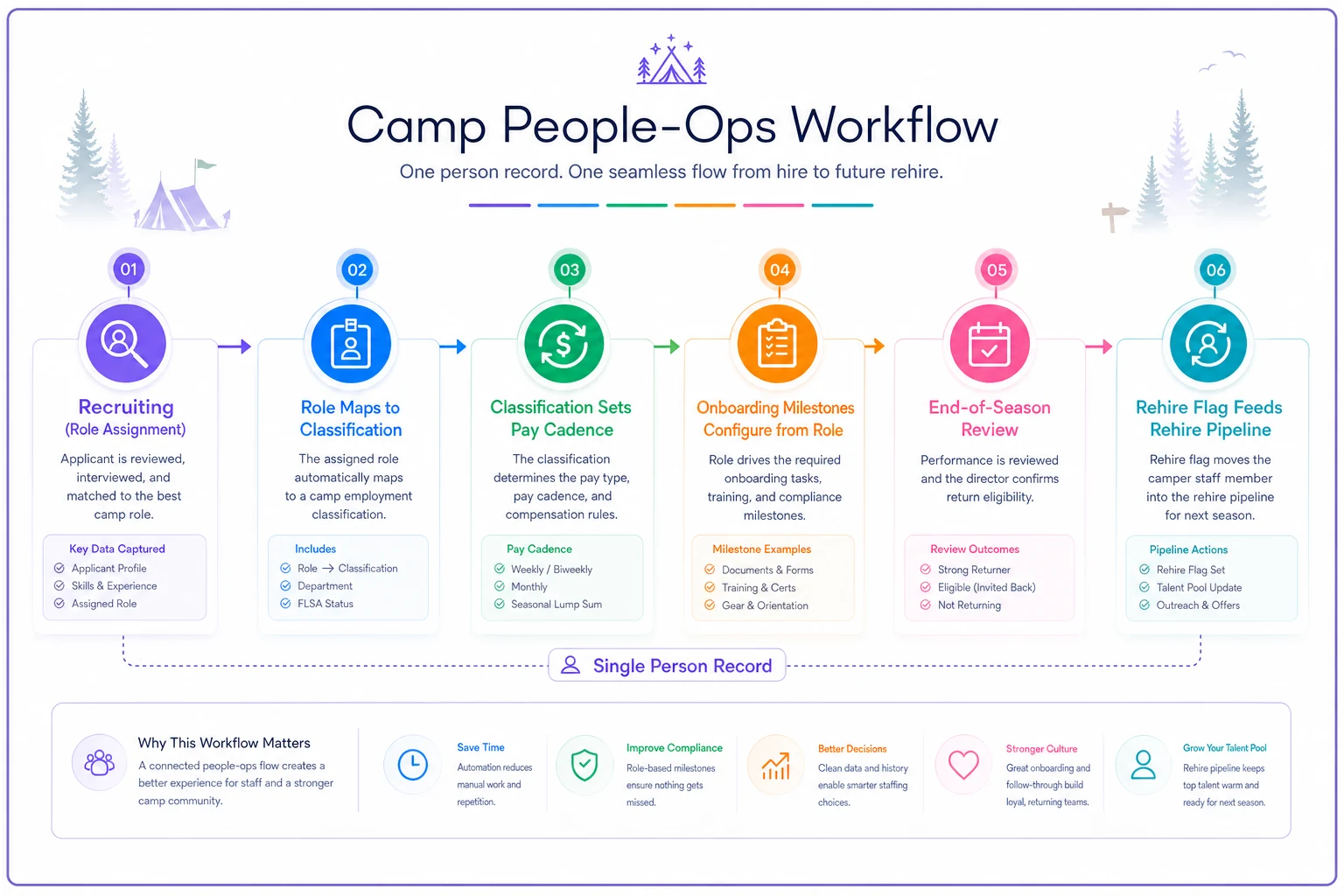
When those pieces share a spine, the seams stop being failure points. When they don't, every handoff is a place for something to slip — and the slips compound with every staff member you add.
Most camps don't need more effort in people-ops. They need fewer handoffs. Design the lifecycle as one connected system, decide the hard things — classification, cadence, rehire criteria — once, and let the structure carry the weight your memory shouldn't have to.
Ready to elevate your camp management?
Join 500+ camps using Campyly to save administrative time, enhance camper experiences, and streamline daily operations.