

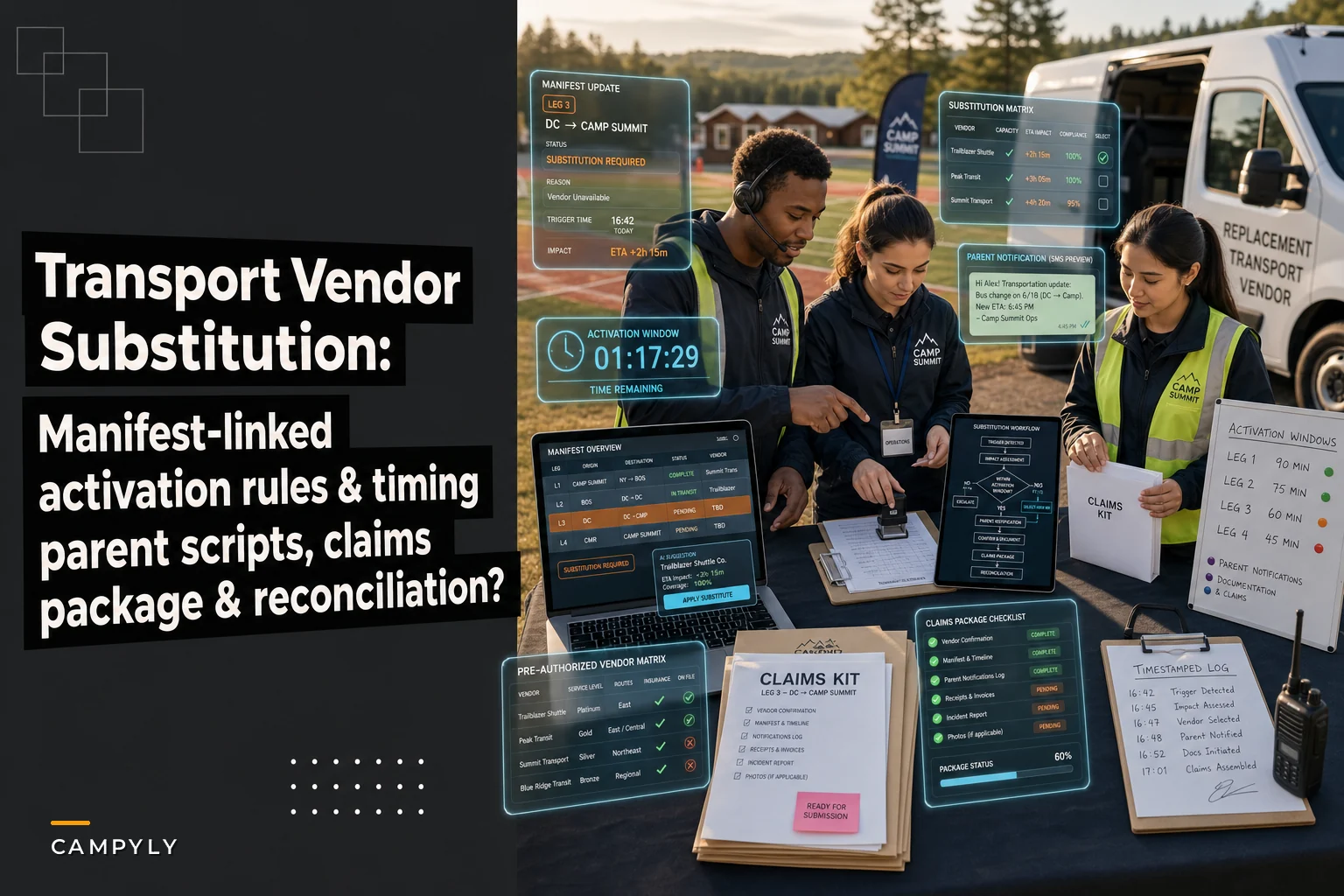

The worst version of a vendor substitution isn't the breakdown itself. It's the 90 minutes after. A coach dies on the highway between the ropes course and the lake, your primary carrier can't send a replacement for three hours, and now you're on the phone with a backup vendor who has no copy of your manifest, doesn't know you have two wheelchair campers on board, and quotes you double your budget because it's "emergency same‑day." Three weeks later the insurer kicks back your claim because nobody logged the swap properly and the paperwork doesn't match the manifest.
That whole chain is preventable — not with better luck, but with a substitution matrix built before the season, tied to your manifests, with pre‑negotiated vendors, scripts your coordinators can read off a phone, and claims packages that come together as the incident unfolds instead of being reconstructed from memory weeks later. This is the piece most camps skip. The qualification side gets all the attention; the substitution side gets improvised. If you haven't locked down who's even allowed to drive for you in the first place, start with the driver and transport vendor qualification checklist first — this article assumes those vendors exist and you're figuring out how to swap between them cleanly under pressure.
Why substitutions on multi‑leg trips break differently than single trips
A single round‑trip is easy to recover from. One leg out, one leg back. If a bus fails, you're dealing with one pickup location and one timeline.
Multi‑leg trips fail in a chained way. A delay on leg two cascades into leg three's dinner reservation, leg four's dam closure window, and the departure slot the whole day was built around. The substitution doesn't just replace a vehicle — it has to replace a vehicle and reschedule everything downstream, often while campers are standing in a parking lot.
The pattern that keeps showing up: camps plan the primary itinerary meticulously and treat the backup as "we'll call someone." But the backup carrier doesn't inherit any context. They don't know which leg they're joining, what headcount looks like after morning no‑shows, whether there are medical riders, or where the group needs to be in 40 minutes. The coordinator ends up re‑explaining the entire trip verbally to a dispatcher writing it on a sticky note.
The second failure is financial. Emergency substitutions almost always cost more, and who eats that extra cost — the camp, the primary vendor who failed, or the insurer — depends entirely on documentation nobody creates in the moment. No swap log, no photos, no timestamped manifest version, no incident note tying the delay to a mechanical failure. Six weeks later it's your word against the invoice.
The pre‑authorized substitution matrix
The core fix is a matrix you build in the off‑season and attach to every manifest. For each trip, each leg, and each vehicle class, you pre‑identify who can substitute in, at what pre‑agreed rate, and under what trigger conditions. "Pre‑authorized" is the operative word — these vendors have already signed off on rates and insurance requirements, so an emergency swap isn't a negotiation, it's an activation.
Simplify camp operations with centralized control.
Campyly empowers you to manage registrations, staff, and activities seamlessly—all from one platform.
- Integrated camper and staff management
- Automated notifications and alerts
- Dynamic scheduling and resource allocation
No credit card required
| Leg | Vehicle class | Primary vendor | Pre‑auth sub (1st) | Pre‑auth sub (2nd) | Agreed emergency rate | Max activation time | Manifest riders |
|---|---|---|---|---|---|---|---|
| 2 (lake→course) | 24‑pax coach w/ lift | Regional Coach Co. | Hilltop Transit | Valley Charters | $185/hr, 2‑hr min | 90 min | 2 wheelchair, 1 EpiPen |
| 3 (course→dinner) | 14‑pax van | Hilltop Transit | Regional Coach Co. | — | $95/hr, 90‑min min | 60 min | 1 severe nut allergy |
| 4 (dinner→camp) | 24‑pax coach | Regional Coach Co. | Valley Charters | Hilltop Transit | $185/hr, 2‑hr min | 90 min | — |
The reason this works is that the decision is already made. When leg two's coach fails, the coordinator doesn't brainstorm — they look at the row, see Hilltop Transit is first sub, see the agreed rate, and call. If Hilltop can't make the activation window, they move to Valley. No pricing surprises, no scrambling to find a vendor who meets your insurance floor.
The matrix has to live attached to the manifest, not in a separate binder. When a coordinator pulls up the trip, the substitution options for each leg should be right there — because the moment they need it is the exact moment they won't go digging through a different folder.
What "pre‑authorized" actually requires
Vendors don't end up in your matrix because you called them once. To sit in a substitution slot, a vendor needs:
-
A signed emergency rate agreement, valid for the season, with the hourly rate and minimums locked
-
Current insurance and driver qualification already on file (same floor as your primaries)
-
A confirmed dispatch contact who answers outside business hours
-
A realistic activation time — how fast they can actually get a vehicle to your region, not a generic "we're fast"
-
Acknowledgment that they may carry manifest riders (lift‑equipped, medical, etc.)
That last point trips people up more than any other. A backup vendor without a wheelchair lift is useless as a substitute for a lift‑equipped leg regardless of how cheap or fast they are. The matrix has to match vehicle capability to the manifest, not just seat count.
Attach the substitution matrix file directly to each digital manifest so coordinators can't miss it when a leg fails.
The matrix has to match vehicle capability to the manifest, not just seat count.
Emergency manifest update rules
When you substitute a vehicle, the manifest changes — and if it doesn't change on paper, you've created a safety and liability gap. The new carrier is responsible for your campers, but the manifest still shows the old vehicle and old driver. If anything goes wrong on that leg, the record is wrong.
-
Freeze the current version before editing. The original manifest for that leg becomes a timestamped record. Never overwrite it — create a new version. This matters enormously for claims, because you need to show the manifest as it was when the failure happened.
-
Log the trigger. One line
what failed, when, where. "Regional Coach #4 mechanical failure, 2:14pm, Route 9 shoulder near mile 23." This single line is what links your extra cost to a covered event.
-
Record the swap. New vendor, new vehicle, new driver name and license verification, substitution start time.
-
Re‑confirm headcount at the swap point. You are physically moving campers between vehicles — this is exactly where someone gets miscounted or left behind. Count on, count off, against the current roster, not the morning's.
-
Flag riders to the new driver in writing. Not verbally in a chaotic parking lot. The wheelchair campers, the allergy riders, the "needs to sit up front" notes — the new driver gets them written down.
The manifest discipline here connects directly to the offsite‑permission and transport‑emergency thinking in the offsite permission and transport emergency workflow. The difference with a substitution is that it adds a handoff in the middle, and handoffs are where custody gets fuzzy. The re‑count rule exists specifically because of that.
Parent scripts, because the phone starts ringing
The moment a leg runs late, parents at the pickup point start texting. If your coordinator is simultaneously managing a vehicle swap, counting campers, and typing individual reassurances to 30 families, something gets dropped — usually the counting.
Pre‑written parent scripts solve this. Not a custom message per incident — a small set of templated messages the coordinator fills in with two or three variables and sends to the whole group at once:
Delay notice (within 15 min of known delay): > "Quick update on today's trip: our bus for the [leg] portion had a mechanical issue and we're bringing in a replacement vehicle. All campers are safe and accounted for. New estimated return is approximately [time]. We'll send one more update when they're on the road." Confirmation on the move: > "Update: campers are on the replacement vehicle and en route. Current ETA to [pickup point] is about [time]. Thanks for your patience."
The script does two things. It stops the individual‑text flood so the coordinator can focus on the actual swap, and it puts "safe and accounted for" in parents' minds before anyone has a chance to invent a worse story. The second part of that — making sure campers are actually accounted for — is why the manifest re‑count rule comes first in the sequence.
Keep them short. Parents don't need the mechanical details; they need "safe" and "when."
Pre-written scripts vs. figuring it out in the moment
Most coordinators default to improvising — typing something on the fly, mid-chaos, while also watching a headcount and talking to a dispatcher. That's how you end up with 40 minutes of silence while parents are standing at a pickup point inventing scenarios.
| Factor | Improvised per‑incident messaging | Pre‑written scripts |
|---|---|---|
| Time to first message | 10–25 min (often after parents already texted) | Under 5 min |
| Tone consistency | Varies with coordinator stress level | Consistent, calm |
| Coordinator attention pulled away | High | Minimal |
| Risk of promising a return time you miss | High | Lower (uses ranges) |
| Record of what was communicated | Scattered across threads | Single logged group message |
The improvised column is where most camps operate by default, and it's the column that generates the angry follow‑up email three days later: "Nobody told us anything for 40 minutes."
The parent script library
A small library of these scripts, written once and reused every season, is worth building properly. You want:
-
A pre‑departure "running late leaving" script
-
A mid‑trip substitution/delay script
-
A "back on the road" confirmation script
-
A significant delay escalation script (for delays past a threshold — say, more than an hour late — that offers a direct number)
-
A post‑incident "we're back, here's what happened" wrap‑up
Store them where coordinators actually work — on the trip itself, next to the manifest and substitution matrix. A script library that lives in a shared drive nobody opens mid‑crisis is effectively a library that doesn't exist.
Templated claims packages for insurer and vendor reconciliation
Here's the part that quietly costs camps real money every year: the extra expense of emergency substitutions goes unrecovered because the claim is incomplete or arrives too late.
A claims package is the bundle of documents you submit to your insurer or the primary vendor to recover the difference between what you budgeted and what the emergency swap actually cost. The problem is that by the time anyone gets around to assembling it, the trip was two weeks ago, the coordinator who ran it is onto other things, and half the supporting detail lives in people's heads.
-
The frozen original manifest (the pre‑swap version, timestamped)
-
The trigger log — the one‑line failure record with time and location
-
The substitution record — which sub vendor, which vehicle, activation time
-
The cost delta — budgeted leg cost vs. actual emergency invoice, with both invoices attached
-
Photos/timestamps where available (the stranded vehicle, the breakdown location)
-
The parent communication log (shows duty of care was maintained — useful if the failure escalates)
-
A short narrative tying it together, written same‑day while it's fresh
The reason "templated" matters is speed and completeness. Insurers and vendors both have windows for disputing charges and filing claims. A package that assembles as the incident unfolds is one you can submit within 48 hours, with nothing missing. A package reconstructed from memory three weeks later is the one that gets rejected for "insufficient documentation" — and rejections are almost never about whether the event happened, they're about whether you can prove the cost and link it to the event.
The reconciliation step people skip
Recovering from the insurer and recovering from the failed vendor aren't the same path, and the same incident might involve both. The primary vendor may owe you a credit for the leg they didn't complete and you may have an insurable excess cost on top. These need to be reconciled so you don't double‑count or, more commonly, forget one of them entirely.
Work through a simple reconciliation line per incident: budgeted cost → what the failed vendor should credit → what the emergency sub charged → net exposure → claimable amount. Most camps never calculate this, which means they absorb losses they were entitled to recover.
A real scenario
A mid‑sized overnight camp runs a four‑leg adventure day for 28 campers, including two who use wheelchairs. Budgeted transport for the day: roughly $1,100 across the legs.
On leg two, the lift‑equipped coach develops a brake fault and gets pulled from service. The primary carrier can't send a replacement lift coach for over three hours. Because the camp had built a substitution matrix, the coordinator pulled up leg two's row, found the pre‑authorized lift‑equipped sub, and activated them — on the road in about 70 minutes at the agreed emergency rate.
The emergency leg plus the knock‑on reshuffle (they dropped the dam stop and reworked the dinner window) pushed the day's actual transport cost to around $1,750 — roughly $650 over budget. But the frozen manifest, trigger log, both invoices, and parent communication log were captured the same day and dropped into the claims template. The failed carrier credited the uncompleted leg, and the excess emergency cost was submitted and recovered.
The contrast is what happens without any of that in place: three hours stranded with two wheelchair campers, a doubled emergency quote negotiated on the spot, 28 families receiving no update for 40 minutes, and a $650 overage absorbed entirely because the claim couldn't be substantiated. Same breakdown. Completely different outcome.
Activation checklist
When a leg fails, the coordinator works this list in order. Keep it on the trip record, next to the matrix:
-
Confirm all campers are safe and off the disabled vehicle
-
Note time, location, and nature of the failure (trigger log)
-
Freeze the current manifest version
-
Pull the substitution matrix row for this leg
-
Activate first pre‑authorized sub; if past activation window, move to second
-
Confirm the sub vehicle meets manifest requirements (lift, capacity, riders)
-
Send the templated delay message to all parents
-
Re‑count campers at the swap point, on and off, against current roster
-
Hand riders/medical notes to new driver in writing
-
Record sub vendor, vehicle, driver, and activation time
-
Assess downstream legs — what gets dropped or shifted
-
Send "back on the road" confirmation to parents
-
Same day
assemble claims package while details are fresh
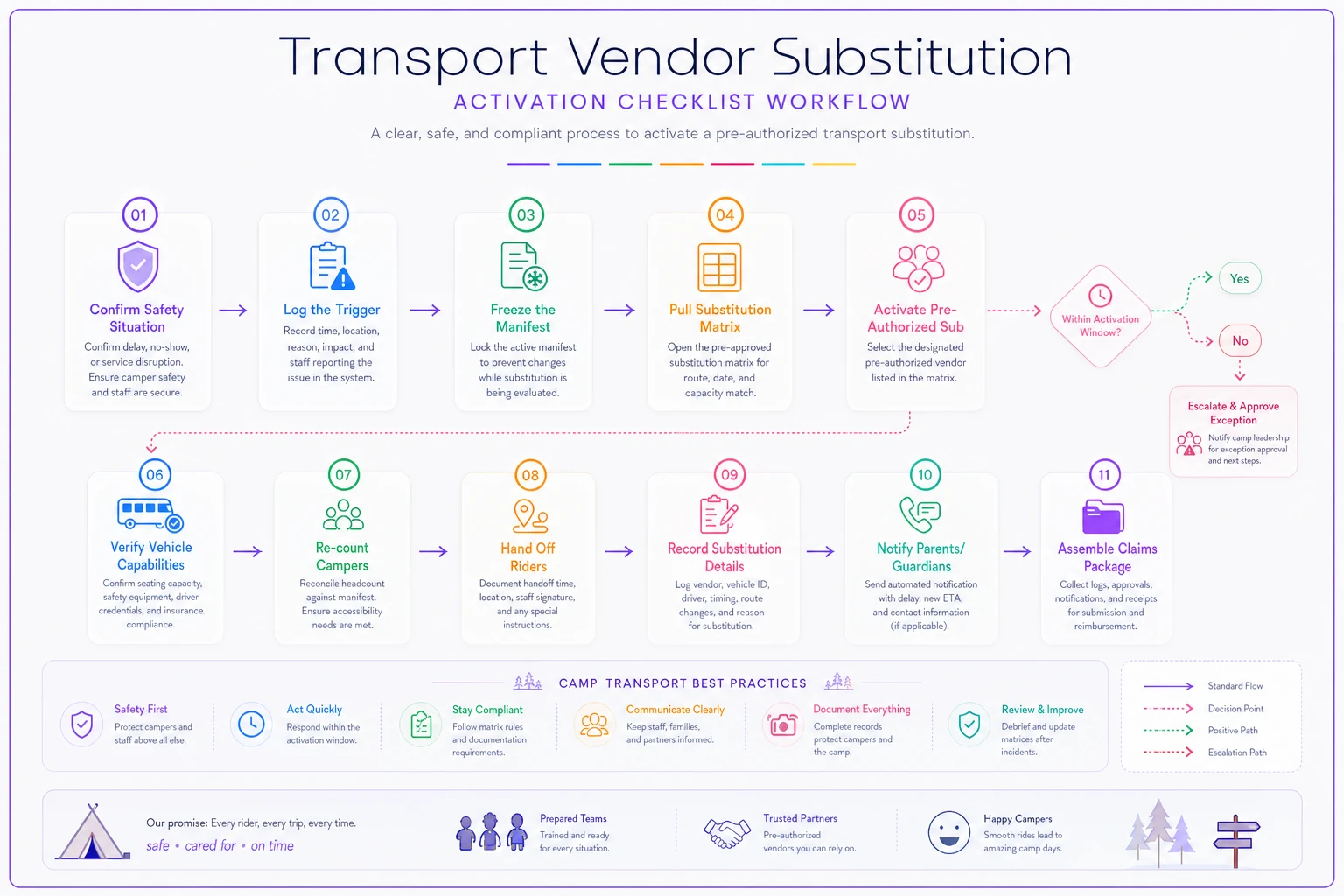
This workflow diagram maps the activation checklist steps in order.
Working through this sequence in order keeps coordinators from jumping to parent communications before headcount is confirmed, or activating a sub before checking whether the vehicle meets manifest requirements. The order matters.
When this level of structure makes sense — and when it's overkill
If your transport is a single round‑trip bus to the same lake every Tuesday, this is more machinery than you need. One backup vendor and a phone number is probably fine.
Where it earns its keep: multi‑leg trips, trips with lift‑equipped or medical‑rider requirements, trips timed around reservations or closing windows, and any program running enough offsite days per season that the odds of a mid‑trip failure stop being hypothetical. If you run two dozen multi‑leg adventure days a summer, you will have a breakdown. The only question is whether it costs you four hours and an unrecoverable overage, or 70 minutes and a clean claim.
The camps that handle substitutions well aren't luckier with their buses. They decided the hard parts — who substitutes, at what rate, what to tell parents, what to document — before the season started, so the only thing left to do under pressure is execute. A broken‑down coach becomes an annoyance instead of a crisis, and the extra cost becomes a claim instead of a loss.
The camps that handle substitutions well aren't luckier with their buses. They decided the hard parts — who substitutes, at what rate, what to tell parents, what to document — before the season started, so the only thing left to do under pressure is execute. A broken‑down coach becomes an annoyance instead of a crisis, and the extra cost becomes a claim instead of a loss.
Ready to elevate your camp management?
Join 500+ camps using Campyly to save administrative time, enhance camper experiences, and streamline daily operations.