

The moment your campers cross the property line, most of the systems you rely on stop working. Your attendance board is back at basecamp. Your nurse is on-site with the meds. And the counselor who "definitely counted heads" is now yelling over engine noise while two kids argue about window seats.
Offsite trips are where camps quietly accumulate the most operational risk, and almost nobody builds a workflow proportional to that risk. A day at the beach or a museum visit gets the same casual treatment as walking a group to the dining hall. That mismatch is exactly where kids get left behind, permission slips go missing, and a director ends up explaining to a parent why nobody noticed their child wasn't on the return bus for eleven minutes.
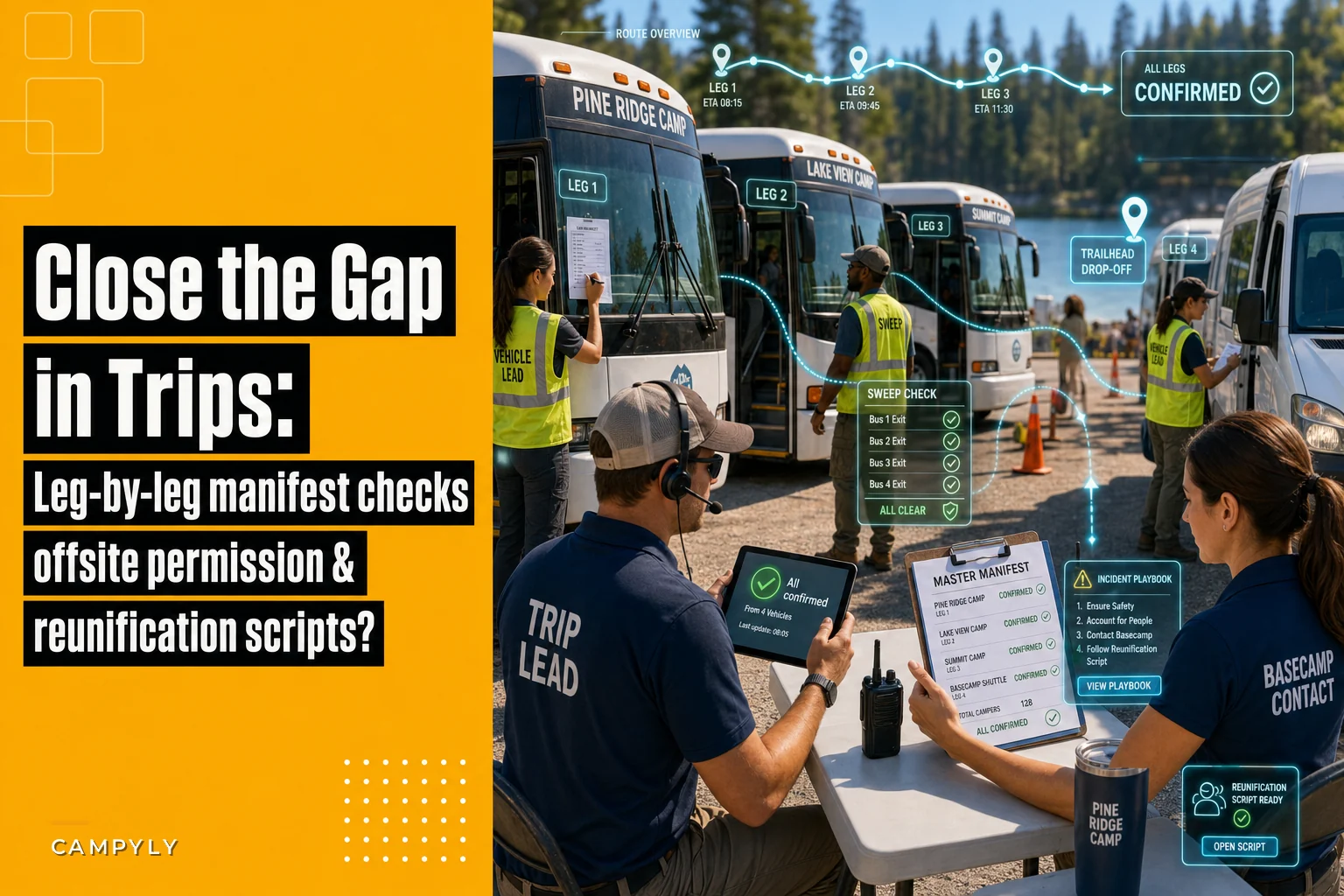
This post is narrow on purpose. It's not about routing your daily shuttle — that's a different problem covered in scalable multi-stop camp bus routing and pickup rules. This is about the camp field trip permission workflow and the transport emergency layer that sits on top of it: gate checks before you leave, who owns what during the trip, manifest reconciliation at every leg, and what people actually say and do when something goes wrong.
The failure isn't the emergency — it's the ten unglamorous steps before it
When a camper goes momentarily "missing" on a trip, the root cause almost never shows up during the scary part. It shows up an hour earlier, in a step somebody skipped because it felt redundant.
A typical example looks like this. A camp takes 44 kids to a regional aquarium across two vans and one bus. At departure, a counselor counts "44, we're good" and the caravan leaves. What nobody catches: two siblings got swapped between vehicles at the last second, and one camper on the manifest actually stayed back sick that morning. So the real number on the vehicles is 43 — but the paper says 44, and now every count for the rest of the day is chasing a phantom.
At the aquarium exit, someone counts 43 and panics. Twenty minutes of frantic searching later, they realize the "missing" camper was never on the trip. That's twenty minutes of staff pulled off the actual group, twenty minutes where a real wanderer could slip away unnoticed.
The lesson is boring and it's the whole ballgame: a headcount only works if it reconciles against a named manifest, not a number. Counting to 44 tells you how many bodies you have. It doesn't tell you which bodies, and "which" is the only thing that matters when a parent calls.
Pre-departure gate checks: the five-minute stop that prevents the two-hour crisis
Think of the departure lot as a gate — nobody crosses it until specific things are true. Not "generally handled." True, checked, initialed.
Simplify camp operations with centralized control.
Campyly empowers you to manage registrations, staff, and activities seamlessly—all from one platform.
- Integrated camper and staff management
- Automated notifications and alerts
- Dynamic scheduling and resource allocation
No credit card required
-
Named manifest per vehicle. Every kid is assigned to a specific vehicle by name, printed on that vehicle's sheet. Not a total — a roster. Van 2 knows it owns Jordan, Priya, Malik, and so on.
-
Permission status verified against the manifest, not the group. Every name on the vehicle sheet has a confirmed offsite permission on file. Any name without one doesn't board — they stay back with a pre-planned alternate activity. No exceptions made in the parking lot under time pressure.
-
Same-day medical flags surfaced. The kid with the epi-pen, the one with the seizure history, the two with severe allergies — the lead on each vehicle knows who they are before departure and where the meds physically are.
-
Two-adult confirmation per vehicle. Each vehicle has a named lead and a named second. The lead owns the count. The second owns the incident phone and the medical kit.
-
Reconcile the morning's actual attendance against the trip manifest. This is the step that catches the sick kid who was supposed to come but stayed home. If the attendance record and the trip manifest disagree, you fix it in the lot — not at the destination.
Have counselors initial the vehicle sheet at the gate so you have a timestamped record of who checked what.
That last step is the one people skip, and it's the one that would have prevented the aquarium mess above. Cross-referencing the trip roster against who actually showed up that morning takes maybe three minutes and eliminates the phantom-camper problem entirely.
One thing worth noting from watching these gate checks play out in practice: camps that write initials on a physical sheet at the gate have far fewer disputes later than the ones relying on a counselor's memory. When something goes sideways at 2pm, "I definitely checked" is worthless. "Here's the sheet, initialed at 9:14" is a record.
Role assignments: stop letting "everyone watches everyone" be the plan
"Everyone keeps an eye on the kids" is how kids get lost. When responsibility is shared by all, it's owned by none. Offsite trips need named roles, and each role needs a single, unambiguous job.
Minimum role structure that actually holds up:
| Role | Owns | Does NOT own |
|---|---|---|
| Trip Lead | The master manifest, the go/no-go call, contact with basecamp | Counting individual vehicles |
| Vehicle Lead (per vehicle) | The named roster for that vehicle, every reconciliation at every leg | The whole trip's status |
| Vehicle Second | Incident phone, medical kit, backup count | Leading the group |
| Roam / Sweep | Physically walking the back of the group, checking bathrooms and exits last | Head counting |
| Basecamp Contact | Static person back on-site with the master manifest and parent contacts | Being on the trip |
The role most camps forget is the Basecamp Contact — a specific staff member who stays behind with a copy of the full manifest and every parent's phone number. When a phone dies offsite or an incident needs a parent called now, you don't want the one person with contact info to be the same person managing a crowd of 40 kids at a rest stop. Separating "handle the situation" from "make the calls" is what keeps a small problem from becoming a bigger one.
The Sweep role is underrated too. Someone whose entire job is to be the last person out of every space — bathroom, gift shop, picnic area — catches the kid who wandered back to look at the sharks one more time. That person doesn't count. They physically check empty spaces. Different job, different failure mode caught.
Live manifest reconciliation at every leg
A "leg" is any transition point: leaving the lot, arriving at the destination, moving from the parking lot into the venue, leaving the venue, arriving at a lunch stop, boarding for the return, arriving back on-site. Every one of these is a place a kid can be left behind, and every one needs a reconciliation.
The rule: you don't move to the next phase until every vehicle lead confirms their named roster is complete. Not a total shouted across the lot. A name-by-name confirmation.
-
Leg name / time Aquarium exit / 1:40pm
-
Vehicle Van 2
-
Expected (named) 12 — [full name list]
-
Confirmed present 12
-
Discrepancy none
-
Vehicle Lead initials ___
-
Reported to Trip Lead at 1:42pm
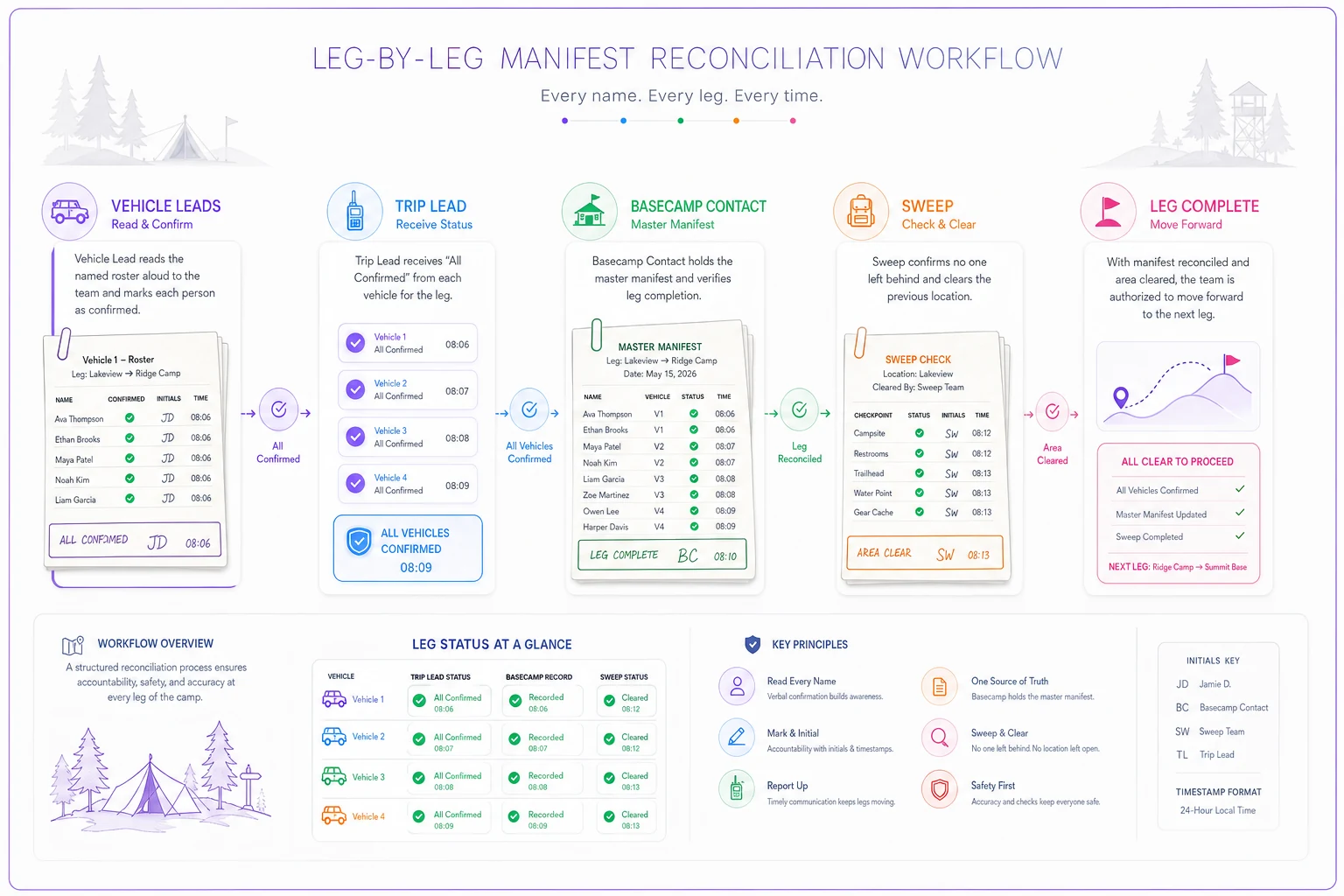
It feels like a lot of ceremony for a beach day. It isn't. A full reconciliation for a 44-kid trip takes under four minutes if roles are clear, and it's the difference between catching a missing kid at the venue where they still are versus discovering it forty minutes down the highway.
The pattern worth internalizing: the cost of catching a missing camper scales with how far you've traveled from where they went missing. Catch it at the exit and you walk back inside. Catch it at the next stop and you're turning a bus around on a highway with 40 confused kids. Reconcile at every leg and you almost always catch it at the exit.
The transport incident playbook
Vehicle breakdowns, minor collisions, a kid who gets sick or hurt in transit — these need a script, because the middle of a roadside incident is the worst possible time to figure out who does what.
-
Vehicle Second calls it in to Basecamp Contact immediately — location, nature of incident, whether anyone is hurt. The Vehicle Lead does not make this call; they're managing kids.
-
Kids stay put and get counted by name. In a roadside incident the instinct is to move kids, and that's exactly when someone drifts. Named count first, movement second, and only to a genuinely safer spot.
-
Basecamp Contact activates the phone tree for affected families only, using the pre-written script. Not a mass alarm — targeted, calm, factual.
-
Trip Lead makes the continue-or-recall decision based on the situation, and communicates it once, clearly, to all vehicle leads.
-
Document as you go. Times, names, what happened, who was contacted. The trip incident shouldn't live in someone's memory; it should feed the same auditable trail you keep for on-site events.
The parent-facing scripts matter more than people expect, because a panicked or vague message creates a second emergency in the parking lot back home. Keep two pre-written templates ready:
Minor incident, everyone safe: "Hi [Parent], this is [Name] from [Camp]. I want you to hear this from us directly and early: our vehicle had a [minor mechanical issue / minor traffic incident] on the way back from [trip]. Every camper is safe and accounted for, including [Child]. We've got a backup vehicle en route and expect to be back by [time]. I'll text an update by [time]. You don't need to do anything right now."
Reunification, when you're bringing kids back or asking for pickup: "Hi [Parent], all campers are safe. Because of [reason], we're asking families to pick up at [location] starting at [time]. Please bring photo ID — we're verifying every pickup against our authorized list by name. If someone other than you is coming, reply here with their name so we can confirm them."
That last line is the reunification safeguard. Under stress, staff hand kids to whoever shows up looking like a parent. The script forces named, ID-checked release against your authorized-pickup list — the same discipline you'd want during any disruption, and it fits naturally into a broader camp continuity framework with scenario playbooks rather than being invented on the shoulder of a highway.
A real scenario
A mid-size day camp running roughly 180 campers a week took one large offsite trip per session — usually 40 to 60 kids to a lake or a science center. Their old process was a single total headcount at departure and arrival. Over two summers they'd had three "lost kid" scares, each resolving fine but each burning 15 to 30 minutes of full-staff panic and at least one very upset parent phone call afterward.
They switched to named per-vehicle manifests, gate-check reconciliation against morning attendance, and leg-by-leg confirmation. On the first trip under the new system, the gate check caught a camper on the trip roster who'd actually gone home sick — a mismatch that under the old system would have triggered a full missing-kid panic at the destination. Across the rest of that season, zero missing-camper scares, and the reconciliation added maybe four to five minutes per leg.
The staff feedback was the interesting part: counselors said the trips felt less chaotic, not more, because everyone finally had a specific job instead of vaguely watching everyone.
When this level of process makes sense — and when it's overkill
This isn't a one-size rule. A named-manifest, leg-by-leg reconciliation is worth the overhead when:
-
You're crossing the property line with more than a handful of kids
-
You're using multiple vehicles (swap risk goes way up)
-
The destination has multiple exits, crowds, or water
-
Younger campers who can't reliably self-report are involved
It's overkill when a counselor walks six kids to a nearby park they can see the whole time. Don't build airport-security ceremony for a group you can count in one glance. The rough judgment call: can one adult see and name every kid at once? If yes, keep it light. If no, run the full workflow.
Camps that get this wrong almost always err toward too little process — treating a 50-kid aquarium trip like a walk to the park because "it's always been fine." It's fine until the day it isn't, and offsite is the one place where "isn't fine" can mean a kid alone in a parking lot.
Where a management platform quietly helps
Most of this you can run on paper, and for a small trip you probably should. But once you're running multiple trips a week with dozens of kids, the manual version starts leaking — a permission slip that's actually expired, a manifest that doesn't match who checked in that morning, a leg reconciliation nobody logged.
This is where operational software earns its place. When your permission records, morning attendance, and trip manifests live in one system instead of three clipboards, the gate check gets a lot harder to fake. The platform can flag a camper on a trip roster whose offsite permission isn't confirmed, or surface the mismatch when someone's marked absent that morning but still sitting on the trip manifest — the exact phantom-camper problem from earlier, caught automatically before anyone boards a van.
The point isn't to replace a counselor's judgment. It's to close the silent gaps: the expired slip nobody re-checked, the reconciliation that got skipped because it was 90 degrees and everyone was running late. Let the system hold the cross-checks so your staff can put their attention on the actual kids in front of them.
Closing thought
The trips that go wrong are rarely the ones with a dramatic emergency. They're the ones with a quiet gap — a count that didn't reconcile to names, a role nobody owned, a leg where everyone assumed someone else was watching.
Build the boring gate checks, assign the specific roles, reconcile by name at every transition, and keep the incident scripts printed and ready. Do that consistently, and the scary moments tend to stay small — because you catch the problem while the kid is still ten feet away, not forty minutes down the road.
Build the boring gate checks, assign the specific roles, reconcile by name at every transition, and keep the incident scripts printed and ready. Do that consistently, and the scary moments tend to stay small — because you catch the problem while the kid is still ten feet away, not forty minutes down the road.
Ready to elevate your camp management?
Join 500+ camps using Campyly to save administrative time, enhance camper experiences, and streamline daily operations.