


Last month, a camp director in New Jersey told me their morning pickup route took 3 hours and 20 minutes. For a route that should've taken 90 minutes. Parents were texting frantically, kids were getting carsick, and by the time everyone arrived at camp, half the morning activities were shot.
The kicker? They had 42 stops for one bus.
Camp bus routing planning isn't just about getting kids from point A to point B. It's about building a system that scales when you grow from 60 campers to 180 campers, when you add that second location, or when half your families move to the new development across town.
Most camps stumble into routing problems gradually. You add a few stops here, squeeze in another family there, and before you know it, your drivers are doing U-turns on dead-end streets while parents call asking why their kid's pickup moved from 7:15 to 8:05.
The hidden math behind routing failures
When camps tell me their buses are "full," I ask them to show me their actual capacity calculations. Usually I get blank stares. They're counting seats, not accounting for the operational reality of multi-stop routing.
Your real bus capacity isn't 48 kids if the bus has 48 seats. It's more like:
-
35-38 kids if you're doing neighborhood pickups
-
28-32 kids if you're covering multiple zones
-
22-26 kids if you're spanning across town
Why? Because every additional stop adds roughly 4-7 minutes to your route when you factor in:
-
Deceleration and acceleration time
-
Parent handoff delays
-
Safety checks
-
Traffic pattern disruptions
-
GPS recalculation for optimal routing
A camp in Connecticut learned this the hard way. They packed 44 kids onto a 48-seat bus, spread across 31 stops. The route that looked like 75 minutes on Google Maps took 2 hours and 45 minutes in reality. Parents started pulling their kids from the bus program entirely.
Stop clustering: the technique nobody teaches
Most camps arrange stops geographically — all the kids from the north side, then the east side, and so on. Seems logical, right? Except it creates massive inefficiencies.
Simplify camp operations with centralized control.
Campyly empowers you to manage registrations, staff, and activities seamlessly—all from one platform.
- Integrated camper and staff management
- Automated notifications and alerts
- Dynamic scheduling and resource allocation
No credit card required
Smart routing uses stop clustering based on three factors:
Density scoring: Group stops by how many kids you can collect within a 0.3-mile radius. A cluster of 6 kids within three blocks beats spreading out to grab individual kids across 2 miles.
Time windows: Parents have different flexibility. Some need 7:00 AM sharp for work. Others have until 8:30. Build clusters around time compatibility, not just geography.
Street accessibility: Dead ends, one-ways, and left-turn restrictions matter more than distance. Routes where driving 0.8 miles extra to avoid three left turns across traffic save 11 minutes.
Start with your furthest pickup point. Draw a circle with a 0.4-mile radius. Count the stops inside. If you have 4+ stops, that's a cluster. Assign it a 12-minute window — enough for delays, not so much parents get antsy.
Move to the next furthest point outside existing clusters. Repeat.
Once you have clusters mapped, sequence them based on traffic patterns for your pickup times. The cluster closest to camp isn't necessarily your last stop. If it's in a school zone that gets clogged at 8:00 AM, hit it at 7:30 instead.
Start with your furthest pickup point.
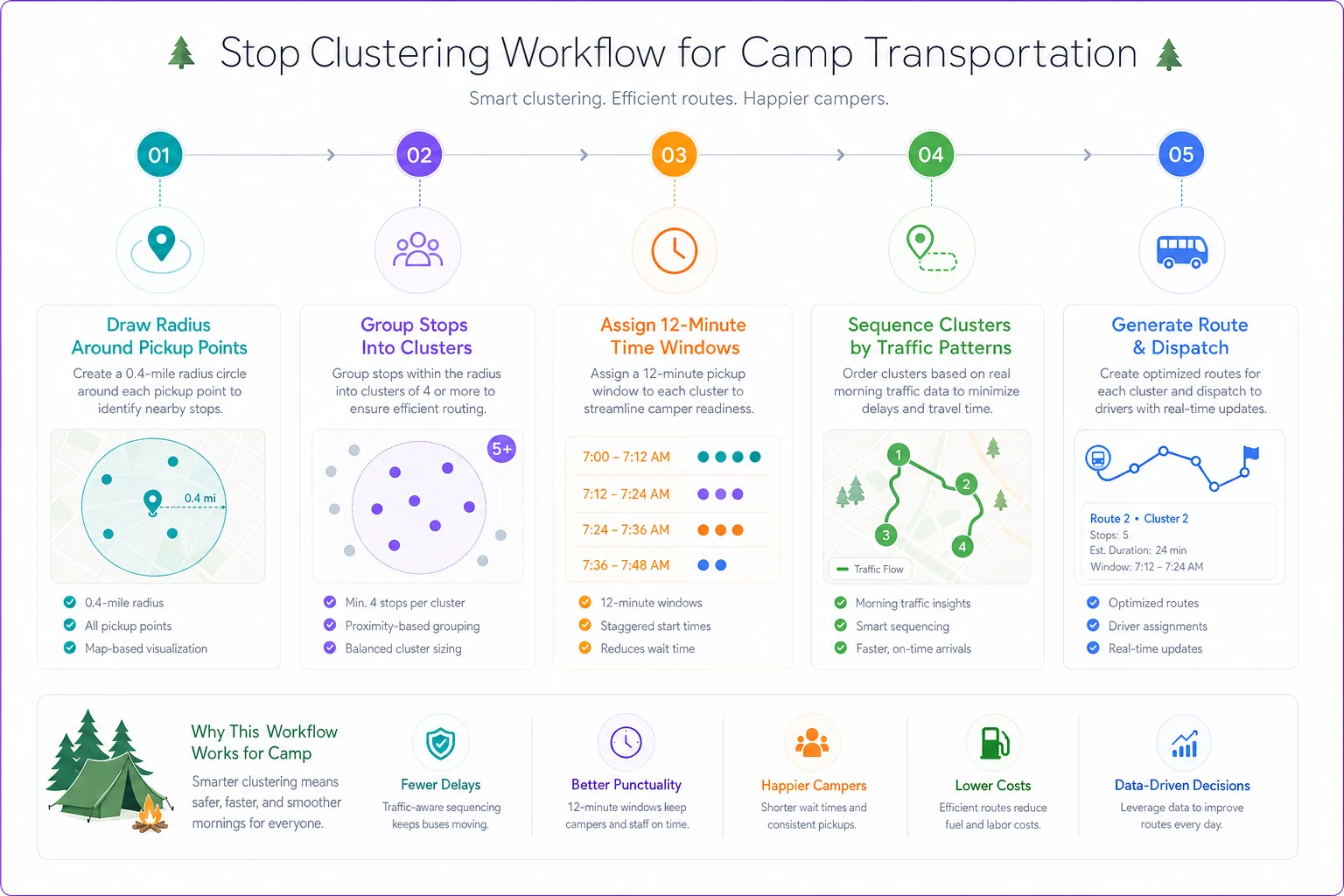
A simple diagram of the clustering workflow.
Building contingency into every route
Your beautiful route plan falls apart the first time a driver calls in sick or a bus breaks down. Without built-in contingency, you're scrambling at 6:30 AM trying to reorganize everything while parents are already heading to pickup spots.
Every route needs three plans:
| Plan | Description |
|---|---|
| Plan A | Normal operations |
| Plan B | Single bus/driver failure |
| Plan C | Multiple failures or weather delays |
For Plan B, design your routes so any single route can be split between two others without exceeding 90 minutes total time. This means keeping each route at about 70% of maximum time capacity during normal operations.
A Massachusetts camp runs 4 buses but designs routes as if they only have 3. The fourth bus handles overflow and provides immediate backup. When everything runs smoothly, that fourth bus does express routes for kids who live far out. When something breaks, it slides right into the gap.
For Plan C, identify "consolidation points" — locations where multiple routes could merge if needed. Usually these are schools, community centers, or large parking lots. Parents get notified to go to the consolidation point instead of regular stops. You lose efficiency but maintain service.
Parent communication that prevents meltdowns
The technology exists to tell parents exactly where the bus is and when it'll arrive. But most camps either don't use it or use it wrong.
Bad approach: "Bus is running late"
Good approach: "Bus is at Stop 12 of 18, currently 11 minutes behind schedule, estimated arrival 7:47 AM"
Better approach: "Bus departed Maple Street at 7:31 AM, 4 stops before yours, ETA 7:47-7:50 AM"
Set up automated messages for three trigger points:
Morning dispatch: "Bus 3 departed camp facility at 7:02 AM for morning pickups. Track at [link]"
Delay threshold: If running 8+ minutes late at any stop, auto-message affected families downstream: "Bus 3 running 10 minutes behind due to traffic on Route 9. Your updated ETA: 8:05 AM"
Arrival warning: When bus is 2 stops away: "Bus 3 approaching your stop in approximately 5 minutes"
One camp reduced parent complaints by 78% just by implementing proactive delay messaging. Parents aren't angry about delays — they're angry about uncertainty.
Real-time check-in systems that actually work
Forget paper rosters. They get wet, torn, lost, or simply ignored when drivers are rushing.
The simplest system that works: QR codes on seatbacks linked to each child's profile. Driver scans when kid boards. System automatically logs time, location, and seat assignment. Takes 2 seconds per kid.
But what makes it bulletproof:
-
Require scan before bus moves from each stop
-
If a registered child doesn't board, system alerts office immediately
-
Parents get confirmation
"Emma boarded Bus 2 at 7:43 AM"
-
At camp arrival, final scan confirms everyone who boarded also arrived
A camp in Pennsylvania discovered one child had been getting dropped at the wrong stop for three days. The grandmother was picking them up and didn't mention it. The real-time system caught it because the "arrival at camp" scan was missing.
The software solution most camps miss
Operational software changes everything. Instead of juggling spreadsheets, Google Maps, and group texts, camps using AI-powered routing platforms handle all of this automatically.
The routing algorithms optimize for real traffic patterns, not just distance. They factor in things like school zones, construction updates, and historical delay patterns. When a driver calls in sick, the system recalculates routes in seconds, sends updated ETAs to parents, and provides turn-by-turn directions to replacement drivers.
These systems learn. They track actual vs. planned timing for every stop, identify bottlenecks, and suggest improvements. One platform helped a camp reduce average route time by 24 minutes just by resequencing stops based on actual traffic patterns rather than theoretical distances.
The AI automation handles parent notifications, check-in verification, and even driver assignments based on who knows which routes. It's not replacing human judgment — it's eliminating the chaos that prevents good judgment.
Pickup window rules that stick
Every camp needs strict pickup window rules, but most implement them wrong. They focus on punishment ("$5 late fee") instead of process.
7:00-7:05 AM: Guaranteed window. Bus waits. 7:06-7:08 AM: Grace period. Bus waits if no one else is delayed. 7:09 AM+: Bus continues. Parent drives to next stop or camp.
But communicate the status. When the bus arrives at 7:02 and nobody's there, driver hits "waiting" in the system. Parents get: "Bus waiting at your stop." At 7:05, system shows "departing soon." At 7:08, "Bus departing."
For afternoon dropoff, reverse the logic. Build 5-minute buffers between stops. If parent isn't there, protocol kicks in:
-
Call primary contact
-
After 3 minutes, call emergency contact
-
After 5 minutes, continue route, circle back at end
-
If still no pickup, return child to camp for late pickup
Document everything automatically through the routing system. You need records when parents claim they were there on time.
Zone-based routing for scalability
Growing from 80 to 200 campers? Don't just add more stops to existing routes. Rebuild using zone architecture.
Divide your service area into 4-6 zones based on:
-
Natural boundaries (highways, rivers)
-
Population density
-
Distance from camp
-
Traffic patterns
Each zone gets dedicated routing logic:
Dense zones: Shorter routes, more stops, smaller buses
Sparse zones: Longer routes, fewer stops, focus on consolidation points
Mixed zones: Hybrid approach with neighborhood clusters feeding into main arteries
The beauty of zones: you can add buses to specific zones during peak weeks without restructuring everything. Running a special program that pulls heavy from the north zone? Add a temporary express bus just for that zone.
When routing optimization pays for itself
Let me paint the real economics. A New York camp with 180 campers was running 5 buses with 34 stops each. Total daily route time: 14 hours of driver pay.
After implementing proper clustering and routing rules:
-
4 buses handling the same 180 campers
-
22-26 stops per route
-
Total daily route time
9 hours
-
Annual savings
roughly $31,000 in driver costs alone
But the bigger win was parent satisfaction. Late arrivals dropped from averaging 12 per day to 2. Parent complaints went from multiple daily to maybe one per week.
They reinvested the savings into better driver training and a GPS tracking system that gave parents real-time updates. Enrollment for the following summer's bus program jumped by 40%.
The mistakes that compound
Small routing mistakes become massive problems:
A bus doing unnecessary left turns across traffic adds 2 minutes per turn. Do that 5 times per route, twice daily, across a 10-week program — you've lost 16+ hours of operational time.
Allowing "just one more stop" when you're already at capacity degrades the entire route. That extra 6 minutes delay cascades. Now every subsequent stop is late, parents are frustrated, and your afternoon routes start behind schedule.
Not accounting for siblings at different pickup times forces double-visits to the same addresses. Camps literally send buses to the same house twice, 40 minutes apart, because they didn't coordinate elementary and middle school pickup times.
Building routes that survive reality
Perfect routes on paper mean nothing when your driver takes a wrong turn or construction blocks Main Street. Build in survival mechanisms:
Buffer stops: Every 4-5 stops, identify a location where the bus can safely wait 2-3 minutes to get back on schedule. Usually school parking lots or churches.
Bypass protocols: For every major road segment, know the alternate route. When Route 9 backs up, drivers should already know to cut through Elm Street.
Communication triggers: Set specific points where drivers must report status. "Departing Zone 2" or "Entering neighborhood circuit 3." This catches problems before they cascade.
The transition from chaos to system
Start small. Pick your worst route — the one that's always late, always has complaints. Apply clustering rules. Set strict pickup windows. Implement basic check-in tracking.
Run it for one week. Document every delay, every complaint, every success. Adjust the clustering based on what actually happened, not what should happen.
Then expand to route two. Use lessons from route one. Within 3-4 weeks, you'll have transformed your entire operation.
The camps that thrive don't have perfect routes. They have systems that adapt when routes go sideways, clear communication when delays hit, and the operational discipline to say no when adding one more stop would break everything.
Your bus routing system is often the first and last touchpoint parents have with your camp each day. When it runs smoothly, nobody notices. When it fails, everybody remembers. Build it right, maintain it actively, and watch how many other operational problems simply disappear.
Because when kids arrive on time, calm, and ready for their day, everything else at camp gets easier. And when parents trust that their child will be picked up and delivered safely and predictably? That's when they start recommending your camp to every family they know.
Ready to elevate your camp management?
Join 500+ camps using Campyly to save administrative time, enhance camper experiences, and streamline daily operations.