


Most transport problems at camps don't happen because a vendor lied on paper. They happen because nobody checked whether the paper matched the bus that pulled into the lot at 6:40 a.m. The contract said "fully licensed drivers with current medicals." The bus that arrived had a substitute driver the office manager had never heard of, no visible first-aid kit, and a cracked windshield that nobody flagged until a parent pointed it out.
That gap — between what you procured and what actually rolls up on departure morning — is the entire problem. This piece is about closing it with a tight, repeatable camp transportation vendor checklist that lives in three places: your questionnaire, your contract, and your day-of verification routine.
Keeping this narrow on purpose. This isn't about route design or permission slips — those are their own beasts. This is specifically about qualifying the vendor and the individual driver, and making sure that qualification holds up on the day it matters.
The procurement failure almost nobody catches
Camps run a decent vendor selection process in February, collect a certificate of insurance, sign a contract, and then treat the vendor as "qualified" for the entire season. No re-check. No day-of verification. The procurement step and the operations step never talk to each other.
-
A driver's CDL medical certificate expires in June, but the vendor's dispatch doesn't catch it.
-
The insurance policy you were shown in March lapses or gets downgraded in May when the vendor switches carriers.
-
The specific bus you were promised — with seatbelts, with A/C — goes into the shop, and they send a backup that doesn't match the spec.
-
The named, background-checked driver calls in sick, and a sub covers the run. A sub you never vetted.
None of these show up in a signed contract. They only surface if you build evidence requirements into the contract and then verify on the day. A clean signature in February tells you almost nothing about the bus in July.
Start with a questionnaire that forces specifics, not adjectives
Most vendor questionnaires are useless because they ask yes/no questions that any vendor will answer "yes" to. "Are your drivers licensed?" Of course they'll say yes. The questionnaire has to force documentary specifics and dated evidence.
Simplify camp operations with centralized control.
Campyly empowers you to manage registrations, staff, and activities seamlessly—all from one platform.
- Integrated camper and staff management
- Automated notifications and alerts
- Dynamic scheduling and resource allocation
No credit card required
Here's what a questionnaire actually needs to pull out of a vendor:
Fleet and vehicle specifics
-
Year, make, and capacity of each vehicle assigned to your contract (not the whole fleet)
-
Seatbelt configuration per vehicle (lap, lap-shoulder, none)
-
Date of last state inspection per vehicle, with inspection sticker number
-
A/C functional status — this matters more than people admit in a July heatwave
-
Backup vehicle plan
what rolls up if the primary is down
Driver specifics
-
Number of named drivers assigned to your contract vs. the total driver pool
-
License class and endorsements per driver
-
Medical certificate expiration dates per driver
-
Date of last motor vehicle record (MVR) pull per driver
-
Background check vendor and date per driver
-
Substitute driver policy — who covers, and are subs held to the same vetting standards
Operational history
-
Accidents or incidents in the last 36 months, with a short description
-
Any license suspensions in the driver pool in the last 24 months
-
Insurance carrier, policy limits, and renewal date
Keep dated digital copies of each named driver's medical certificate and most recent MVR in a single, easy-to-search folder for quick day-of retrieval.
A good filter question that separates serious vendors from everyone else: "Can you provide dated copies of each named driver's medical certificate and most recent MVR before the first run, and again if a driver changes mid-season?" Vendors who hesitate here are telling you their internal tracking is sloppy — which is exactly the thing that bites you in July.
Contract redlines: require evidence, not promises
A contract that says "Vendor shall maintain all required licenses and insurance" is nearly worthless. No evidence trigger, no consequence. You need clauses that make the vendor produce proof on a schedule and notify you of changes within a defined window.
Here are the redlines that actually matter:
| Contract area | Weak language (avoid) | Evidence-based language (use) |
|---|---|---|
| Driver licensing | "Drivers will be properly licensed" | "Vendor provides copies of CDL, endorsements, and medical certificates for each named driver before first run; re-provides within 48 hrs of any driver substitution" |
| Insurance | "Vendor maintains adequate insurance" | "Vendor names camp as additional insured; provides COI with specific limits; notifies camp within 5 business days of any policy change or lapse" |
| Vehicle maintenance | "Vehicles are maintained properly" | "Vendor provides state inspection dates and maintenance log for assigned vehicles; day-of driver carries proof of current inspection" |
| Substitutions | (usually silent) | "Any substitute driver or vehicle meets identical vetting standards; camp notified of substitution before departure, not after" |
| Breach / stop-work | (usually silent) | "Camp may refuse any vehicle or driver that cannot produce required day-of documentation, with no penalty to camp" |
That last row is the one people forget, and it's the one that gives your morning staff real authority. Without a no-penalty refusal clause, your gate person feels pressured to wave through a bus they're unsure about because they're afraid of a cancellation fee or stranding a group of kids. Put the right to refuse in writing, and your staff can actually enforce the checklist.
Worth adding: a maintenance log evidence clause. Ask that the vendor keep — and produce on request — a simple service log for the vehicles assigned to your contract. You're not trying to become a fleet manager. You just want to be able to say "show me the brake service record for Bus 14" if something feels off. Vendors who can't produce this quickly are running reactive maintenance, which is a trip risk.
The day-of verification routine (where most of the value lives)
All the procurement work collapses if nobody checks the actual bus and the actual driver on the morning of the run. The day-of routine is short — one trained staff member, under ten minutes per vehicle — but it has to be consistent and documented.
Here's the verification workflow, in order:
-
Match the manifest to the vehicle. Before the kids board, your transport coordinator confirms the vehicle that arrived matches the one on the assignment sheet — plate, capacity, A/C spec. Substitute vehicle? Flag it and check it against your spec requirements before loading.
-
Verify the driver identity against your named list. The driver shows ID. The name matches your vetted driver roster. If it's a substitute, ask for proof the vendor vetted them to the same standard — and note it. An unexpected sub is the single most common day-of surprise, and the one most likely to get waved through.
-
Check driver credentials physically. Current license, medical certificate not expired. This sounds excessive until the morning you catch an expired medical and realize the vendor's dispatch missed it for two weeks.
-
Quick vehicle walk-around. Tires, windshield, visible damage, functioning doors, first-aid kit present, fire extinguisher present and charged, emergency exit clear. Thirty seconds, but it catches the cracked-windshield situation before a parent does.
-
Confirm seatbelt availability matches the roster count. Especially critical for younger campers where belts are required.
-
Log the verification with a timestamp and the staff member's name. This is the step people skip, and it's the step that saves you if there's ever an incident review. A dated sign-off record is what turns "we think we checked" into "here's the signed verification from 6:48 a.m."
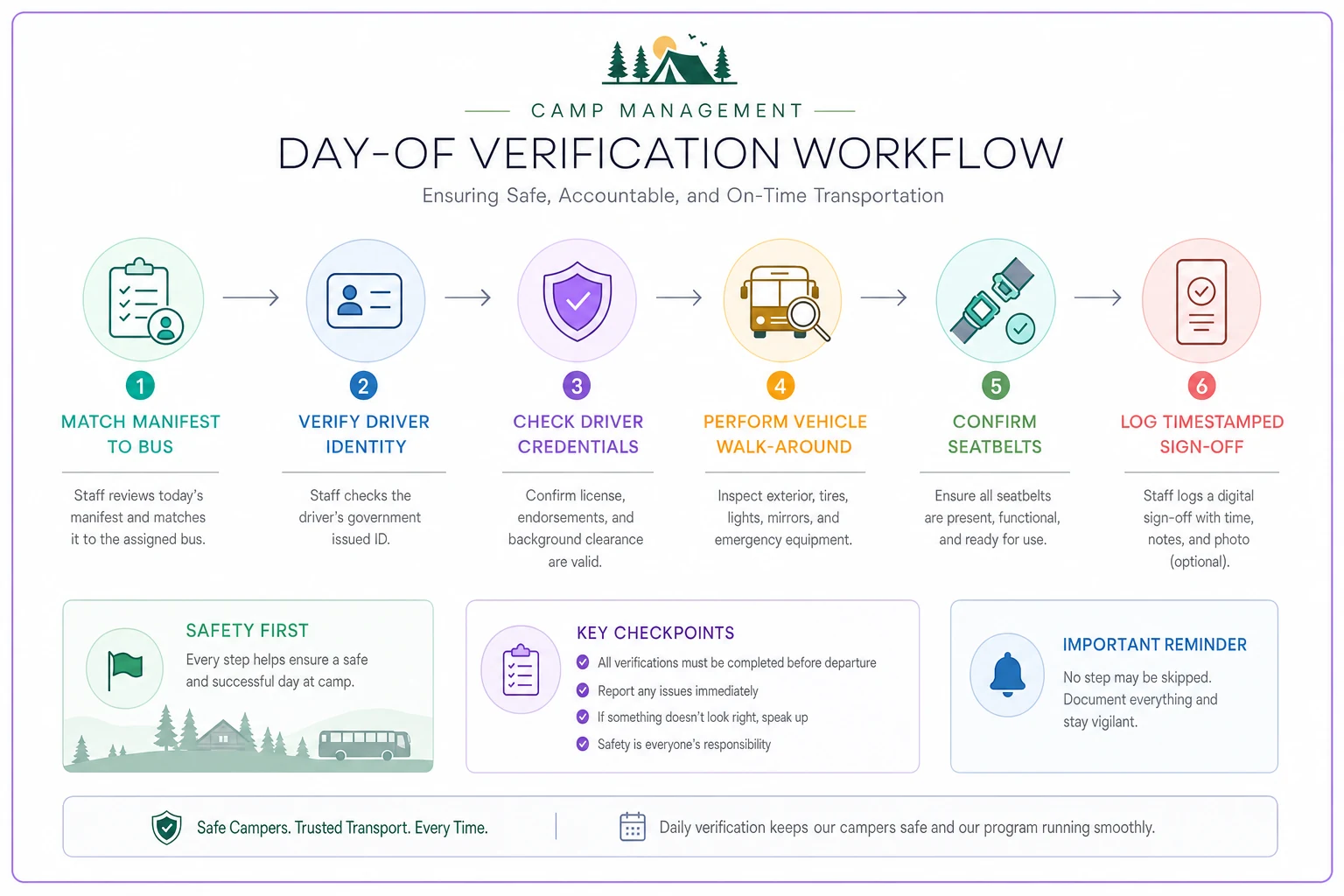
Use this workflow as a quick reference for morning staff or a training poster.
The sign-off matters as much as the checks themselves. If an incident happens, your documented verification is part of your defensibility — which ties directly into how you handle auditable incident management. A verification that isn't recorded might as well not have happened.
A real scenario: the substitute driver nobody vetted
A mid-sized day camp running around 180 campers across four bus routes contracted a regional transport vendor for the season. Good contract, COI on file, four named drivers vetted in March. Everything looked clean.
Week three: one named driver was out with a back injury. The vendor sent a substitute for the 7:00 a.m. route. Real, licensed driver — but he hadn't gone through the camp's background check requirement, and his medical certificate had lapsed two weeks earlier. The vendor's dispatch hadn't tracked it.
Because this camp had added a day-of verification step that season, the transport coordinator caught the expired medical at step 3 and held the bus. The vendor scrambled a properly credentialed driver within about 40 minutes. The route ran half an hour late — annoying, parents got a text, no real harm.
The prior season, that morning would have gone differently. The sub would have loaded 40-some kids and driven off, nobody the wiser, with an expired-credential driver behind the wheel. The cost of the fix was one late route and a tense phone call. The cost of not having the check could have been catastrophic — for the kids, and for the camp's liability position.
The director's takeaway: the contract's substitution clause and the day-of credential check worked together. One without the other wouldn't have mattered.
When this level of rigor makes sense — and when it's overkill
When it makes sense:
-
You're busing minors, especially younger campers, on daily routes
-
You use multiple vendors or a vendor with a large, rotating driver pool
-
Your routes involve highways, long distances, or offsite field trips
-
You've had even one near-miss with a substitute driver or vehicle
When it's lighter-touch:
-
A single, long-tenured owner-operator who drives every run personally, credentials verified once, no substitution risk
-
Very short, low-speed shuttle runs on private property
Even in the lighter cases, keep the annual questionnaire and the evidence-based contract clauses. What you can ease up on is the frequency of day-of checks when the same vetted driver shows up every morning with the same vetted vehicle. The checklist should scale to actual risk, not turn into bureaucracy for its own sake.
One thing worth saying plainly: any camp relying on a vendor's verbal assurance that "all our drivers are good" hasn't actually qualified anyone. That phrase is the tell. If a vendor can't produce dated evidence per driver, your procurement process collected optimism, not verification.
Where the checklist connects to the rest of your transport operation
This vendor qualification work doesn't stand alone. It sits upstream of your trip execution — the permission flows, emergency procedures, and contact chains you need once the bus is actually moving. If those aren't tight, the vendor checklist only covers half the risk. Worth pairing this with your offsite permission and transport emergency workflow so the "is this vendor qualified" question and the "what happens if something goes wrong mid-route" question live in the same operational system.
The honest reason these checks get skipped is that tracking per-driver credential dates, per-vehicle inspection dates, and substitution notifications across a full season is tedious manual work. Spreadsheets go stale. This is exactly the kind of recurring, date-sensitive verification where an AI-powered management platform earns its place — flagging expiring medicals, storing vendor evidence against the contract, prompting the day-of sign-off routine. Not a magic fix. Just the thing that keeps the checklist from decaying back into "we signed a contract in February and hoped."
Pulling it together
Transport vendor qualification isn't a one-time procurement box to check. It's three linked things: a questionnaire that forces documentary specifics, a contract that requires dated evidence and gives your staff the right to refuse, and a short day-of routine that verifies the actual bus and the actual driver against what you were promised — with a timestamped sign-off.
The camps that avoid trip disasters aren't the ones with the fanciest contracts. They're the ones whose 6:45 a.m. staff member has a clear, authorized checklist and actually uses it, every run, even on the morning everything looks fine. Because the morning everything looks fine is exactly when the substitute driver with the expired medical slips through.
Transport vendor qualification isn't a one-time procurement box to check. It's three linked things: a questionnaire that forces documentary specifics, a contract that requires dated evidence and gives your staff the right to refuse, and a short day-of routine that verifies the actual bus and the actual driver against what you were promised — with a timestamped sign-off.
The camps that avoid trip disasters aren't the ones with the fanciest contracts. They're the ones whose 6:45 a.m. staff member has a clear, authorized checklist and actually uses it, every run, even on the morning everything looks fine. Because the morning everything looks fine is exactly when the substitute driver with the expired medical slips through.
Ready to elevate your camp management?
Join 500+ camps using Campyly to save administrative time, enhance camper experiences, and streamline daily operations.