

The most dangerous ten minutes at a camp isn't during swim or archery. It's the first fifteen minutes of the day, when buses are still rolling in, three parents are dropping off late, one counselor called out sick, and somebody is trying to check off 90 kids on a clipboard while answering questions about lost water bottles.
That's the window where attendance goes wrong. And when it goes wrong, it's not a small clerical thing — it's a "we thought Marcus was here and he was actually still at home" thing. Camp attendance tracking is really about closing the gap between who you think is present and who actually is, before that gap becomes a phone call to a parent asking where their kid is.
This post is about that gap specifically. Not scheduling, not staffing ratios — just the reconciliation routine that catches errors twice a day, keeps a clean audit trail, and quietly handles no-shows so they don't cost you a seat.
Where morning rollcall actually breaks
The failure almost never looks dramatic. It looks like a counselor marking a whole group "present" because they saw most of them and assumed the rest were in the bathroom. It looks like a late drop-off that never made it onto the sheet because the front desk person was mid-conversation. It looks like two groups sharing a check-in line and one kid getting counted in the wrong group.
The single most common source of attendance error isn't a kid going missing — it's a kid being present but attributed to the wrong group or session. The count is right at the camp level. It's wrong at the group level. So your total headcount reconciles perfectly, everyone relaxes, and nobody realizes Group B is carrying a kid who's actually assigned to Group C until pickup, when the wrong parent is waiting at the wrong spot.
The mechanical reason this keeps happening: most camps run one check-in event and treat it as the source of truth. One person, one sheet, one moment. There's no second look. If that single check-in has an error, nothing downstream catches it until something breaks — usually at pickup or when a parent calls.
The fix isn't "be more careful." People are careful and still miss kids at 8:47am with a line out the door. The fix is a reconciliation routine — a structured second (and third) check that compares independent data points and flags mismatches automatically.
The core idea: reconcile, don't just count
Counting is "how many kids are here." Reconciling is "does the number of kids here match every list that says who should be here, and can I explain every difference."
Simplify camp operations with centralized control.
Campyly empowers you to manage registrations, staff, and activities seamlessly—all from one platform.
- Integrated camper and staff management
- Automated notifications and alerts
- Dynamic scheduling and resource allocation
No credit card required
You reconcile three lists against each other:
-
Expected — who was registered/scheduled for today (including drop-in changes)
-
Arrived — who physically checked in (bus manifest + walk-up drop-off)
-
Accounted — who each group leader confirms is physically standing with them right now
When those three agree, you're done. When they don't, every discrepancy needs an explanation before the day proceeds. That's the whole discipline.
Most camps only work with lists 1 and 2. Adding list 3 — the group-leader confirmation — is what catches the misattribution problem, because it's collected by the person actually looking at the kids, not by the person at the check-in table.
The morning reconciliation routine (step by step)
This is designed to run inside the first 25 minutes of the day. It assumes buses and walk-ups are both in play.
-
Freeze the expected list at cutoff. Pull the day's roster the night before and lock a version. Late registrations and cancellations after cutoff go into a separate "changes" bucket so you always know what your baseline was.
-
Check in against the manifest, not from memory. Bus riders get checked off the bus manifest as they step off. Walk-ups get checked off the walk-up list. Two separate streams, two separate lists. (If your bus routing is a mess, that upstream chaos flows straight into attendance — worth reading Don't overload routes: scalable multi‑stop camp bus routing and pickup rules if pickup logistics are part of your problem.)
-
Group leaders do a physical count at 8
50.
Not a name check yet — just a headcount. "I have 14." The expected number for that group is known. If it matches, move on. If not, escalate immediately. -
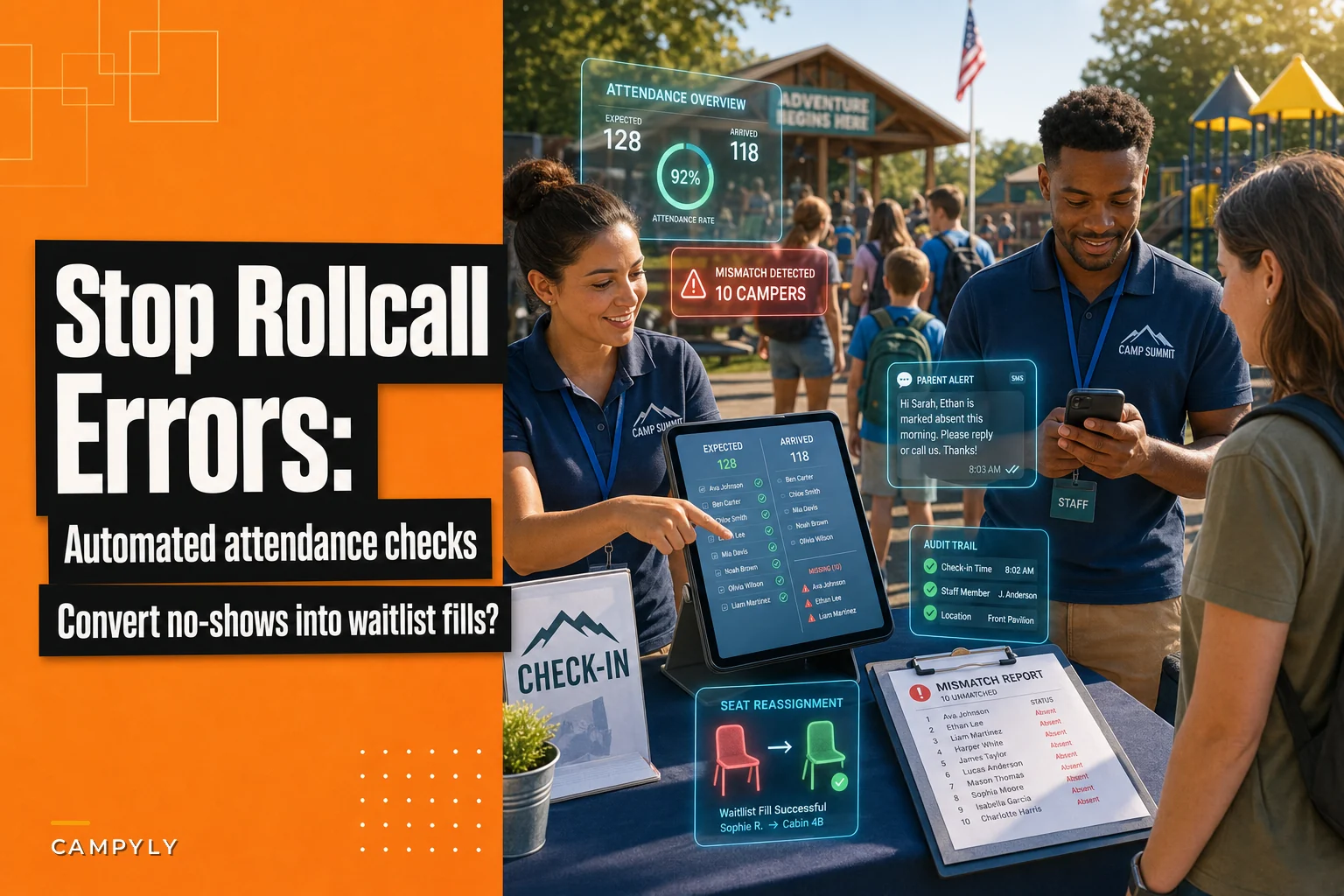
Run the mismatch report. Compare Expected vs Arrived vs Group counts. Anyone in Expected but not Arrived is a potential no-show. Anyone Arrived but not confirmed by a group is a misattribution risk.
-
Resolve every discrepancy before activities start. Each flagged name gets a status: no-show (confirmed), late arrival (expected), reassigned group, or unknown — and unknown is the only status that stops the clock.
-
Trigger parent alerts for confirmed no-shows. Any expected kid not accounted for by the cutoff gets an automated "we haven't seen [name] this morning — are they coming today?" message to the parent.
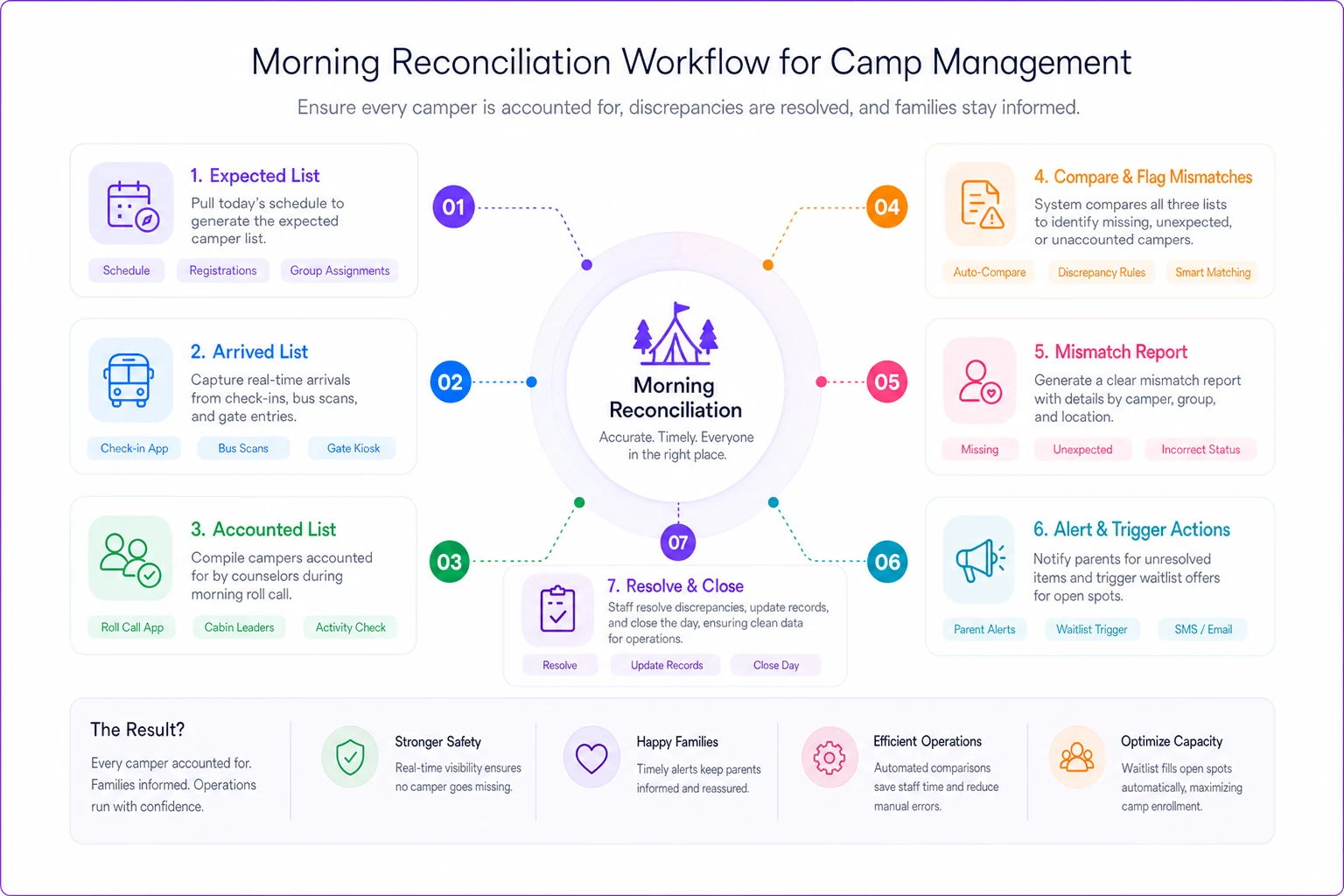
The whole point of the numbered flow is that step 5 has a hard rule: no group starts its first activity with an unresolved "unknown." That single rule is what prevents the missing-kid scenario, because you physically cannot proceed while a name is unaccounted for.
Audit checks that actually catch things
An audit check is just a rule that says "if X and Y disagree, flag it." Here are the ones that earn their keep:
-
Total vs sum-of-groups check. Camp-wide headcount must equal the sum of every group's count. If they match but names don't, you've got a swap. If they don't match, you've got a missing or extra kid.
-
Bus manifest vs check-in check. Every name on the bus manifest should appear in check-in. A rider who boarded but never checked in is an immediate flag — that's a kid who got off somewhere they shouldn't have, or a scanning miss.
-
Repeat no-show check. A kid who's a no-show two days in a row with no parent response gets escalated, not re-messaged with the same template. Silent repeat no-shows are sometimes a sign of a withdrawal nobody logged.
-
Late-arrival aging check. A "late arrival expected" status that's still open at 10:30 is no longer a late arrival. It flips to "unaccounted" and gets treated as urgent.
The mistake people make with audit checks is running them once. These should re-run every time the data changes — a late drop-off at 9:15 should automatically clear that kid's no-show flag and cancel the parent alert if it hasn't sent yet. A static morning report goes stale by 9am.
Automate audit re-runs so late arrivals clear flags and cancel alerts in real time.
These checks should be event-driven, not a single report someone looks at once.
Parent alerts: timing beats volume
The instinct is to alert fast and alert a lot. That backfires. Parents who get a "where's your kid" text at 8:40 when they told you last week they'd be dropping off at 9 will stop trusting your messages — and then they'll ignore the one that actually matters.
| Situation | Alert timing | Message tone |
|---|---|---|
| Expected, not arrived by cutoff | ~15 min after cutoff | Soft check: "Haven't seen [name] yet — coming today?" |
| Parent flagged a known late arrival | No alert | Suppressed automatically |
| No-show, no parent reply | ~45 min after cutoff | Firmer: "We still haven't seen [name], please confirm" |
| Repeat no-show, 2nd day | Immediate, plus staff escalation | Direct + internal flag |
| Checked in but left group unaccounted | Internal only, no parent alert yet | Staff resolves first |
Notice the last row. If a kid is somewhere on site but not confirmed with their group, you don't alarm the parent — you send staff to find them. Parent alerts are for "not on site," not for "not yet located." Blurring those two is how you create panic over a kid who's just in the bathroom.
The suppression logic matters more than the sending logic. A parent who pre-notified you about a dentist appointment should never get a no-show text. When that suppression is manual, it fails constantly — someone forgets to check the note. When it's tied to the record automatically, the alert simply doesn't fire.
Turning no-shows into waitlist fills
A confirmed no-show for a full-day or specialty session is an empty seat you already accounted for in staffing. If you have a waitlist, that seat has value.
The trigger logic works like this: once a spot is a confirmed no-show — parent replied "not coming today" or the aging window closed with no response — and the session has a waitlist, the system can offer that seat to the next family with a short acceptance window (say, until 10am). If they take it, great. If not, it rolls to the next.
-
Only convert confirmed no-shows, never "unaccounted" ones. You don't want to fill a seat for a kid who's actually just late and about to walk in.
-
Respect a hard cutoff time. Converting a waitlist family at 11am for a day that started at 9 is more disruption than it's worth.
-
Cap same-day conversions so you don't create a check-in surge no one's staffed for.
A realistic example: a mid-size day camp running around 240 kids across the week was seeing roughly 6–9 no-shows on any given day in specialty sessions — robotics, horseback — each of those seats sold out with a waitlist behind them. They weren't filling any of them. By the time anyone noticed the empty seats, it was midday. After adding a confirmed-no-show trigger with a 10am cutoff, they were filling somewhere around 3–5 of those seats most days. Over an 8-week season, that's a few thousand dollars in otherwise-lost specialty revenue, plus a bunch of waitlisted families who suddenly felt taken care of.
The revenue is nice. The parent goodwill from "a spot opened up and we thought of you" is arguably worth more.
Seat and group reassignment rules
Reassignments are where clean attendance data goes to die. A counselor moves a kid to another group verbally, nobody updates the record, and now your group counts will never reconcile because the source of truth doesn't reflect reality.
Set a rule that any reassignment — group change, session swap, waitlist fill — must be recorded before it takes effect, not after. The kid moves because the record moved, not the other way around. It sounds bureaucratic, but it's the difference between reconciliation that works and reconciliation that's always slightly off "because of that one move this morning."
-
Reassignments freeze at the same cutoff as the roster. After cutoff, changes go to the "changes" bucket and are handled as exceptions, not silently absorbed.
-
Every reassignment carries a reason code (no-show fill, ratio balance, behavior, parent request). Reason codes make the end-of-day audit fast.
-
A reassignment automatically updates the group leader's roster and the pickup list. A kid moved between groups who gets picked up from the old group's spot is a pickup incident waiting to happen.
Locking reassignment rules into your system prevents the quiet drift that makes reconciliation impossible.
The afternoon reconciliation (don't skip it)
Morning gets all the attention. The afternoon check is what prevents the truly bad outcome: a kid leaving with the wrong person, or a kid still on site after everyone assumes the day is over.
The afternoon routine mirrors the morning in reverse:
-
Confirm every present kid is accounted for at departure prep. Present count should equal your reconciled morning number minus any logged mid-day pickups.
-
Check out against the pickup list, not from memory. Same discipline as check-in. Bus riders off the manifest, walk-up pickups verified against authorized-adult records.
-
Run the "still here" report. Any kid checked in this morning and not checked out is flagged — hard stop until located. This is the single most important report of the entire day.
-
Reconcile mid-day changes. Early pickups, activity swaps, and reassignments should all explain any difference between the morning number and the departure number.
The "still here" report is non-negotiable. It takes about ninety seconds when the data is clean, and it catches the exact scenario every camp director has nightmares about.
When this level of rigor makes sense — and when it's overkill
When it's worth it: any camp over ~60 kids, anything with buses, anything with mixed drop-in and full-session enrollment, and anything running specialty sessions with waitlists. The more moving parts, the more a single check-in fails you.
When it's overkill: a small, single-group program of 20 kids where the same counselor sees every face all day and knows every parent. Forcing a three-list reconciliation on that is bureaucracy for its own sake. A simple morning and afternoon name check is genuinely enough.
Who should not build this manually: if you're running multiple sites or your groups shuffle daily, doing this on paper will eat a coordinator's entire morning and still leak errors. The reconciliation logic — comparing three lists, aging out late arrivals, suppressing alerts for pre-notified absences, firing waitlist offers on confirmed no-shows — is repetitive rule-checking that's miserable by hand and reliable when it's automated. This is where an operational platform that handles check-in, group rosters, parent messaging, and reconciliation in one place stops being a nice-to-have. Not because the software is magic, but because the discipline described here is hard to sustain manually past a certain size, and it quietly breaks on the busiest, most understaffed mornings — which are exactly the mornings you need it most.
If you want the bigger picture of how attendance fits into your other daily systems, the modular camp operations playbook covers how these routines connect so one weak point doesn't cascade.
A short real scenario
A two-site summer program, roughly 180 kids split across the sites, was running paper rollcall. Their recurring problem wasn't lost kids — it was misattribution: kids counted in the wrong group, which meant their group counts never quite matched, so nobody trusted the counts, so nobody acted on discrepancies fast. Pickup confusion happened a couple times a week.
They didn't overhaul everything. They added three things: a group-leader physical count at 8:50, a total-vs-sum-of-groups audit check, and a hard rule that no group starts activities with an unresolved unknown. Within the first two weeks, morning discrepancies that used to sit unexplained until pickup were getting caught and resolved before 9am. Pickup mix-ups dropped to nearly none. The reconciliation added maybe ten minutes to their morning, and gave back far more than that in avoided phone calls and afternoon scrambles.
No dramatic transformation. Just a routine that made the number on the clipboard actually mean something.
The takeaway
Attendance isn't a headcount, it's a reconciliation. One check-in is a single point of failure; three independent lists that must agree turn a stressful guessing game into a system that catches its own mistakes. Add sensible parent alerts that suppress the false alarms, reassignment rules that keep your data honest, and a trigger that turns confirmed no-shows into filled seats — and the most dangerous ten minutes of your camp day becomes one of the most controlled.
Start with the morning three-list check and the "still here" report this week. Those two alone will catch the errors that matter most, and everything else builds naturally from there.
Start with the morning three-list check and the "still here" report this week. Those two alone will catch the errors that matter most, and everything else builds naturally from there.
Ready to elevate your camp management?
Join 500+ camps using Campyly to save administrative time, enhance camper experiences, and streamline daily operations.