

Most aquatics coverage doesn't fail during a chaotic emergency. It fails at 2:47 PM on a Tuesday when a guard steps off the stand to grab water, the relief guard is still finishing a bandage at the health hut, and nobody actually owns the empty chair for ninety seconds. That gap almost never causes an incident. But the fact that it can is the whole problem, because your entire liability posture is built on the assumption that the water is never unwatched.
The tricky part with a camp lifeguard staffing protocol is that it lives at the minute level, not the shift level. You can have the right ratio, the right certifications, the right total headcount, and still have a 40-second window where the deep end has zero eyes on it because two rotations collided. This article is about closing those windows — the rotation timing, the rest math, the pre-service checks, and the handoff scripts — not aquatics safety in general.
The failure isn't understaffing, it's the seams between guards
When directors think about coverage lapses, they usually think headcount. In real operations, the dangerous lapses happen at the seams — the moment one guard hands a zone to another.
Here's what that looks like on a waterfront. A guard on the buddy-check stand is scheduled to rotate to the dock at the top of the hour. The rotation is supposed to be a clean swap: incoming guard takes the stand, outgoing guard walks. But the incoming guard is 90 seconds late because their previous relief ran long. So the outgoing guard has a choice: leave the stand empty and stick to the schedule, or stay past their rotation and drift into fatigue. Both are wrong. That's the seam.
A few patterns show up consistently in how these seams open:
-
Rotations that depend on a person being "roughly on time" instead of a hard handoff signal
-
No named owner for a zone during the swap, so for 30–60 seconds the zone is technically everyone's and actually nobody's
-
Rest breaks scheduled by clock time rather than by verified relief arrival
-
Certification checks done once in June and never re-verified when a guard gets reassigned to a harder zone
The thing most people miss: the more zones you have, the more seams you have, and seams grow faster than zones. Three waterfront zones don't mean three handoffs — with staggered rotations you can easily be running six to eight handoff moments an hour, each one a candidate for a lapse.
Minute-level rotation rules that actually hold
The fix for seams is to stop treating rotation as "swap at the top of the hour" and start treating it as a scripted event with a defined trigger. Guards should never leave a stand because the clock says so. They leave because relief has physically arrived, made eye contact, and taken verbal ownership.
Simplify camp operations with centralized control.
Campyly empowers you to manage registrations, staff, and activities seamlessly—all from one platform.
- Integrated camper and staff management
- Automated notifications and alerts
- Dynamic scheduling and resource allocation
No credit card required
A workable rotation cadence for a mid-size pool or waterfront:
-
20 minutes on a scanning stand (high-attention zones — deep end, dive area, main swim zone)
-
20 minutes on a lower-load post (shallow, buddy board, front entry) or active relief
-
20 minutes off-stand (rest, hydration, bathroom, no scanning duty)
That 20/20/20 rhythm matters because sustained scanning attention degrades noticeably after about 20–30 minutes. Guards start "looking" without "seeing." Rotating them off the high-attention stand before that drop-off is a performance decision, not a comfort one.
The non-negotiable rule layered on top: the outgoing guard does not move until the incoming guard says the handoff line and takes the seat. No exceptions, even if the incoming guard is late. If relief doesn't show, the outgoing guard stays and radios the deck supervisor — the empty-chair option is removed entirely.
Sample daily rotation tracker
| Time | Guard A | Guard B | Guard C | Guard D |
|---|---|---|---|---|
| 1:00–1:20 | Deep Stand | Shallow Stand | Support/Relief | Rest |
| 1:20–1:40 | Rest | Deep Stand | Shallow Stand | Support/Relief |
| 1:40–2:00 | Support/Relief | Rest | Deep Stand | Shallow Stand |
| 2:00–2:20 | Shallow Stand | Support/Relief | Rest | Deep Stand |
| 2:20–2:40 | Deep Stand | Shallow Stand | Support/Relief | Rest |
The support/relief slot is doing double duty: it's the person who covers bathroom breaks and health-hut runs without pulling anyone off a scanning stand. That's what keeps the seams closed. If you only staff enough guards to fill stands, every single break becomes a coverage gap.
Label relief slots clearly on the rotation grid and post who is on support/relief each block so everyone knows who covers breaks.
This diagram shows the rotation and handoff workflow in a four-guard waterfront.
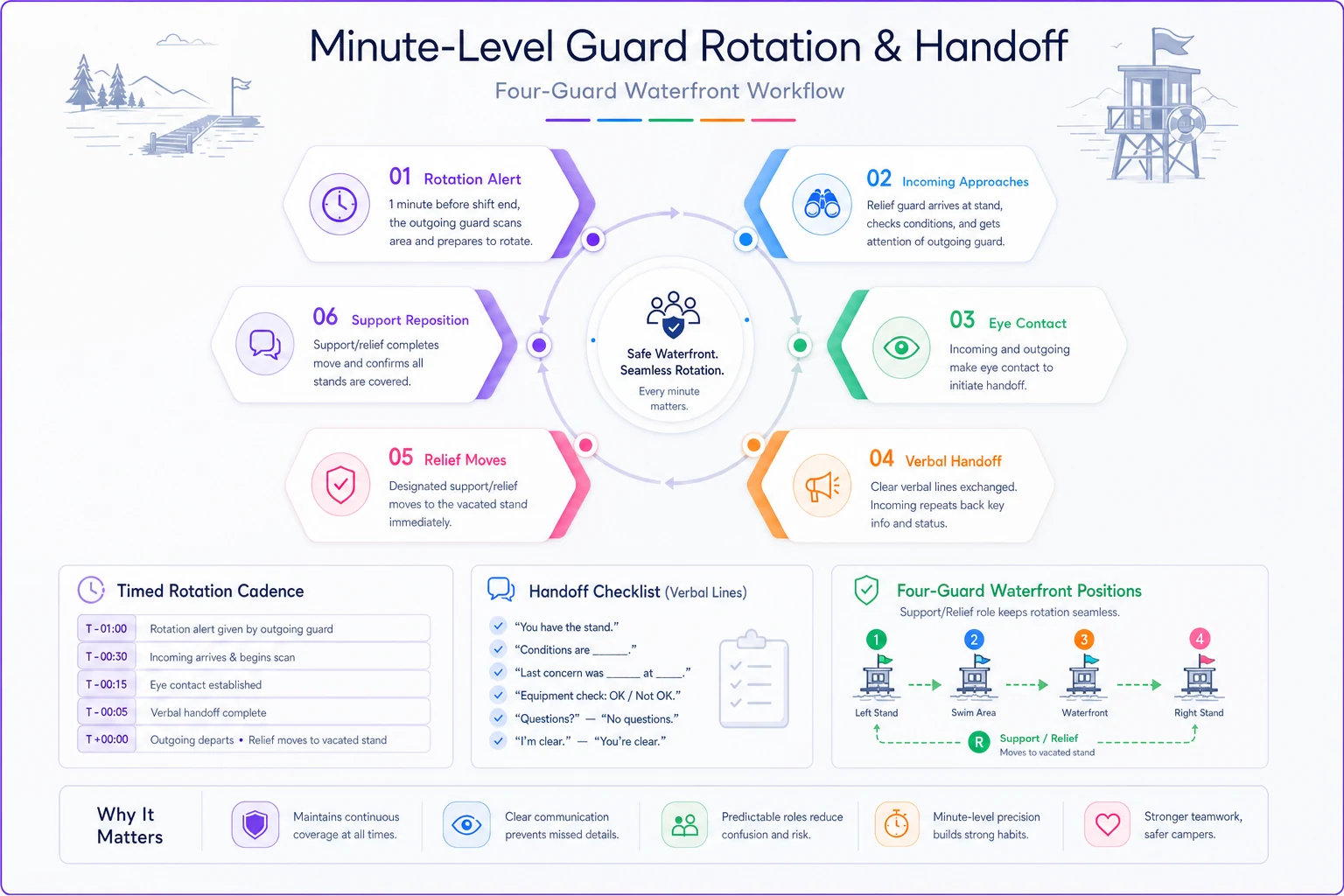
No exceptions: outgoing guard stays until relief says the line and takes the seat.
Certification gating: stop assigning guards to zones they aren't cleared for
A quieter failure than the empty chair is the mismatched chair — a guard sitting on a stand they aren't actually certified or checked out to run. This happens constantly during reassignments. Someone calls out, the schedule gets reshuffled at 8 AM, and a guard whose deep-water skills were never verified ends up on the dive stand.
Certification gating means a guard cannot be assigned to a zone unless their credentials for that specific zone are current and on file. Not "they're a lifeguard" — but "they hold the open-water endorsement, their in-service skills check for this dock is logged within the last 30 days, and their CPR/AED is current."
The practical version of gating uses tiers:
| Zone | Minimum credential | In-service check required |
|---|---|---|
| Shallow / instructional | Basic lifeguard cert | Every 30 days |
| Main swim / deep end | Lifeguard + deep-water skills verified | Every 14 days |
| Open water / dock | Waterfront/open-water endorsement | Every 14 days + weekly swim test |
| Small craft supervision | Waterfront + craft-specific | Per activity block |
One thing worth flagging: treating the June certification as valid all summer is a mistake that's easy to make and hard to defend afterward. Skills degrade, and a guard who was sharp in week one may not have done a real deep-water tow since. The 14-day in-service window on the harder zones isn't bureaucracy — it's the only thing standing between "certified on paper" and "capable right now."
When you reshuffle the schedule for an absence — and you will, constantly during peak weeks — certification gating is the check that stops a well-meaning last-minute swap from putting an under-qualified guard on your riskiest stand. If you're building out how those absences get backfilled in the first place, this pairs well with a broader step-by-step contingency plan for last-minute staff absences during peak weeks so the replacement guard is both available and cleared for the zone.
Minimum-rest requirements and why fatigue is a coverage issue
Rest isn't a wellness perk for guards — it's a scanning-quality control. A dehydrated, overheated guard on hour four of a five-hour block is technically present and functionally impaired.
Reasonable minimum-rest rules for a hot-weather aquatics day:
-
No more than 40 continuous minutes on a scanning stand before a rotation off
-
At least one full 20-minute off-stand block per hour during peak heat
-
A hard 30-minute meal break out of the sun, off the schedule entirely, with coverage backfilled — not absorbed by the remaining guards
-
A cap on total scanning hours per guard per day, typically around 4–5 hours of actual stand time even in a longer shift
The pattern that trips camps up: they schedule enough guards for the stands but not enough to actually honor rest. So the rest blocks quietly disappear the first hot week, guards eat lunch on the stand, and by mid-July you've got tired guards making the kind of small attention lapses that precede incidents. Rest coverage is a staffing-model decision made in the spring, not a favor you grant in the moment.
Daily pre-service water checks
Before the first camper touches the water, someone owns a pre-service check. This is a fixed, non-optional routine — not "the guard glances at the pool."
-
Water clarity — can you see the main drain / bottom clearly at the deepest point? If not, the water is closed until resolved.
-
Chemical readings — chlorine and pH logged with actual numbers, not "looked fine." Out-of-range = closed.
-
Rescue equipment count — reaching poles, ring buoys, rescue tubes, backboard, and spinal collar all present and staged at known locations.
-
AED check — powered, pads in date, battery indicator green.
-
Communication check — every radio keyed and confirmed, whistle per guard, emergency phone reachable.
-
Boundary and depth markers — ropes, buoys, and depth signage in place and correct.
-
Environmental scan (open water) — weather, current, wildlife, submerged hazards, entry/exit conditions.
The number one thing that gets skipped: logging the actual numbers. "Checked" is not a record. When something goes wrong, "chlorine 2.1 ppm, pH 7.4, logged 8:52 AM by initials" is what protects the camp. A checkmark protects nobody.
Drill cadence tied to session cadence
Drills fail when they're annual. A single June in-service does not keep response sharp through eight weeks of turnover, weather, and fatigue. And because many camps run 3–7 day sessions with fresh campers each week, you can't assume campers know the whistle signals or the clear-the-water protocol — that's a new-population variable every session.
A cadence that matches session rhythm:
-
Start of every session (day 1) guard team walks the emergency action plan on-site, physically, at each entry and exit point. Not read aloud — walked.
-
Weekly one unannounced in-water rescue scenario during operating hours (staged safely), timed from whistle to victim-secured.
-
Every 2 weeks a full spinal-injury / backboard drill, because it's the response most likely to be rusty and the one where mistakes cause the most harm.
-
Session turnover a 5-minute clear-the-water drill with the new campers so every session learns the whistle-and-exit signal on day one.
Track drill times. A backboard extraction that took 3 minutes in June should not take 6 minutes in July. If it does, that's your early-warning signal that skills are drifting and it's time for a re-check.
Emergency handoff scripts
The seam problem shows up hardest in an actual emergency, when a rescuing guard leaves their zone to enter the water. The instant they do, their zone is uncovered — unless the handoff is scripted and automatic.
-
Rescuing guard signals (long whistle blast) and calls the zone
"Deep stand rescue — cover my zone!"
-
The designated backup guard (the support/relief slot) immediately moves to cover the vacated stand and acknowledges: "Deep stand covered."
-
The deck supervisor activates the EAP, clears the water if warranted (whistle pattern), and controls the scene perimeter.
-
A named guard runs for the AED / calls EMS — this role is pre-assigned at the start of the day, not decided in the moment.
-
Once resolved, no one returns to normal rotation until the supervisor does a verbal re-count of all stands: "Deep — covered. Shallow — covered. Support — back. Resume."
The mistake to avoid: assuming the nearest guard will "obviously" cover. Under stress, everyone watches the rescue. That's exactly when the other zones go blind. The script exists so that covering the vacated stand is a reflex tied to a specific person, not a judgment call made in a panic.
Verbal handoff lines for routine rotations should be just as fixed and just as short:
-
Incoming
"I've got the deep stand."
-
Outgoing
"You have the deep stand." (then, and only then, they move)
Two lines. Every rotation. It feels almost silly the first day and it's the reason no chair ever sits empty.
A short real scenario
A day camp running a single pool with a deep end had four guards on rotation and a coverage model that looked fine on paper. Their actual problem was hydration and bathroom breaks: guards were stepping off stands ad hoc, and on any given afternoon there were several brief windows where the deep end had only one set of eyes on it instead of the required two.
They changed two things. First, they built a dedicated support/relief slot into the rotation so no break ever pulled a guard off a scanning stand. Second, they enforced the two-line handoff — nobody moves until relief takes the seat verbally. It cost them a modest amount of extra guard hours per week, somewhere around an added part-time block across the season.
The result wasn't dramatic. No more ad-hoc empty-chair windows, weekly rescue-drill times tightened up because the same person always owned relief, and when a state inspector did a spot visit mid-July, the logged pre-service numbers and rotation tracker ended the conversation quickly. Boring, verifiable coverage. That's the goal.
Where scheduling tools quietly help
The manual version of all this — rotation grids, certification expiry dates, in-service logs, drill times — lives in a binder and a whiteboard, and it works right up until the 8 AM reshuffle when someone calls out. That's when the binder can't tell you which available guard is actually cleared for the deep stand.
This is the narrow place where an operational scheduling platform earns its keep. When rotation templates, certification gating, and rest rules are built into software, a last-minute swap can flag automatically if it would put an uncleared guard on a gated zone or push someone past their rest cap. The AI-assisted scheduling logic doesn't replace your judgment — it just refuses to let the reshuffle create a lapse you wouldn't have caught by hand at 8 AM under pressure. The value isn't automation for its own sake; it's that the coverage rules you wrote in the spring actually hold in the moment.
If the rotation itself is what you're wrestling with beyond aquatics, the same seam-and-ownership thinking carries over to your broader activity blocks. The conflict-free activity rotation blueprint for 3–7 day sessions applies the same discipline to the rest of the camp day.
The one thing to fix first
If you change nothing else this season, remove the empty-chair option. Make it a hard rule that no guard leaves a stand until relief has verbally taken it, and staff a dedicated relief slot so breaks never create a gap.
Every other piece here — certification gating, rest math, drill cadence, handoff scripts — is built to protect coverage. But the seam between two guards is where coverage actually lives or dies, and it's the cheapest thing to fix. Close the seams, log the numbers, and the rest of your camp lifeguard staffing protocol has something solid to stand on.
If you change nothing else this season, remove the empty-chair option. Make it a hard rule that no guard leaves a stand until relief has verbally taken it, and staff a dedicated relief slot so breaks never create a gap. Every other piece here — certification gating, rest math, drill cadence, handoff scripts — is built to protect coverage. But the seam between two guards is where coverage actually lives or dies, and it's the cheapest thing to fix. Close the seams, log the numbers, and the rest of your camp lifeguard staffing protocol has something solid to stand on.
Ready to elevate your camp management?
Join 500+ camps using Campyly to save administrative time, enhance camper experiences, and streamline daily operations.