


The third week of July 2023 almost broke me. I had 340 campers rotating through 18 activities across 6 locations with 4 shared resource pools (kayaks, archery equipment, climbing gear, art supplies), and my Excel spreadsheet rotation schedule completely fell apart by Tuesday morning.
Two groups showed up at the lake for kayaking. The archery range had nobody for an hour, then three groups at once. Our rock wall instructor stood around waiting while kids sat bored in the pavilion because their crafts instructor was somehow scheduled at the nature center.
That disaster taught me something: camp activity rotation isn't just about filling time slots—it's about understanding resource dependencies, travel distances, energy curves, and conflict patterns that only become visible when you track the right data points.
Why traditional rotation schedules create operational chaos
Most camps build rotations backwards. They start with a blank grid, fill in activities, then scramble when conflicts emerge during actual operations. This approach fails because it ignores four critical operational layers that determine whether a rotation actually works.
Activity category requirements dictate which activities can follow each other. You can't schedule swimming right after lunch. High-energy activities shouldn't stack back-to-back for younger groups. Creative activities need setup/cleanup buffers that athletic activities don't.
Resource pools create hidden dependencies between seemingly unrelated activities. Your 20 kayaks might support two simultaneous groups, but only if you have enough life jackets in the right sizes. The pottery wheels can handle one group, but the kiln firing schedule means certain days are completely blocked.
Physical distances between venues add transition complexity. Moving 30 eight-year-olds from the sports field to the arts barn takes 12 minutes on a good day. Put the nature trail after swimming and you lose 20 minutes just getting kids changed and walking across camp.
Instructor availability creates bottlenecks you don't see until Day 2. Your climbing wall specialist also teaches wilderness skills. Your senior lifeguard runs water sports in the morning. When someone calls in sick, multiple activities suddenly have no coverage.
Building activity categories that prevent systematic failures
Activities naturally cluster into seven operational categories. Each has distinct resource needs and conflict patterns that matter more than the specific activity names.
Simplify camp operations with centralized control.
Campyly empowers you to manage registrations, staff, and activities seamlessly—all from one platform.
- Integrated camper and staff management
- Automated notifications and alerts
- Dynamic scheduling and resource allocation
No credit card required
High-Energy Athletic covers capture the flag, soccer, basketball, and relay races. These activities require open field space with minimal equipment setup. They conflict with other field sports and anything immediately after meals. Energy impact depletes physical reserves and requires recovery periods.
Water-Based includes swimming, kayaking, paddleboarding, and water games. These require certified lifeguards, dry-off time, and changing facilities. They conflict with other water activities and need cold weather backup options. Energy impact is physically tiring but refreshing, making them good midday placements.
Skill-Development encompasses archery, climbing wall, ropes course, and mountain biking. These require specialized instructors, safety equipment, and smaller group sizes. They conflict with weather conditions and equipment maintenance windows. Energy impact is mentally engaging with moderate physical demand.
Creative/Crafts involves pottery, painting, jewelry, woodworking, and tie-dye. These require indoor space, supply inventory, and cleanup time. They conflict with messy activities before meals and rushed transitions. Energy impact is calming and good for energy recovery.
Nature/Science covers hiking, animal care, gardening, and wilderness skills. These require weather flexibility, variable duration, and specific locations. They conflict with time-sensitive activities afterward and allergy considerations.
Performance/Drama includes music, theater, dance, and talent prep. These require indoor space, sound management, and practice continuity. They conflict with quiet activities nearby and split attendance. Energy impact is socially energizing and builds through the week.
Free Choice/Club encompasses reading, board games, friendship bracelet making, and chill time. These require flexible space and minimal supervision ratios. They conflict with nothing and serve as universal buffers.
The breakthrough comes from treating these categories as building blocks with rules, not just labels.
Resource tagging system that reveals hidden conflicts
Traditional schedules track "who goes where when" but miss "what they need when they get there." Resource tagging changes this by mapping every dependency before you build the schedule.
Here's the tagging structure that's prevented most of our conflicts:
Location Tags:
-
PRIMARY
Lake, Pool, Field-A, Field-B, Gym, Arts-Barn, Theater, Nature-Area
-
SECONDARY
Pavilion-1, Pavilion-2, Basketball-Court, Tennis-Courts
-
FLEXIBLE
Any-Outdoor, Any-Indoor, Any-Covered
Equipment Tags:
-
EXCLUSIVE
Pottery-wheels(4), Kayaks(20), Climbing-harnesses(15)
-
SHARED
Sports-balls, General-craft-supplies, Board-games
-
CONSUMABLE
Paint, Clay, T-shirts-for-dyeing, Science-materials
Tag consumables with estimated uses per session to plan replenishment ahead of time.
Instructor Tags:
-
CERTIFIED
Lifeguard-needed, Climbing-certified, Archery-certified
-
SPECIALIZED
Drama-teacher, Pottery-instructor, Nature-specialist
-
GENERAL
Any-counselor, Senior-staff, Junior-staff-supervised
Group Constraint Tags:
-
SIZE
Max-12, Max-20, Max-30, Full-group-ok
-
AGE
Minimum-age-8, Minimum-age-10, Minimum-age-13
-
DURATION
Fixed-45min, Fixed-90min, Flexible-30-60min
When you tag everything, conflict patterns become obvious. You see that scheduling two "Lifeguard-needed" activities in the same time slot breaks even if they're at different locations. You notice that "Pottery-wheels(4)" means maximum one group at a time, regardless of group size.
The camp activity rotation matrix that actually works
The rotation matrix isn't just a schedule—it's a constraint satisfaction system. The actual structure that handles 3-7 day sessions without conflicts looks different than what most camps build:
DIMENSION 1: Time Blocks
-
Block A
9:00-10:15 (75 min)
-
Block B
10:30-11:45 (75 min)
-
Block C
1:00-2:15 (75 min)
-
Block D
2:30-3:45 (75 min)
-
Block E
4:00-5:00 (60 min, flexible)
DIMENSION 2: Group Tracks (Example for 6 groups)
-
Track Red
Ages 8-9, 28 campers
-
Track Blue
Ages 8-9, 26 campers
-
Track Green
Ages 10-11, 24 campers
-
Track Yellow
Ages 10-11, 25 campers
-
Track Orange
Ages 12-13, 22 campers
-
Track Purple
Ages 12-13, 20 campers
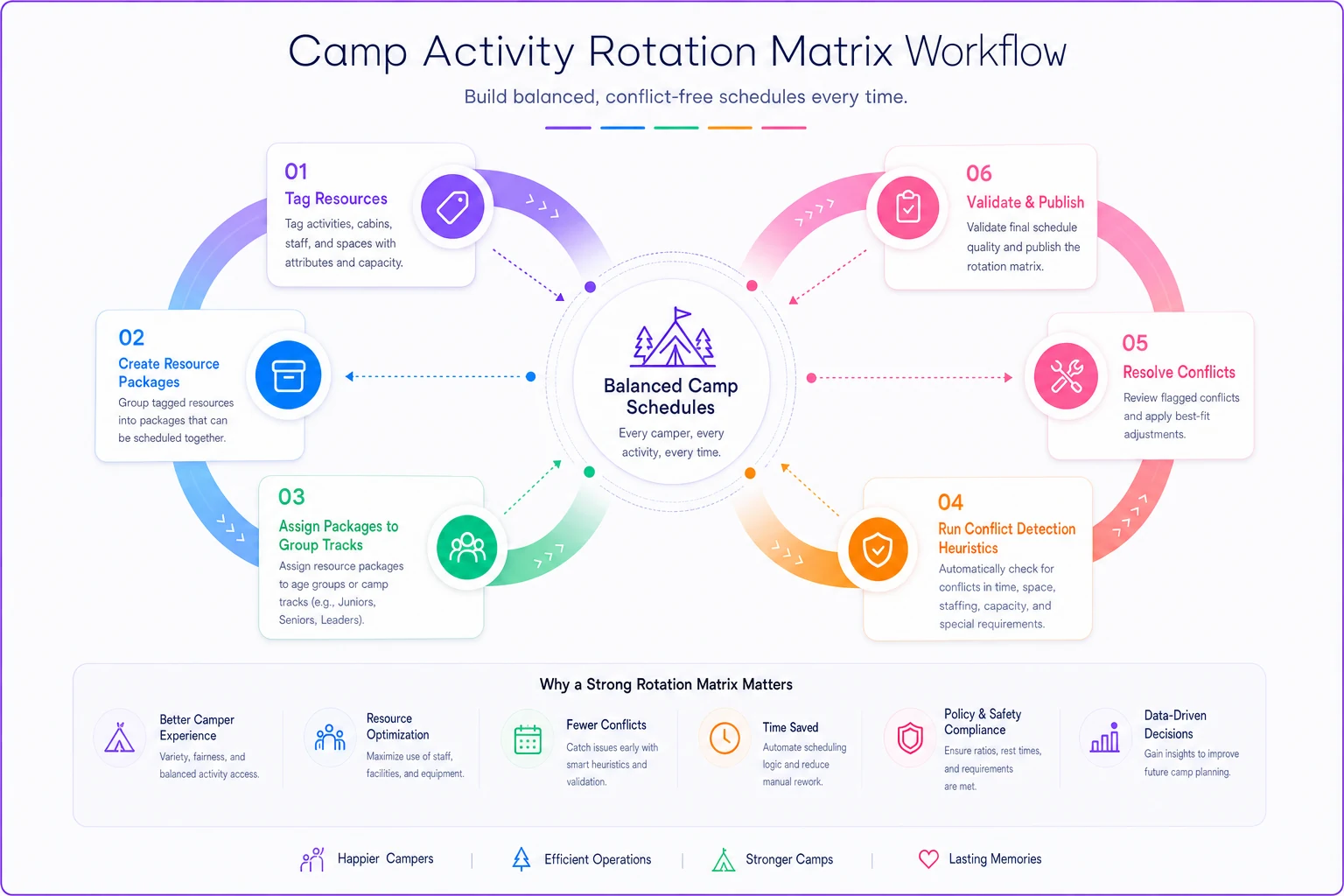
DIMENSION 3: Activity Assignments with Resource Locks Day 1 | Block A: Red → Swimming (Pool, 2-Lifeguards, Changing-rooms) Blue → Crafts (Arts-Barn, General-supplies, Any-counselor) Green → Archery (Range, Archery-cert, Equipment-set-12) Yellow → Drama (Theater, Drama-teacher, Sound-system) Orange → Climbing (Wall, Climbing-cert, Harnesses-15) Purple → Nature (Trail, Nature-spec, First-aid-kit)
You don't assign activities to time slots—you assign resource packages to group tracks, then validate no conflicts exist.
Conflict detection heuristics that catch problems before they happen
Manual conflict checking fails about 30% of the time because humans miss non-obvious conflicts. These five heuristics catch most problems:
Heuristic 1: Exclusive Resource Validation
-
Check if multiple groups assigned to same block
-
Verify no shared EXCLUSIVE resource tags exist
-
Flag conflict if overlap detected
Heuristic 2: Instructor Overlap Detection
-
Scan for instructor assigned to multiple activities in same block
-
Check minimum transition time requirements
-
Flag conflict if timeline impossible
Heuristic 3: Location Proximity Check
-
Calculate walking time between consecutive activity locations
-
Compare against available transition time
-
Flag yellow warning if tight transition detected
Heuristic 4: Energy Balance Validation
-
Review consecutive activity energy levels for same group
-
Check age-appropriate energy management
-
Flag potential energy depletion risks
Heuristic 5: Weather Dependency Scan
-
Identify outdoor activities without indoor backup
-
Verify flex period availability for weather changes
-
Flag weather vulnerability warnings
Running these checks against your draft rotation surfaces problems like: "Tuesday Block B has three groups needing certified lifeguards but only two on staff" or "Green track has back-to-back activities across camp with only standard transition time."
3-Day Session Rotation Example
Group Composition:
-
Eagles
30 campers, ages 10-12
-
Hawks
30 campers, ages 10-12
-
Falcons
30 campers, ages 13-15
-
Owls
30 campers, ages 13-15
Day 1: Skill Building Focus
| Time | Eagles | Hawks | Falcons | Owls |
|---|---|---|---|---|
| 9:00-10:30 | Archery (Range) | Swimming (Pool) | Climbing (Wall) | Drama (Theater) |
| 10:45-12:15 | Swimming (Pool) | Climbing (Wall) | Drama (Theater) | Archery (Range) |
| 1:30-3:00 | Crafts (Barn) | Nature (Trails) | Kayaking (Lake) | Sports (Field-A) |
| 3:15-4:45 | Drama (Theater) | Archery (Range) | Sports (Field-A) | Climbing (Wall) |
Day 2: Rotation Advancement
| Time | Eagles | Hawks | Falcons | Owls |
|---|---|---|---|---|
| 9:00-10:30 | Climbing (Wall) | Drama (Theater) | Archery (Range) | Swimming (Pool) |
| 10:45-12:15 | Nature (Trails) | Crafts (Barn) | Swimming (Pool) | Kayaking (Lake) |
| 1:30-3:00 | Sports (Field-A) | Kayaking (Lake) | Nature (Trails) | Crafts (Barn) |
| 3:15-4:45 | Kayaking (Lake) | Sports (Field-A) | Crafts (Barn) | Nature (Trails) |
Day 3: Choice & Completion
| Time | Eagles | Hawks | Falcons | Owls |
|---|---|---|---|---|
| 9:00-10:30 | Choice Block | Choice Block | Choice Block | Choice Block |
| 10:45-12:15 | Tournament Prep | Tournament Prep | Performance Prep | Performance Prep |
| 1:30-3:00 | All-Camp Tournament/Showcase | |||
| 3:15-4:45 | Closing Ceremonies & Awards |
No two groups need the same certified instructor simultaneously, water activities have drying time built in, and high-energy activities alternate with calmer ones.
5-Day Session Rotation Example
Standard week-long camps get more complex but follow similar principles. You need variety without repetition fatigue.
Modified Group Structure:
-
6 groups of 25-30 campers each
-
Age-banded but with mixed skill levels
-
Must hit all major activity categories
Core Rotation Pattern (Monday-Thursday):
Each group completes this sequence once, starting at different points:
Morning Block Sequence:
-
Water Activity (90 min)
-
Skill Development (75 min)
-
High-Energy Athletic (75 min)
-
Creative/Crafts (75 min)
Afternoon Block Sequence:
-
Nature/Science (75 min)
-
Performance/Drama (75 min)
-
Second Sport/Game (60 min)
-
Free Choice (60 min)
Friday Modification:
-
Morning
Group choice from favorite activities
-
Afternoon
All-camp special event
The five-day structure lets each group experience every major activity twice, building skills between sessions while preventing repetition fatigue.
7-Day Session Rotation Blueprint
Week-long sessions need variety maintenance and energy management across the full span. Engagement patterns change over seven days.
Days 1-2: Introduction & Assessment
-
All groups rotate through all activity categories
-
Shorter blocks (60 min) to maintain engagement
-
Instructors assess skill levels and interests
Days 3-4: Skill Development
-
Extended blocks (90 min) for deeper engagement
-
Groups can choose one "major" to focus on
-
Traditional rotation for other activities
Day 5: Mid-Session Mixer
-
Special all-camp activities
-
Break normal group structures
-
Rest day for specialized equipment/venues
Days 6-7: Mastery & Showcase
-
Morning
Intensive skill blocks
-
Afternoon
Prepare for final showcase
-
Evening of Day 7
Parent showcase/demonstration
This structure recognizes that engagement patterns change across a full week. Early variety prevents boredom, mid-week mixing refreshes energy, and end-of-week focus creates achievement sense.
Pre-session validation checklist
Before any rotation goes live, run through this validation checklist:
Resource Validation:
-
Count maximum concurrent users for each exclusive resource
-
Verify equipment quantities match largest group size
-
Confirm backup equipment for high-wear items
-
Check consumable supplies last full session
Instructor Coverage:
-
Every certified-required slot has qualified instructor
-
Backup instructor identified for each certification need
-
Transition time between instructor assignments verified
-
Break coverage planned for all-day instructors
Physical Flow:
-
Map walking times between all activity pairs
-
Identify bathroom access for each venue
-
Verify water fountain availability in summer
-
Check indoor alternatives for all outdoor activities
Group Management:
-
Confirm group sizes match activity maximums
-
Validate age-appropriate activity assignments
-
Check energy balance across each day
-
Verify special needs accommodations possible
Schedule Conflicts:
-
Run all five conflict detection heuristics
-
Check for exclusive resource overlaps
-
Verify no double-booked instructors
-
Confirm venue capacity not exceeded
Communication Prep:
-
Activity location maps created
-
Counselor rotation sheets printed
-
Parent-facing schedule simplified
-
Special instructions documented
Before any rotation goes live, run through this validation checklist:
Turning chaos into smoothly operating rotations
The difference between camps that run smoothly and those that feel chaotic isn't the quality of activities—it's the operational structure underneath. When you properly categorize activities, tag resources, and validate conflicts before Day 1, you eliminate most of the scrambling that exhausts staff and frustrates campers.
Staff stop playing schedule whack-a-mole and focus on actual program delivery. Campers experience variety without chaos. Parents see organization instead of confusion.
The camp activity rotation matrix isn't about creating rigid structure—it's about building flexible frameworks that handle real operational complexity. When group sizes change, when instructors call in sick, when weather forces programs indoors, your rotation matrix shows you exactly what can flex and what can't.
This systematic approach scales. Whether you're running 60 campers or 600, three days or three weeks, the same principles apply. Tag your resources, validate your conflicts, and build rotations that respect both operational constraints and camper energy patterns.
That July week taught me that hope isn't an operational strategy. Real rotation planning means understanding every dependency before the first camper arrives. When Monday morning comes, you want to be focused on creating magical camp experiences, not figuring out why three groups just showed up at the climbing wall.
Ready to elevate your camp management?
Join 500+ camps using Campyly to save administrative time, enhance camper experiences, and streamline daily operations.