

The gap that hurts kids isn't the intake form. Most camps collect allergy info fine. The gap is the 40-yard stretch between what a parent typed in June and what a 17-year-old server scoops onto a tray in July. That's where a peanut allergy becomes a peanut sandwich.
A camp meal service allergy SOP isn't a document you write once and file. It's a chain of handoffs — intake field to label to prep station to briefing to sign-off — and the chain breaks at the handoffs, not in the middle of any single step. Fix the handoffs, and you fix the incidents.
This is a walkthrough of that chain, start to finish, with the specific failure points where camps actually get burned.
Where the chain breaks (and why it's almost never the kitchen's fault)
Kitchens get blamed after an incident, but trace it back and the failure usually happened upstream. A few patterns come up over and over:
-
Free-text allergy fields. A parent writes "allergic to nuts, also we avoid dairy but it's not serious." Now your kitchen has to interpret severity from a run-on sentence. "Avoid dairy" and "anaphylactic to dairy" get treated the same — or worse, get handled differently by different staff on different days.
-
The roster and the kitchen list living in two places. Registration knows about the allergy. The kitchen printed its list last Tuesday. A camper who joined mid-week isn't on the July 14 printout.
-
Verbal-only handoffs at prep. The head cook tells the line "table 3 has a gluten kid" and walks off. Two hours and a shift change later, nobody remembers which kid.
-
No day-of confirmation. The system assumes the allergy list from intake is still accurate. But kids get pulled for field trips, new campers join Wednesday, parents update restrictions. Static lists rot.
What ties all of these together: the allergy data never gets structured early enough. If severity, allergen, and camper ID aren't captured as discrete fields at intake, every downstream step is guessing.
Step one: make the intake field do work
The intake form is where you either set the kitchen up to win or hand them a mess.
Simplify camp operations with centralized control.
Campyly empowers you to manage registrations, staff, and activities seamlessly—all from one platform.
- Integrated camper and staff management
- Automated notifications and alerts
- Dynamic scheduling and resource allocation
No credit card required
Stop collecting allergies as a paragraph. Collect them as fields.
At minimum, each dietary restriction should capture:
-
Camper ID (linked, not typed)
-
Allergen or restriction category (from a controlled list, not free text)
-
Severity — three tiers is enough
anaphylactic / medical, intolerance, preference
-
Cross-contact sensitivity — yes/no (this is separate from the allergy itself; a kid can be fine eating something a shared knife touched, or not)
-
Emergency medication on site — EpiPen location, yes/no
The severity tier matters more than most people realize. A kitchen running 300 lunches can't treat every "no dairy" like a life-threatening event — staff burn out and start ignoring the tags altogether. But they absolutely need to know which five kids will end up in an ambulance if the line messes up. Tiering tells the kitchen where to spend its attention.
Tie Camper ID fields directly to your registration database so kitchen labels can be printed from the confirmed roster instead of retyped.
One thing worth enforcing: no allergy field should accept free text as the only input. Let staff add a note, sure, but the note supplements a structured tag — it never replaces it. The moment "it's complicated, see notes" becomes the actual data, your labeling and prep steps have nothing clean to key off of.
Step two: labeling that survives a chaotic lunch line
Labels are where structured intake data becomes something a 16-year-old server can act on in three seconds. If a server has to read a paragraph, they won't. If they have to remember a name, they'll get it wrong during a 200-kid rush.
A workable labeling scheme, color plus text:
| Tier | Color | Label reads | Server action |
|---|---|---|---|
| Anaphylactic / medical | Red | Camper name + allergen ("NO peanut") | Stop, verify camper ID, hand personally |
| Intolerance | Yellow | Camper name + restriction | Serve the alternate, double-check |
| Preference | Green | Camper name + note | Serve alternate if available |
Color is the point. A server scanning a tray line catches red before they read a single word. The name-plus-allergen text is the confirmation, not the primary signal.
Labels that come off. Tape on a hot tray peels. Use labels that stick to the plate cover or the tray itself, and pre-print them the night before from the confirmed roster — don't handwrite during service.
One label per meal, tied to the individual. Batch-labeling "the gluten-free tray" for a table invites the wrong kid grabbing it. Tier-red kids get individually named plates. It's slower. It's also the difference between a normal Tuesday and a 911 call.
Step three: separate prep stations that actually stay separate
Perfect labels still cause cross-contact if the food was contaminated before it hit the plate. Prep station discipline is where the intolerance-vs-anaphylactic distinction earns its keep.
For tier-red allergens present at your camp that week:
-
A dedicated prep zone — physically separate counter space, not "the clean end of the same cutting board"
-
Color-coded equipment for that zone — purple boards and utensils are a common allergen-safe convention; pick one and stay consistent
-
Allergen-free ingredients prepped first, before allergen-containing food is out, so airborne flour or spilled sauce isn't already on the surface
-
A physical barrier or clear buffer between the safe zone and the main line
A pattern that trips camps up: they set up a beautiful separate station and then, mid-rush, a cook reaches across it with a spoon that just stirred the cheese sauce. Separation isn't just spatial layout — it's a rule about traffic and hands. The staff briefing covers that, because layout alone won't enforce it.
Allergen prep also feeds back into ordering and stock. If you're running dedicated gluten-free or nut-free product lines, that's a separate inventory stream with its own par levels — the same discipline you'd apply in a simple inventory system for camp gear and consumables applies to specialty food stock, because running out of the safe alternative mid-week forces exactly the improvisation that causes incidents.
Step four: the pre-service briefing and sign-off
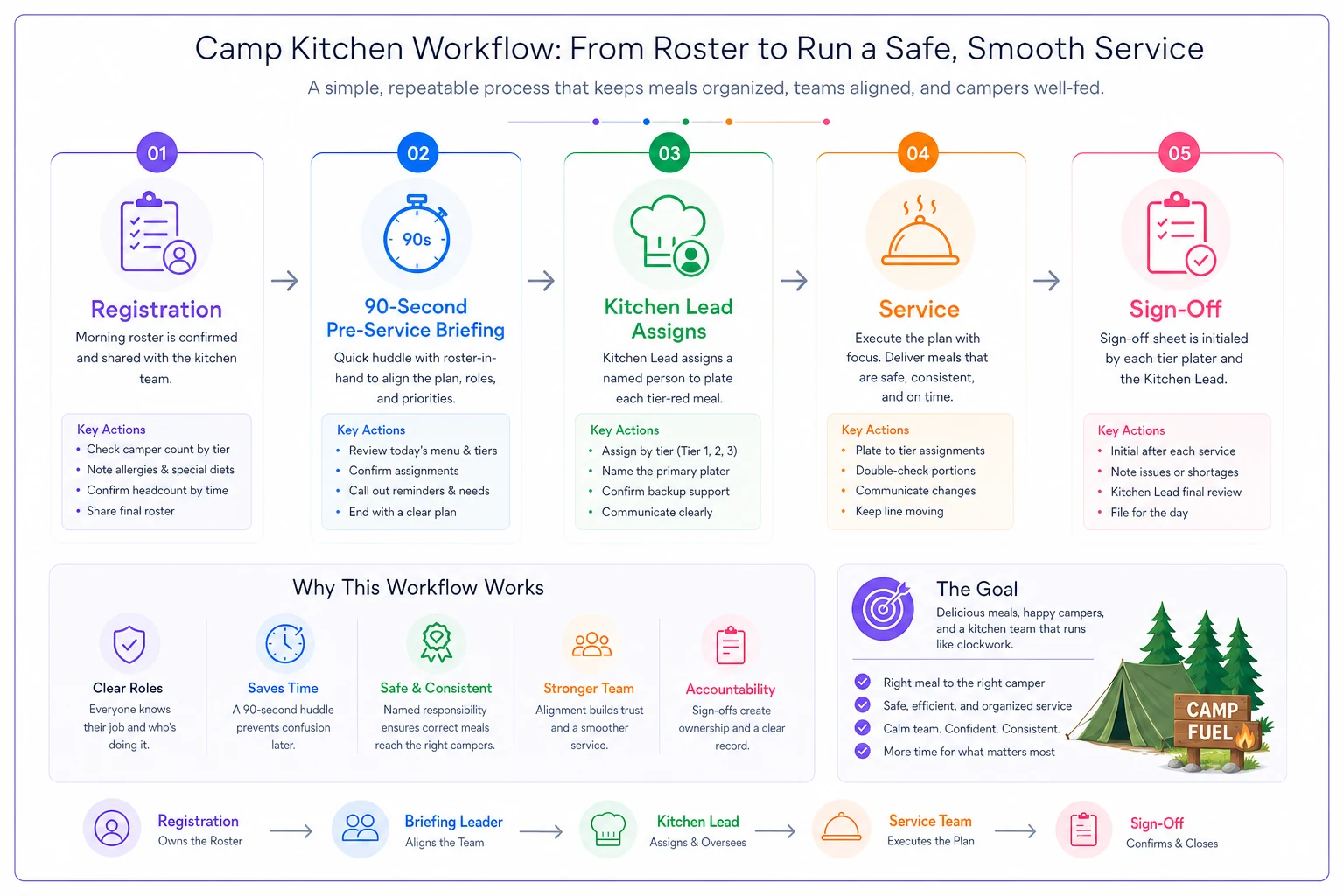
Every meal, before service, someone owns a 90-second briefing. Not a memo. A verbal, roster-in-hand confirmation with a physical sign-off.
The briefing covers:
-
How many tier-red meals today, and for whom — by name, by station
-
What changed since yesterday — new campers, kids off-site, updated restrictions
-
Who's plating each red meal — one named person, not "the line"
-
Where the EpiPens are and who's trained — every single meal, not just day one
Then the sign-off. The person running service and the kitchen lead both initial a sheet confirming the day's allergy meals match the confirmed roster. This sounds bureaucratic until you've had an incident and needed to reconstruct who knew what. A dated, initialed briefing sheet is also exactly the kind of record that fits into a broader auditable incident-management system — when something goes wrong, you can show the verification actually happened.
Quick visual of the pre-service briefing and sign-off workflow.
The mistake camps make: they do the briefing on day one and assume it carries. It doesn't. Shift changes, new hires mid-week, a substitute cook — the briefing has to happen every service because the people change.
Step five: day-of verification (the step everyone skips)
This is the one that separates camps that have close calls from camps that have incidents.
The allergy list from intake is a starting point, not a live truth. Between June registration and a Wednesday-in-July lunch, things drift:
-
A camper joined Monday and their allergy never made it to the kitchen printout
-
A parent emailed an update Tuesday night that nobody synced
-
A kid on the list is on a field trip and their special meal is being made for no one
Day-of verification is a same-morning reconciliation between today's actual attendance and today's allergy meal list. Whoever runs morning rollcall confirms which allergy kids are present, and that count goes to the kitchen before prep starts, not after the trays are already made.
A tight day-of routine:
-
Pull the confirmed present-today roster after morning check-in
-
Filter to campers with any dietary tag
-
Cross-check against the kitchen's prepped-meal count for the day
-
Flag additions (new or updated) and subtractions (absent or off-site)
-
Kitchen lead confirms receipt before allergen prep begins
The reason this gets skipped is timing pressure — morning is chaos, breakfast prep is already underway, and reconciling feels like a luxury. But additions are the dangerous half. A new Wednesday camper with a shellfish allergy who isn't on the kitchen's Tuesday printout is exactly the scenario that ends badly.
This is also where keeping intake data and the daily roster in one connected system pays off. When allergy tags live in registration and attendance check-in pulls from the same source, day-of verification is a filtered view, not a manual re-typing of lists between two apps. Camps running allergy data in a spreadsheet separate from their check-in system are the ones re-keying — and re-keying is where a name gets dropped.
Step six: the ingestion-response plan
Even a perfect chain assumes bad days. The response steps have to be as rehearsed as the prevention steps, because a reaction unfolds in minutes.
Your written ingestion-response protocol should cover:
-
Recognition — signs of a reaction, who's authorized to make the call (err toward acting)
-
Medication — exact EpiPen location for that camper, that day, and at least two trained staff who can administer
-
Escalation — call 911, and the exact person who calls parents (don't leave that ambiguous in the moment)
-
Documentation — what happened gets logged the same day while memory is fresh
The named-roles piece is what fails under stress. "Someone will call the parents" means nobody does for twenty minutes. Assign it by role at the briefing — the service lead calls 911, the director calls the parent — and it actually happens.
A real scenario
A mid-size day camp, around 260 campers per session, ran allergy info as a column in their registration export that the kitchen printed each Monday. Two near-misses in one summer: a new mid-week camper with a tree-nut allergy who wasn't on the printout, and a mislabeled tray that a camper caught before eating.
They didn't buy anything fancy. They restructured intake into tiered fields, moved to individual named labels for tier-red meals, added a 90-second pre-service briefing with an initialed sheet, and — the real fix — a same-morning reconciliation between check-in and the kitchen's meal count.
The following session, mid-week gaps closed because additions surfaced every morning instead of once a week. Mislabeling complaints dropped to near zero once labels were pre-printed from the confirmed roster instead of handwritten during service. No incidents that session, and a smaller but real bonus: less wasted food, because they stopped prepping special meals for kids who were off-site.
Who this level of rigor is for — and who's overbuilding
This full chain makes sense when you're serving more than a handful of allergy kids, you have shift changes or mid-week enrollment, and you run enough volume that servers can't personally know every camper. Once you're past roughly 100 meals a service, the memory-based approach fails silently until it doesn't.
You might be overbuilding if you're running a camp of 30 kids where the same cook knows every camper by name and the roster never changes mid-session. Individual named labels and a formal sign-off sheet may be more process than a stable, tiny operation needs — though even then, day-of verification for new arrivals is worth keeping.
Don't skip the day-of step regardless of size. It catches the most dangerous failure mode — the camper the system doesn't know about yet — and it costs almost nothing to run.
The thing to actually fix first
If you change one thing this season, structure the intake fields and connect them to your daily attendance so verification is a filter, not a retype. Labels, stations, and briefings all fail predictably when the underlying data is a paragraph in a column somebody printed last week.
The camps that avoid cross-contact incidents aren't the ones with the strictest kitchens. They're the ones where a form field from June still reliably changes a plate in July — because every handoff in between was designed to carry that information forward instead of dropping it.
The camps that avoid cross-contact incidents aren't the ones with the strictest kitchens. They're the ones where a form field from June still reliably changes a plate in July — because every handoff in between was designed to carry that information forward instead of dropping it.
Ready to elevate your camp management?
Join 500+ camps using Campyly to save administrative time, enhance camper experiences, and streamline daily operations.