

Most camps don't fail accommodations because they don't care. They fail because the whole thing lives in one coordinator's head. A parent mentions their kid uses a wheelchair during registration, someone jots it in a notes field, and then it surfaces again on the first morning when a counselor realizes the ropes course rotation has no plan for it. Now you're improvising in front of a nervous parent and a kid who already feels different.
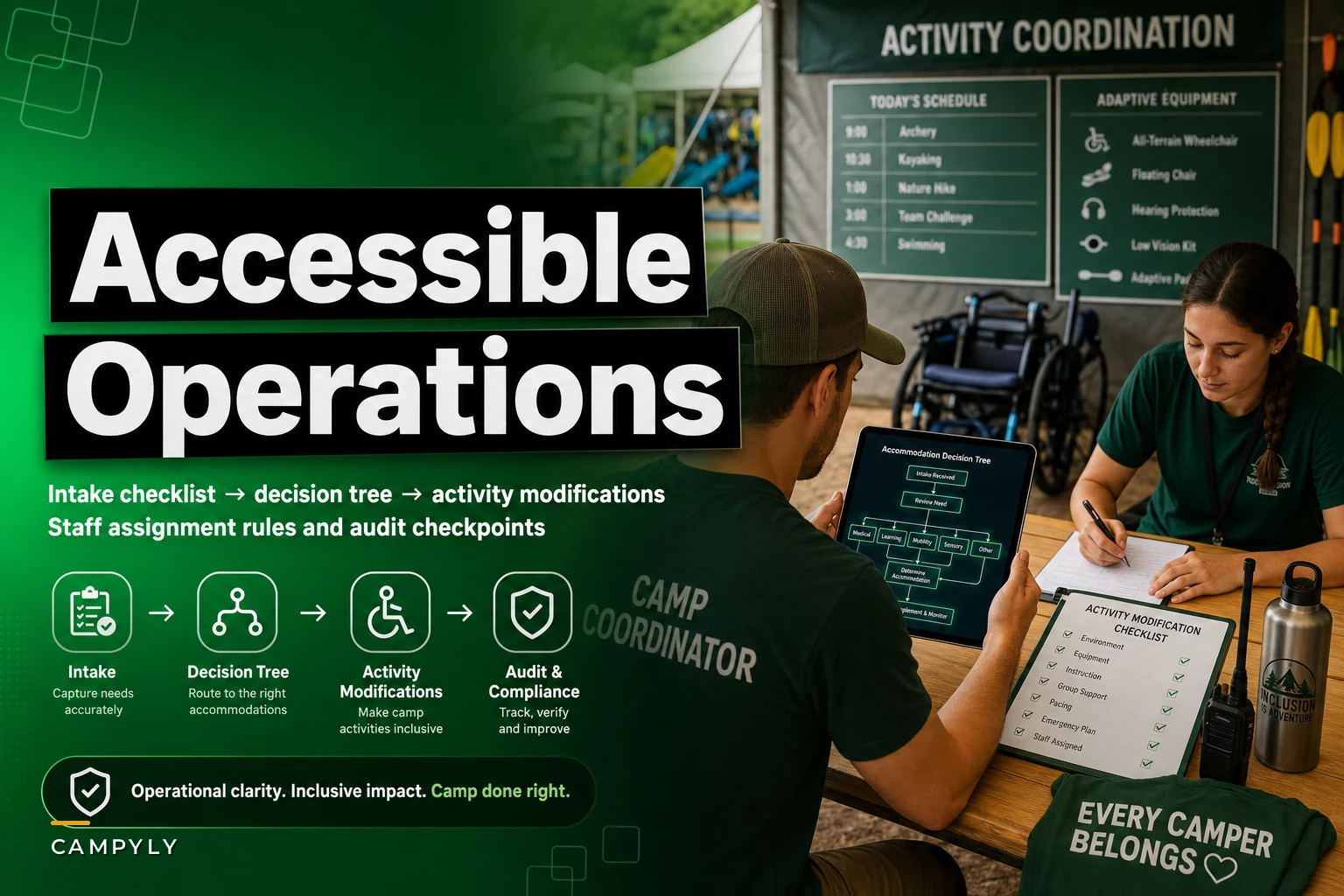
That gap — between "we knew about it" and "we actually operationalized it" — is where camp accessibility accommodations quietly break down. This post is about closing that gap with an actual workflow: an intake checklist that captures the right information, a decision tree that routes each request, activity modification templates staff can pull off the shelf, and audit checkpoints so nothing gets promised and then forgotten.
The goal isn't to make accommodations a legal exercise. It's to make them boring. Predictable. Handled the same way whether the request comes in March or the night before a session starts.
Why accommodations fall apart between registration and day one
The failure almost always happens in the handoff. Registration collects the information. Program staff need to act on it. Nobody owns the middle.
A typical example: a family registers in April and notes their child has ADHD and struggles with transitions. That note sits in the registration record. In June, the activity coordinator builds rotations. In July, a group counselor gets a roster with names and ages — but not the transition note, because it was never pushed into the operational layer. The kid has a rough time during the third rotation switch of the day, and everyone treats it as a behavior problem instead of a known accommodation that was never staffed.
-
The information exists but isn't structured. "Sensitive to loud noise" written in a free-text box means nothing until someone translates it into "assign to indoor archery block, skip the drum circle."
-
Nobody decided who decides. Some accommodations are trivial (a shaded seat). Some need a real conversation (can this camper safely do the overnight?). Without a routing rule, everything either gets rubber-stamped or stalls.
-
Modifications get reinvented every time. The same "how do we adapt canoeing for limited mobility" question gets solved from scratch by whoever's on duty, at varying quality levels.
-
No one checks whether the promise was kept. A parent was told their kid would have a buddy for swim. Three weeks in, staff turnover happened, and the buddy assignment silently disappeared.
Getting this right is really a documentation and coordination problem, which is why it fits alongside the same discipline you'd apply in a modular camp operations playbook to prevent last-minute chaos. Accommodations are just another module that needs to survive the handoff from registration to the field.
The intake checklist: capture decisions, not just facts
Most intake forms ask what's wrong with the kid. That's the wrong frame. You want to capture what the camper needs to fully participate, and what the operational implication actually is.
Simplify camp operations with centralized control.
Campyly empowers you to manage registrations, staff, and activities seamlessly—all from one platform.
- Integrated camper and staff management
- Automated notifications and alerts
- Dynamic scheduling and resource allocation
No credit card required
Structure your intake to force specificity. A good accommodation intake captures:
-
The functional need, in participation terms — not "diabetes," but "needs blood sugar checks before and after high-activity blocks and access to fast-acting glucose."
-
What the family has seen work elsewhere. Parents are your best source. A kid who did fine at another camp with a written daily schedule taped to their cabin wall is telling you exactly what to replicate.
-
Triggers and hard limits. What situations reliably cause problems, and what's genuinely off the table for safety.
-
Equipment or supplies the camper brings vs. what you provide. This single question prevents a lot of day-one scrambling.
-
Communication preferences. Does the camper respond better to visual cues, a quiet warning before transitions, a designated adult?
The mistake here is treating intake as a one-time form. In real operations, the useful details often come out in a five-minute follow-up call, not the registration field. Build a standing rule: any flagged accommodation triggers a short call with the family before the season, and the notes from that call become the operational record — not the original form.
Make the follow-up call a required step so the clarified notes become the working record, not the initial registration field.
One thing worth flagging early: keep medical and disability information handled with the same care you'd apply to any sensitive camper data. If your consent and retention rules are loose, accommodation intake is exactly where you'll get exposed.
The decision tree: route every request so nothing stalls
Once you have structured intake, every accommodation needs to flow down one of a few clear paths. Without this, small requests eat director time and big ones slip through.
Here's a routing structure that works in practice:
| Request type | Example | Route to | Timeline |
|---|---|---|---|
| Standard / low-lift | Shaded seating, printed daily schedule, seat near the front | Coordinator applies template, no escalation | Handled at rostering |
| Activity modification | Adaptive paddling, alternative to high-ropes, sensory break plan | Coordinator + activity lead build from template | 1–2 weeks before session |
| Staffing-dependent | 1:1 support, dedicated buddy, medication administration | Director + staffing lead, may affect ratios | 3–4 weeks before session |
| Safety review required | Overnight participation with a mobility or medical need, water activities with seizure history | Director + medical/health lead, possible family conference | As early as possible |
The point of the tree isn't bureaucracy. It's making sure a request for a shaded chair doesn't sit in the same queue as a request that changes your staffing ratios. Roughly speaking, the majority of accommodation requests a camp gets are low-lift template stuff — the value of the tree is that it clears those instantly so real attention goes to the handful that genuinely need it.
A visual decision tree helps staff quickly see who owns each branch and what timeline applies.
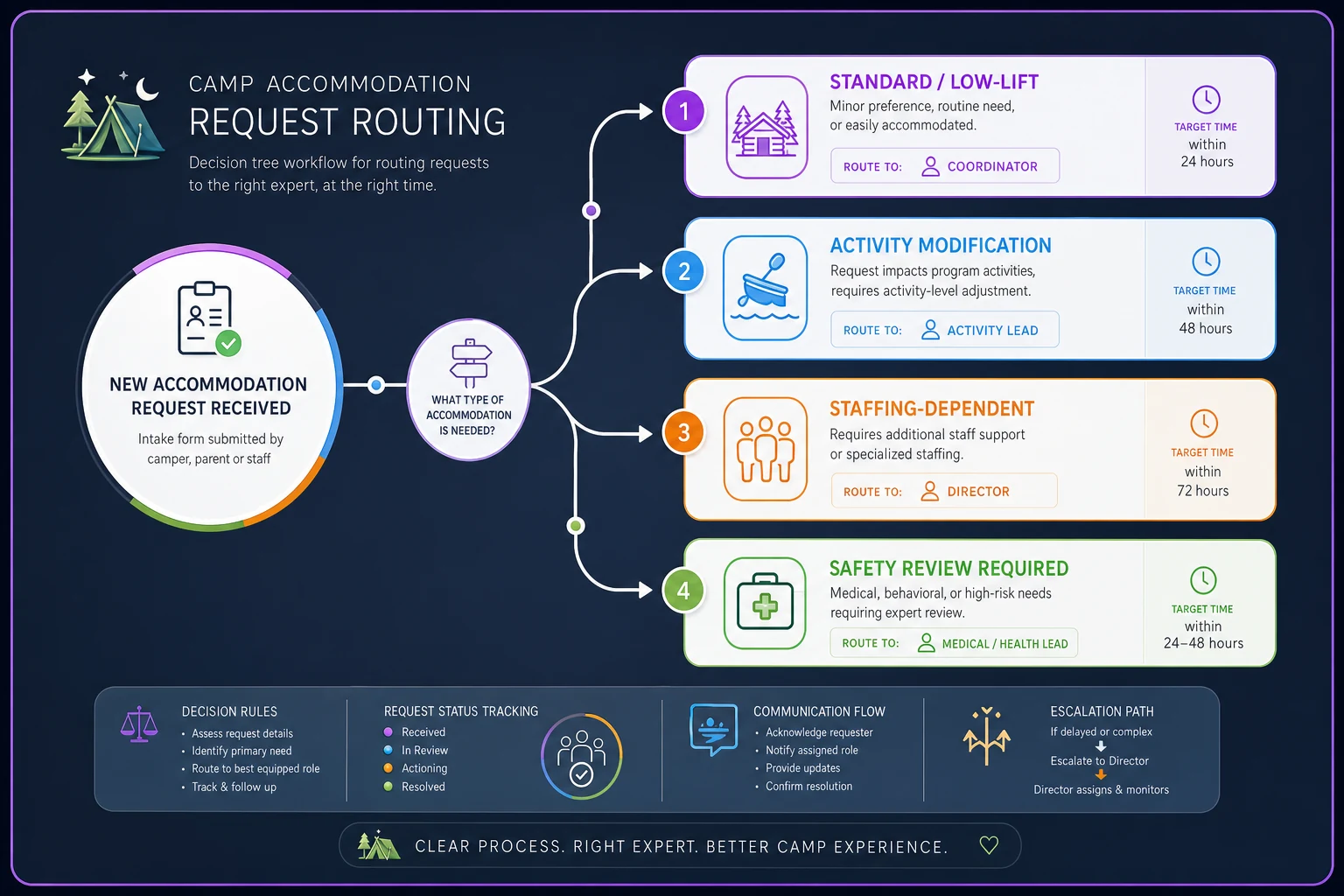
A common mistake: routing based on diagnosis instead of operational impact. Two kids with the same diagnosis can land in completely different branches depending on what they actually need on-site. Route on the need, not the label.
Activity modification templates: stop solving the same problem twice
This is the piece most camps skip, and it's the piece that saves the most day-of chaos. For every core activity, you want a pre-built menu of modifications that staff can pull without inventing anything.
Take a standard high-ropes/climbing block. Your modification template might include:
-
Ground-based challenge course station for campers not doing the elevated element, run in parallel so no one sits out watching.
-
Belay-assist role — a camper who can't climb participates as part of the ground team, which keeps them inside the activity socially, not on the sidelines.
-
Modified harness and lower-height traverse for campers with limited mobility but cleared for elevation.
-
Sensory plan — noise-reducing headphones available, a quiet staging spot, a scripted "here's what happens next" walkthrough before the block starts.
The workflow to build these is straightforward but has to happen off-season, not during a session:
-
List your core activities (usually 12–20 for a typical program).
-
For each, ask
what are the three most common reasons a camper couldn't fully participate? Mobility, sensory, medical, and processing/transition needs cover the bulk of it.
-
Write one concrete modification for each of those categories — specific enough that a 19-year-old counselor can execute it without calling you.
-
Note what equipment or extra staffing each modification requires, so it feeds cleanly back into your rostering and supply planning.
Once these exist, the coordinator's job during intake shifts from "invent a solution" to "select the right template and assign it." That's the difference between accommodations that survive staff turnover and ones that don't.
The best templates get better every season. Build in a two-minute debrief after any modification gets used — did it work, what would you change — and fold that back in. Over a couple of seasons you end up with genuinely battle-tested plans instead of educated guesses.
Staff assignment rules: match the accommodation to the right person
An accommodation is only as good as the person executing it. The two failure modes here are opposite extremes: assigning your most experienced staff to everything (burning them out), or spreading accommodations randomly (so a camper with real needs gets whoever's on the roster that day).
A workable rule set:
-
Template-level accommodations can go to any trained counselor. That's the whole point of templating — it lowers the skill floor.
-
Staffing-dependent accommodations get assigned by name before the session, with a named backup. If the primary person is out, the backup already knows the plan. Never leave a 1:1 support role as "whoever's free that day."
-
Continuity matters more than seniority. A camper who needs consistent transition warnings benefits far more from the same counselor across the week than from a rotating cast of your best staff.
-
Every accommodation gets an owner, not a group. "The waterfront team knows" is how things get dropped. One named person is accountable, even if several people execute.
Write these rules down and attach them to the roster, not to a person's memory. When peak-week staffing gets thin and you're pulling people to cover absences, the assignment rules are what keep a critical accommodation from evaporating in the shuffle.
Audit checkpoints: verify the promise was actually kept
This is the part that separates a real system from a good intention. You promised things to families. Something has to check that they're still happening once camp is chaotic.
Build in a small number of checkpoints:
-
Pre-session sign-off. Before a session starts, the coordinator confirms every flagged accommodation has a template assigned and an owner named. No blanks.
-
Day-two spot check. After the first full day, verify the plan is actually running in the field, not just on paper. Day two is where you catch that the sensory headphones never made it to the archery range.
-
Mid-session review for staffing-dependent cases. For the handful of high-need accommodations, a quick check that the assigned person is present and the backup knows the plan.
-
End-of-session debrief. What worked, what didn't, what template needs updating. This is also where you capture anything that should carry forward if the family returns.
Treating accommodations as something you can audit — with clear ownership and a paper trail — is the same mindset behind an auditable camp incident-management system. You want to be able to answer, at any point, "what did we commit to, who owns it, and is it actually happening?"
A simple pre-session checklist to run before every session:
-
[ ] Every flagged camper has structured intake notes (not just a raw registration field)
-
[ ] Each accommodation is routed and its route is resolved
-
[ ] Activity modifications are selected and attached to the roster
-
[ ] Staffing-dependent accommodations have a named owner and named backup
-
[ ] Required equipment/supplies are confirmed on-site
-
[ ] Family has been told what to expect and by whom
Treating accommodations as something you can audit — with clear ownership and a paper trail — is the same mindset behind an auditable camp incident-management system. You want to be able to answer, at any point, "what did we commit to, who owns it, and is it actually happening?"
A real scenario: mid-sized day camp, one broken handoff
A mid-sized day camp — roughly 240 campers across summer sessions — kept running into the same problem. Accommodations got captured at registration but lived in the sign-up system, and field staff never reliably saw them. Over one season they had a string of small failures: a camper with a nut allergy nearly ended up in a cooking activity, a kid who needed transition warnings had three rough days before anyone connected it to a note the parent left in April, and two families quietly didn't re-enroll.
Nothing catastrophic happened, which is exactly why it kept happening — no single incident forced a fix.
They changed three things before the next season. Any flagged accommodation triggered a short pre-season family call, and those notes became the working record. They built modification templates for their 15 core activities over the off-season. And they added the pre-session sign-off and a day-two spot check.
The difference showed up less in a single number and more in the tone of the season. Day-one improvising basically stopped. The director estimated they cut accommodation-related fire drills by more than half, and the two families who'd left the prior year came back after a coordinator specifically walked them through the new process. A first-year counselor could run an adaptive canoeing station without a panicked radio call. It wasn't magic — it was just moving the work upstream so it wasn't happening live in front of a worried parent.
When to invest in this — and when it's overkill
If you run more than a handful of accommodations a season, or you've had even one "how did we miss this" moment, the full workflow pays for itself in reduced day-of chaos and fewer families who feel let down.
If you're a very small camp with two or three accommodations a year and a director who's personally involved in every one, a lighter version is fine — the intake call and a written plan per camper might be all you need. Building 20 activity templates for three accommodations is over-engineering.
The one thing nobody should skip, regardless of size: the audit checkpoint. Even the smallest camp needs a moment before each session where someone confirms the promise made to a family is actually staffed and owned. That single habit prevents most of the failures worth preventing.
Where software quietly helps — without becoming the whole plan
None of this requires special tooling to work. It requires structure. But the reason accommodations fall through is almost always the handoff, and that's where a decent camp management platform earns its place: pushing the accommodation from the registration record into the counselor's daily roster, flagging which campers have active plans, and holding the owner and backup assignment so it survives staff changes. When the note lives in the operational layer instead of a buried field, the day-two spot check gets a lot easier because there's an actual record to check against.
The tooling isn't the system, though. The intake call, the decision tree, the templates, and the checkpoints are the system. Software just keeps them from getting lost between the person who took the request and the person standing at the ropes course at 9 a.m. Get the workflow right first, and let the platform carry it — not the other way around.
None of this requires special tooling to work. It requires structure. But the reason accommodations fall through is almost always the handoff, and that's where a decent camp management platform earns its place: pushing the accommodation from the registration record into the counselor's daily roster, flagging which campers have active plans, and holding the owner and backup assignment so it survives staff changes. When the note lives in the operational layer instead of a buried field, the day-two spot check gets a lot easier because there's an actual record to check against.
The tooling isn't the system, though. The intake call, the decision tree, the templates, and the checkpoints are the system. Software just keeps them from getting lost between the person who took the request and the person standing at the ropes course at 9 a.m. Get the workflow right first, and let the platform carry it — not the other way around.
Ready to elevate your camp management?
Join 500+ camps using Campyly to save administrative time, enhance camper experiences, and streamline daily operations.