

The hours between lights-out and sunrise are where most camps run the thinnest on supervision and the weakest on documentation. During the day you've got activity leads, specialists, directors walking the grounds. At 11:40pm you've got one tired 19-year-old counselor — sometimes two — covering a cabin or a cluster of cabins, and whatever system you built to keep eyes on kids is now running on their judgment alone.
A solid cabin night safety SOP isn't about making night staff work harder. It's about closing the gaps where a kid can slip out, a medical issue goes unnoticed for 40 minutes, or a homesick 9-year-old wanders toward the lake without anyone knowing until breakfast. And when a parent or your insurer asks "who checked the cabin, and when?" — you want a log that answers that instantly, not a counselor trying to reconstruct their night from memory.
This post covers the overnight window only: rotation timing, pre-bed checks, supervisor handoffs, and the sign-off records you'll want if there's ever an incident review or audit.
The failure almost always happens in the handoff, not the rotation
Camps tend to obsess over rotation frequency — "do we check every 20 minutes or every 30?" — but the incidents that turn into real problems rarely come from the interval being slightly too long. They come from a handoff gap: the moment one counselor assumes the other has it covered.
A typical example looks like this. Two counselors share night duty for a four-cabin unit. One does the 10pm and 10:30 rounds, then steps out to use the staff bathroom and grab water. He assumes his co-counselor picked up the 11pm sweep. She assumed he'd be back in five minutes. Nobody did the 11pm check. A camper with a mild asthma flare-up sat up coughing for most of that window before another kid went to find an adult.
Nothing catastrophic happened that night. But that's the pattern — a verbal, assumed handoff with no record, no timestamp, and no single person clearly "on." What turns up again and again across overnight programs is that the rotation schedule looks airtight on paper and falls apart in the handshake between two humans at midnight.
So before you tune your rotation intervals, fix the handoff. Every transition of overnight responsibility needs:
-
A named person who is explicitly "on duty" right now
-
A physical or digital sign-off confirming the handoff happened
-
A quick status note on anything unusual (homesick camper, kid who felt nauseous at dinner, a bed near the door)
If you can't answer "who was on at 1:15am?" in under ten seconds, your handoff process isn't documented well enough.
Minute-level rotation patterns that match actual risk
Not every hour of the night carries the same risk, and flat "check every 30 minutes all night" schedules waste attention early and under-cover the tricky windows.
Simplify camp operations with centralized control.
Campyly empowers you to manage registrations, staff, and activities seamlessly—all from one platform.
- Integrated camper and staff management
- Automated notifications and alerts
- Dynamic scheduling and resource allocation
No credit card required
| Time window | Risk profile | Suggested check cadence |
|---|---|---|
| Lights-out → ~11:30pm | Highest activity: kids still awake, bathroom trips, homesickness peaks | Every 15–20 min |
| ~11:30pm → 1:00am | Settling period, late wanderers, first signs of illness | Every 20–25 min |
| 1:00am → 4:30am | Deepest sleep, lowest movement, but hardest for staff to stay alert | Every 30 min |
| 4:30am → wake-up | Early risers, bathroom traffic, kids sneaking out | Every 20 min |
The point isn't to copy these numbers exactly — your cabin layout, camper ages, and staffing ratios change everything. A unit of 8-year-olds needs tighter early-evening coverage than a cabin of 15-year-olds. What matters is that your cadence is written down and tied to the clock, so a counselor isn't improvising intervals at 2am when their judgment is at its worst.
One thing worth flagging: the 1am–4:30am stretch is where sign-off logs get fudged. Staff get drowsy, do a less thorough sweep, and backfill the log later. A pre-bed check routine and a log format that forces a real observation — not just a checkmark — reduce that drift considerably.
Here's a quick visual of a rotation workflow and where checks should concentrate through the night.
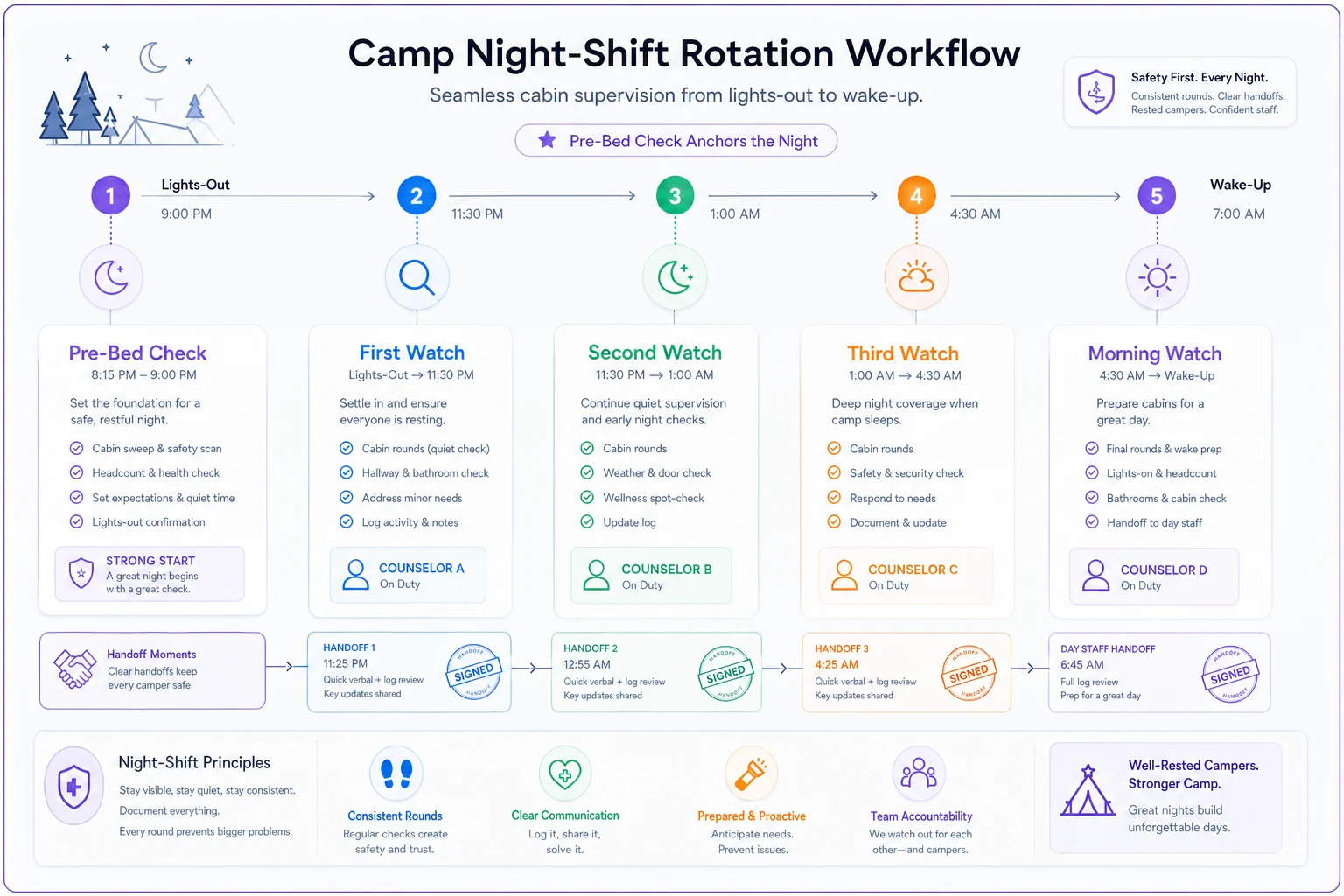
The visual highlights tying cadence to the clock and the handoff points where logs should capture current status rather than a checkbox.
The pre-bed check: a 6-step routine before you sign off the unit
The single most valuable 10 minutes of the overnight shift happens right at lights-out. A thorough pre-bed check sets the baseline for everything that follows. If you know exactly who's in which bed and what their condition is at 10:15pm, every later round becomes a quick confirmation instead of a fresh headcount.
Run it as a fixed sequence:
-
Physical headcount against the roster. Not "they're all here-ish." Count bodies, match names. Note any camper who's in the bathroom so the number reconciles.
-
Confirm bed assignments. Flag any camper near an exterior door or window — that's your wander-risk and your weather and temperature concern.
-
Medical and condition check. Anyone who flagged a headache, stomach issue, or injury earlier? Note it on the log now with their current state. This is also where overnight meds or inhalers get confirmed as accessible.
-
Environmental scan. Working flashlight, clear path to the door, no tripping hazards, screens intact, temperature reasonable.
-
Verbal expectations. Where the counselor is, how to get help, bathroom rules. Thirty seconds, every night.
-
Sign the pre-bed log with time, counselor name, headcount, and any flags.
The pre-bed sign-off is your anchor record.
That last step matters more than it looks. The pre-bed sign-off is your anchor record. If an incident happens at 2am, the first question in any review is "what was the camper's condition at lights-out?" — and a filled-in pre-bed log answers it without anyone guessing.
Programs that run tight overnight ops tend to share one thing: the camps with the fewest 2am surprises aren't the ones doing the most rounds. They're the ones with the most disciplined pre-bed checks. You catch the homesick kid, the queasy kid, the kid who "forgot" to mention their inhaler — before they become a midnight emergency.
Supervisor handoffs and the sign-off log
Your overnight structure usually has two layers: counselors on cabins, and a supervisor or night director covering the unit or the whole site. The handoff between these layers is where accountability lives.
-
Time of handoff and both names
-
Headcount confirmed at handoff (yes/no + number)
-
Open items carried forward — the sick kid, the homesick one, the camper on a behavior plan
-
Any environmental issues — broken screen, flickering light, propped door
-
Supervisor contact and escalation path for the shift
The operational logic here is straightforward: the log isn't paperwork for its own sake. It's the thing that lets the 1am supervisor instantly know the 10pm supervisor already flagged Cabin 3's homesick camper, so she checks on that kid first instead of discovering the situation cold.
A sign-off log template you can copy
UNIT: DATE: COUNSELOR(S) ON DUTY: PRE-BED CHECK (complete at lights-out) Time: _ Headcount: / Flags: Door/window risk beds: __ Meds confirmed accessible: Y/N Signed: OVERNIGHT ROUNDS Time | Headcount | Observation / Action | Initials |||_ |||_ |||_ SUPERVISOR HANDOFFS Time | Off-going | On-coming | Open items | Initials x2 ||||__ INCIDENTS / ESCALATIONS (time, what, who notified, outcome) ___
Building the rotation into your staffing roster (not around it)
A lot of overnight coverage problems are really roster problems. The SOP is fine, but the schedule quietly assumes a counselor who worked a full day is sharp enough to run disciplined 20-minute checks until 2am, then wake up for morning activities. That assumption breaks on peak weeks.
The fix is a rotation that treats night duty as its own staffed role — rotated fairly, with built-in contingency. A few things that hold up in practice:
-
Cap consecutive overnight shifts. Two or three in a row, then a break. Alertness degrades fast past that point.
-
Pre-assign a backup for every night. If the on-duty counselor gets sick or has a family emergency, there's a named person stepping in — not a scramble. This ties directly into your broader contingency plan for last‑minute staff absences during peak weeks.
-
Don't stack overnight duty on top of a high-intensity day assignment. The counselor who ran waterfront all afternoon shouldn't also be solo on a four-cabin overnight.
-
Rotate the hard windows. The 1am–4
30am stretch is brutal. Spread it so the same two people aren't always drawing the deepest, drowsiest shift.
A simple rotation spreadsheet structure
Set up columns for: Date, Unit, On-Duty Counselor, Backup Counselor, Supervisor, Shift Window, Consecutive-Nights Count, and Rest-Day Flag. The consecutive-nights counter is the feature that actually earns its keep — it makes fatigue visible before it becomes a safety problem. When someone hits their cap, the cell flags and your scheduler reassigns before that person is running checks on four hours of sleep.
Where this ties into your other safety systems
Overnight supervision doesn't live in isolation. If your camp runs waterfront, the same discipline you apply to lifeguard rotation and rescue protocols — named coverage, clear handoffs, no assumed overlap — is exactly the mindset that prevents overnight gaps. The failure mode is identical: two people each assuming the other has it.
Camps that run clean overnights tend to treat night duty with the same seriousness they'd give aquatics coverage. It's a staffed, documented, rotated responsibility — not something that just happens by default after the campfire dies down.
A quick real scenario
A mid-sized overnight camp — around 180 campers across two age-grouped units — kept running into the same problem on peak weeks: counselors couldn't reliably say who did which round after midnight, and twice a season a camper's early-morning illness went unnoticed until wake-up. No lawsuits, but one upset parent and a nervous insurer review.
-
They changed three things
a mandatory pre-bed sign-off anchored to the roster, a one-page overnight log with forced observations instead of checkmarks, and a consecutive-nights cap of two with a named backup for every night.
The following season, overnight documentation was complete on nearly every night — up from roughly 60–70% before. More importantly, both early-morning illness cases that came up were caught during 4:30am rounds, because the log structure pushed staff to actually look rather than just walk past. The insurer review went from a list of concerns to a two-line note. No dramatic turnaround story — just a system that stopped leaking at the exact hour it used to.
When tighter overnight SOPs make sense — and when they don't
This makes sense when you run overnight or multi-night programs, especially with younger campers, kids on medications, or any history of wandering or late-night incidents. If you've ever been unable to answer "who checked the cabin at 2am?", you need this.
This is overkill when you're a day camp with no overnight component — most of this doesn't apply, and bolting it on just creates paperwork nobody needs.
Be careful if your staffing is already stretched so thin that adding overnight structure means the same exhausted people doing more. In that case, fix the roster and ratios first. A well-written SOP run by counselors on their third consecutive overnight shift and four hours of sleep isn't safety — it's a document that looks like safety.
The goal through all of this is straightforward and not glamorous: at any minute of the night, someone knows exactly who's responsible, exactly how many campers are accounted for, and exactly what to do if something's wrong — and there's a record proving it. Nail the handoffs, anchor everything to the pre-bed check, keep the log honest, and build the rotation into a roster that accounts for how tired people actually get. That's what keeps a quiet night quiet.
Ready to elevate your camp management?
Join 500+ camps using Campyly to save administrative time, enhance camper experiences, and streamline daily operations.