

Most camps don't fail their safeguarding audit because they skipped training. They fail because they can't prove the training happened in a way a licensor or accreditor will actually accept. The session took place, the staff learned the material, everyone nodded along — and then three months later a regulator asks for signed attendance, the version of the policy that was taught, and evidence that each person passed a competency check. Suddenly the director is digging through a shared Google Drive folder, a stack of paper sign-in sheets, and someone's camera roll.
That gap — between "we trained people" and "we can defend that we trained people" — is what this post is about. Not safeguarding content itself (you already have curriculum, or your accrediting body prescribes it). The problem is the operational machinery around recurring child safeguarding training camp programs: scheduling across a 12-month cycle, capturing proof automatically, and keeping attendance records clean enough that a regulator doesn't flinch.
Why safeguarding training collapses into a paperwork fire drill
The seasonal nature of camps works against good training records. Staff arrive in waves — year-round admin in January, lifeguards and specialists in May, the big counselor cohort in June. Training gets delivered in bursts, often by different people, using whatever slide deck was handy that week. Nobody owns the record, only the delivery.
-
The "we did it in all-staff orientation" problem. Safeguarding got covered in a 4-hour firehose on day one, bundled with sunscreen policy and radio etiquette. There's a single sign-in sheet for the whole morning, so there's no proof the safeguarding portion specifically was completed, timed, or understood.
-
Version drift. Your reporting policy got updated in April after a state guidance change. Half your staff were trained on the March version. When the audit comes, you can't show who got which version.
-
Refreshers that quietly don't happen. Returning staff are assumed to "already know it." Then a returning counselor from two seasons ago is on the roster with no current-year training record at all.
-
Evidence scattered across formats. Attendance on paper, quiz results in a notebook, the actual session recording nowhere. Reassembling this under audit pressure takes days.
The underlying issue is that training gets treated as an event instead of a recurring record-producing process. Events end. Processes leave a trail.
The shift: from annual dump to 12-month micro-training
The fix that actually survives an audit is breaking safeguarding into short, repeatable modules spread across the year — each one producing its own small, dated, signed artifact. Instead of one 4-hour session that's nearly impossible to document cleanly, you get 15–25 minute modules, each with a brief assessment and an automatic attendance record.
Simplify camp operations with centralized control.
Campyly empowers you to manage registrations, staff, and activities seamlessly—all from one platform.
- Integrated camper and staff management
- Automated notifications and alerts
- Dynamic scheduling and resource allocation
No credit card required
This isn't about adding more training hours. Total time is often less. It's about chunking so each piece is individually provable and individually refreshable.
Here's a realistic 12-month skeleton. Adjust the months to your hiring calendar — the point is the cadence, and that each module stands alone as evidence.
| Month | Module (15–25 min) | Audience | Artifact produced |
|---|---|---|---|
| Jan | Safeguarding policy overview + code of conduct | Year-round staff, leadership | Signed acknowledgment + 5-question check |
| Feb | Recognizing signs of abuse/neglect | Year-round staff | Rubric-scored scenario quiz |
| Mar | Reporting chain & mandated reporter duties | Year-round staff | Signed flowchart confirmation |
| Apr | Policy update briefing (if any changes) | Anyone trained pre-change | Version-stamped acknowledgment |
| May | Supervision ratios & "two-adult" rule | Specialists, lifeguards | Attendance + short assessment |
| May | Physical contact & boundaries | All arriving staff | Scenario rubric |
| Jun | Full counselor safeguarding core | New counselor cohort | Attendance + pass/fail competency |
| Jun | Peer-to-peer & bullying response | New counselor cohort | Scenario rubric |
| Jul | Mid-season refresher: reporting steps | All on-site staff | Attendance + 3-question spot check |
| Aug | Incident debrief & lessons learned | All on-site staff | Attendance log |
| Oct | Off-season review: what we reported, what we'd change | Leadership | Summary artifact |
| Dec | Annual completion rollup & gap report | Director | One-page compliance summary |
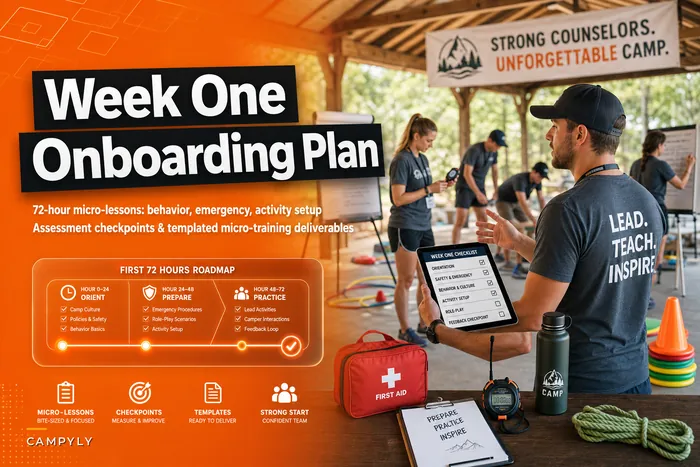
June is intentionally heavy — that's when the counselor wave lands. If you've already built a tight first-week process, this layers directly onto it. The counselor onboarding plan for the first 72 hours is the natural place to slot the June core safeguarding module so it's captured as part of structured onboarding rather than bolted on later.
Short assessment rubrics that actually mean something
A sign-in sheet proves attendance. It does not prove competency. Accreditors increasingly want evidence that staff can apply what they learned, not just that they sat in the room. That's where short rubrics earn their keep.
Keep them small. A good safeguarding micro-assessment is three to five items, scenario-based, scored pass/needs-review. The goal isn't a sophisticated exam — it's a defensible record that someone demonstrated understanding.
A workable rubric for a "recognizing and reporting" module:
-
Scenario item "A camper tells you something concerning about a situation at home. What are your first three actions?" — Pass requires: do not promise confidentiality, document factually, report up the chain same day.
-
Boundary item Given four interaction examples, flag which violate the two-adult rule. — Pass requires 4/4 correct.
-
Reporting item Name who you report to and the timeframe. — Pass requires correct person + correct timeframe.
The scoring key is the rubric. Store it alongside results so an auditor can see not just that someone scored 4/5, but what "passing" actually required. That connection — score plus criteria plus the policy version taught — is what turns a quiz result into real audit evidence.
Make rubrics 3–5 items with an explicit remediation path so a single failed item doesn't become an unresolved audit finding.
One mistake worth flagging: don't make rubrics so hard that half your staff fail and you have no documented remediation. A failed assessment with no follow-up is worse than no assessment at all, because now you've documented that someone didn't understand the material and did nothing about it. Build a simple remediation note into the rubric from the start: failed → re-trained on [date] → re-assessed → passed.
Automated evidence capture: stop assembling proof by hand
The single biggest time sink in a safeguarding audit is reconstruction. The training happened — the evidence just isn't in one place or one format. Evidence capture should happen at the moment of training, not when the audit letter arrives.
-
Who — a roster tied to actual staff IDs, not a handwritten list where "J. Smith" could be either of two people.
-
What — the exact module name and the policy version taught.
-
When — a timestamp that can't be backdated.
-
Proof of participation — a signature or acknowledgment, plus the assessment result.
-
The materials themselves — the deck or recording version used that day.
The practical move is to template this so every module produces the same five things in the same structure. When the format is identical across all twelve months, assembling a year-end package becomes a filtering exercise, not an archaeology project.
A realistic workflow shift looks like this:
-
Instead of a paper sign-in, staff confirm attendance on a shared device or their phone, which stamps the time and their verified identity.
-
The assessment runs right after, results scored against the stored rubric automatically.
-
The policy version is attached by reference, not copied — so you always know exactly which document each person saw.
-
Everything drops into one record per person per module.
This is the same discipline that makes incident records hold up under scrutiny. If you've already built an auditable incident-management system, apply the same evidence-structure thinking here: timestamped, attributed, version-stamped, and immutable after the fact. Training records and incident records are the two things regulators most want to cross-check, and they're far more useful when they share a consistent format.
AI-powered operational software can help close this gap — not by replacing your training process, but by handling the evidence layer automatically. When staff complete a module, the system captures attendance, scores the assessment, and attaches the correct policy version to the record without anyone needing to remember to do it manually. That consistency is exactly what makes the year-end audit package feel effortless instead of like a reconstruction project.
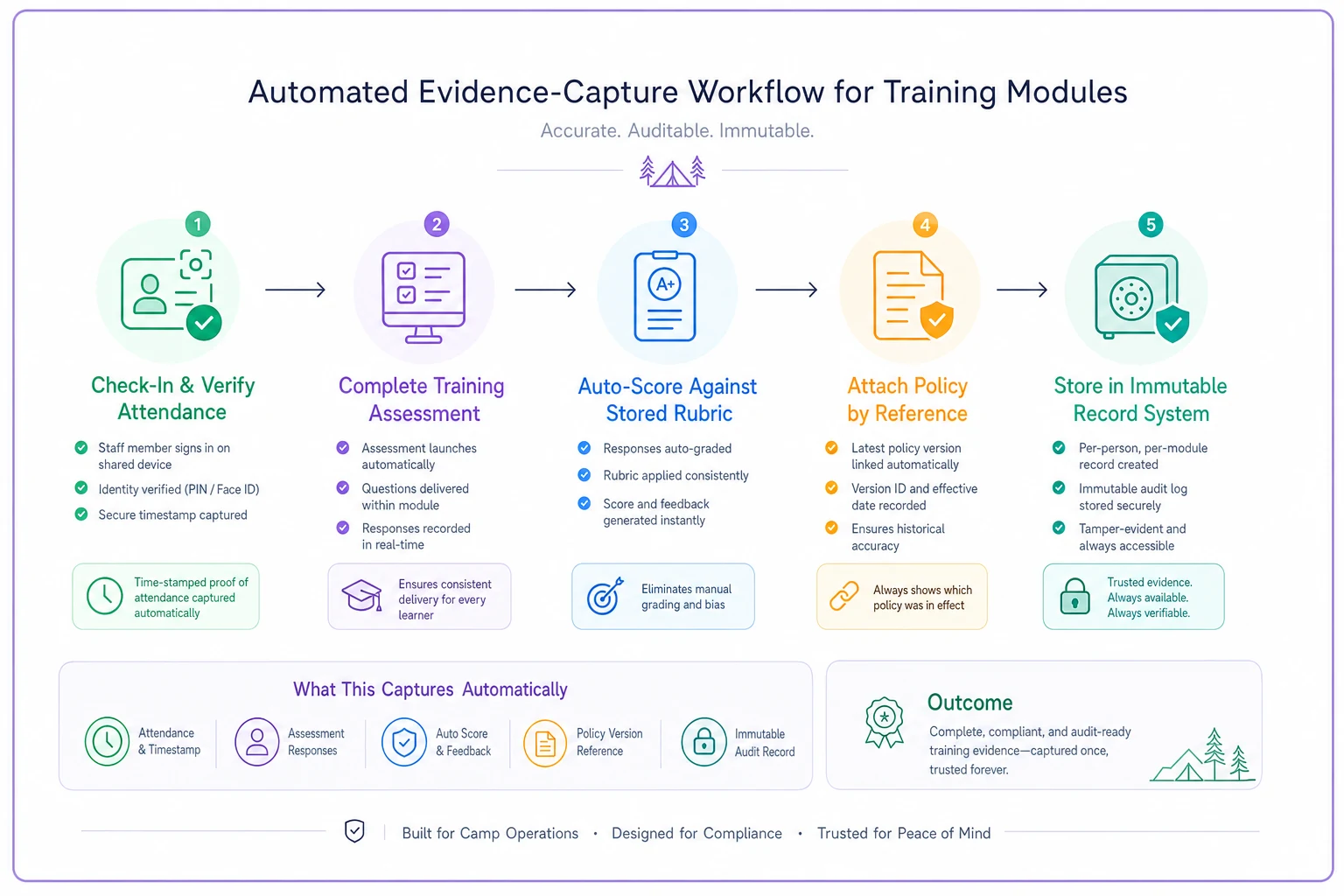
This workflow shows how attendance, assessment, and policy versioning flow into a single immutable record per person per module.
Attendance records designed for the person reviewing them
A subtle point most camps miss: attendance records should be built for the auditor, not for internal convenience.
An internal attendance log says "June safeguarding — 28 attendees." An audit-ready one lets a reviewer answer, in under a minute: Did every active staff member complete the required modules for their role, on the current policy version, with a passing assessment, before their first contact with campers?
-
Role-based requirements. A kitchen staffer and a cabin counselor don't need identical modules. The record should show required-vs-completed per role, so gaps are obvious.
-
"Before first camper contact" flag. For new staff, the critical compliance question is often sequencing — was training completed before they supervised children? A timestamp relative to their start date answers this.
-
Current-version check. A completion on last year's policy should visibly flag as expired, not silently count as current.
-
Gap report on demand. The record should surface who is missing what, not just list who showed up.
The camps that sail through audits aren't the ones with the most training — they're the ones who can produce a one-page gap report showing role-required module completion, with exceptions clearly documented and remediated.
The one-page compliance artifact
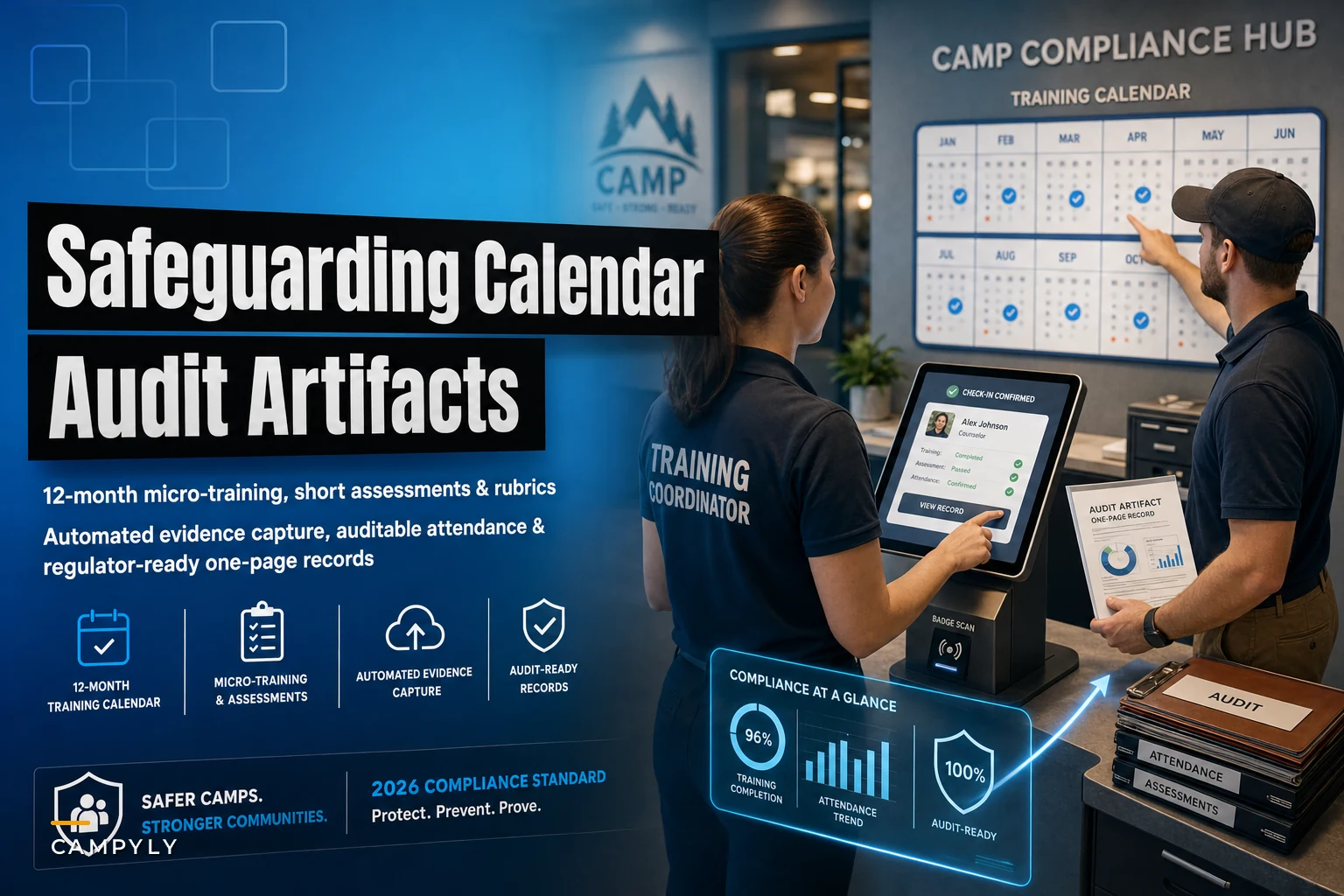
At the end of the cycle, you want a single page per staff member — and a single rollup for the whole organization — that a regulator can read without asking follow-up questions. Overloaded multi-tab spreadsheets actually hurt you here. They signal disorganization and invite more digging.
-
Name, role, start date, status
-
Each required module, with completion date, policy version, and assessment result
-
Any failures and documented remediation
-
A single completion status
Compliant / Gap / Expired
The organizational rollup is just the aggregate: total staff, percent fully compliant by role, open gaps, and a remediation timeline for anything outstanding. One page. That document is what you hand over, and it's what buys you credibility for everything else in the review.
A real scenario
A mid-sized overnight camp — roughly 60 seasonal staff plus about a dozen year-round — had always done safeguarding in a single orientation block. Their last accreditation review flagged them not for lack of training but for "insufficient documentation of individual completion and competency." Reassembling evidence after that review took their assistant director close to two full weeks, pulling from paper sheets, email threads, and a couple of counselors' memories.
They switched to the 12-month micro-module approach the following year. Total training time actually dropped a bit, because content stopped being repeated redundantly across sessions. The bigger change was at audit time: the year-end package went from a two-week reconstruction to generating a per-staff one-pager and an org rollup in an afternoon. Completion sat around 97% going into the review, with the remaining handful flagged and remediated on a documented timeline — which the reviewer explicitly noted as acceptable because the gap was visible and managed rather than hidden.
The outcome wasn't dramatic. It was quieter: a clean review, no corrective action plan, and an assistant director who got two weeks of her shoulder season back.
When this makes sense — and when it doesn't
Worth building if:
-
You're accredited or licensed and face recurring documentation requirements.
-
Staff arrive in multiple waves across the year.
-
You have returning staff who need refreshers, not full retraining.
-
Your last audit involved any scramble to produce records.
Probably overkill if:
-
You run a single short program with under a dozen staff who all start the same day — a single well-documented session may genuinely be enough.
-
You're not subject to any external review and have no insurer or parent-facing documentation obligations (rare, but it happens for very small informal programs).
Who should not simply copy this calendar: anyone whose accrediting body prescribes specific modules, frequencies, or assessment standards. Start from their requirements and map these mechanics onto them. The 12-month skeleton above is a structure, not a substitute for your jurisdiction's rules.
Getting started without boiling the ocean
You don't need to build the whole year at once. Sequence it:
-
List every role and the modules each role legally or by accreditation standard requires.
-
Pick your single standard evidence format — the five fields every module must capture.
-
Build the one-page per-person artifact template first, then work backward. Knowing what the final page must show tells you exactly what each module needs to capture.
-
Convert your existing content into 15–25 minute chunks; don't rewrite, just split.
-
Attach a 3–5 item rubric to each chunk with an explicit pass line and a remediation path.
-
Run one full cycle, then tighten based on where evidence was actually hard to produce.
The whole point is that proof becomes a byproduct of doing the training correctly, not a separate project you dread every spring. Safeguarding is the one area where "we definitely did it" is not good enough — the record has to speak for itself when you're not in the room to explain it.
The whole point is that proof becomes a byproduct of doing the training correctly, not a separate project you dread every spring. Safeguarding is the one area where "we definitely did it" is not good enough — the record has to speak for itself when you're not in the room to explain it.
Ready to elevate your camp management?
Join 500+ camps using Campyly to save administrative time, enhance camper experiences, and streamline daily operations.