

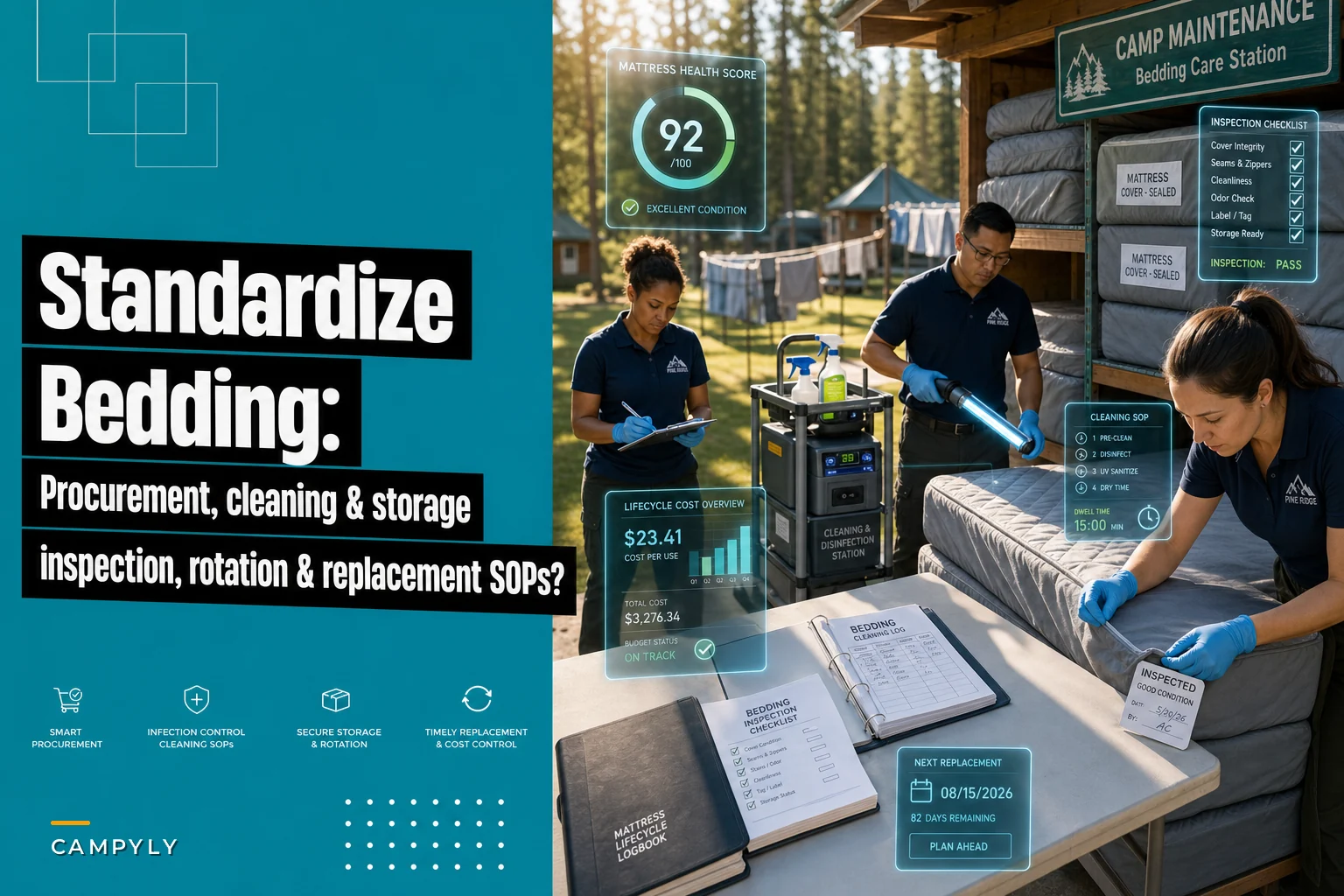

Most camps treat mattresses as a "buy once, forget for a decade" purchase. Then week three of a busy season hits, a camper's parent finds a suspicious bite pattern, and suddenly a $90 foam mattress becomes a $12,000 problem involving a pest company, three closed cabins, and a very unhappy board.
The bedding side of camp operations gets almost no attention until something goes wrong. And when it goes wrong, it goes wrong publicly. This playbook is built around the decisions that actually matter: what specs to demand before you buy, what to put in the vendor contract, how to clean and store between sessions, and how to budget replacement so you're never stuck buying 60 mattresses in a panic in May.
I'll keep this vendor-neutral. No product recommendations, no brand comparisons. The goal is a system you can hand to a facilities lead and have them run without you.
Start With Specs, Not Price
The single most expensive mistake in camp bedding procurement is comparing mattresses on price per unit without a spec sheet. A $75 mattress and a $140 mattress can look identical in a photo and behave completely differently after 400 camper-nights and eight sanitizing wipe-downs.
Camp mattresses live a brutal life. They get flipped, dragged, sat on by counselors, soaked by the occasional accident, and wiped down with disinfectant that would destroy a consumer mattress cover in a season. Consumer sleep specs are irrelevant here. What matters is the cover, the fill, and how the thing responds to repeated cleaning.
Here's the baseline spec sheet to require from any vendor before you even discuss quantity:
| Spec | What to Require | Why It Matters for Camps |
|---|---|---|
| Cover material | 100% waterproof, wipeable (vinyl, PVC, or coated polyester) with welded/RF-sealed seams | Sewn seams wick liquid into the fill; welded seams keep fluids out during accidents and sanitizing |
| Fluid resistance | Fully sealed, not just "water-resistant" | Water-resistant covers fail after repeated disinfectant exposure |
| Fill density | Foam density spec'd in writing (lbs/ft³), typically 1.8+ for durability | Low-density foam compresses and dips within one to two seasons |
| Fire compliance | Meets CFR 1633 (open flame) and 1632 | Non-negotiable for institutional/dormitory use; ask for the certificate |
| Chemical resistance | Cover rated for hospital-grade disinfectants (quats, bleach dilutions) | Some vinyls crack when hit with bleach repeatedly |
| Antimicrobial treatment | Nice-to-have, not a substitute for cleaning | Marketing often oversells this; treat it as a bonus |
| Weight & size | Confirm dimensions and weight per unit | Heavy mattresses slow down teardown and storage |
The line that catches most camps off guard is seam construction. A waterproof cover with sewn seams isn't actually waterproof where it matters. Ask the vendor directly: are the seams welded, RF-sealed, or sewn? If they don't know, that tells you something about the product.
Also demand a written fill density number. "High-quality foam" means nothing. A 1.8 lb/ft³ foam and a 1.2 lb/ft³ foam feel the same in a showroom and behave completely differently by August. The cheaper foam develops body-impression dips that never recover, and dipped mattresses hold moisture in the low spots — which is exactly where mold and odor start.
The Contract Terms That Actually Protect You
Once specs are locked, the contract is where camps lose money quietly. A typical situation: a camp orders 80 mattresses, 14 arrive with cover defects, and the vendor "offers to replace them next season." Now you're running the summer short because there was no defect clause and no delivery-window penalty.
Simplify camp operations with centralized control.
Campyly empowers you to manage registrations, staff, and activities seamlessly—all from one platform.
- Integrated camper and staff management
- Automated notifications and alerts
- Dynamic scheduling and resource allocation
No credit card required
-
Delivery window with a penalty clause. "Delivered by June 1" means nothing without a consequence. Spell out a per-day credit or the right to source elsewhere at their cost if they miss.
-
Defect inspection window. Require a 30-day window from delivery to report defects, with vendor-paid replacement and return shipping. Camps often unbox in May and don't find defects until they're setting up cabins.
-
Warranty specifics in plain terms. Not "10-year warranty." Ask: does it cover cover cracking? Foam sag beyond a stated depth (e.g., 1.5")? What voids it — and does institutional cleaning void it? Get that in writing.
-
Consistent spec across reorders. Vendors quietly change foam suppliers. Add a clause that reorders must match the original density and cover spec, or you're notified in advance.
-
Volume-tiered replacement pricing. Lock next-season replacement pricing when you place the bulk order. This protects your budget from surprise increases.
> Vendor guarantees delivery of all units no later than [date]. For each business day of delay, Vendor issues a credit of [$X per unit per day]. Buyer may inspect and report cover or fill defects within 30 calendar days of delivery; Vendor replaces defective units at no cost including freight within 14 days. All reorders placed within 24 months shall match the original foam density ([X lb/ft³]) and cover specification, or Buyer will be notified in writing prior to fulfillment.
The delivery penalty is the term camps skip most and regret most. When your season start date is fixed and immovable, a late mattress shipment isn't an inconvenience — it's campers sleeping on the floor. The same discipline you'd apply in a seasonal program portfolio and pricing playbook belongs in your procurement contracts too.
Infection-Control Cleaning SOPs (Between Campers and Between Sessions)
There are two cleaning tiers, and camps constantly confuse them: turnover cleaning (between individual campers or after accidents) and deep session cleaning (between full sessions). Treating a session turnover like a quick wipe-down is how odor and contamination accumulate.
A simple workflow for the two-tier cleaning process:
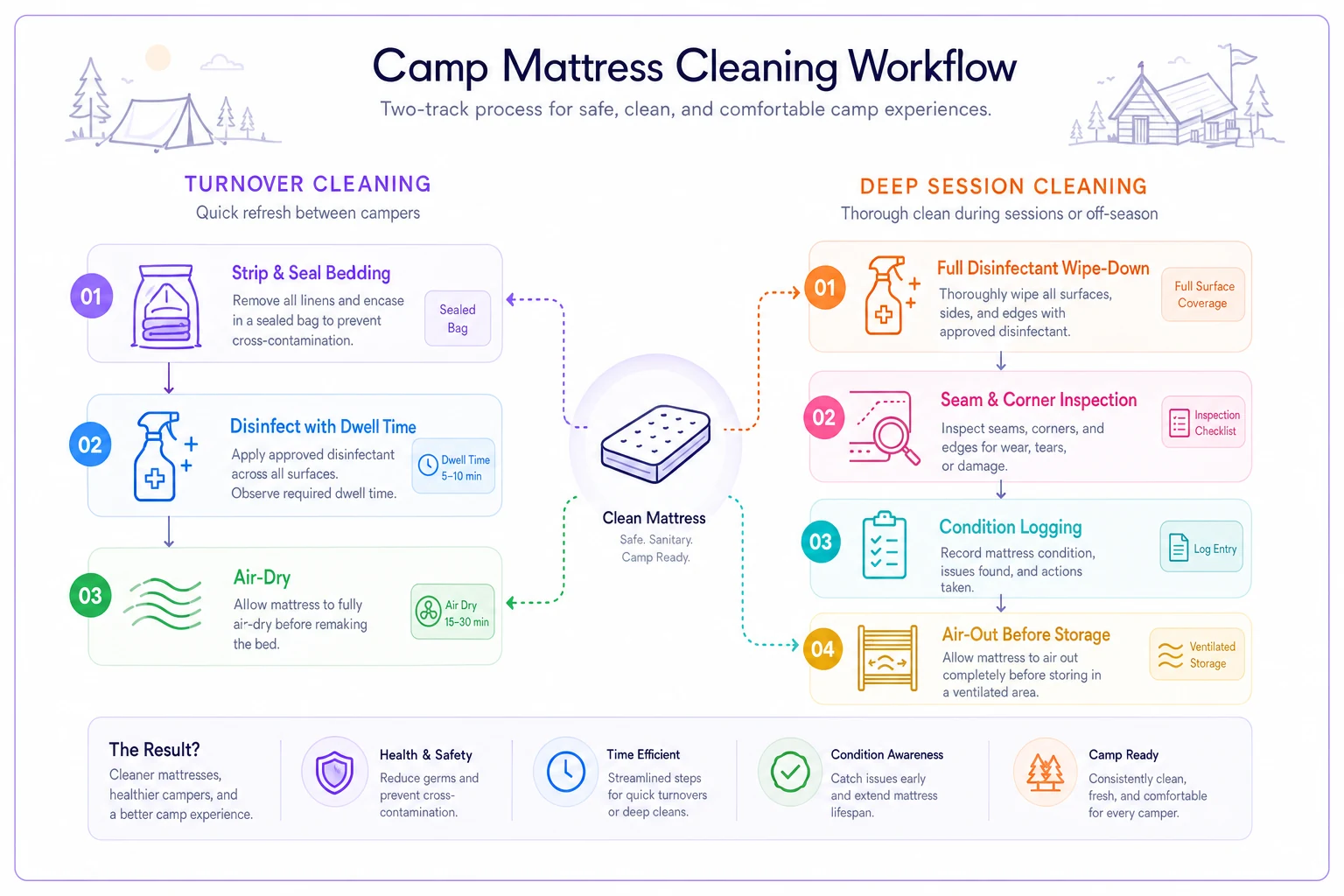
Turnover cleaning — between campers or after an incident:
-
Strip all bedding into a sealed laundry bag (not an open cart — more on this in the bed-bug section)
-
Wipe the entire mattress surface, sides, and underside seams with an EPA-registered disinfectant rated for your cover material
-
Respect the dwell time. This is the mistake that undoes everything. Most disinfectants need 3–10 minutes of wet contact to actually work. A staffer who sprays and immediately wipes dry has sanitized nothing.
-
Let the mattress fully air-dry before re-dressing. Re-dressing a damp mattress traps moisture under the fitted sheet.
Deep session cleaning — between full sessions:
-
Full disinfectant wipe-down top, bottom, and all four sides
-
Inspect every seam and corner for cracks, tears, or moisture staining
-
Log the mattress condition (see storage/inspection section)
-
Air out in a dry, ventilated space for a set period before storage or re-dressing
A quick note on chemicals: your disinfectant has to be compatible with your cover. This is why the procurement spec and the cleaning SOP are linked. Camps that buy the cheapest bulk disinfectant and the cheapest mattress often discover mid-season that one is destroying the other — cracked, peeling covers by July, which then let fluid into the foam.
The dwell-time failure is worth repeating because it's the most common invisible mistake. Your cabins can look spotless and your mattresses can still be contaminated if staff aren't leaving the disinfectant wet for the required time. Build the dwell time into the SOP as an explicit step with a timer, not a vague "wipe down thoroughly."
Bedding Laundering Schedule
Mattress covers get wiped; bedding gets laundered. If your camp provides linens, blankets, or pillows, here's a defensible schedule.
-
Sheets & pillowcases Laundered between every camper. No exceptions, no "it looks clean."
-
Blankets Between every camper if provided per-bed; if campers bring their own, this is on the family (state it clearly in your packing communications).
-
Pillows (camp-provided) Waterproof-encased pillows wiped between campers; pillow protectors laundered between campers; the pillow itself washed between sessions or replaced on a set cycle.
-
Mattress protectors (if used over the cover) Laundered between every camper.
Wash temperature matters more than most people think. To handle both sanitation and any early bed-bug risk, wash on the hottest cycle the fabric tolerates and dry on high heat. Heat is what actually kills bed bugs and dust mites — a warm wash and a low-heat dry does not.
Two operational patterns worth flagging:
-
Color-code or bag by cabin. Mixing laundry from all cabins into one pile removes any ability to trace a problem back to a source. If a cabin later shows an issue, you want to know which linens went where.
-
Separate clean and dirty flow physically. Clean laundry that shares a cart or a table with incoming dirty laundry is not clean laundry anymore. This sounds obvious and gets violated constantly during a rushed Saturday turnover.
Separate clean and dirty flow physically. Clean laundry that shares a cart or a table with incoming dirty laundry is not clean laundry anymore. This sounds obvious and gets violated constantly during a rushed Saturday turnover.
Inspection and Storage Between Seasons
Storage is where mattress lifespan is won or lost. A good mattress stored badly is a ruined mattress. In camp facilities generally, the off-season does more damage than the season itself — a mattress sitting in a damp, unventilated shed for nine months is quietly absorbing moisture the whole time.
End-of-season inspection checklist — tag every mattress:
-
[ ] Cover intact — no cracks, tears, peeling, or exposed foam
-
[ ] Seams sealed — no separation or wicking stains
-
[ ] No permanent body-impression dips beyond your threshold (e.g., 1.5")
-
[ ] No moisture staining or odor
-
[ ] No mold or mildew spotting
-
[ ] Fully dry before storage
-
[ ] Condition logged with mattress ID and date
-
[ ] Flagged for repair, retire, or return-to-service
Tag each mattress with an ID — a simple numbered label works — and log its condition. This turns "we think most of them are fine" into an actual inventory you can budget from. If you already run structured gear tracking, fold mattresses into that same system rather than treating them as invisible fixed assets.
Storage rules that actually extend life:
-
Store flat or on edge, off the floor — never leaning in a slumped bend that creases the foam permanently
-
Off the ground entirely. Pallets or shelving. Floor storage invites moisture and pests.
-
Dry, ventilated space. Moisture is the enemy. Sealed plastic wrap in a humid shed traps condensation — worse than no wrap at all.
-
If you cover them, use breathable covers, not sealed plastic
-
Keep them away from exterior walls that sweat with temperature swings
The sealed-plastic-in-a-humid-shed mistake ruins more mattresses than any camper ever will. People wrap mattresses tightly to "protect" them, trap warm moist air inside, and open a moldy mess in May. Breathable covers and airflow beat sealed plastic every time.
Bed-Bug Prevention (The Section That Pays for Itself)
One bed-bug incident can shut cabins, trigger professional remediation running into thousands of dollars, and — worse — generate the kind of parent phone calls that follow a camp for years. Prevention is cheap. Reaction is not.
The prevention system:
-
Waterproof, wipeable covers with sealed seams (yes, the same spec from procurement — bed bugs hide in seams and folds; smooth sealed covers give them nowhere to live and let you spot them).
-
Inspect at every turnover. Check mattress seams, corners, and the bed frame for small dark spots (fecal marks), shed skins, or live bugs. A flashlight and 30 seconds per bed.
-
Sealed laundry bags, not open carts. Transporting stripped bedding in an open cart across camp is how bugs spread from one cabin to twenty. Bag at the bed, transport sealed, wash on high heat.
-
High-heat drying is your kill step. Heat kills all life stages. This is why the laundry schedule specifies high heat, not just clean.
-
Have a response plan before you need it. Which pest vendor, what the isolation procedure is, how you communicate to affected families. Deciding this during an active infestation is chaos.
The single highest-leverage habit is the turnover inspection. Bed bugs are catchable early. One bug found at a Saturday turnover is a contained problem. The same bug found three weeks later after it's spread through a cabin is a closed-cabin, refund-issuing, pest-company emergency. Thirty seconds per bed at turnover is the cheapest insurance in your whole operation.
Rotation and Replacement Budgeting
Mattresses don't fail all at once, and that's exactly why camps get surprised. They degrade gradually, then a cluster fails the same summer, and you're buying 40 units unplanned in the spring at whatever price the vendor names.
Rotation slows this down. Flip and rotate mattresses on a set schedule so wear distributes evenly instead of concentrating in the spots that get used hardest — bottom bunks, high-traffic cabins. Rotate head-to-foot at each session turnover and track which mattresses have carried the heaviest load.
Replacement budgeting is where the tagging system from your inspection pays off. Instead of a surprise, you have a projected replacement schedule.
A simple way to build it: assume a realistic service life for your mattress grade — often somewhere around 5–8 years for a solid institutional mattress in camp conditions, less if you bought thin low-density foam. Then divide your fleet across that lifespan so you're replacing a portion every year rather than the whole set at once.
A realistic example:
A camp with 120 mattresses at roughly $110 each has about $13,200 tied up in bedding assets. If they buy cheap and the fleet dies in 3–4 years, they're facing something like a $3,300–$4,400 replacement cost every single year, often bunched into bad years. Spec'd up to durable mattresses lasting 6–7 years, that annual replacement drops to roughly $1,900–$2,200 and — this is the part that matters — it becomes predictable. They replace around 18–20 mattresses a year on a rolling schedule instead of getting hit with a full-fleet replacement in a single panicked spring.
The math almost always favors buying up on spec and budgeting a rolling annual replacement line. The cheap mattress isn't cheap once you count the shorter lifespan, the higher failure rate, and the emergency purchases at non-negotiated prices.
Put a fixed annual bedding replacement line in your budget based on your inspection tags. Tag the mattresses flagged "retire," add the ones aging past your service-life threshold, and you have next year's order before the season even ends.
Staff Micro-Training Outlines
None of this works if it lives in a binder nobody reads. The camps that execute cleanly break it into short, specific micro-trainings — the same approach that works for counselor onboarding in the first 72 hours. Three short modules cover the whole system:
Module 1 — Turnover cleaning (10 minutes):
-
How to strip and bag bedding (sealed bag at the bed)
-
Disinfectant, dwell time, and the timer rule
-
Air-dry before re-dressing
-
Common failure
spraying and wiping immediately
Module 2 — Inspection (10 minutes):
-
The 30-second bed-bug check at every turnover
-
What fecal spots, shed skins, and live bugs look like
-
Who to report to immediately and how to isolate
-
End-of-session mattress condition logging
Module 3 — Storage and teardown (10 minutes):
-
Final cleaning and full dry-down
-
Flat or on-edge, off the floor, breathable cover
-
No sealed plastic in humid storage
-
Logging condition tags for the replacement budget
Keep each module to one page. Demonstrate once, watch each staffer do it once, done. The dwell-time rule and the sealed-bag rule are the two habits worth over-training — those are the two that fail silently and cause the most downstream damage.
When to Fix, When to Retire
A quick decision guide, because camps hold onto dying mattresses far too long:
-
Repair/keep Minor cover scuff with no foam exposure, no dips, no odor, no moisture. Cosmetic only.
-
Retire immediately Any cover crack or tear exposing foam (fluid gets in, it's now unsanitizable), any mold or persistent odor, any permanent dip past your threshold, any confirmed pest activity in the foam.
-
Borderline — flag and watch Early body impressions, minor seam stress. Rotate it to a lower-use cabin and re-inspect next turnover.
The rule of thumb: once fluid can reach the foam, the mattress is done. You cannot reliably sanitize the inside of a mattress. A cracked cover isn't a cosmetic issue — it's a retirement trigger.
Bottom Line for Directors
Camp bedding and mattresses fail on a predictable timeline, in predictable ways, for predictable reasons — bad specs, no contract protection, skipped dwell times, sealed-plastic storage, and no rotation. Every one of those is a system problem you can fix before the season, not a crisis you manage during it.
Build the spec sheet, put the delivery penalty and defect window in the contract, run the two-tier cleaning SOP with real dwell times, laundry on high heat in sealed bags, breathable off-floor storage, a 30-second turnover inspection, and a rolling annual replacement line funded off your inspection tags. Hand the three micro-trainings to your facilities lead and it runs without you. Do that, and the mattress that used to be a $12,000 mid-season surprise becomes a $2,000 line item you planned for in October.
Ready to elevate your camp management?
Join 500+ camps using Campyly to save administrative time, enhance camper experiences, and streamline daily operations.