

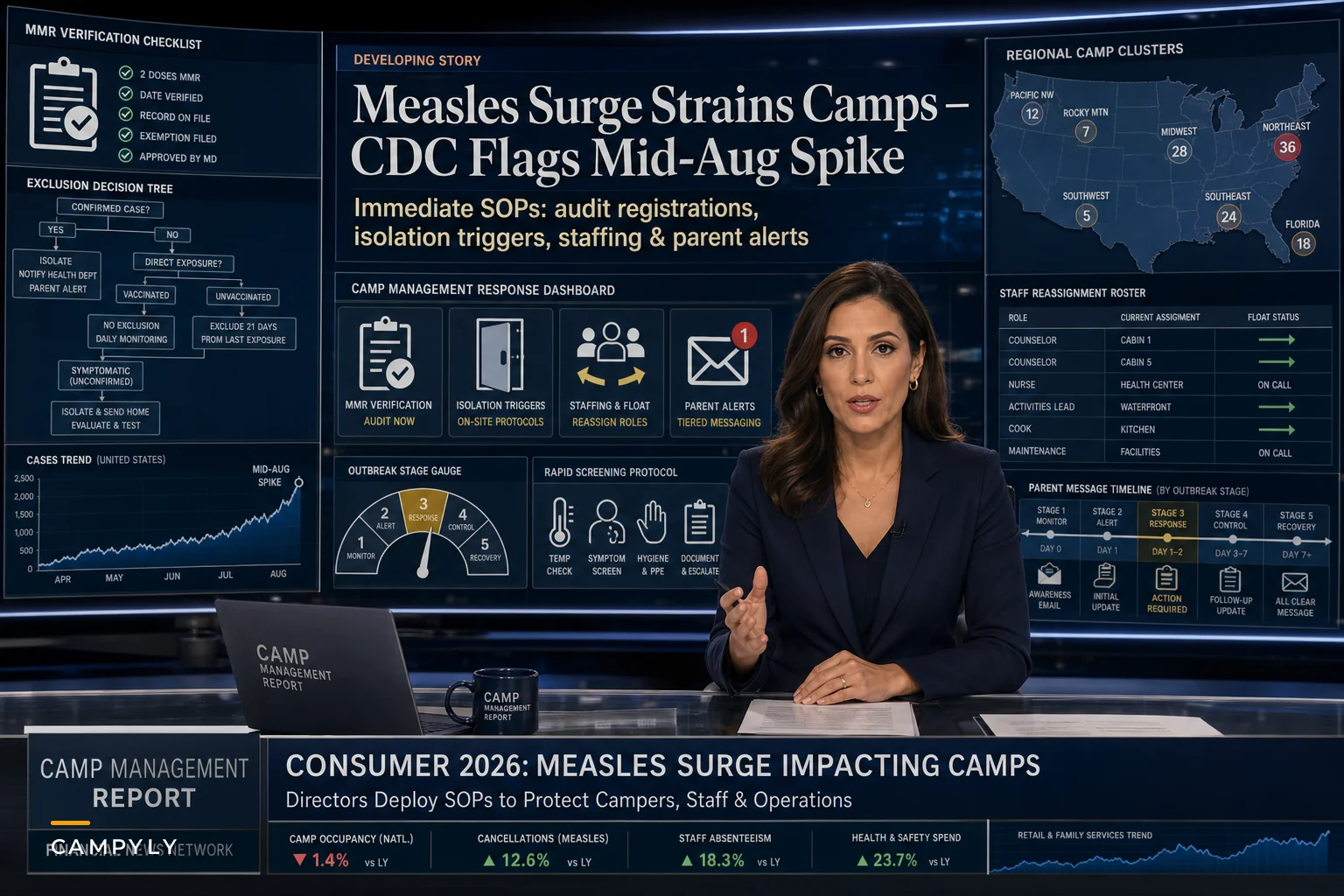

The timing on this one is bad. According to a recent CDC update, U.S. measles cases climbed to 2,566 in 2026 — the highest total in 35 years — and the increase is landing right in the middle of summer camp season. A CIDRAP analysis noted that roughly two-thirds of cases involve school-aged kids between 5 and 19, which is pretty much the exact age band most day and overnight camps are built around.
So this isn't an abstract public-health headline for camp directors. It's an operational problem that can show up as a single exposed camper on a Tuesday and turn into a cohort-wide exclusion decision by Thursday. The camps that handle it well won't necessarily be the ones with the strongest opinions about vaccines — they'll be the ones whose intake data, exclusion logic, and parent messaging were already wired together before the first case showed up.
That's what this post is about. Not the science, not the politics. Just the workflows you can actually tighten this week.
Start with the gap most camps don't know they have
Most camps think they collect immunization records. What they actually collect is a PDF a parent uploaded in March that nobody's looked at since, sitting in a folder that isn't searchable by vaccine, by date, or by camper cohort.
That distinction matters a lot when a health department calls and asks: "Can you give us a list of every unvaccinated or under-vaccinated camper in the same group as your confirmed case — within two hours?"
If the answer lives inside 400 individual PDFs, you're going to spend your afternoon opening files instead of managing the actual situation. This is the single biggest failure point in real operations — not the exclusion decision itself, but the inability to query who's affected fast enough to act on it.
So before anything else, run this test: pull up your registration system right now and try to generate a list of campers by MMR status. If you can't do it in under five minutes, that's your first project, not your parent letter.
The registration intake fields you actually need
Camp intake forms tend to accumulate questions over the years — someone adds a field after an incident and it just stays forever. For measles specifically, you don't need more fields, you need the right structured ones. A scanned immunization form is an image, not data.
Simplify camp operations with centralized control.
Campyly empowers you to manage registrations, staff, and activities seamlessly—all from one platform.
- Integrated camper and staff management
- Automated notifications and alerts
- Dynamic scheduling and resource allocation
No credit card required
At minimum, your intake should capture these as discrete, filterable fields:
-
MMR dose 1 date
-
MMR dose 2 date
-
Exemption status (medical / non-medical), if applicable in your state
-
Date the record was verified by staff — not just uploaded
-
Name or initials of the staff member who verified it
-
Recent travel to an area with active outbreak (yes/no + region)
That last one gets skipped constantly. Exposure risk isn't only about vaccination status — a fully vaccinated kid returning from a region with active spread is still worth flagging for a few days of extra attention.
The "verified by" and "verified date" fields are the ones that save you later. There's a real difference between "a parent uploaded something" and "a staff member confirmed two valid MMR doses on this date." When you're reconstructing decisions after the fact, that distinction matters more than people expect.
A scanned immunization form is an image, not data.
When you're reconstructing decisions after the fact, that distinction matters more than people expect.
Build the exclusion decision tree before you need it
The worst time to figure out your exclusion policy is 7:40 a.m. with a line of cars and a coordinator texting you that a camper's sibling was just diagnosed. You want this decided in advance, written down, and genuinely boring to execute.
An exclusion workflow generally breaks into three buckets: confirmed case, direct exposure, and symptomatic-but-unconfirmed. They don't get treated the same way, and conflating them is where camps either overreact — excluding half the camp unnecessarily — or underreact and let an exposed kid stay in rotation.
| Situation | Immediate action | Who to notify | Return condition |
|---|---|---|---|
| Confirmed case at camp | Isolate, send home same day, notify health dept | Health dept, parents of cohort, staff | Per health dept clearance |
| Direct exposure, vaccinated | Monitor for symptoms, allow attendance | Parents of that camper | No exclusion unless symptomatic |
| Direct exposure, unvaccinated/exempt | Exclude per local guidance (often ~21 days) | Health dept, parents | Per exclusion window / clearance |
| Symptomatic, unconfirmed | Isolate, send home, recommend evaluation | Parents | Medical note / symptom resolution |
The exact exclusion windows depend on your local health department — don't hardcode a number from a blog post, including this one. The point of the table isn't the specific days. It's that every scenario has a predetermined action so nobody's improvising under pressure.
One thing camps consistently miss: exclusion decisions ripple into staffing. If you exclude a cohort, you may also be excluding or reassigning the counselors who worked directly with them. Your exclusion tree and your staff coverage plan are effectively the same document.
Here's a quick visual of that decision tree.
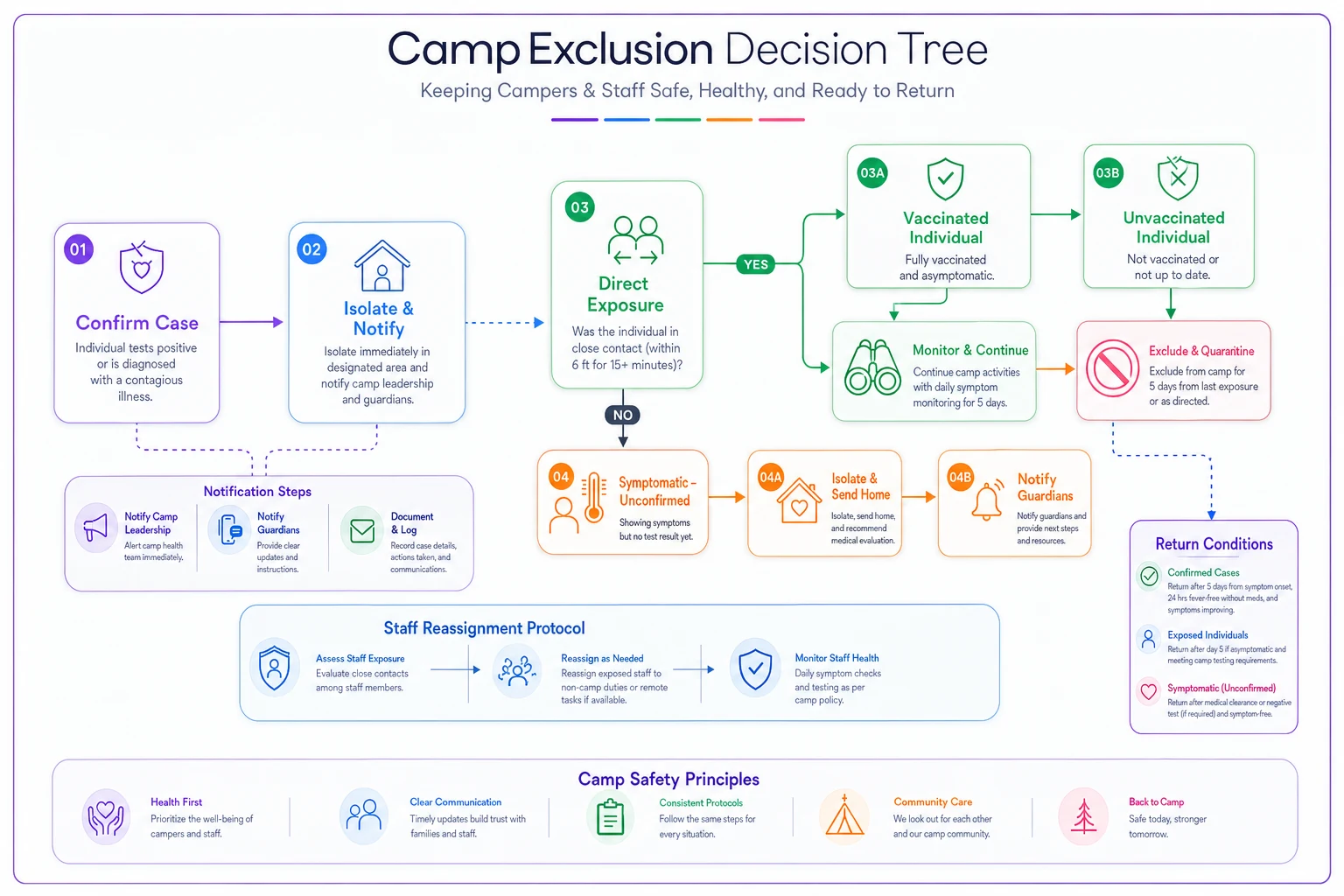
Use the decision tree to align staff actions and staffing contingencies so execution is boring, fast, and consistent.
Screening and isolation: the on-site workflow
Screening for measles is trickier than a temperature check because early symptoms look like a common cold, and the rash shows up days later. You're not going to catch every case at drop-off. What you can do is build a workflow that catches the obvious ones and isolates fast when something looks off.
A simple day-of flow that works without grinding your morning to a halt:
-
Drop-off flag check — Any camper flagged for recent exposure or travel gets a quick verbal check-in: "any fever, rash, or red eyes since yesterday?"
-
Counselor mid-day awareness — Counselors know the three-symptom combo to watch for (fever + rash + cough/runny nose/red eyes) and exactly where to send a kid who shows it.
-
Designated isolation space — Not a hallway. A specific room, away from the group, with a staff member assigned and a mask if age-appropriate.
-
Parent contact and pickup — Same-day pickup for anyone symptomatic, with a scripted message so staff aren't inventing words on the spot.
-
Log the event — Time, symptoms observed, action taken, who was contacted. This feeds directly into your incident record if it becomes a real case.
Don't treat isolation space as an afterthought. Camps in shared facilities — churches, schools, rec centers — often have nowhere appropriate to isolate a kid and only discover this when they actually need it. Walk your site this week and physically pick the room.
Coordinating with your local health department early
This is the least glamorous item on the list and probably the highest-leverage one. Camps that already have a named contact at their county health department move significantly faster when something happens.
Call before you have a case. Ask three things:
-
Who do we report a suspected case to, and how quickly?
-
What's your current guidance on exclusion windows for exposed unvaccinated kids?
-
Do you want line lists in a particular format?
That last question sounds minor but it's the whole game. If the health department wants a specific spreadsheet layout — camper name, DOB, MMR dates, cohort, last day present — and your system can export exactly that, you've turned a multi-hour scramble into a two-minute task. Set up that export template now, while nothing's on fire.
Staff coverage when workers get exposed too
Everyone plans for camper exclusion and forgets that counselors get excluded on the same terms. An unvaccinated staff member with direct exposure could be out for weeks depending on local guidance, and these tend to be your youngest, most seasonal workers.
A few things that actually hold up under pressure:
-
Know your staff MMR status in advance, tracked the same way you track campers — same fields, same verification process.
-
Fold exposure into your existing absence contingency, not a separate plan. A measles exclusion is functionally a multi-week unplanned absence, and your system for handling those should already apply.
-
Cross-train so no single counselor is load-bearing for anything that requires a certification. If your only lifeguard gets excluded, that's a program-level problem, not a scheduling note.
Camps that struggle most are usually the ones running so lean that any two-person absence collapses a session. Measles exclusion just exposes a fragility that was already there.
Parent communication: tiered, calm, and pre-written
This is where most of the actual damage — reputational and financial — happens. Not from the virus. From messaging that's late, vague, or panicked.
The core principle is tiering. You don't send the same message to the whole camp when one cohort had an exposure. Over-broad alerts cause mass withdrawals and phone lines that melt down; under-communication destroys trust when parents hear about it from another parent before they hear it from you.
Three pre-written tiers, ready to fill in and send:
-
Tier 1 — General awareness (no case at camp) "Cases are rising regionally. Here's what we're doing. Please keep symptomatic kids home." Proactive, reassuring, no alarm.
-
Tier 2 — Exposure in a specific cohort Sent to affected families first, then a broader "we want you to hear this from us" note. Specific about what happened and what you're doing.
-
Tier 3 — Confirmed case and exclusions Coordinated with the health department, factual, with clear next steps and a clear statement of who's affected.
Write these now. Get them reviewed. The difference between a message drafted at 8 p.m. during an active situation and one drafted calmly in advance is the difference between "these people have it handled" and "these people are winging it."
For the mechanics of actually delivering these under pressure — sequencing, avoiding contradictory messages, keeping front-line staff on script — the runbook in avoid panic: parent communication for on-site emergencies covers the delivery framework in detail and maps directly onto a measles scenario.
Refunds and exclusions: decide the money question in advance
When you exclude a healthy-but-unvaccinated camper for a 21-day window, that family paid for a week they can't attend. What's your policy?
If you don't have one written down, you'll make it up per-family, which is how you get inconsistency, resentment, and eventually a "but you gave them a refund" argument. Decide the rule before the season:
-
Full credit toward a future session?
-
Prorated refund?
-
No refund, but a held spot?
There's no universally right answer — it depends on your cancellation terms and margins. What matters is that it's written, published, and applied identically to everyone. Consistency is what protects you, both legally and reputationally.
A quick real scenario
A mid-sized day camp — roughly 260 campers across weekly sessions — stored immunization records as uploaded PDFs with no structured MMR field. When a nearby school reported a case, a handful of parents called asking whether their kids were grouped with unvaccinated campers. The director couldn't answer quickly and spent most of a day opening files by hand.
The following season they moved to structured intake fields — MMR dates, verification status, cohort tags — and pre-wrote the three-tier parent messages. When a genuine exposure scare hit in July, generating the affected line list took a few minutes instead of most of a day, and the Tier 2 message went out the same morning. Withdrawals stayed in the low single digits instead of the wave they'd braced for. Nothing dramatic — just the difference between controlled and chaotic.
Where operational software fits (and where it doesn't)
None of this requires fancy software. A disciplined camp with well-maintained spreadsheets and pre-written templates can execute most of it. But the friction points — searching records by vaccine status, generating cohort line lists, sending tiered messages quickly, logging isolation events — are exactly where a proper camp management platform actually earns its keep.
The value isn't automation for its own sake. It's that when your intake data is structured, an AI-assisted operational system can surface "here are the 14 campers in Cohort C without documented second doses" in seconds, instead of you reconstructing it under stress. That's the gap between reacting and scrambling.
If you're evaluating tools around this, the test is straightforward: can it store immunization status as queryable data, tag campers by cohort, and let you message a filtered group in a few minutes? If yes, it'll pay for itself the first time you actually need it. If it just stores PDFs, it's not solving the problem you have.
Bottom line
The 2026 surge isn't something camps can control. What you can control is whether your registration data is queryable, your exclusion logic is settled in advance, your isolation space actually exists, and your parent messages are written before you need them. Do those four things this week, and a measles scare becomes a manageable operational event instead of a season-defining crisis. The camps that stay calm aren't lucky — they just did the boring prep before anyone was watching.
Ready to elevate your camp management?
Join 500+ camps using Campyly to save administrative time, enhance camper experiences, and streamline daily operations.