

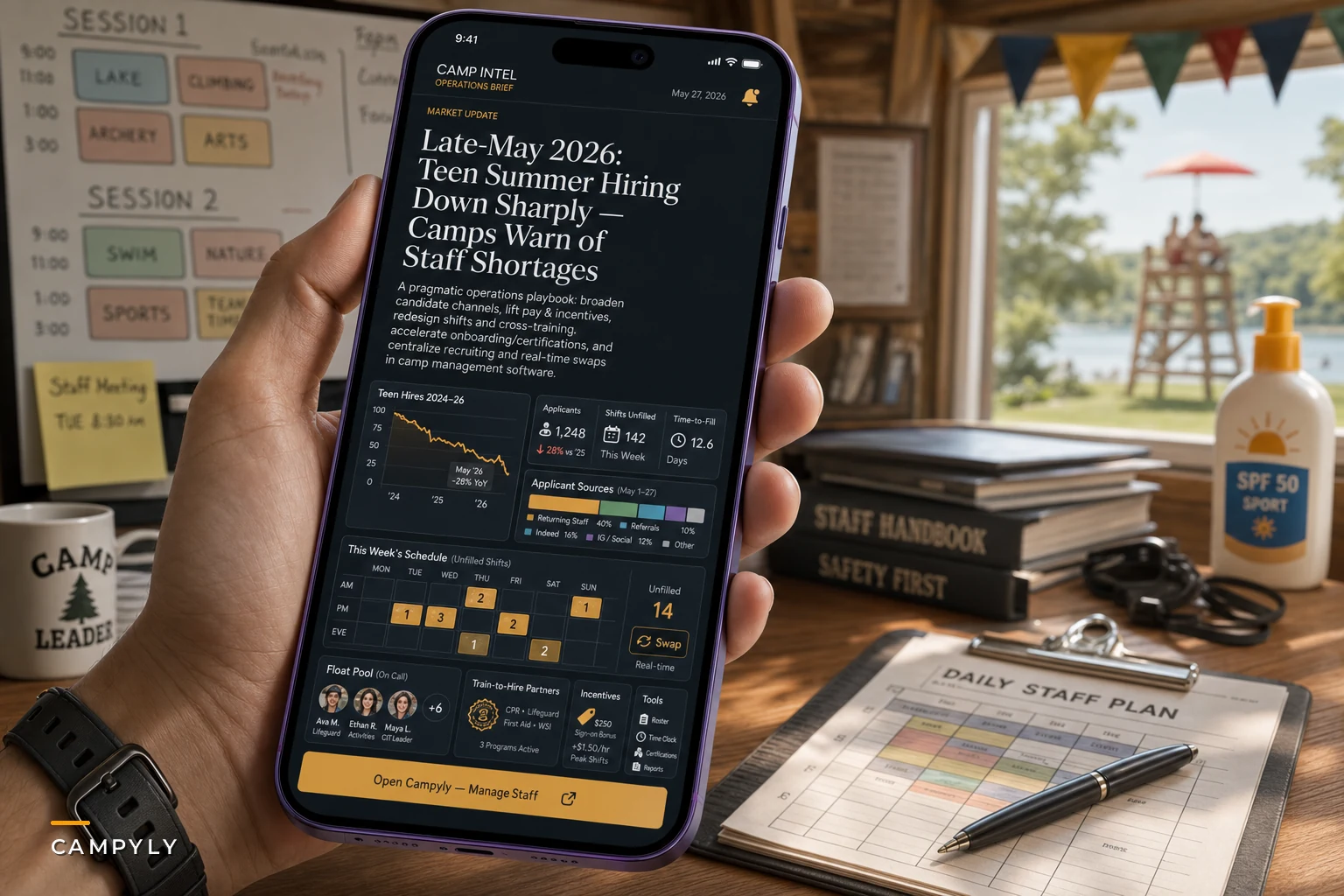

Late May typically marks the final sprint for summer camp staffing—when directors lock in their counselor rosters and finalize training schedules. This year feels different.
USA Today reported that teen summer employment has cratered to near-historic lows for 2026, with projections showing the smallest available pool of 16-to-19-year-old workers in decades. The timing couldn't be worse. Peak camp weeks start in three weeks, parent deposits are non-refundable, and you're staring at a spreadsheet with way too many empty cells.
The numbers paint an ugly picture. Where you might have seen 40 applications for a junior counselor position five years ago, camps are now getting 8-12. Starting wages that used to attract dozens of candidates barely generate interest. A director in upstate New York told me she's offering $18/hour for positions that paid $12 just two summers ago—and still can't fill her lifeguard slots.
This isn't just a wage problem or a temporary blip. The operational structure most camps rely on—hiring waves of teens for 8-10 week commitments—is fundamentally breaking down. And the camps that survive this transition won't be the ones who simply throw more money at the problem.
Why traditional camp staffing models are collapsing
The teen labor shortage exposes something camps have been avoiding for years: an over-dependence on a single demographic for critical operational roles. When your entire staffing model assumes unlimited access to high schoolers and college students willing to work for relatively low wages in exchange for "experience" and "fun," you're building on sand.
Look at the actual workflow breakdown. A typical 200-camper overnight program needs roughly 35-40 staff members during peak weeks. About 25 of those positions have historically been filled by counselors aged 18-22. Another 8-10 spots go to junior counselors or CITs aged 16-18. That means 80-85% of your operational capacity depends on a labor pool that's shrinking by double-digit percentages year over year.
The ripple effects are brutal. When you can't hire enough counselors, you start combining cabin groups. Combine enough groups, and your staff-to-camper ratios push against state regulations. Push too hard, and you're either canceling sessions or operating illegally. Most directors know this math intimately—they just haven't had to confront it at this scale before.
Wage increases alone won't fix this. A camp in Vermont bumped counselor pay from $380/week to $520/week last summer. Applications increased by about 15%, but qualified candidates who actually showed up for training? Almost no change. The kids who would have worked for $380 aren't suddenly available at $520—they're simply not in the market at all.
The hidden costs of understaffing that directors miss
Every unfilled position creates operational debt that compounds throughout the summer. Directors focus on the obvious problem—not enough bodies to maintain ratios—but miss the cascade of secondary failures that actually sink programs.
Simplify camp operations with centralized control.
Campyly empowers you to manage registrations, staff, and activities seamlessly—all from one platform.
- Integrated camper and staff management
- Automated notifications and alerts
- Dynamic scheduling and resource allocation
No credit card required
Take activity scheduling. With full staffing, you run six concurrent activity blocks with specialized instructors. Drop to 80% staffing, and suddenly your archery instructor is also teaching arts and crafts. The quality drops, parents notice, and next summer's enrollment suffers. One bad summer due to understaffing can trigger a three-year decline spiral that kills the camp entirely.
Communication workflows break down even faster. When counselors are stretched thin, the small stuff stops happening. Daily parent updates get skipped. Medication logs get sloppy. Incident reports get filed late or not at all. These aren't just customer service failures—they're liability nightmares waiting to happen.
The scheduling complexity alone can overwhelm camps operating at skeleton crew levels. A fully staffed camp might handle a counselor calling in sick without much drama. At 70% staffing, that same sick day means pulling someone off their day off, which burns them out faster, which leads to more sick days. The math gets exponentially worse as the summer progresses.
Then there's training dilution. When you're desperate for warm bodies, that two-week pre-camp training gets compressed to five days. Background checks get rushed. Reference calls get skipped. You know you're taking risks, but August feels very far away when you're staring at empty bunks in May.
Alternative labor pools most camps haven't considered
The smartest camps I've worked with stopped competing for teens entirely. They're tapping labor pools that traditional camps ignore.
International staff have always been part of the equation through J-1 visa programs, but camps are getting creative with recruitment. Instead of relying on placement agencies that charge $2,000-3,000 per placement, they're building direct relationships with universities in specific countries. A camp in Pennsylvania partnered with a sports science program in Ireland. They get 12-15 counselors every summer who view it as an internship, not just a job. The retention rate? About 70% return the following year.
Early retirees represent another untapped pool. These aren't your typical counselors—they're program directors, facilities managers, and health officers. A recently retired nurse makes an incredible camp health director. A former middle school principal can run your CIT program better than any 22-year-old. The pay expectations are higher, but so is the reliability and expertise.
The real breakthrough is competency-based hiring instead of age-based hiring. Why does your arts and crafts instructor need to be 19? A 35-year-old parent who runs an Etsy shop might be perfect for that role. They're not interested in living at camp for eight weeks, but they'll happily drive in for day shifts if the schedule works around their life.
Parent volunteers can fill gaps if you structure it right. Not as counselors, but in operational support roles. One camp created a "parent corps" that handles things like camp store inventory, photo documentation, and pickup/dropoff logistics. They work in one-week rotations, get a discount on tuition, and solve your coverage problems for non-counselor roles.
Restructuring pay and benefits without destroying your budget
Most camps approach compensation backwards. They set a budget, divide by positions, and hope for the best. But when you're competing against retail and restaurants paying $16-20/hour, your $400/week counselor position looks insulting—even with "free room and board."
What actually moves the needle: tiered compensation based on commitment and competency, not just experience. Create meaningful pay differentials that reward the behaviors you need.
| Role Level | Traditional Pay | Restructured Pay | Key Difference |
|---|---|---|---|
| First-year counselor | $400/week flat | $425/week base + $50/week perfect attendance | Incentivizes reliability |
| Returning counselor | $450/week flat | $475/week + $75 for each specialty cert | Rewards skill development |
| Senior counselor | $500/week flat | $525/week + 10% of session revenue increase | Ties pay to camp success |
| Specialist instructor | $550/week flat | $650/week for 6 weeks (not 8) | Acknowledges market rate |
The certification bonuses work particularly well. Lifeguard certification? Extra $100/week. Wilderness first responder? Another $100/week. Suddenly your counselors are motivated to upskill during the off-season, and you're building a more capable staff.
The six-week contract option can drastically increase college applicant interest.
Benefits matter more than raw dollars for many workers. Offering legitimate professional development—not just "leadership experience"—attracts a different caliber of applicant. Partner with a local community college to offer credits. Provide actual teaching certifications. Make the summer valuable beyond the paycheck.
The six-week contract option has been huge for attracting college students. Instead of demanding eight or ten weeks, offer shorter commitments at higher weekly rates. You'll need to stagger your staffing, but you'll actually fill the positions. Two counselors working six weeks each is infinitely better than zero counselors for twelve weeks.
Smart scheduling tactics that maximize thin coverage
When you can't hire more people, you need to get surgical about scheduling. This isn't about making counselors work more hours—that path leads to burnout and mid-summer walkouts. It's about restructuring how you deliver the camp experience with fewer staff.
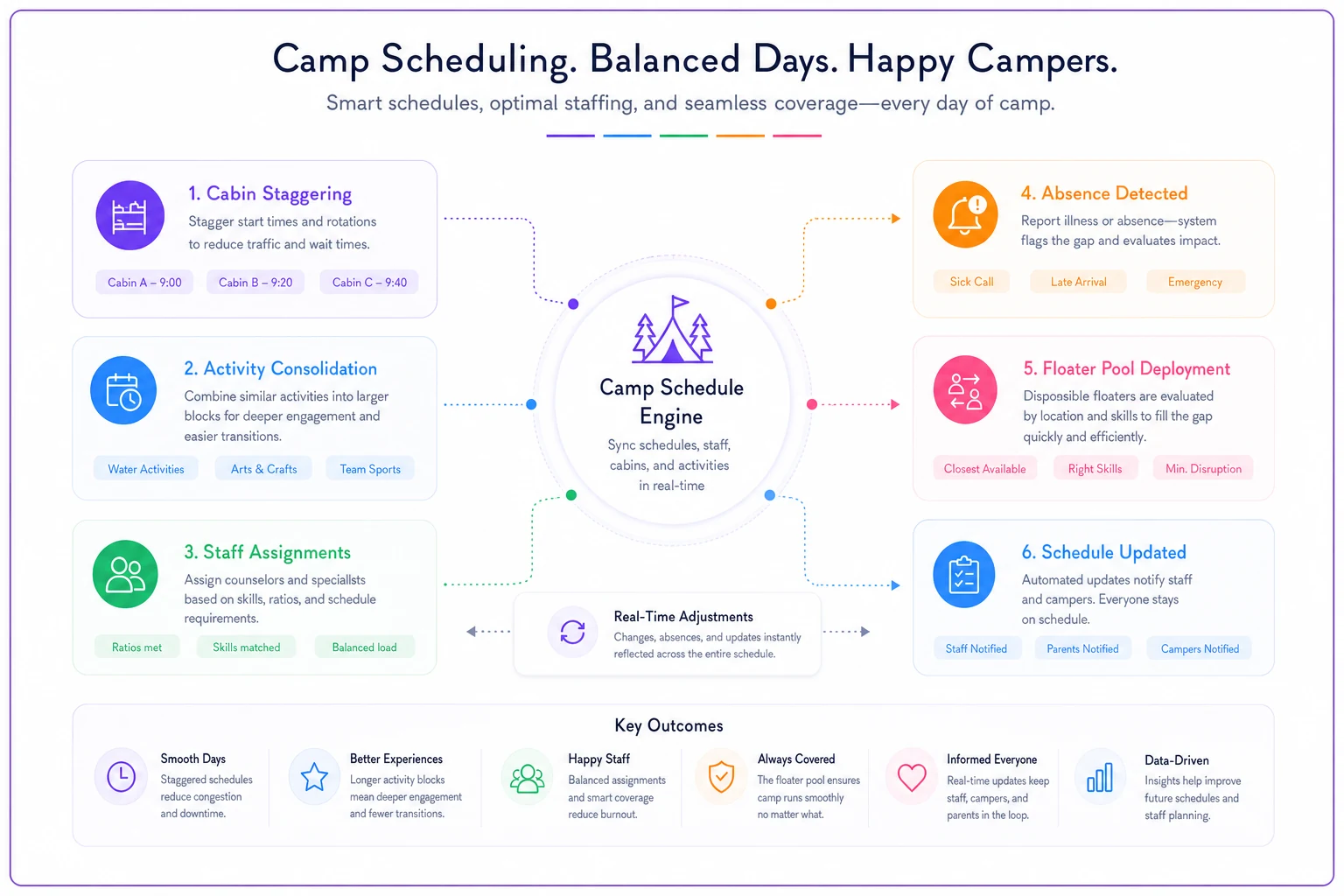
Start with activity consolidation. Instead of running six simultaneous activity periods with one counselor each, run three double-size activities with two counselors each. The math works better for coverage, and frankly, kids often prefer the energy of larger groups for certain activities. You lose some of that "small group intimacy," but you gain operational stability.
-
Stagger your cabin times differently
offset schedules by 30 minutes between age groups so specialized staff can cover multiple slots.
-
Build in "camp-wide" programming blocks like movie nights and talent shows to engage large numbers with fewer staff.
-
Use a "floater pool" of 3-4 strong counselors with no assigned cabins who fill gaps as needed.
Stagger your cabin times differently. Traditional camps run all cabins on identical schedules—wake up, breakfast, activities, lunch, etc. But if you offset schedules by 30 minutes between age groups, you can share specialized staff more effectively. The archery instructor can cover juniors at 9am and seniors at 9:45am without feeling stretched.
Build in "camp-wide" programming blocks that require less supervision. Movie nights, talent shows, capture the flag—these events can engage 200 campers with 6-8 staff instead of the usual 20+. Use them strategically to give counselors real breaks while maintaining engagement.
The "floater pool" model works if you commit to it. Hire 3-4 strong counselors whose only job is to fill gaps. They don't have assigned cabins or activities. They go where needed each day. It feels expensive until you realize these floaters prevent the dominoes from falling when someone calls in sick. This connects to contingency planning for absences, but the floater model takes it further by building flexibility into your base structure rather than scrambling when issues arise.
Here's a quick visual of how staggered schedules, activity consolidation, and a floater pool interact to cover shifts without increasing total staff.
Use these tactics strategically rather than as permanent sacrifices to program quality—some activities are better small, and some work fine bigger.
Technology and systems that reduce staff workload
Manual processes that made sense with full staffing become impossible when you're running lean. The camps surviving this shortage are the ones aggressively eliminating administrative burden from counselor roles.
Parent communication is the easiest win. Instead of expecting counselors to write individual updates, implement a photo-sharing system where counselors snap pictures throughout the day, tag campers, and parents get automated daily galleries. Takes minutes instead of hours. Some platforms even use facial recognition to auto-tag campers, though that raises its own concerns.
Digital health logs eliminate the paper shuffle. When every medication administration, temperature check, and bandaid gets logged in a central system, your health officer can actually monitor compliance instead of chasing down paperwork. One camp reduced health-related documentation time by about 70% just by going digital.
Activity signup and scheduling should never be manual at this point. Campers pick activities on tablets, the system auto-balances numbers, and counselors just show up with their assigned groups. No more standing in lines, counting heads, or reshuffling when activities are full.
The operational intelligence you get from integrated systems helps you spot problems before they explode. When check-in times start creeping later across all activities, you know counselors are burning out. When incident reports spike in specific cabins, you can intervene before someone gets hurt. Without AI automation tracking these patterns, you're flying blind until something breaks.
Most camp software sucks. It's either designed for huge camps with dedicated IT staff, or it's so simple it barely helps. The sweet spot is platforms that handle your core workflows (registration, health, activities, communication) in one place without requiring a computer science degree to operate. The best ones now incorporate AI to handle things like scheduling optimization and automated parent updates, freeing your staff to actually work with campers instead of computers.
When to pull the trigger on session modifications
Sometimes the math just doesn't work. Better to make hard decisions in May than to deliver a dangerously understaffed experience in July. Most camps wait too long, hoping for a miracle hire that never comes.
Your break-even calculation needs to include more than direct costs. A session running at 60% capacity with 70% staffing might technically generate positive revenue, but what happens to next year's enrollment when those families have a mediocre experience? Sometimes canceling Week 3 to properly staff Weeks 1, 2, and 4 is the smarter play.
Age bracket consolidation can work if you message it right. Instead of separate 8-10 and 11-13 programs, run a combined 8-13 program with "mentorship opportunities" for older campers. Parents actually love this if you frame it as leadership development. Just make sure your insurance covers the modified age ranges.
Consider shifting to shorter sessions. Two-week sessions are getting harder to staff. But you might fill week-long "specialty camps" more easily. Shorter commitment for staff, more focused programming, and often higher per-day revenue. A camp in Michigan switched from two 4-week sessions to five 10-day specialty sessions and actually increased both revenue and staff applications.
The nuclear option is reducing capacity. If you normally take 200 campers but can only safely handle 140 with current staffing, then cap it at 140. Raise prices to compensate. Market it as a "more intimate experience." Whatever you need to tell yourself. Because running at safe ratios with 140 happy families beats getting shut down mid-summer with 200 angry ones.
Building your 2027 staffing pipeline now
The camps that thrive next summer are planning today, not in March 2027. The teen labor shortage isn't reversing anytime soon, so you need structural changes, not band-aids.
Start with your CIT program. Most camps treat CITs as cheap labor. Instead, build a genuine leadership development pipeline. Partner with schools for credit. Offer real certifications. Make it prestigious enough that families plan their high schooler's summer around it. A strong CIT program essentially pre-hires your counselors two years in advance.
Alumni engagement can't be an afterthought anymore. Every former camper is a potential staff member, but most camps lose touch the moment they age out. Build an alumni network that keeps them connected. Offer reunion weekends. Create "alumni counselor" positions with flexible scheduling for college students. One camp maintains relationships with about 400 alumni and fills 40% of counselor positions from that pool.
The relationship with local colleges needs to be more than posting flyers in the student center. Offer actual internships with learning objectives and faculty supervision. Create practicum opportunities for education majors. Build semester-long relationships, not just summer transactions. When students see camp as part of their professional development, the quality and retention improve dramatically.
Your staff referral program probably sucks. Most camps offer something like "$100 if your friend completes the summer." Try $250 upfront when they accept the job, plus another $250 if both the referrer and referee complete the season. Yeah, it's more expensive. But hiring bonuses of $500-1000 are becoming standard in other industries. Might as well pay your current staff instead of Indeed.
The reality check nobody wants to hear
Some camps won't survive this transition. The ones clinging to the old model—hoping the teen labor pool magically refills, refusing to raise wages, avoiding operational changes—will close. Probably 15-20% of traditional overnight camps will shut down or radically restructure in the next three years.
But the camps that adapt are discovering something interesting: they're actually running better programs. When you're forced to hire more carefully, train more thoroughly, and operate more efficiently, quality improves. Parents notice. Word spreads. Enrollment strengthens even as others struggle.
The staffing crisis is forcing camps to professionalize in ways they've resisted for decades. Better systems, clearer workflows, competitive compensation, meaningful benefits. Stuff that should have happened years ago but didn't because there was always another teenager willing to work for pocket money and memories.
Running a camp with 30% fewer staff than ideal feels impossible until you realize how much time was wasted on inefficient processes. How many hours counselors spent on paperwork that could be automated. How much energy went into scheduling that software handles better. How many communication failures happened because nobody had a clear system.
The camps succeeding aren't just throwing money at the problem or lowering their standards. They're fundamentally rethinking how to deliver the camp experience with a different workforce model. And honestly? Many of them are building stronger, more sustainable operations than they had before the shortage.
This summer will be rough. Some weeks will run understaffed despite your best efforts. Some activities will get canceled. Some families will be disappointed. But if you're strategic about restructuring now—pay, recruitment, scheduling, and systems—you'll emerge from 2026 with a camp built for the next decade, not the last one.
The teen labor pool isn't coming back. Time to build something better.
The teen labor pool isn't coming back. Time to build something better.
Ready to elevate your camp management?
Join 500+ camps using Campyly to save administrative time, enhance camper experiences, and streamline daily operations.