


Most camps don't buy sleep systems wrong because they pick cheap gear. They buy wrong because they buy for the wrong variable. A director orders 120 bunk mattresses based on price-per-unit, then finds out three seasons later that the vinyl cracks, the foam holds moisture, and the whole cabin smells like a wet dog by mid-July. The mattress was "cheap." The five-year cost was brutal.
This guide is built around the actual decisions you'll make when specifying and purchasing sleep equipment — indoor bunks, cots, rollaways, and tent systems — and how to think about each one across the six things that actually matter: comfort, durability, safety, cleaning, storage, and total cost. Not price. Cost. Those are different numbers, and confusing them is the most common procurement mistake camps make.
Start with cost-per-bed-year, not sticker price
The number that should drive every sleep purchase is cost-per-bed-year. Total cost of ownership divided by beds divided by expected usable seasons.
| Mattress tier | Unit cost | Usable seasons | Cost per bed-year | Replacement labor/hauling per cycle |
|---|---|---|---|---|
| Budget vinyl foam | ~$65 | 3.5 | ~$18.50 | High (frequent) |
| Mid-tier welded antimicrobial | ~$155 | 8 | ~$19.40 | Low |
| Premium coil/hybrid institutional | ~$310 | 12 | ~$25.80 | Very low |
Budget and mid-tier land almost on top of each other for cost-per-bed-year — but that table doesn't capture the hidden costs of the cheap option: more frequent disposal fees, more storage churn, more mid-season failures, more parent complaints. Once you fold those in, the mid-tier is almost always cheaper to own. The premium tier only makes sense when you have year-round use, a retreat-center clientele expecting hotel-grade comfort, or beds that get slept on 200+ nights a year.
Budget gear wins on the invoice and loses on the ledger. That's the pattern worth remembering.
Indoor bunk mattresses: what actually kills them
For cabin bunks, three things destroy mattresses early — and none of them are the sleepers.
Simplify camp operations with centralized control.
Campyly empowers you to manage registrations, staff, and activities seamlessly—all from one platform.
- Integrated camper and staff management
- Automated notifications and alerts
- Dynamic scheduling and resource allocation
No credit card required
The first is moisture ingress through the seams. Sewn or taped covers fail at the corners. Kids sit on the edges, the seam flexes, water and sweat get in, and the foam becomes a sponge you can't dry out. Welded or RF-sealed vinyl covers solve this. When you spec, the phrase you want in the quote is "waterproof welded seams," not "water-resistant cover."
The second is UV and heat during off-season storage. A mattress stacked against a window in a hot storage barn degrades faster than one that's being slept on all summer. Vinyl gets brittle. It's a storage problem that shows up looking like a durability problem.
The third is cleaning chemical incompatibility. Camps buy a mattress rated for one thing, then wipe it down with whatever bleach solution is in the supply closet, and the cover discolors and cracks within a season or two. Always match your disinfectant to the manufacturer's chemical compatibility sheet before you standardize a cleaning protocol.
On age fit: younger camper cabins (7–11) do fine on 4"–5" foam. Teen and adult retreat bunks really want 6" or a coil hybrid. The comfort complaints from adults on 4" foam are relentless, and for a retreat center where guests are paying $200+ a night, thin foam quietly damages your rebooking rate.
Cots and rollaways for multi-use spaces
Multi-use spaces are their own animal. Gyms, dining halls, and program rooms that flip from daytime activity to overnight sleeping need gear that sets up fast, stacks tight, and survives being dragged across concrete by tired staff at 10pm.
What separates good cots from cots you'll be cursing by week three:
-
Frame welds over rivets. Riveted joints loosen with repeated folding. Welded steel frames cost more upfront and hold up far longer under daily setup/teardown cycles.
-
Deck material matters more than padding. A taut, breathable poly deck outlasts a cheap fabric deck that sags and tears at the grommets.
-
Nesting/stacking design. If cots don't nest, your storage footprint explodes. Forty cots that stack like a bad Jenga tower will consume an entire closet.
-
Setup time. Test it. A cot that takes 90 seconds to open times 60 units times two flips a day is real labor. A 15-second cot saves you hours a week.
Rollaways with thin mattresses are a middle ground — useful for overflow, staff housing, and family-camp weekends. They're more comfortable than cots but heavier and they eat storage. Buy them for flexibility, not as your primary sleep inventory.
When cots make sense: flexible-use facilities, day-to-overnight conversions, overflow capacity, staff spaces.
When cots are a bad idea: as the backbone of a fixed-bunk cabin program. If a bed is going to live in one spot all summer, a real bunk mattress is more comfortable and cheaper to own than a premium cot.
Tent sleeping systems: backcountry vs. platform camps
Tent programs split into two completely different buying decisions, and camps get burned when they treat them the same.
Platform/wall-tent camps — the classic canvas-on-wood-platform setup — are basically outdoor cabins. You can run real cots or even foam mattresses on the platforms because the platform keeps everything off the ground and dry. Spec here looks a lot like your multi-use cot spec: durable welded cots, breathable decks, plus weatherproof off-season storage because canvas and foam both hate damp winters.
Backcountry and trek programs are a different universe. Weight and packability dominate every other variable. You're buying sleeping pads and bags, not mattresses. The mistakes are predictable:
-
Buying pads with a low R-value for shoulder-season trips, then dealing with cold, sleep-deprived campers who are harder to manage the next day.
-
Buying bags rated by "comfort" marketing numbers instead of the EN/ISO limit rating. A "30-degree bag" is often a 40-degree comfort bag. Spec by the ISO comfort rating, not the headline number.
-
Ignoring repairability. Field-repairable pads and bags with available patch kits can save entire trips. A pad that can't be patched in the backcountry is dead weight after one puncture.
For younger campers on trek programs, sizing matters — shorter bags in the right length, lighter pads they can actually carry. Drafty extra length in a bag steals warmth. This is a comfort and a safety decision at altitude or in cold.
Fire safety and health compliance — the part that gets skipped until an inspection
This is where sloppy procurement turns into a shutdown risk. Every mattress, cot pad, and tent-platform foam you buy for a licensed camp needs to meet the flammability standard your jurisdiction enforces — most commonly CFR 1633 (open-flame) and/or CFR 1632 (cigarette ignition) compliance for mattresses, with many states layering on California TB 117-2013 or institutional flame-retardancy requirements on top.
The procurement failure looks like this: a camp orders "commercial mattresses" from a general supplier, gets a great price, and the units arrive with no flammability certification documentation. Now you've got 100 mattresses you can't prove are compliant, and your fire marshal wants paperwork.
The fix is a hard rule in your buying process: no compliance certificate, no purchase order. Require the manufacturer to include the specific flammability standard and certification with the quote, not "available on request." If a vendor stalls on providing it, that's your answer about the product.
Same discipline applies to health and cleanability. For any licensed program, surfaces need to be non-porous and disinfectable. Fabric-covered mattresses without a wipeable barrier are a health-inspection liability and a lice/bedbug nightmare. Spec wipeable, sealed surfaces for anything a camper sleeps on directly.
Three budget-tier configurations
Here's how the same 100-bed cabin program looks at three realistic budget levels. These are configurations, not just price points — the tradeoffs are baked in.
Tier 1 — Lean / startup (~$7k–$9k for 100 beds)
Budget welded-vinyl foam mattresses at 4"–5", basic waterproof covers replaced as they fail, and a full mattress replacement cycle every 3–4 seasons. Best for new camps, tight capital, or day-heavy programs with light overnight use.
Tier 2 — Balanced / recommended default (~$15k–$19k for 100 beds)
Mid-tier antimicrobial mattresses with welded seams at 5"–6", documented flammability compliance on file, and a standardized cleaning protocol matched to cover chemistry. Expect a 7–9 season lifespan and the lowest real cost-per-bed-year of the three tiers. Best for most established overnight camps.
Tier 3 — Premium / retreat-grade (~$30k–$40k for 100 beds)
Coil/hybrid institutional mattresses at 6"+, hotel-adjacent comfort for paying adult guests, and a 10–12 season lifespan. Best for year-round retreat centers, high-nightly-rate facilities, and operations where rebooking revenue depends on comfort.
Most camps overspend at Tier 1 through replacement churn, or underspend at Tier 3 by buying premium gear for seasonal-only use. Tier 2 is the right answer far more often than directors expect.
A procurement checklist you can actually use
Before you sign anything, run every sleep-system purchase through this:
-
Cost-per-bed-year calculated, not just unit price
-
Flammability certification (CFR 1633/1632, TB 117 as applicable) included in writing
-
Cover is wipeable, non-porous, welded/sealed seams
-
Manufacturer chemical-compatibility sheet for disinfectants obtained
-
Expected lifespan stated by vendor (get it in writing)
-
Storage footprint measured — will it actually fit your off-season space?
-
Setup/teardown time tested for cots and rollaways
-
Age/program fit confirmed (thickness, sizing, R-value where relevant)
-
Warranty terms and defect/replacement process documented
-
Lead time confirmed against your season start date
-
Sample unit ordered and stress-tested before bulk order
Order a sample unit and stress-test it in your actual facility usage before committing to a bulk purchase.
That last one saves camps thousands. Buy one, abuse it for a month, then decide.
An editable RFP / quote request you can send vendors
Copy, paste, adjust the numbers, and send this to every vendor. Uniform requests get you comparable quotes instead of apples-to-oranges guesses.
> Sleep System Quote Request
-
Product name, model, and dimensions
-
Cover material and seam construction (specify welded/sealed)
-
Foam type, thickness, and density (or coil spec)
-
Flammability compliance standard(s) and certification — attach documentation
-
Antimicrobial/moisture treatment details
-
Approved cleaning/disinfecting chemicals and compatibility sheet
-
Manufacturer-stated expected lifespan under institutional use
-
Warranty length, coverage, and replacement process
-
Unit price at quantities of 25 / 50 / 100 / 250
-
Lead time from PO to delivery
-
Freight/delivery terms and any hauling of old units
-
Sample unit availability and cost
Copy, paste, adjust the numbers, and send this to every vendor. Uniform requests get you comparable quotes instead of apples-to-oranges guesses.
A real scenario: the mid-tier switch
A 140-bed overnight camp in a humid Southeast region was replacing budget vinyl foam mattresses roughly every three seasons — around 45 units failing each year between seam splits and moisture damage. Between the units, disposal fees, and staff hours hauling and swapping, the "cheap" mattresses were running them somewhere in the $3.5k–$4.5k range annually, plus a steady drip of parent complaints about smell.
They moved to a mid-tier welded antimicrobial mattress on the next full replacement cycle. Higher invoice upfront — roughly $18k versus the ~$9k a budget re-buy would've cost. Annual failures dropped to a handful, disposal runs nearly vanished, and the moisture-smell complaints stopped almost entirely by the following season. Their cost-per-bed-year came out lower within about four years, and the cabins just held up better. Nothing dramatic — a purchase that finally matched how the equipment actually gets used.
Where roster and assignment workflows quietly connect
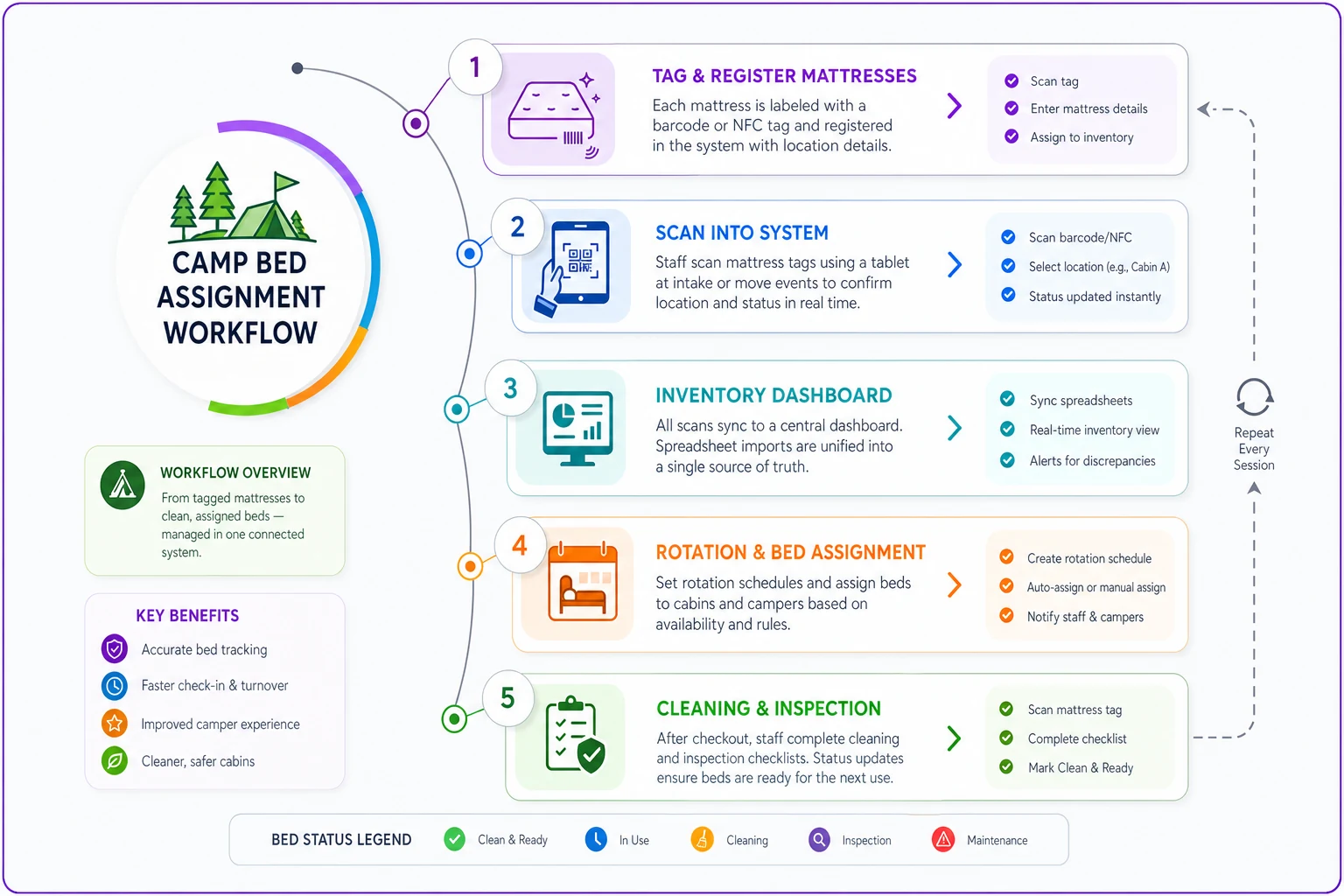
Sleep equipment isn't purely a purchasing problem — it touches operations the moment you assign campers to specific beds. Camps that track which mattress sits in which bunk (by tagging units) can rotate wear, flag failing units before they become complaints, and time replacements accurately instead of guessing.
That only works if your bed inventory and your camper-assignment data actually line up, which is the kind of thing that falls apart when your records live in five spreadsheets.
Here's a simple workflow diagram showing how inventory tagging, assignment, rotation, and cleaning checks should connect in practice.
If you've ever discovered your bed counts and your registration counts don't match, the root cause is usually structural — and it's worth reading why your registration system might be lying to you about your real capacity before your next big equipment order.
Clean assignment data also makes cleaning protocols enforceable. When you know which beds were used, by whom, and when they were last sanitized, it matters enormously during a lice scare or a health inspection — and it's the kind of thing that's nearly impossible to reconstruct after the fact from memory or scattered notes.
Buy for how the beds actually get used
The best camp sleep system isn't the most expensive one or the cheapest one. It's the one specced to your real usage pattern, storage reality, and compliance requirements, then judged on cost-per-bed-year instead of the invoice total.
Get the flammability documentation before you buy, test a sample before you commit to a bulk order, and match your cleaning chemistry to your covers so you're not quietly destroying the gear you just paid for.
Do that, and you'll rarely think about your mattresses again for eight or nine seasons — which is exactly the point.
Ready to elevate your camp management?
Join 500+ camps using Campyly to save administrative time, enhance camper experiences, and streamline daily operations.