



The Conference Board's latest read landed at 89.4 on August 25, and while the headline number barely moved, the part that should catch a camp director's attention is the Expectations Index, which fell sharply. According to the Conference Board's August release, households are getting more pessimistic about future income and spending — not necessarily about today, but about the next six months. Reuters framed it as rising short-term pessimism heading into fall.
For most industries that's abstract. For camps, the timing is almost painful. August and early September is exactly when families are deciding whether to lock in next summer's early-bird deposit, whether to keep a fall break mini-session, or whether to quietly let a hold expire. When parents feel uncertain about their own paycheck, discretionary spending like camp gets paused first — and camp sits right at the top of the "nice but not mandatory" list for a lot of households.
This isn't a reason to panic-discount. It's a reason to tighten the parts of your enrollment and payment structure that quietly leak money when demand softens. Most camps have policies built for a confident buyer. When the buyer gets nervous, those same policies start working against you.
What changes when confidence softens
The mistake camps make is assuming a confidence dip means fewer people want camp. That's usually not it. What changes is behavior around commitment, and it shows up in four predictable ways.
Deposits get delayed, not cancelled. Families still intend to enroll. They just wait. A parent who would've put down a deposit in September now waits until January "to see how things go." Your enrollment curve flattens and shifts right, which wrecks your ability to plan staffing and supplies early.
Cancellation and prorate requests climb. Not dramatically — but noticeably. A family that loses a shift, or whose partner's hours get cut, will ask to drop a week and get credited. If your policy is vague, every one of those becomes a negotiation.
Payment-plan requests spike. More families ask to split the balance. This is actually good news if you're set up for it, and a cash-flow headache if you're not.
Price sensitivity sharpens on add-ons. The base tuition holds, but the extras — extended care, the special overnight, the optional trip — get cut first. Your per-camper revenue quietly drops even when headcount looks fine.
None of these are catastrophic on their own. The problem is they compound, and most camps don't notice until the season's financial forecast is already off by 8–12%.
The underlying problem: your policies assume a confident buyer
Camp pricing and cancellation policies are almost always written during good times, when seats fill themselves and nobody reads the fine print. Then demand softens, families start reading that fine print carefully, and the gaps show up all at once.
Simplify camp operations with centralized control.
Campyly empowers you to manage registrations, staff, and activities seamlessly—all from one platform.
- Integrated camper and staff management
- Automated notifications and alerts
- Dynamic scheduling and resource allocation
No credit card required
A typical example: a mid-sized day camp with roughly 480 weekly slots across the summer runs a "full refund minus $75 admin fee if cancelled 30+ days out." Fine when 10 families use it. When 40 families use it in a soft year, that's a lot of refunded revenue on seats you now have to refill on short notice — and the $75 fee doesn't come close to covering the operational cost of that churn.
The deeper issue isn't the refund amount. It's that the policy treats every cancellation the same and gives the camp no way to retain the money in the system. A refund is a dollar walking out the door. A credit is a dollar that stays and often gets spent on more camp. When confidence is shaky, the difference between those two defaults is enormous over a full season.
Rework your cancellation tiers before booking season, not during
The single highest-leverage move right now is making your cancellation and prorate rules clearer and more graduated. Vague policies invite negotiation; rigid policies invite chargebacks and bad reviews. You want something predictable for parents and protective for you.
A tier structure that holds up when families are nervous:
| Cancellation timing | Refund option | Credit option | Notes |
|---|---|---|---|
| 60+ days before start | 90% refund | 100% credit | Credit is the more attractive default |
| 30–59 days | 50% refund | 90% credit, valid 12 months | Most cancellations land here |
| 8–29 days | No refund | 60% credit | Seat is hard to refill this late |
| 0–7 days | No refund | 25% credit, medical exceptions | Documented illness handled separately |
The credit column is always more generous than the refund column. You're not being stingy — you're steering families toward keeping the money in your ecosystem. A parent choosing between a 50% refund and a 90% credit almost always takes the credit, especially if it's easy to apply to a sibling or a future session.
If you want the full operational logic behind building prorate rules and automated credits that don't erode trust, we broke that down in detail in our guide to camp cancellation and credit operations — this section is the pricing-psychology layer on top of that framework.
Payment plans are a demand tool, not just an accommodation
Most camps treat installment plans as a favor they grudgingly extend. In a soft-confidence year, that framing is backwards. A well-structured payment plan is one of the cheapest ways to convert a hesitant family into an enrolled one, because it lowers the perceived commitment at the exact moment the parent is most anxious about spending.
The mechanics matter, though. A plan that collects the full balance too late leaves you exposed if the family drops. A plan that front-loads too aggressively defeats the purpose. Here's a structure that balances both:
-
Non-refundable deposit at signup — 15–20% of tuition. This is your commitment anchor and it filters out genuinely uncommitted families.
-
Second installment 60 days out — brings you to roughly 50% collected before you've spent much on that camper.
-
Third installment 30 days out — brings you to about 80%.
-
Final balance 7–14 days before start — collected before the camper walks in, not after.
The key rule: never let the collection schedule lag behind your cost schedule. If you're paying for staff and supplies before you've collected 80% of tuition, a wave of late cancellations turns into real losses.
Auto-charge installments to avoid manual invoicing and reduce late balances.
One more thing worth saying plainly — auto-charge the installments. Manual invoicing in a soft-payment environment is how you end up with a spreadsheet of "will follow up" balances that never get collected. When a family knows the card runs automatically on a set date, follow-through goes way up and your front desk stops chasing money.
When discounting is the right move — and when it quietly destroys margin
The reflex during a demand dip is to cut price. Sometimes that's correct. Often it's not.
When a targeted discount makes sense:
-
Filling specific low-demand weeks (early June, the week after July 4th) that would otherwise run under capacity
-
Sibling or multi-week bundles that increase total contract value
-
Early-commitment incentives that pull deposits forward and improve your planning
When discounting is a bad idea:
-
Across-the-board tuition cuts that train your entire base to expect lower prices next year
-
Last-minute "flash" discounts that punish families who already paid full price — nothing generates resentment faster
-
Discounting your highest-demand weeks, which would've sold anyway
The mistake pattern is discounting breadth instead of depth. A camp that shaves $50 off every registration gives away money on seats it would've filled regardless. A camp that offers a real incentive only on its genuinely soft weeks protects margin while solving the actual problem.
Rework your parent communication before the questions start
Softer confidence means more families reading your policies, asking more questions, and comparing you against alternatives. If your cancellation and payment terms live in a PDF nobody reads until they're upset, you've built a conflict machine.
Get ahead of it. A short, plain-language "flexibility page" that explains your credit options, payment-plan availability, and medical exception process does two things: it reassures nervous families before they bail, and it dramatically cuts the volume of one-off email negotiations your team has to field.
The camps that handle a soft year best are usually the ones who centralized this. When enrollment status, payment schedules, credit balances, and cancellation history all live in one place — instead of scattered across a registration tool, a payment processor, and someone's inbox — a parent's question gets answered in thirty seconds instead of a three-email chain. This is where solid operational software earns its keep: when a family asks "what's my credit balance and can I apply it to my daughter's fall session," the answer is instant and correct. Automated installment charging and rule-based credit application take the manual chase out of exactly the workflows that get overwhelmed when demand gets choppy.
Here's a simple workflow that shows how centralizing enrollment, payments, credits, and automated charges reduces manual work and speeds answers.
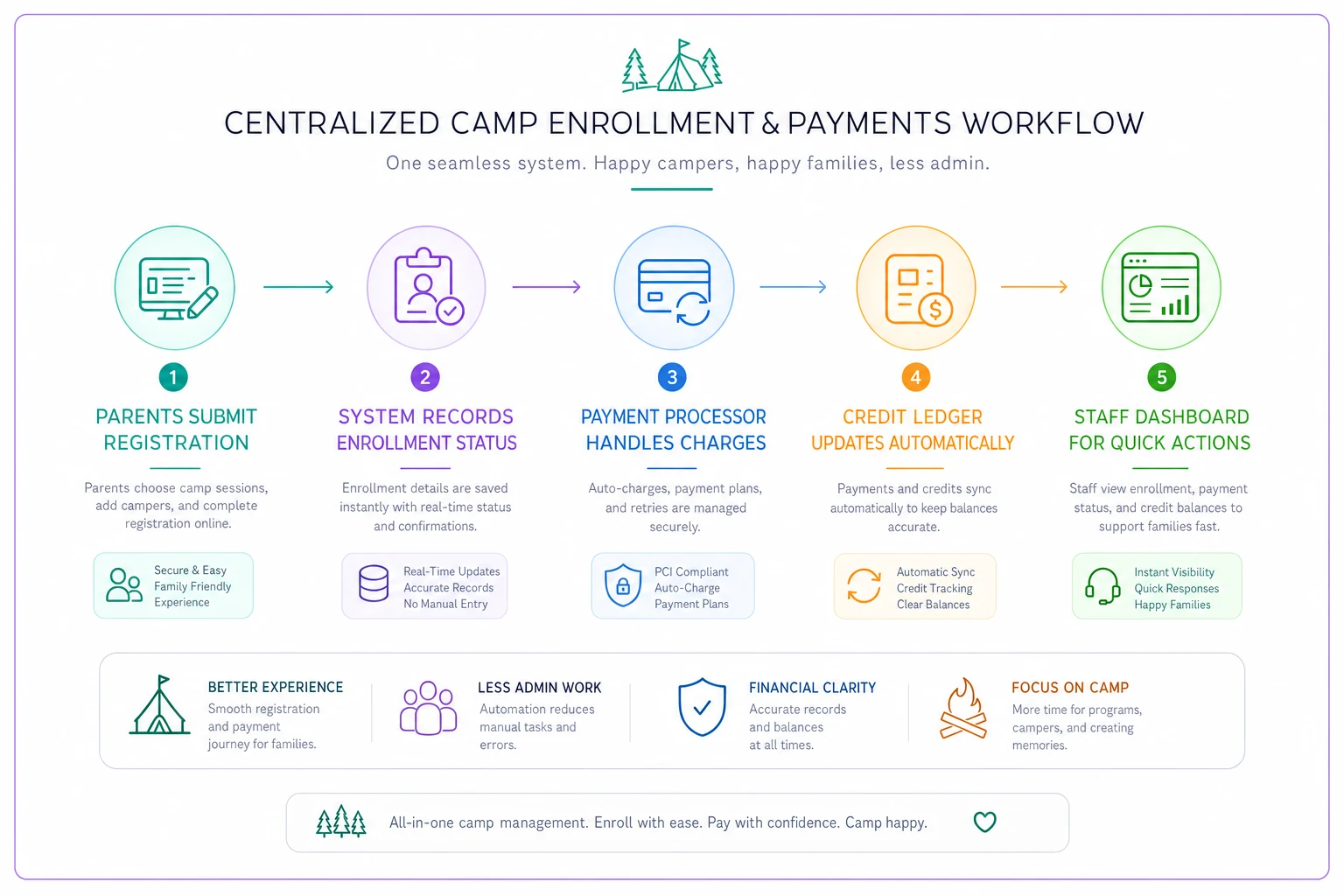
That flow cuts back-and-forth emails and missed payments, letting staff answer questions instantly instead of chasing information across tools.
A real scenario
A suburban day camp — around 420 weekly slots across nine weeks — went into a soft booking season with the old "full refund minus admin fee" policy and manual invoicing. By early summer they'd refunded close to $18k, had roughly $9k in unpaid late balances they were still chasing, and two low-demand weeks running at about 60% capacity.
The following year they made three changes: graduated tiers that defaulted heavily toward credits, auto-charged four-installment payment plans, and a targeted discount limited to their two softest weeks. Refunds dropped to around $6k because most cancellations converted to credits that got reused. Late unpaid balances basically disappeared once installments ran automatically. The two soft weeks filled to roughly 85% with the targeted incentive.
Total enrollment was similar. What changed was retention of money that would have leaked out, plus far fewer hours spent negotiating and chasing. In a nervous year, that's the whole game.
What to do in the next few weeks
Before booking season fully ramps, run through this:
-
Rewrite cancellation policy into graduated tiers, with credits always more generous than refunds
-
Set installment schedules that stay ahead of your cost schedule, and turn on auto-charging
-
Identify your genuinely soft weeks and design targeted incentives only for those
-
Kill any impulse toward across-the-board tuition cuts
-
Publish a plain-language flexibility page covering credits, plans, and medical exceptions
-
Centralize enrollment, payment status, and credit balances so questions get answered instantly
-
Rebuild your season financial forecast assuming deposits arrive later than usual
A dip in consumer expectations doesn't have to mean a dip in your season. Families still want camp — they're just more careful about committing to it. Your job isn't to convince a nervous parent to be less nervous. It's to remove the friction and risk that turns hesitation into a lost enrollment. Camps that go into a soft year with clear, credit-weighted policies and automated collection tend to come out the other side with their revenue and their parent relationships intact. The ones running last year's confident-buyer playbook usually find out in July that they didn't.
A dip in consumer expectations doesn't have to mean a dip in your season. Families still want camp — they're just more careful about committing to it. Your job isn't to convince a nervous parent to be less nervous. It's to remove the friction and risk that turns hesitation into a lost enrollment. Camps that go into a soft year with clear, credit-weighted policies and automated collection tend to come out the other side with their revenue and their parent relationships intact. The ones running last year's confident-buyer playbook usually find out in July that they didn't.
Ready to elevate your camp management?
Join 500+ camps using Campyly to save administrative time, enhance camper experiences, and streamline daily operations.