

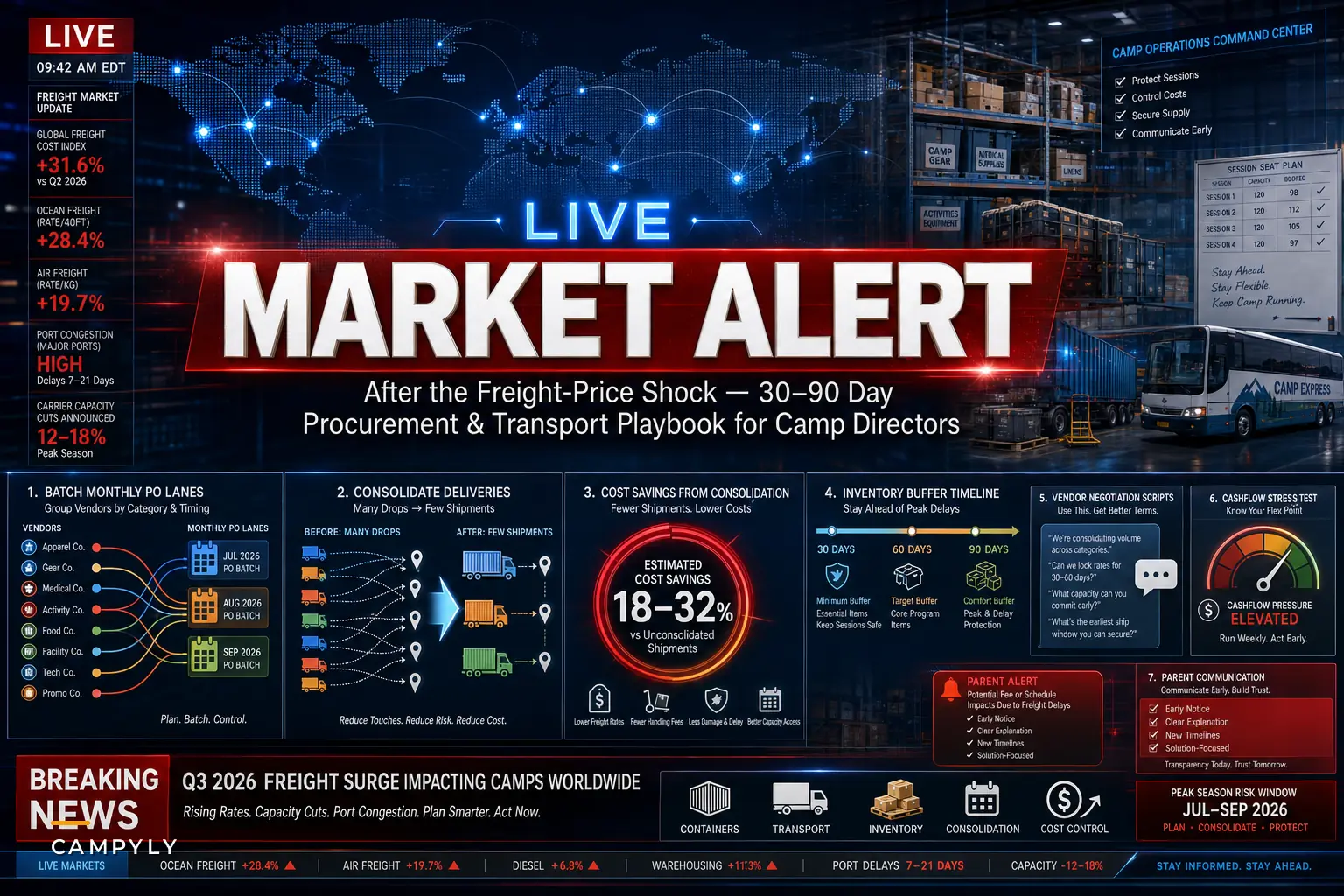

If you're pricing out bus contracts or finalizing fall purchase orders, you already feel it. Diesel is sitting north of $6 a gallon in a lot of regions, truck capacity is tight, and the quotes coming back from vendors look nothing like last year's. The Q3 2026 numbers put a label on what camp buyers have been living through: the U.S. Bank Freight Payment Index showed shipper spending jumped 32.1% year-over-year, a five-year high, even as actual freight demand stalled. A recent Reuters report framed it plainly—costs climbing while volume flattens is a nasty combination, because you're paying more to move the same amount of stuff.
For most industries that's an annoyance. For camps it's a timing problem. Your buying is compressed into a few months and revenue is locked in by registration. You can't mark things up mid-season like a retailer can. So the question isn't "how do we absorb this"—it's "how do we change the way we order, store, and schedule transport so the freight premium hits us as little as possible."
Here's what's actually happening underneath the headline number, and the procurement, inventory, and transport moves that matter most.
The freight spike exposes a scheduling flaw, not just a cost problem
The instinct when you see a 32% freight jump is to treat it as a line-item cost increase—add a buffer, update the budget, move on. But freight pricing isn't a flat tax. It's wildly uneven depending on when and how you order. Two camps buying the same pallet of supplies can pay radically different delivery costs based entirely on timing and consolidation discipline.
What rising freight costs actually expose is that most camps order reactively. Gear gets ordered when someone notices the bin is low. Maintenance parts get expedited because a pump died. Food orders get split across three vendors because nobody consolidated the list. In a cheap-freight environment, that sloppiness costs you a little. In a tight-capacity, $6-diesel environment, every small-batch, last-minute, split shipment carries a premium—and those stack up fast.
This usually shows up as a dozen small invoices with delivery or fuel surcharges that nobody scrutinizes individually because each one looks minor. A $40 surcharge here, an expedite fee there. Across a full season you might find you spent somewhere between $4k and $6k on freight premiums that more disciplined ordering would have cut roughly in half.
Before touching vendor contracts, the real win is fixing the pattern of how your camp buys.
Where the freight premium actually lands at a camp
Not all camp purchases are equally exposed. Freight cost scales with weight, volume, distance, and urgency—so the categories that get hit hardest are the heavy, bulky, or time-sensitive ones.
Simplify camp operations with centralized control.
Campyly empowers you to manage registrations, staff, and activities seamlessly—all from one platform.
- Integrated camper and staff management
- Automated notifications and alerts
- Dynamic scheduling and resource allocation
No credit card required
| Purchase category | Freight exposure | Why it's exposed | Best defense |
|---|---|---|---|
| Mattresses & bedding | Very high | Bulky, low value-to-volume, often shipped LTL | Buy early, consolidate, buy closer to source |
| Food & consumables | High | Frequent deliveries, fuel surcharges per drop | Fewer, larger deliveries; regional vendors |
| Maintenance parts | Medium–high | Often expedited when something breaks | Spare-parts buffer to avoid rush shipping |
| Program/craft supplies | Medium | Many small orders from many vendors | Consolidate into fewer POs |
| Transport (buses, trips) | Very high | Diesel is a direct input cost | Route efficiency, contract structure |
The mattress and bedding line is the one that quietly eats budgets. A box of craft supplies is light and cheap to ship. A truckload of mattresses is the opposite—low value per cubic foot, so you're essentially paying freight to move air. If you're replacing bedding on a cycle, the freight environment should directly influence when you pull the trigger. The full replacement-timing logic is in the camp bedding and mattress playbook—the short version is that in a high-freight year, bunching your bedding replacement into one consolidated order beats spreading it across two seasons, even if it strains cashflow a bit.
Consolidation is the highest-leverage move—and the one camps do worst
If you only change one thing this year, change how many separate shipments hit your camp.
Carriers price small shipments brutally right now. Less-than-truckload rates and per-stop fuel surcharges mean that four separate deliveries of craft supplies cost dramatically more than one combined order—even for the same total weight. The tighter capacity gets, the more carriers prioritize full, efficient loads, and the more you pay for being the inconvenient small drop.
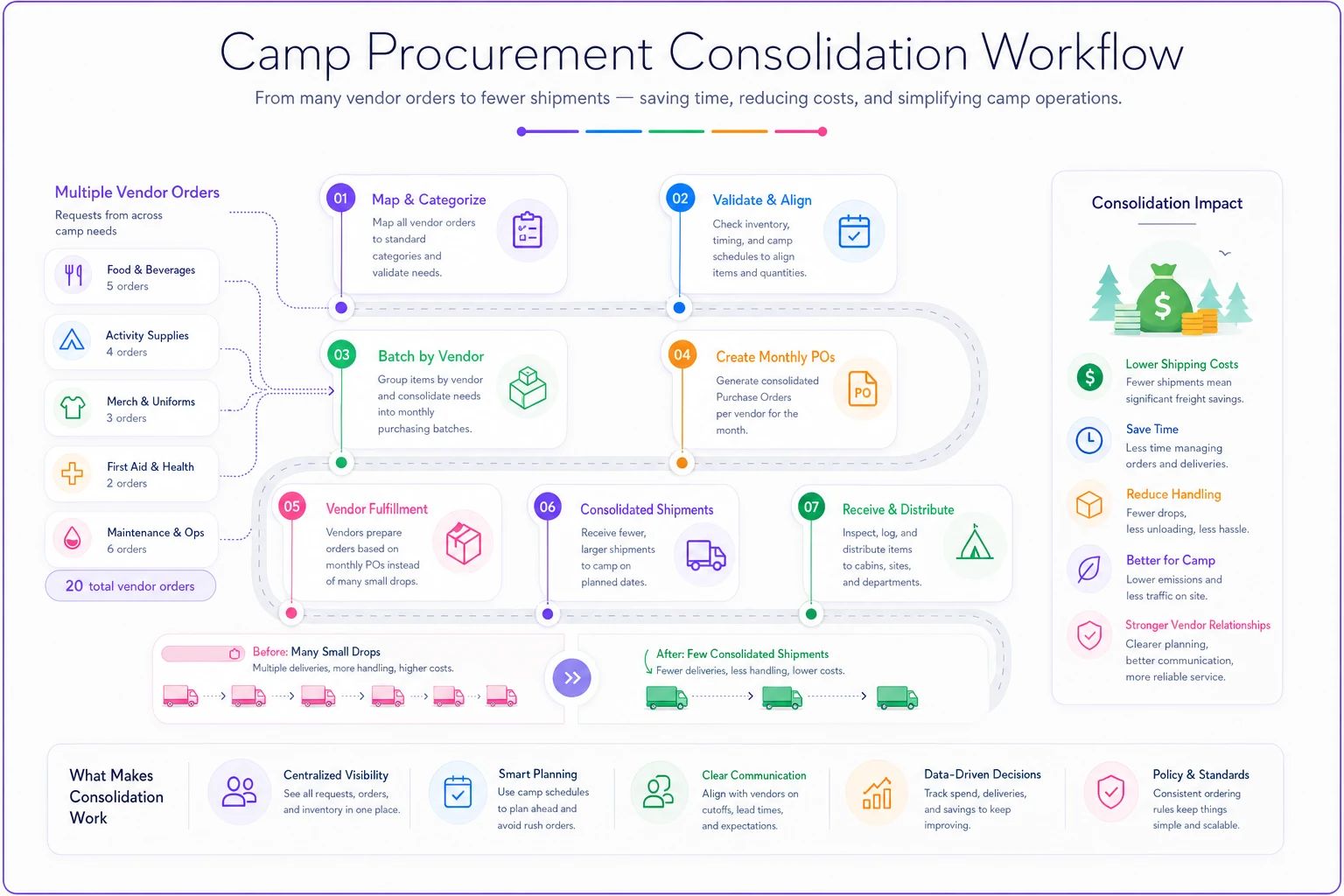
A typical example: a mid-size day camp ordering program supplies from five vendors across the spring, averaging around nine separate deliveries. Each carried its own freight or fuel line. By narrowing to two primary vendors and batching orders into monthly POs, they cut deliveries down to about four and trimmed combined freight and surcharge costs somewhere in the 30–35% range. Same products. Different ordering rhythm.
Here's a quick visual of a consolidation workflow.
-
Map every recurring order by vendor and delivery frequency. You can't consolidate what you can't see.
-
Identify split purchases—anything you're buying from multiple vendors that one vendor could supply.
-
Set order windows instead of ordering on-demand. Monthly or bi-weekly batches, not whenever someone remembers.
-
Ask vendors for freight-inclusive pricing so surcharges aren't a moving target.
-
Combine departments' lists. Kitchen, maintenance, and program staff ordering separately from the same supplier is pure waste.
-
Check minimum-order thresholds for free or reduced freight—sometimes buying slightly more unlocks a meaningful freight break.
One thing to avoid: over-consolidating perishables or anything storage-sensitive. Batching craft paper is smart. Batching three months of fresh produce into one delivery is how you create spoilage, which costs more than the freight you saved.
Rethinking inventory buffers when shipping is slow and expensive
The old inventory instinct in a high-freight year is "stock up on everything." That's half right and half dangerous.
The part that's right: for non-perishable essentials with unpredictable restocking timelines—maintenance parts, cleaning supplies, durable gear—carrying a deeper buffer genuinely protects you. The whole reason emergency expedite shipping hurts so much right now is tight capacity. If you've got the part on the shelf, you never pay the rush premium. A spare-parts buffer for your most failure-prone equipment (pumps, HVAC components, kitchen parts) often pays for itself the first time you avoid a $200 expedite on a $30 part during peak week.
The part that's dangerous: blindly inflating buffers across the board ties up cash and storage you probably don't have. And for anything with a shelf life, overbuying just converts a freight problem into a waste problem.
-
Protect-against-stockout items — cheap to store, expensive or slow to reorder urgently. Buffer these aggressively.
-
Just-in-time items — perishable, bulky-to-store, or seasonal. Keep these lean and rely on consolidation instead.
Keep a list of the five highest-failure parts and prioritize buffers for those.
This is where a real inventory system earns its keep. If you're tracking consumption rates and reorder points instead of eyeballing bins, you can set buffers deliberately per item rather than panic-buying. Camps that already run seasonal forecasting on consumables tend to ride out freight spikes better—they're ordering on data, not on the last time someone noticed an empty shelf. AI-assisted operational platforms that automate reorder triggers and track seasonal usage patterns are genuinely useful here, not because AI is magic, but because the manual version of that tracking usually doesn't get done consistently.
Transport contracts: where fuel cost hides and how to structure around it
Bus and transport costs are the most direct freight exposure a camp has, because diesel is a straight input. When fuel spikes, your transport vendors feel it as hard as you do—and how your contract is written determines who absorbs that pain.
The pattern worth understanding: vendors protect themselves with fuel surcharges, and those surcharges are often where the real cost lives, separate from the base rate you negotiated. A base rate that looks flat year-over-year can still cost you 15–25% more once the fuel surcharge floats up with diesel prices. If you only negotiate the base and ignore the surcharge mechanism, you negotiated the wrong number.
-
How is the fuel surcharge calculated? Tie it to a published diesel index, not the vendor's discretion.
-
Is there a surcharge cap? Even a ceiling on how high it can float protects your budget.
-
Can you lock base rates for the season in exchange for committed volume?
-
What does cancellation or route-change cost? Flexibility gets expensive when capacity is tight.
-
Are there efficiency incentives—fewer, fuller routes in exchange for better pricing?
Route efficiency is cost control in a high-diesel year. Fewer miles and fewer near-empty runs directly lower the fuel your vendor burns, which is the lever behind every negotiation. Camps running tight, consolidated routing have real leverage; camps running half-full buses to scattered stops have none.
When buying early makes sense—and when it doesn't
Buying early makes sense when: the item is non-perishable, you're confident in the quantity, you have storage, and freight or price is clearly trending up. Bedding, durable gear, cleaning supplies, maintenance parts—all solid early-buy candidates, especially if consolidating the order unlocks a freight break. Buying early is a bad idea when: the item is perishable, storage is tight, the quantity depends on uncertain enrollment, or the product has a seasonal element that could leave you holding obsolete stock. Locking in a large food order against enrollment you haven't confirmed just moves your risk from freight to waste and cashflow. Who should not aggressively pre-buy: camps already tight on cash reserves.
Tying up working capital in inventory to save a few points on freight can create a cashflow squeeze that's far more dangerous than the freight premium itself. If reserves are thin, prioritize consolidation and contract structure over stockpiling.
A real scenario: mid-size overnight camp, fall 2026 ordering cycle
An overnight camp serving around 280 campers was staring at noticeably higher quotes across the board heading into fall purchasing. Their prior-year pattern: order as needs came up, split across roughly seven vendors, frequent small deliveries, and a habit of expediting maintenance parts during the season.
-
Consolidated program and facility supplies from seven vendors down to three, with batched monthly POs.
-
Built a spare-parts buffer for their five most failure-prone pieces of equipment, ordered early in one shipment.
-
Renegotiated their bus contract to tie the fuel surcharge to a published diesel index with a cap, in exchange for committing their full-season volume.
The result wasn't dramatic or instant—nobody's freight bill drops in half overnight. But across the planning period they trimmed combined freight, surcharge, and expedite costs by roughly $5k–$7k against what the same buying pattern would have cost under the new rates. The spare-parts buffer alone saved them two mid-season expedites during peak weeks. The bigger win was predictability: with the surcharge capped and orders batched, their transport and supply budget actually held through the season instead of slowly drifting upward.
Pulling it together
The freight spike is real and broad-based. But the camps that handle it best aren't simply the ones who padded their budget—they're the ones who used the pressure as a reason to fix ordering habits they'd tolerated for years. Reactive buying, split vendors, uncapped surcharges, panic expedites. The U.S. Bank data covered by Reuters is the alarm, but the response is operational, not financial.
Consolidate shipments. Split your inventory into protect-against-stockout and just-in-time buckets and buffer deliberately. Read the fuel surcharge mechanism in every transport contract before you sign. Pre-buy the durable stuff, stay lean on the perishable stuff, and don't let a freight panic push you into a cashflow problem. Do those things consistently and the premium shrinks from a season-defining threat to a manageable line item—and the ordering discipline you build this year keeps paying off long after diesel prices settle back down.
Ready to elevate your camp management?
Join 500+ camps using Campyly to save administrative time, enhance camper experiences, and streamline daily operations.